

Most cottage food businesses stall after the first few months. Not because the food is bad — usually the food is great. They stall because the vendor runs out of ideas for what to do next. The friends and family have all ordered. The first few farmers markets went well but did not turn into a flood of new customers. The Instagram account has 200 followers and seems stuck there. Revenue is decent but not growing, and the whole operation feels like it has hit a ceiling that nobody warned you about.
The short version: To grow a cottage food business, you need to do five things in roughly this order: get your first 100 real customers through free marketing channels like farmers markets, Facebook groups, and word of mouth; build simple systems so you can produce more without working more hours; raise your prices when demand justifies it; diversify your revenue streams beyond a single farmers market booth; and plan for what happens when you approach your state's revenue cap. Growth is not about working harder — it is about working on the right things at the right time.
If that sounds like a lot, it is not. Most of these steps are things you can tackle one at a time, on your own schedule, without quitting your day job or investing thousands of dollars. This guide walks through each stage of growth, with links to detailed guides on every topic so you can go deeper wherever you need to.
Most cottage food businesses get stuck at the transition from selling to people they know to selling to strangers. The first wave of sales — friends, family, coworkers, neighbors — comes easily because those people already trust you and want to support you. But that initial wave has a natural limit. Once everyone in your personal network has bought from you, growth requires reaching people who have never heard of you, and that is a fundamentally different challenge.
Here are the most common stall points and what causes each one:
| Stall Point | What It Looks Like | Root Cause |
|---|---|---|
| Friends-and-family plateau | Sales were strong for weeks 1-4, then dropped sharply | You have saturated your personal network and have not built a channel to reach new people |
| Production bottleneck | You have more orders than you can fill but cannot figure out how to make more | No batch production system, inefficient kitchen workflow, or recipes that do not scale well |
| Pricing trap | You are busy but not profitable — lots of orders, little money left over | Prices are too low, you have not calculated your real cost per item, or you are undervaluing your time |
| Marketing paralysis | You know you need to promote your business but do not know where to start or what works | No marketing plan, trying too many channels at once, or expecting results too fast |
| Burnout wall | You are exhausted, resentful, and thinking about quitting | Overcommitting to orders, no production schedule, no boundaries on your time |
| Revenue cap anxiety | You are approaching your state's cottage food sales limit and do not know what comes next | No transition plan for moving to a commercial kitchen or restructuring your business |
The good news is that every one of these stall points has a clear path through it. The vendors who grow past them are not more talented or better funded — they are the ones who identified which bottleneck was actually holding them back and focused on that one thing.
If you are in the very early stages and still figuring out whether to take the leap, start with the guide on turning your food hobby into a side business. If you are past that and already selling, keep reading.
Your first 100 customers come from showing up consistently in the places where local food buyers already spend their time — farmers markets, Facebook groups, Nextdoor, and the real-world social networks of your existing customers. You do not need ads, a website, or a big social media following. You need to be visible, reliable, and easy to buy from.
Here is the priority order for most cottage food vendors:
Farmers markets are the single best customer acquisition channel for cottage food vendors because they put your products directly in front of people who already want to buy local food. A single market appearance can generate 10 to 30 new customer contacts if you are prepared.
If you are considering expanding to additional markets, the guide on whether you should do multiple farmers markets breaks down the math on when that makes sense.
Local Facebook groups and Nextdoor are where your neighbors are already talking about food recommendations. These platforms let you reach hundreds or thousands of local people for free, but only if you participate as a community member first and a vendor second.
The full strategies for selling food on Facebook groups and selling food on Nextdoor go deeper on what works and what gets you banned. For farm stand vendors specifically, our guides on using Facebook for farm stand marketing and using Nextdoor for farm stand customers cover the farm-stand-specific strategies.
Word of mouth is the most powerful marketing channel for small food vendors because it comes with built-in trust. A recommendation from a friend carries more weight than any ad or social media post.
For a complete breakdown of word-of-mouth marketing for food businesses, including how to systematize it rather than hoping it happens, see the full guide.
Instagram works for cottage food vendors, but not the way most people think. You do not need thousands of followers or viral reels. You need a consistent local presence that shows your products, your process, and your personality to the people in your area who might actually buy from you.
If you are interested in video, TikTok can be surprisingly effective for selling homemade food — especially for vendors with a good story or a photogenic product.
Getting customers is only half the equation. Keeping them is where the real revenue lives. A customer who orders from you every week for a year is worth far more than ten one-time buyers, and it costs you almost nothing to keep them coming back. Our guide on building a farm stand loyalty program covers the specific retention tactics that work for small vendors — no punch cards required.
Getting your first 100 customers is the hardest part of growing a cottage food business. After 100, you have enough word of mouth, enough repeat buyers, and enough momentum that growth starts to compound. The detailed guide walks through a week-by-week plan for reaching that milestone.
Most cottage food vendors who reach 100 customers do it within three to six months of consistent effort across two to three channels. The key word is consistent. Posting once, doing one market, and sending one message does not work. Showing up every week across your chosen channels does.
The transition from selling to friends to selling to real customers is a mindset shift as much as a tactical one. It means treating your food business like a business, not a favor.
Free marketing works when you focus on the channels that reach local food buyers and commit to showing up consistently rather than trying everything once. The biggest mistake cottage food vendors make with marketing is spreading themselves across every platform and doing none of them well.
Here is what actually moves the needle, ranked by impact for most cottage food vendors:
Setting up a Google Business Profile for your food vendor business is one of the highest-return free marketing actions you can take. When someone searches "homemade cookies near me" or "fresh bread [your town]," your profile is what shows up — if you have one.
People buy from people, especially in the cottage food world. Your brand story — why you started, what you care about, what makes your products different — is not fluff. It is the reason someone chooses your jam over the three other jam vendors at the farmers market.
Text message marketing has the highest open rate of any marketing channel — over 90% of texts are read within three minutes. For a cottage food vendor, a weekly text to your customer list with what is available this week can drive more orders than any social media post.
Good photos sell food. Bad photos make great food look mediocre. You do not need a professional camera — a smartphone and natural light are enough if you know the basics.
Getting reviews is marketing that compounds over time. Every review makes it easier for the next customer to trust you. Ask consistently, make it easy with a QR code or direct link, and respond to every review you receive.
If you are starting with zero marketing budget, the guide on how to market your food business with no budget lays out a complete plan using only free tools and your own time. Most cottage food vendors who reach $1,000 or more per month in sales do it entirely through free marketing channels. Paid ads come later, if ever.
You scale production by building systems — batch cooking schedules, standardized recipes, inventory tracking, and clear boundaries on your time. Scaling is not about working more hours. It is about getting more output from the hours you already work.
Batch cooking is the foundation of efficient production for a cottage food business. Instead of making each order individually, you produce in larger batches on dedicated production days and fill orders from your inventory.
A production schedule turns chaos into a system. It tells you what to make, how much to make, and when to make it — so you are not making last-minute decisions every week.
Scaling a recipe from home kitchen quantities to market batches is not as simple as multiplying everything by four. Some ingredients, especially leaveners, spices, and fats, behave differently at larger volumes.
Once you are producing in batches, you need to know what you have on hand, what is running low, and what is about to expire. A simple inventory tracking system — even a spreadsheet — prevents waste and stockouts.
Burnout is the number one reason cottage food businesses fail after the first year. Not lack of customers, not bad products — just exhaustion from trying to do everything yourself with no boundaries.
Scaling your food business without quitting your day job is entirely possible, but it requires honest planning about how many hours you can sustainably work each week. Most successful part-time cottage food vendors cap their production at 15 to 20 hours per week and design their business around that constraint.
You should raise your prices when demand consistently exceeds your supply, when your cost-per-item analysis shows you are underpricing, or when you have not raised prices in over a year. Most cottage food vendors underprice their products, sometimes dramatically, because they anchor to grocery store prices rather than to the actual cost of handmade, small-batch food.
Before raising prices, you need to know what each product actually costs you to make. Most vendors underestimate their costs because they forget to include their own time, packaging, market fees, gas, and equipment wear.
The guide on calculating your real cost per item walks through a formula that accounts for:
Raising prices without losing customers is about transparency and timing. Here is what works:
Most cottage food vendors who raise prices by 10-20% lose fewer than 5% of their customers — and the increased revenue per order more than compensates. If you lose zero customers after a price increase, you probably did not raise them enough.
Every state with a cottage food law sets a maximum annual revenue you can earn selling from your home kitchen. These caps range from $25,000 in some states to $75,000 or more in others, and a few states have no cap at all. According to the USDA's overview of local food systems, direct-to-consumer food sales have grown significantly, pushing more home-based vendors toward their state limits.
The guide on cottage food revenue caps covers the specifics of how caps work, how to track your sales against them, and what counts toward the limit. Key things to know:
If you are approaching your cap and want to keep growing, the most common next step is moving from cottage food to a commercial kitchen. This unlocks higher (or no) revenue caps, lets you sell to retailers and restaurants, and opens up wholesale channels.
The transition involves:
The average cost to rent shared commercial kitchen space ranges from $15 to $35 per hour, depending on your area and the kitchen's amenities. Many vendors start with 8 to 12 hours per week and scale up as revenue grows.
Do not wait until you hit your cap to start planning. If you are at 70% or more of your state's limit, start researching commercial kitchen options, talking to other vendors who have made the transition, and building the financial cushion to cover the increased costs. A planned transition is manageable. A forced, last-minute transition is stressful and expensive.
You build multiple revenue streams by expanding where and how you sell — not by adding dozens of new products or overcommitting to channels you cannot sustain. The goal is to reduce your dependence on any single source of income so that a bad market day, a slow season, or a venue closure does not wipe out your business.
If you are only selling at farmers markets, adding online ordering to your existing market business is the single highest-impact revenue stream you can add. It lets your existing customers order ahead, brings in customers who cannot make it to the market, and creates a sales channel that works even when you are not physically present.
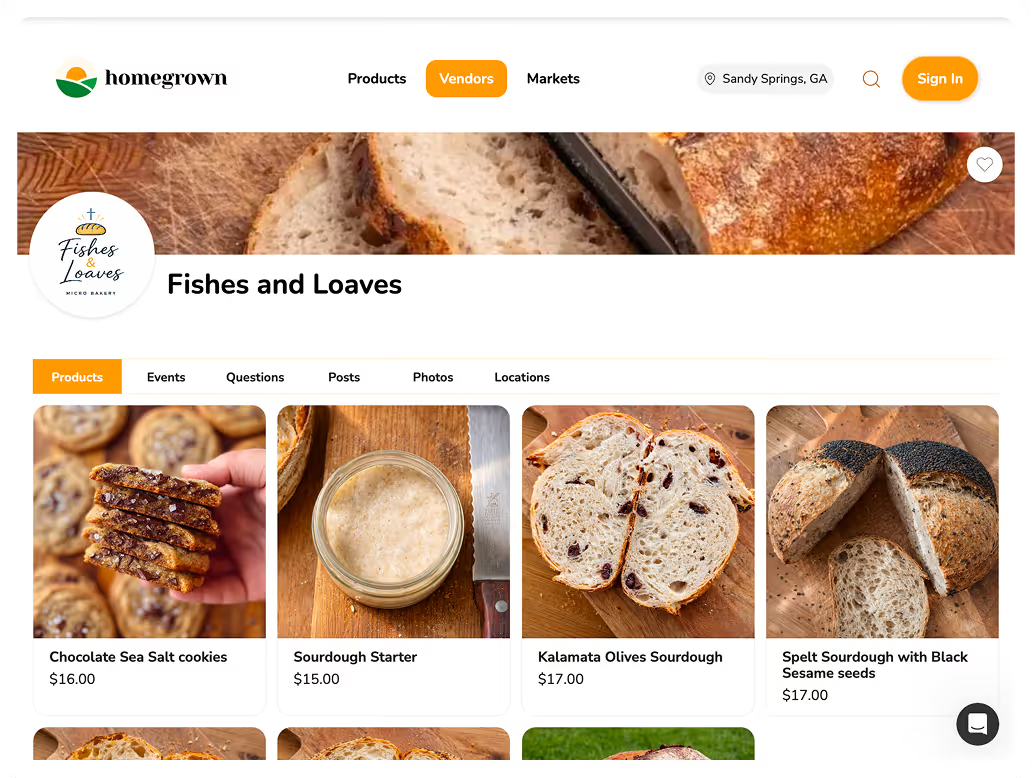
Homegrown costs $10/month with no percentage fees and gives you a professional ordering page you can set up in an afternoon. Share the link at your booth, in your email, on your social media, and on your Google Business Profile. Customers browse your products, place an order, and pay — all before you start production. That matters for growth because every order comes in prepaid with pickup details already confirmed, so you are not spending Tuesday nights managing DM conversations instead of scaling your business. Taking orders through Instagram DMs works when you have 8 customers but becomes a full-time communication job at 30. Etsy takes 6.5% of every sale and puts your local products in a global marketplace where your neighbors will never find you. Homegrown does not run your farmers market booth, write your marketing emails, or scale your recipes — this guide covers those. What it does is give you one link that turns market-day browsers into weekday pre-order customers.
Adding a second or third farmers market can significantly increase your revenue, but only if the math works. Consider:
Most vendors find that two markets is the sweet spot — enough to diversify without overextending production capacity.
Beyond markets and online ordering, there are several second revenue stream options worth considering:
The key is to add one new revenue stream at a time and make sure it is profitable and sustainable before adding another. Most successful cottage food vendors have two to three revenue streams, not seven.
Here is a realistic timeline for growing a cottage food business from launch to multiple revenue streams:
| Stage | Timeline | Focus | Revenue Target |
|---|---|---|---|
| Launch | Months 1-3 | Get first 50 customers, one farmers market, social media presence | $500-$1,500/month |
| Foundation | Months 3-6 | Reach 100 customers, build email list, dial in production | $1,500-$3,000/month |
| Growth | Months 6-12 | Add online ordering, consider second market, raise prices | $3,000-$5,000/month |
| Scaling | Year 2+ | Multiple revenue streams, possibly commercial kitchen, systems in place | $5,000-$10,000+/month |
These are not guarantees — they are benchmarks based on what successful cottage food vendors typically achieve when they work consistently on the right things. Your timeline will depend on your product, your market, your available hours, and your state's cottage food laws.
Ready to start selling locally? The easiest way to take local orders and get paid is an online storefront — see the best platform to sell food from home, or set up a Homegrown storefront in about 15 minutes ($10/mo, 0% commission).
Most cottage food businesses start for $200 to $500, covering initial ingredients, packaging, labels, and any required permits or registrations. You do not need a commercial kitchen, expensive equipment, or a large inventory. Start with your best-selling product, make small batches, and reinvest your early profits into growing your supplies and variety. Many states allow you to use your home kitchen under cottage food laws, which eliminates the biggest startup cost most food businesses face.
Most cottage food vendors who treat their business seriously reach $2,000 to $3,000 per month within six to twelve months. Reaching full-time income ($4,000 to $6,000 per month or more) typically takes one to two years and usually requires multiple revenue streams — a combination of farmers markets, online ordering, and possibly custom orders or wholesale. The timeline is faster if you can dedicate more hours per week and if you are in a market with strong demand for local food. The USDA Economic Research Service reports that direct-to-consumer food sales continue to grow nationally, which is encouraging for new vendors.
Requirements vary by state. Most states require a cottage food registration or permit, which is typically free or costs $25 to $75. Some states require no registration at all. Very few states require a full business license for cottage food operations, but you may need one if you are selling through certain channels or under a business name different from your own. Check your state's department of agriculture website for the specific requirements.
The most profitable cottage food products tend to be specialty baked goods (decorated cookies, artisan bread, specialty cakes), preserved foods (jams, pickles, sauces), and products with a strong local identity or unique story. Profitability depends more on your pricing and production efficiency than on the product category. A vendor selling $12 jars of specialty jam with a 60% margin is more profitable per hour than one selling $3 cookies with a 30% margin, even if the cookie vendor has more customers.
You compete by being different, not cheaper. Find your niche — a product nobody else at your market makes, a unique flavor profile, a dietary specialty (gluten-free, vegan, keto), or a production method that sets you apart (stone-ground, wood-fired, naturally fermented). Then compete on consistency, presentation, and customer relationships. The vendors who struggle are the ones selling the same products as everyone else at the same price. The vendors who thrive are the ones who have carved out a unique position that loyal customers seek out specifically.
Both. Social media is how people discover you. A dedicated ordering page is how they buy from you. Use Instagram, Facebook, and TikTok to build awareness and show your products. Then direct people to a dedicated ordering page where they can actually place an order. Trying to take orders through DMs and comments works at very small volumes but becomes chaotic fast. A proper ordering page makes you look professional and saves you hours of back-and-forth messaging every week.
The biggest mistake is trying to grow in every direction at once — adding five new products, joining three new markets, launching on every social media platform, and starting a wholesale program all in the same month. Growth that lasts comes from focusing on one thing at a time, doing it well, and building on each success. Pick your biggest bottleneck right now, solve it, and then move to the next one.
Growing a cottage food business is not glamorous. It is showing up at the farmers market when it is 95 degrees outside. It is testing your fourth batch of a new recipe at 9 PM on a Tuesday. It is sending the weekly email even when you are tired. But the vendors who do these things consistently — who build systems, raise their prices when they should, and invest in the right growth levers at the right time — are the ones who turn a kitchen hobby into a real, sustainable business. And you do not have to do it alone. The right ordering tools handle the ordering, the customer communication, and the logistics so you can focus on what you do best: making great food.