

The most effective way to grow your cottage food business without spending money on advertising is to build a local vendor community — a group of 3 to 10 non-competing food vendors who cross-promote each other's products, share customers, and collaborate on events. A jam maker who partners with a bread baker and a honey producer creates a "local food trio" that is more valuable to customers than any single vendor. The bread baker's customers discover the jam. The jam maker's customers discover the honey. Everyone sells more without competing for the same dollar.
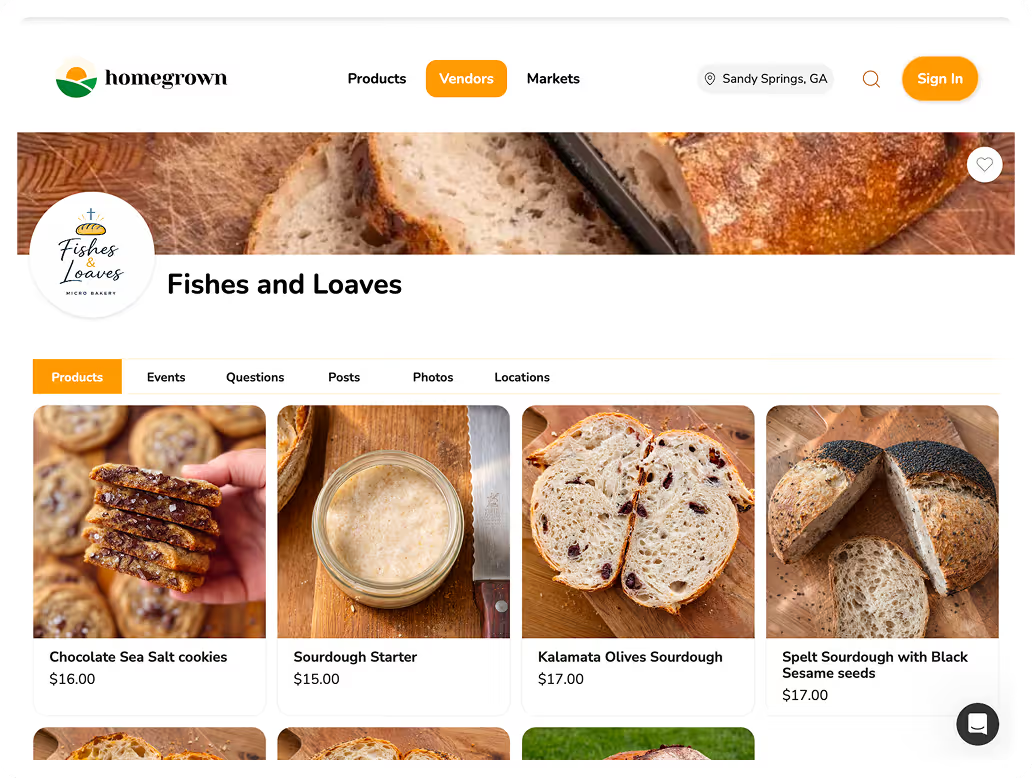
The short version: A vendor community is a group of local food vendors who help each other grow through cross-promotion, shared events, and customer referrals. You do not compete because you sell different products. The sourdough vendor, the jam maker, the egg seller, and the cookie baker each have their own customer base — but their customers overlap. When you recommend each other, every vendor's customer list grows. Start by reaching out to 2 to 3 vendors at your farmers market or in your area who sell products that complement yours. Agree to mention each other in Instagram posts, share each other's ordering links, and create a combined product bundle ("The Saturday Morning Basket: sourdough + jam + eggs + cookies for $30"). A Homegrown storefront makes this easy because each vendor has their own ordering page — you just share each other's links.
A customer who buys your sourdough bread every Saturday also buys eggs from the vendor three booths down and honey from the farm stand on Route 9. These are the same people spending their food budget on local products. Right now, they discover each vendor independently. A vendor community makes discovery intentional — your bread customer learns about the egg seller because you told them.
Two bread bakers in the same market compete. A bread baker and a jam maker complement each other. When you build a community with non-competing vendors, every recommendation is pure upside. The jam maker gains a customer. You gain goodwill and a reciprocal recommendation. Nobody loses a sale.
A single vendor posting once per week on Instagram reaches their own followers. Five vendors who share each other's posts reach five audiences. If each vendor has 300 followers and 60% overlap, the group reaches roughly 900 unique local food buyers instead of 300. That is 3x the audience for the same effort.
Splitting a $50 per week farmers market booth fee with one other vendor costs you $25 instead of $50. Sharing a $200 liability insurance policy through a joint vendor application saves everyone money. Printing a combined marketing flyer ("Visit These 5 Local Vendors") costs $50 total instead of $50 per vendor.
The easiest place to find community partners is at the market where you already sell. Walk the market as a customer before or after your shift. Note which vendors sell products that complement yours and seem friendly and professional.
Good partners for a bread baker:
Good partners for a baked goods vendor:
Do not say "we should collaborate sometime." That is vague and goes nowhere. Instead, propose something concrete:
"I sell sourdough and you sell jam — our customers are the same people. What if we each mention the other's products in our next Instagram post? I will tag you and link to your ordering page if you do the same for me."
A specific, low-commitment proposal gets a yes. A vague suggestion gets a "sounds cool" that never happens.
Your vendor community does not have to be limited to market vendors:
Do not try to build a 10-vendor network on day one. Start with one or two complementary vendors. Prove the model works (you send them customers, they send you customers, both of you sell more) before expanding.
The simplest and most effective community activity is sharing each other's content:
Ohio State's Center for Cooperatives outlines four levels of marketing collaboration for small farms, and most of them start with nothing more than two vendors who sell on the same days deciding to cross-promote.
As.
Create a bundle that includes products from multiple vendors:
| Bundle | Contents | Price | Vendor Split |
|---|---|---|---|
| The Breakfast Box | Sourdough + jam + eggs + honey | $28 | $7 each (4 vendors) |
| The Weekend Treat | Cookies + coffee + chocolate | $22 | $7.33 each (3 vendors) |
| The Gift Basket | Bread + jam + honey + candle | $35 | $8.75 each (4 vendors) |
Each vendor produces their products, one vendor assembles and sells the bundle (rotating weekly), and revenue splits evenly or by contribution.
Bundles sell well because customers love the convenience of a curated selection. A $28 basket feels like a better deal than buying four individual products for $32 — even though the vendor revenue is the same.
Host events together that draw more traffic than any vendor could alone:
The most powerful community activity is a genuine personal recommendation. When a customer asks "do you know where I can get local honey?", your answer should be: "Yes — @LocalHoneyVendor has the best wildflower honey. Here is their ordering link."
This costs nothing, builds trust with your customer (they see you as a resource, not just a seller), and generates a referral for your partner vendor.
A vendor community is not a business partnership, an LLC, or a formal organization. It is a handshake agreement: "We will promote each other, share customers, and collaborate on bundles and events. No contracts, no fees, no obligations beyond being a good partner."
Formal structures add complexity and legal overhead that small vendors do not need. If a partner is not pulling their weight, stop collaborating with them. No lawyers required.
Create a group text or Facebook Messenger group for community coordination:
Track three metrics monthly:
If after 3 months your referral customers have increased, your bundle revenue is positive, and your social reach is growing, the community is working. If not, adjust your partners, your promotion frequency, or your bundle strategy.
Cross-promotion only converts when there is somewhere to send the referral. If your partner vendor takes orders through Instagram DMs, your recommendation becomes "go DM them and hope they respond" — which most customers will not do. If the vendor has no ordering page at all, the referral dies at "look them up on Facebook."
Homegrown costs $10/month with no percentage fees and gives each vendor a shareable ordering link that community partners can drop directly into posts, stories, and face-to-face conversations at the market. A customer clicks the link, sees the products, orders, and pays — no DMs, no follow-up, no friction. Homegrown does not build your vendor community, does not coordinate bundles between partners, and does not manage your cross-promotion schedule — this guide covers those. What it does is give every referral a place to land where the customer can actually buy something.
Start with 2 to 3 and grow to 5 to 8 over time. More than 10 becomes difficult to coordinate and the cross-promotion loses impact because no one can meaningfully promote 10 different vendors every week. The ideal size is 4 to 6 vendors with complementary products.
Address it directly: "I have had a few customers mention quality issues with [product]. I want to keep recommending you, but I need to feel confident about the quality. Can we talk about it?" If the quality does not improve, stop promoting them. A bad recommendation reflects on your credibility.
Not initially. A name becomes useful if you do joint events or create a combined social media presence ("The [City] Local Food Collective" or "[City] Cottage Food Community"). But naming it is optional — the value is in the collaboration, not the branding.
Yes. In fact, vendors at different markets expand each other's geographic reach. A vendor at the downtown market and a vendor at the suburban market bring different customer bases, making cross-promotion more valuable than if they were both at the same market.
Look for non-food artisan vendors (candle makers, soap makers, potters) or farm stands that do not sell homemade food. You can also connect with vendors in neighboring towns — online cross-promotion works regardless of distance, and you can collaborate on shipping or delivery bundles.
No. Each vendor should maintain their own separate ordering page to keep finances, inventory, and customer relationships independent. Cross-promote by sharing each other's links, not by merging operations. This keeps things simple and avoids the complexity of splitting shared payments.
Give it two weeks before addressing it — sometimes people get busy. After two weeks, send a direct message: "Hey, I noticed we have not been cross-promoting lately. I shared your jam post last week but I did not see a share back. Are you still interested in the community?" Most of the time this is an oversight, not intentional. If the pattern continues after the conversation, stop promoting them and redirect that effort toward a more engaged partner. A vendor community only works when everyone contributes roughly equally. One vendor doing all the promoting while others only receive creates resentment and burns out the giver.
In the first month, expect 2 to 5 new customers from cross-promotion — mostly from social media shares and verbal referrals. By month three, if you and your partners are consistently promoting each other, you should see 5 to 15 new customers per month attributed to community referrals. The compounding effect is real: every new customer who discovers you through a partner becomes a potential referral source themselves. After 6 months, established vendor communities typically report that 15 to 25% of new customers come from partner referrals rather than independent discovery. The vendors who see the fastest results are the ones who actively mention partners in face-to-face conversations at the market, not just on social media.
Keep the money trail simple. The vendor who assembles and sells the bundle collects full payment from the customer, then distributes each partner's share within 48 hours via Venmo, Zelle, or cash. Agree on pricing and splits BEFORE launching the bundle — not after. For a $28 breakfast box with 4 vendors contributing, each vendor delivers their product to the assembler by Thursday, the assembler packages Friday, and payment goes out by the following Monday. Track everything in a shared spreadsheet or group chat so there is no ambiguity about who is owed what. If the financial tracking feels burdensome, simplify by having each vendor price their contribution independently and letting the customer pay each vendor separately at a joint pop-up event instead.