

Raising your prices feels risky when you know your customers by name. You see them every Saturday at the market. They message you midweek to place orders. They tell their friends about your jam, your hot sauce, your bread. The last thing you want is for a price increase to push them away.
But here is the reality: if your costs have gone up and your prices have not, you are slowly working yourself out of business. Ingredients cost more. Packaging costs more. Gas to get to the market costs more. And your time is worth more than it was when you started.
The good news is that most customers expect prices to change. They have watched prices rise at every grocery store and restaurant they visit. What matters is not whether you raise prices — it is how you do it.
This guide walks you through when to raise prices, how much to increase them, how to communicate the change, and how to keep your best customers coming back.
Here is what you need to know: Raise your prices when your costs increase, when you are undervaluing your time, or when you have improved your products. Keep increases under 10 to 13 percent at a time to stay within the range most customers accept without changing their buying behavior. Tell customers directly and honestly, give advance notice when possible, and frame the increase around the value they are getting. Most customers will stay — and the few who leave over a dollar or two were never your most loyal buyers.
The short version: You can raise prices without losing loyal customers by doing it gradually, explaining why (higher ingredient costs), raising your strongest products first, and adding small value like better packaging or a thank-you note. Most regulars expect occasional increases — chronic under-pricing costs you far more than a fair raise ever will.
Most food vendors wait too long to raise prices. They absorb cost increases for months, work longer hours for less money, and only consider a price change when they are already frustrated. By that point, they often need a bigger increase than if they had adjusted earlier.
This is the most straightforward reason to raise prices. If butter costs 30 percent more than it did last year, your baked goods should reflect that. If the jars you use went from $1.20 to $1.60 each, your jam price needs to absorb that change.
Track your ingredient and supply costs every month. When your total cost per item increases, that is your signal to adjust. You do not need to wait until costs have risen dramatically. Small, regular adjustments are easier for customers to accept than one large jump after years of holding steady.
Many food vendors price their products based on ingredients alone and forget to pay themselves for their time. If you spend six hours making a batch of 24 jars of salsa and price them at $8 each, your ingredient cost might be $3 per jar. That leaves $5 per jar, or $120 for six hours of work — before you subtract packaging, labels, transportation, and market fees.
If your hourly rate after all expenses is less than what you would earn at a regular job, your prices are too low. Your skill, your recipes, and your time have value. Pricing them properly is not greedy — it is necessary to keep your business running.
Maybe you switched to organic ingredients, upgraded your packaging, started using locally sourced produce, or added a new flavor that took weeks to develop. These improvements cost you more and deliver more to your customers. A price increase tied to a visible improvement is the easiest kind to justify because your customers can see and taste the difference.
The size of your increase matters as much as the increase itself. Go too high and you risk losing customers. Go too small and you will need another increase in three months.
For most food vendors, a 5 to 10 percent increase is the sweet spot. On an $8 jar of jam, that is 40 to 80 cents — which you would round to $8.50 or $9. On a $12 pie, that is $13. These are increases that most customers barely notice, especially when the product they love has not changed.
Research from Revenue Management Solutions published in Restaurant Business found that consumer traffic holds steady with price increases up to about 10 percent, but drops sharply once increases hit the 10 to 13 percent range. Beyond that threshold, the traffic decline can cancel out the revenue gains from higher prices. While this research focused on restaurants, the principle applies to any food business: keep your increases moderate and your customers keep buying.
Every product has a psychological price point — a number where customers start to hesitate. A $6 cookie feels different than a $7 cookie, even though the difference is small. Pay attention to round numbers and common price points in your market.
If your jam is currently $8 and you need to raise it, going to $8.50 feels like a small adjustment. Going to $10 feels like a jump, even though it is only $2 more. If you need a larger increase, consider doing it in two steps — $8 to $9 now, and $9 to $10 in six months — rather than one jump that crosses a psychological barrier.
The way you communicate a price increase matters more than the increase itself. Most customers understand that prices go up. What frustrates them is feeling blindsided or disrespected.
Do not hide a price increase or hope nobody notices. Your regular customers will notice. And if they find out through a higher total at checkout instead of hearing it from you, it damages trust.
A simple, honest message works best: "Starting next month, my prices will be going up slightly. Ingredient costs have increased significantly this year, and I want to keep making the same quality products you love. My jam will go from $8 to $9 a jar. I appreciate your continued support."
That is it. No long explanation. No apology. No over-justifying. Just a clear statement of what is changing and why.
Tell your customers before the increase takes effect. Two to four weeks is enough notice. This shows respect for their budget and gives them time to stock up at the current price if they want to.
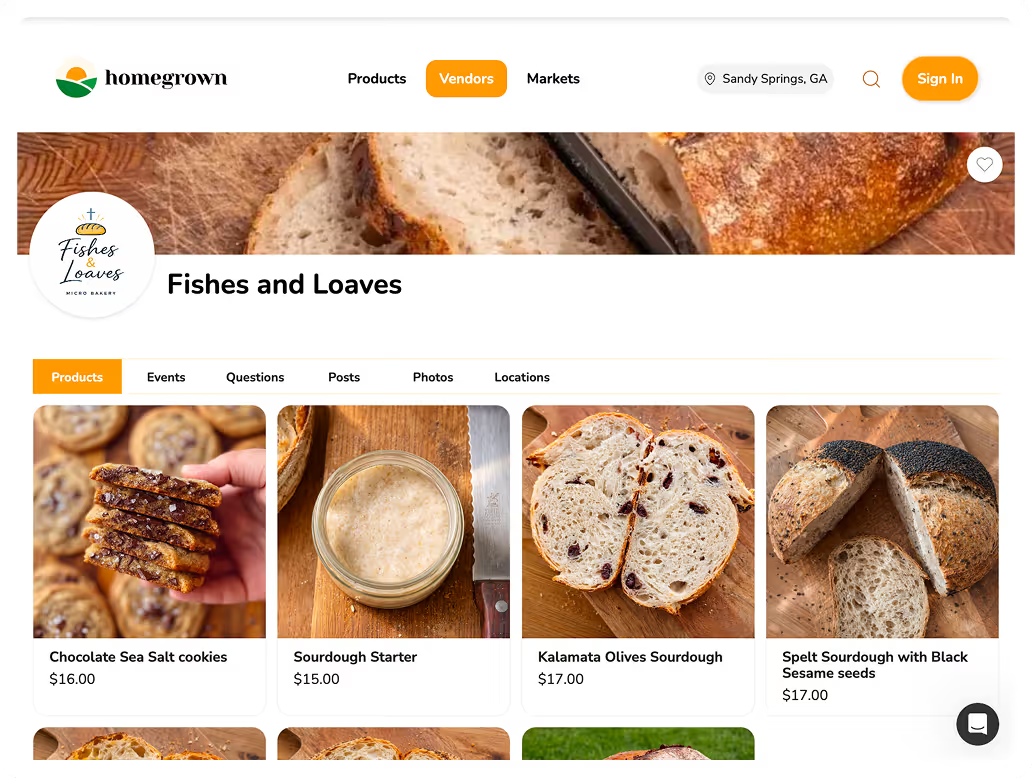
For farmers market customers, mention the change at the market the week before. For online customers, update your ordering page and send a message through your email list. For Nextdoor or social media customers, post a brief update. The key is that nobody should be surprised when they see the new price. If you are using Homegrown — $10/month with no percentage fees beyond standard payment processing — updating your prices takes about two minutes and every customer sees the new price the next time they visit your page. Compare that to Etsy, where every price increase also increases the percentage fee you pay on each sale, or managing prices through text messages where customers might still have your old price in a screenshot. Homegrown does not tell you what to charge — it gives you a platform where your updated prices are clear and consistent across every order.
You do not need to justify every penny, but connecting the increase to value helps customers understand the change. "I switched to all organic berries this season" explains a price increase in a way that actually makes customers feel better about paying more. "My packaging now keeps your bread fresh twice as long" turns a cost increase into a benefit for the customer.
If the increase is purely cost-driven, you can still frame it around what stays the same: "Even with ingredient costs going up, I am committed to using the same quality butter and real vanilla extract in every batch. The new price reflects what it actually costs to make these the right way."
This is the part that scares most vendors. But the reality is usually much less dramatic than what you imagine.
Research from the Richmond Federal Reserve found that a 1 percent price increase raises annual customer turnover from about 14 percent to 21 percent. That means even with a small increase, roughly 4 out of 5 customers stay. And in practice, food vendors who sell directly to their community often see even better retention because their customers have a personal relationship with them, not just a transactional one.
Your regulars — the people who buy from you every week, who recommend you to their friends, who send you messages about how much they love your products — are not going to leave over a reasonable price increase. They buy from you because of you, not because you are the cheapest option.
Every business has price-sensitive customers who will switch to a cheaper option the moment prices go up. These are not the customers you build a food business around. Your business grows through loyal customers who value quality and consistency — the ones who become the foundation of word-of-mouth marketing for your food business.
If you lose a few customers after a price increase, look at who left. Usually it is the occasional buyer, the person who was already comparing your price to the grocery store, or someone who was only buying when you offered a discount. Your core customers — the ones who make up the majority of your revenue — almost always stay.
A price increase is a moment when customers pay extra attention to your business. Use that attention to reinforce why they buy from you in the first place.
The worst thing you can do after raising prices is cut corners. If customers are paying more, they expect the same quality or better. This is not the time to switch to cheaper ingredients, reduce portion sizes, or skip the finishing touches that make your products special.
After a price increase, double down on quality. Make sure every jar, every loaf, every batch is as good as the one that earned you those loyal customers in the first place. Quality consistency is what keeps customers coming back — and it is what makes them feel good about paying more.
A price increase is a perfect time to recognize the people who have been buying from you since the beginning. Consider offering your regulars a small thank-you: a free sample of a new flavor, a buy-five-get-one deal, or early access to a seasonal product.
This is where a loyalty program for your food business pays off. If you already track repeat customers, you can offer them something special that acknowledges their support. It does not need to be expensive — it just needs to show that you value their loyalty.
Sometimes the best way to justify a higher price is to deliver a slightly better experience. Add a handwritten thank-you note to orders. Include a recipe card that uses your product. Upgrade your packaging so it looks more professional. These small additions cost you very little but make customers feel like they are getting more value — which softens the impact of a price increase.
The goal is not to distract from the higher price. It is to remind customers why they chose you in the first place and reinforce that buying from you is worth it.
How often should I raise my prices?
Review your costs every three to six months. If costs have increased, adjust your prices. Small, regular increases are much easier for customers to accept than one large increase every two or three years. An annual increase of 3 to 5 percent barely registers with most buyers, but waiting three years and then raising prices 15 percent will shock them.
Should I raise all my prices at once or one product at a time?
Raise them all at once. If you stagger increases across different products, customers who buy multiple items will experience repeated price changes over several months, which feels worse than one clear adjustment. A single increase with clear communication is cleaner and more honest.
What if my competitors charge less than me?
Your competitors are not your benchmark — your costs and your value are. If a competitor sells jam for $6 and you sell yours for $9, but your jam uses better ingredients, comes in better packaging, and your customers love the taste, the price difference is justified. Competing on price is a race to the bottom. Compete on quality, consistency, and the relationship you build with your customers. Those are the advantages that helped you build your first 100 customers in the first place.
Do I need to explain why I am raising prices?
A brief explanation helps, but you do not need to justify every detail. "Ingredient costs have gone up" or "I am using higher quality ingredients" is enough. Over-explaining can make you sound apologetic or defensive. State the change, give a short reason, and move on. Your customers are adults who understand how pricing works.
Should I offer a discount to soften the increase?
No. Offering a discount at the same time you raise prices sends a confusing message and trains customers to wait for sales. Instead, focus on maintaining quality and rewarding loyalty in ways that do not undercut your new pricing — like including a free sample or a thank-you note with their next order.
What if I am just starting out — should I start with lower prices and raise them later?
Start at a price that covers your costs, pays you fairly for your time, and reflects the quality of your product. Starting too low creates an expectation that is hard to change later. It is much easier to maintain fair pricing from day one than to train customers on a low price and then take it away. If you are unsure how to set your initial prices, factor in every cost — ingredients, packaging, labels, transportation, market fees, and your time — and price accordingly. You can always run a small introductory offer for your first week, but make sure your regular pricing is sustainable from the start.