

Someone in your town is searching "homemade cookies near me" right now. Or "local honey delivery." Or "farmers market bread [your city]." If your food business doesn't show up in those results, that customer buys from someone else — or doesn't buy at all. And you never even know they were looking.
Getting found online as a small food vendor isn't about becoming an SEO expert. It's about putting your business in the places where local customers are already searching. Most of those places are free, take less than an hour to set up, and start working within days.
This guide shows you exactly how to make your food business visible to local customers searching online — even if you don't have a website, a storefront, or any marketing experience.
The short version: Local customers find food businesses through Google search, Google Maps, Instagram, Facebook, and local food directories. The single most impactful thing you can do is claim and fully complete your Google Business Profile — businesses with complete profiles get 7x more clicks than incomplete ones. After that, make sure your business name, location, and products are consistent everywhere you appear online. Add your business to 2-3 local food directories, post regularly on social media with location tags, and list your products on a local food marketplace. Most vendors can do all of this in one afternoon.
Most small food vendors are invisible online — not because their products aren't good, but because they haven't put their business information in the right places. Here's what's usually missing:
According to SeoProfy's local SEO research, 98% of consumers search online for nearby businesses, and 78% of mobile local searches lead to an offline purchase. Your customers are searching — you're just not where they're looking.
Claim and complete your Google Business Profile. This is the highest-impact, lowest-effort action you can take to get found locally. A Google Business Profile (GBP) is the free listing that appears when someone searches for a business on Google or Google Maps. It shows your business name, location, hours, photos, reviews, and a link to your website or ordering page.
Here's why it matters for food vendors specifically:
If you haven't set up your Google Business Profile yet, our step-by-step guide on setting up Google Business Profile for a home food business walks you through the entire process. It takes about 30 minutes, and verification usually completes within a week.
Claiming your profile is step one. Optimizing it is what actually gets you found. Here's what to fill out and why each field matters:
Choose the most specific category that fits your business. "Food producer" or "Baker" is better than "Food." Google uses your category to decide which searches to show you in. You can add multiple categories — pick a primary one and 2-3 secondary ones.
Good category choices for food vendors:
Write 2-3 sentences describing what you sell, where you sell, and what makes your products special. Include your city name and the types of products you offer. This helps Google match you to relevant searches.
Example: "Handmade sourdough bread and pastries baked fresh weekly in Austin, TX. Available for pre-order online and at the Downtown Austin Farmers Market every Saturday. All products made with organic flour and locally sourced ingredients."
Upload at least 10-15 high-quality photos of your products, your market booth setup, and your packaging. Google profiles with photos get 42% more requests for directions and 35% more website clicks than profiles without photos. Update photos monthly with seasonal products.
List every product you sell with a description and price. This creates individual search entries for each product — so when someone searches "sourdough bread Austin," your specific product listing can appear, not just your business name.
Google Business Profile lets you publish short posts (like social media updates). Post weekly about what's available this week, market schedules, seasonal specials, or new products. Active profiles rank higher than dormant ones.
Ask your regular customers to leave Google reviews. After a market day, send a quick text: "Hey, if you enjoyed the cookies today, would you mind leaving a quick Google review? It really helps people find me." Aim for at least 10-15 reviews in your first month. Respond to every review — positive and negative — to show you're an active, engaged business.
Google Business Profile is your foundation, but it's not the only place local customers search. Here are the other platforms worth your time:
| Platform | Why It Helps | Setup Time | Cost |
|---|---|---|---|
| Visual discovery, location tags, hashtag search | Already have it | Free | |
| Facebook Business Page | Local search, community groups, marketplace | 30 minutes | Free |
| Local food marketplace | Product-level search, built-in buyer traffic | 1-2 hours | $0-$15/month |
| Yelp | Review-driven discovery, ranks in Google | 20 minutes | Free |
| Local food directories | Niche audience already looking for local food | 15 minutes each | Usually free |
| Nextdoor | Hyper-local neighborhood recommendations | 15 minutes | Free |
You don't need to be on every platform. Pick 3-4 where your customers already spend time and do those well. Being great on three platforms beats being mediocre on eight.
Social media posts can appear in Google search results, especially Instagram and Facebook content. Here's how to make your posts work for local discovery:
Tag your city, your farmers market, or your neighborhood on every single post. When someone searches "[your city] cookies" or "[your market name]," location-tagged posts are more likely to appear. This costs nothing and takes two seconds per post.
Generic hashtags like #cookies or #homebaker reach a huge audience but almost none of them are local. Use specific hashtags instead:
Combine 3-5 local hashtags with 2-3 product hashtags on every post. The local ones connect you to nearby customers; the product ones help people searching for specific items.
Don't just tag your location — say it in your caption. "Fresh sourdough available for pre-order this week in Austin" is more searchable than "Fresh sourdough available for pre-order this week." Search engines and social algorithms both use caption text for discovery.
Algorithms favor active accounts. Posting 3-4 times per week keeps you visible in feeds and search results. Inconsistent posting (once every two weeks) signals an inactive business. You don't need professional photos every time — a quick iPhone shot of fresh cookies coming out of the oven performs just as well as a styled photo shoot.
Local food directories are websites that list food producers, farmers, and vendors in a specific area. They're valuable for two reasons: they have an audience of people specifically looking for local food, and they create backlinks to your business that help your Google ranking.
Directories worth listing on:
When listing on directories, use exactly the same business name, address, and phone number everywhere. Google cross-references these listings. If your name is "Sarah's Sweet Treats" on Google but "Sarahs Sweet Treats" (no apostrophe) on a directory, Google sees them as potentially different businesses and reduces your ranking confidence.
The ultimate goal is for your specific products to appear when someone searches for them locally. Here's how to make that happen:
Instagram photos aren't indexed well by Google for product searches. But product listings on marketplaces, Google Business Profile, and directory sites are. Make sure every product you sell is listed with:
Write product descriptions the way customers search for them. Nobody searches "artisanal hand-crafted small-batch preserves." They search "homemade strawberry jam Austin TX." Use plain language and include your location naturally.
A local food marketplace indexes your products for local search automatically. When you list "Sourdough Boule - $8" on a marketplace, that product becomes searchable through Google for people in your area. This is one of the fastest ways to get individual products ranking in local search — much faster than building your own website or standalone store.
You don't need analytics software to know if local discovery is improving. Here are the signals to watch:
Track these signals monthly. You don't need a spreadsheet or dashboard — just a note in your phone with monthly tallies. After 2-3 months, you'll see clear trends in how customers are finding you.
Yes. Google allows "service area businesses" that don't have a traditional storefront. You can set your service area to your city or county without displaying your home address. This is perfect for cottage food producers and market vendors who operate from home. You'll still appear in local search results for your area.
Google Business Profile verification takes 3-7 days. After that, you can start appearing in local search results within 1-2 weeks of completing your profile. Ranking improves over the first 2-3 months as you add reviews, photos, and posts. It's not instant, but it's dramatically faster than waiting for a website to rank through traditional SEO.
No. A Google Business Profile, social media presence, and marketplace listing can get you found locally without a website. A website helps, but it's not required — and for most part-time vendors, the time spent building and maintaining a website is better spent on the free platforms that already rank well in local search.
Competition in local search is actually much lower than you'd think for food vendors. Most cottage food producers and market vendors haven't set up their Google Business Profile, haven't listed on local directories, and don't use location tags on social media. By doing these basics, you'll likely be one of the few local food vendors appearing in search results for your area.
Even 5-10 Google reviews make a significant difference for a local food vendor. The goal isn't to compete with restaurants that have hundreds of reviews — it's to have enough reviews that Google trusts your listing and customers trust your business. Aim for 10-15 reviews in your first month, then 2-3 new reviews per month after that.
Not yet. Optimize your free listings first — Google Business Profile, social media, and directories. Most food vendors can generate meaningful local visibility without spending a dollar on ads. If after 3-6 months you want to boost specific products or seasonal offerings, Google Local Ads can work well at $5-$10 per day. But exhaust the free options first.
Ask in person at the market, right after a purchase: "If you have a minute, a Google review would really help me out." Then text them a direct link to your review page (Google Business Profile has a "Share review form" link). Timing matters — ask when the customer is happiest, which is right after they've bought something they love. Don't ask for reviews over social media — personal asks convert 5-10x better.
You don't need to become an SEO expert to show up when local customers search for food online. You need to put your business information in the right places, keep it consistent, and make it easy for people to find and order from you.
Start with these three actions today:
These three steps take less than 2 hours total. Within a month, you'll notice new customers finding you online who never would have discovered your business at the market alone.
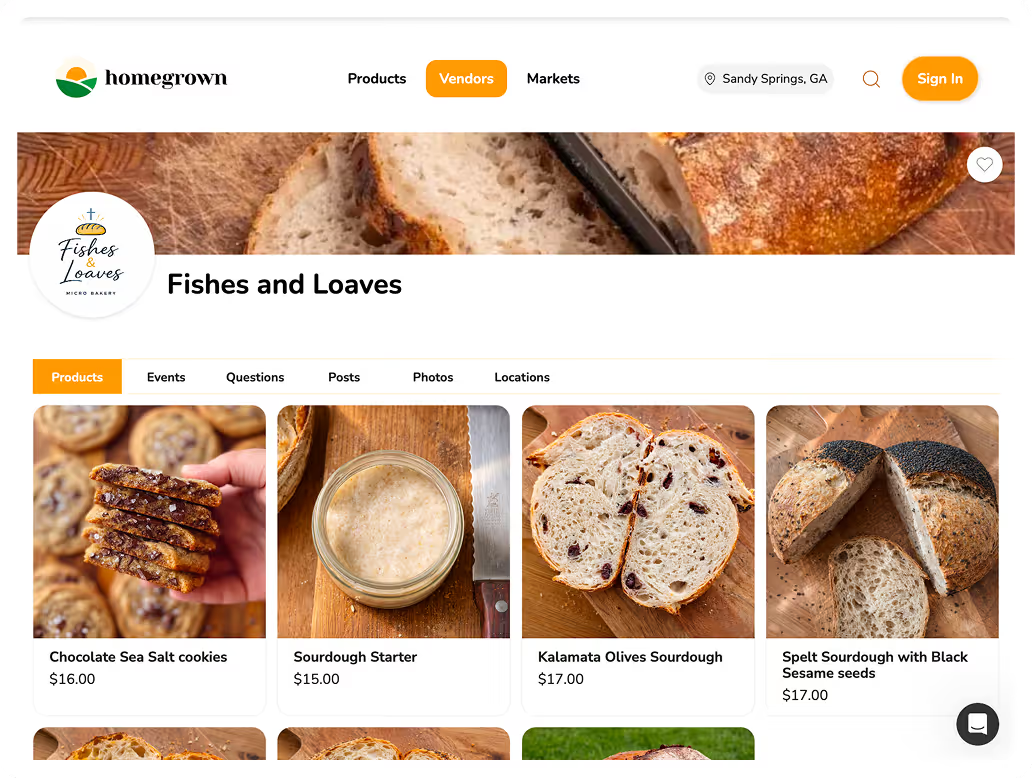
Set up your Homegrown storefront and make your products searchable and orderable for local customers — most vendors are live in under an hour.