

You are making money at the farmers market. Your regulars show up every Saturday. You sell out of your best products by noon. People are asking if you take online orders. You want to grow — more sales, more customers, more revenue. But you also want to keep your day job, your health insurance, and at least some of your weekends.
Here is the thing most food business advice gets wrong: scaling does not mean going full-time. It means earning more from the hours you are already working. It means building systems that grow your revenue without growing your workload at the same rate.
Most part-time food vendors hit a ceiling around $500 to $800 per month — not because demand is low, but because they are stuck doing everything the same way they did when they started. Scaling is about breaking through that ceiling without breaking yourself.
The short version:
Scaling a food side business is fundamentally different from scaling a reselling operation, a freelance service, or a digital product. Three constraints make food businesses unique, and ignoring them is why so many vendors burn out trying to grow.
You cannot speed up a recipe. If your bread dough needs two hours to rise, it needs two hours. If your jam takes 45 minutes to reach the right temperature, it takes 45 minutes. Unlike a freelancer who can work faster with experience, your production time is mostly fixed by chemistry and physics.
This means the path to scaling is not "make food faster." It is everything else — how you take orders, how you plan production, how you package, how you sell. The vendors who scale successfully are the ones who compress the non-production hours, not the cooking hours.
A reseller can buy inventory in January and sell it in March. A digital creator can make a product once and sell it forever. You cannot do either of those things. Your cookies have a shelf life. Your prepared foods need to be fresh. Your jam might last longer, but you still need jars, labels, and storage space.
This perishability means you cannot just "batch a month of inventory" the way other side hustles can. Your production and sales cycles are tightly linked, usually within a few days of each other. Scaling has to work within that window.
Most states have cottage food laws that cap how much revenue you can earn from a home kitchen — anywhere from $25,000 to $75,000 per year depending on the state, with some states having no cap at all. If your state has a low cap, your scaling strategy needs to account for it.
Beyond revenue caps, growing past a certain point may require a commercial kitchen, additional permits, or liability insurance. These are not reasons to avoid scaling — they are guardrails you need to know about before you plan. Check your state's rules before you map out a growth strategy. For a full breakdown, see our guide on understanding your state's cottage food revenue cap.
There are three levers that grow your food business revenue without adding more hours to your week: raise your prices, add a sales channel, or increase your production efficiency. Most vendors jump straight to "make more food," which is the hardest and least effective option.
Raising prices is the most underused growth lever for part-time food vendors. If you are selling out at your farmers market booth every week, your prices are too low. Selling out is not a success — it means you left money on the table and went home early with nothing to show for the demand you turned away.
A 20 percent price increase on a product you sell 50 units of per week adds the same revenue as selling 10 more units — with zero extra production time. If your $5 cookies become $6 cookies and nobody stops buying them, you just gave yourself a raise without adding a single hour of work.
Start with your best sellers. Raise prices by 10 to 20 percent and watch what happens. Most vendors are surprised to find that customers do not flinch. The ones who buy your food at the farmers market are buying quality and trust, not hunting for the cheapest option.
Your first sales channel is probably a farmers market booth. Adding a second channel — online pre-orders, local delivery, wholesale to a coffee shop — adds revenue without requiring a separate production day. You are already making the food. A new channel just gives you more places to sell it.
The highest-return second channel for most part-time vendors is online ordering. Instead of hoping foot traffic brings enough buyers on Saturday, you take orders during the week and show up to the market knowing exactly how much you have already sold. Learn how to set this up without it taking over your life in our guide on how to handle online orders without losing your mind.
Efficiency gains do not sound exciting, but they are often worth more than a new sales channel. If you can cut your packaging time in half by setting up an assembly line, or eliminate 2 hours of texting per week by using an ordering system instead of DMs, those hours become production capacity you can use to fill new orders.
The biggest efficiency gains for most vendors come from batch production — making more of fewer products in dedicated production sessions instead of small batches of many products spread across the week. For step-by-step methods, see our guide on how to batch cook efficiently for your food business.
Not every growth strategy makes sense at every stage. A vendor making $300 per month needs different advice than a vendor making $2,000 per month. Here is what to focus on at each level.
At this stage, your job is not to scale. It is to find your best products and get consistent. Pick 3 to 5 products that sell well and that you can make reliably every week. Stop experimenting with your menu every market day. Your regulars want to know they can count on you for the same great salsa, the same cookies, the same jam.
This is the stage where you build your production rhythm. Figure out how many hours it takes to produce your lineup, how much it costs in ingredients, and what your actual profit per unit looks like. You cannot scale what you have not measured.
This is where most part-time vendors get stuck. You are selling consistently at the market, but you have hit the ceiling of what one market day can generate. The next move is not a second market — it is online ordering.
Pre-orders let customers place orders during the week, so you know exactly what to make before your production day. No more guessing, no more overproducing "just in case," no more throwing away unsold product. Every unit you make has a buyer.
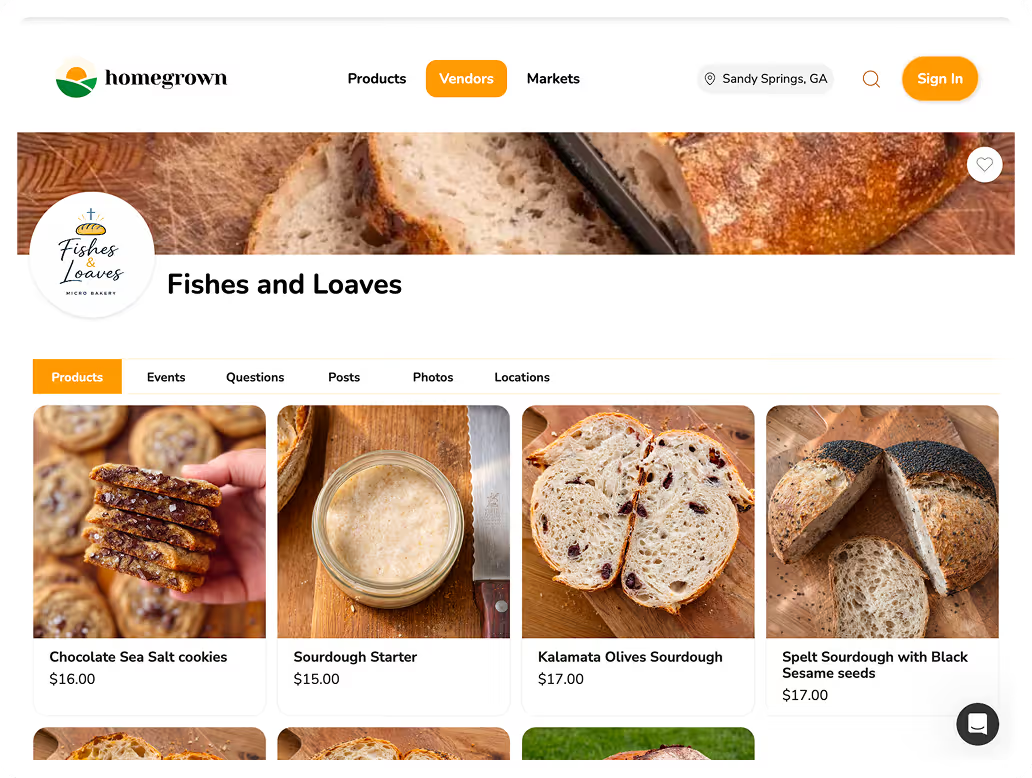
The average side hustler earns about $1,215 per month, but most food vendors fall well below that until they add a second sales channel. Online ordering is the fastest way to close that gap. Most vendors at this stage are cobbling together Instagram DMs and Venmo — it works at 10 orders a week until you miss one on a Thursday night and lose the sale. Square Online seems like an upgrade, but it charges per transaction and is designed for retail stores with inventory, not a vendor who bakes to order. Etsy takes 6.5% and is built for shipping — most of your customers live 15 minutes away and want to pick up Saturday morning. Homegrown is $10/month flat — customers see your menu, pick pickup or local delivery, and pay before you start producing. No percentage fees eating your margins, no DMs to track, no Venmo screenshots to reconcile. It will not manage wholesale accounts or schedule your production days — but for turning market regulars into weekly pre-order customers, it removes the exact bottleneck that keeps part-time vendors stuck at $500.
At this level, you have a proven product line and a functioning sales system. Now is when optimization pays off. Raise prices on your best sellers. Tighten your production process. Consider adding a second market or a small wholesale account — but only if your production capacity supports it.
This is also the stage where time management becomes critical. You are juggling more orders, more customers, and more logistics. Build a weekly schedule that assigns specific tasks to specific days instead of letting food business work bleed into every evening. For a complete weekly framework, see our guide on how to manage your time as a part-time food vendor.
Here is a number that surprises most people: only 20 percent of side hustlers actually want to turn their side business into a full-time venture. The other 80 percent are perfectly happy earning strong supplemental income while keeping their day job.
At $2,000 or more per month, you have a real business. The question is whether you want to keep growing or hold steady at a level that works for your life. Both are legitimate choices.
If you want to grow further, this is typically when you need to consider a commercial kitchen, part-time help, or more formal distribution channels. If you want to stay at this level, your job is to protect it — maintain quality, keep your systems running, and resist the urge to add complexity that does not add profit. To figure out what revenue level actually makes sense for your situation, see our guide on financial goals for a part-time food business.
Pre-orders are the single most effective scaling tool for part-time food vendors, and most vendors underuse them. A pre-order system turns your production from guesswork into a predictable process.
Without pre-orders: You estimate how much to make based on last week's sales, your gut feeling, and the weather forecast. You overproduce some items and underproduce others. You bring home unsold product, eat the cost, and feel frustrated.
With pre-orders: Customers place orders by Wednesday. You see exactly what is needed. You produce Thursday and Friday. Every unit has a buyer. Your revenue is locked in before you start cooking.
Pre-orders also solve the problem of scaling without scaling hours. If you know you have 30 cookie orders before you start baking, you can plan one efficient production session instead of making "some extra just in case" and wasting time on product that might not sell.
To transition your existing customers to pre-ordering, start simple. Tell your market regulars: "You can order ahead this week and skip the line on Saturday." Post your ordering link on your social media. Make it easy. Once customers try it, most prefer it — they get guaranteed availability, and you get guaranteed revenue.
If you already have a Homegrown storefront, share the link with your market regulars and tell them they can order ahead and skip the line on Saturday. If you do not, the setup takes about 15 minutes.
Adding a second market is one of the most common scaling moves, and one of the most commonly regretted. A second market doubles your setup and teardown time, doubles your production requirements, and takes another full day out of your week. Before you commit, make sure the math works.
Add a second market when:
Do not add a second market when:
The alternative: For many vendors, adding online ordering generates more incremental revenue than a second market — with far less time commitment. Online orders use the same production you are already doing and add sales without adding another full market day.
Wholesale can be a smart scaling move, but the margins are very different from direct-to-consumer sales. At a farmers market or through online orders, you keep 70 to 80 percent of the retail price. Wholesale accounts typically pay 40 to 50 percent of retail. You are trading margin for volume and predictability.
Wholesale works when:
Wholesale does not work when:
Start with one account. A local coffee shop, a gift store, a small grocery. Deliver once a week on a set schedule. Track your costs carefully for the first month to make sure the margin works. If it does, you can add more accounts over time.
The goal of scaling production is to make more product in the same number of hours, not to add more hours. Here are four strategies that work for part-time food vendors.
Simplify your menu. Every product on your menu adds setup time, ingredient sourcing, recipe switching, and packaging variations. Cutting your menu from 8 products to 5 does not reduce your revenue if you redirect that production time to your best sellers. Make more of what sells fastest.
Batch in larger quantities. If you are making 30 jars of jam, making 50 takes almost the same amount of active time. The cooking and cooling time is fixed. The only variable is more jars, more labels, more lids — and those steps are fast. Scale up your batch sizes before scaling up your production days.
Prep components in advance. Measure and bag dry ingredients on Sunday night. Pre-cut fruit on Wednesday. Prepare labels and packaging materials the evening before production day. When your production session starts, you should be ready to cook — not measuring flour and searching for jar lids.
Set up an assembly line for packaging. Instead of labeling one jar, filling it, capping it, and moving to the next — set up stations. Fill all jars first. Cap all jars. Label all jars. Assembly-line packaging is two to three times faster than one-at-a-time packaging.
Not every month needs to be a growth month. Sometimes the smartest move is to hold your current level and let your systems catch up to your sales. Here are the signs that you need to stabilize before you grow further.
Your quality is slipping. If you are rushing recipes, skipping quality checks, or sending out product that is not your best work, you have outgrown your current capacity. Scaling on top of declining quality loses customers faster than growth adds them.
Your profit margin is shrinking. Revenue is going up but profit is flat or falling. This usually means your costs are scaling faster than your prices — you are buying more ingredients, paying for more packaging, maybe renting kitchen time. Pause and fix your unit economics before adding more volume.
You dread production days. When making food stops being something you enjoy and starts feeling like an obligation you resent, that is your body telling you to slow down. Burnout does not fix itself with more sales.
Your response time is getting worse. Customers are waiting longer for replies. Orders are getting mixed up. You missed a pickup time. These are signs that your admin systems cannot keep up with your sales volume.
When you see these signs, the move is to simplify, not to push harder. Cut your lowest-selling product. Raise prices so you can sell less and make the same money. Take a week off. The business will survive — and it will be stronger when you come back with better systems.
Most part-time food vendors earn between $500 and $2,000 per month once they have a consistent product line and at least one market or sales channel. Vendors who add online ordering typically earn 30 to 50 percent more than vendors who only sell at markets. The ceiling depends on your state's cottage food laws, your available production hours, and your pricing. A part-time food business earning $1,500 per month is a strong, sustainable operation.
Sell more of what you already make. Adding products increases your ingredient costs, your production complexity, and your decision fatigue — all without guaranteeing more revenue. If your current best sellers are moving well, make more of them. The time you save by not developing new recipes goes directly into filling more orders of your proven products.
Start by checking your state's specific cap — it ranges from $25,000 to over $75,000 depending on where you live, and some states have no cap at all. If you are approaching your cap, focus on raising prices rather than increasing volume. Higher prices per unit let you earn more within the same cap. If you have genuinely outgrown your cottage food limits, the next step is usually a shared commercial kitchen, which opens new sales channels and removes the cap.
For most part-time vendors, online ordering generates more incremental revenue per hour invested than a second market. A second market requires a full additional day of setup, sales, and teardown. Online orders use the same production you are already doing and add revenue without adding another full day of work. Add online ordering first, and only consider a second market once your online channel is running smoothly.
A well-organized part-time food business with one market and online ordering typically takes 12 to 18 hours per week. This includes two production sessions, one market day, and a few hours of admin, order management, and communication. Vendors who add a second market or wholesale accounts should expect 18 to 22 hours per week. Beyond 22 hours, you are approaching part-time-plus territory and should evaluate whether the additional hours are generating proportional revenue.
Consider a commercial kitchen when you have consistently hit your cottage food revenue cap for at least 3 months, when you need equipment your home kitchen cannot support, or when health department regulations in your state require it for the products you want to sell. A shared commercial kitchen typically costs $15 to $30 per hour, so make sure your margins can absorb that cost before committing. The advantage is that a commercial kitchen removes cottage food restrictions and opens doors to wholesale, retail, and catering.
Scaling a part-time food business is not about working harder or longer. It is about earning more from the hours you already have — through better pricing, smarter sales channels, and systems that grow with you instead of against you.
If you are ready to add online ordering as your next growth lever, set up your Homegrown storefront today. It takes less than 15 minutes, and it gives your customers a simple way to order while giving you predictable revenue every week.