

You grew more than you could sell at the market last Saturday. Half those tomatoes went to the neighbors again. You've been thinking there has to be a better way — a way to let customers order before you harvest, or at least before you load the truck.
There is. But selling fresh produce online works differently than selling baked goods, jars of jam, or shelf-stable snacks. Perishability changes everything. Your harvest quantities shift week to week. A head of lettuce picked Tuesday is not the same product on Friday. The platforms and strategies that work for someone selling hot sauce or granola don't translate to a farmer with fifty pounds of zucchini that needs to move by Saturday.
The short version: Sell produce online using a pre-order model tied to your harvest schedule — take orders early in the week, close them before harvest day, and fulfill through a single pickup window. CSA subscriptions and weekly share boxes give you guaranteed revenue before you pick. Keep it local (farm pickup or short delivery), update your availability weekly, and use a simple Homegrown storefront instead of a full e-commerce platform.
The good news is that the right approach — pre-orders, subscription boxes, local pickup, and weekly ordering rhythms — turns those constraints into strengths. When you sell produce online the right way, you reduce waste, build a committed customer base, lock in revenue before you harvest, and add a channel that works alongside or even instead of your farmers market booth.
This guide covers what actually works for small farms selling produce online: the channels that fit perishable goods, how to price what you grow, how to manage orders without letting logistics take over your mornings, and how to build a system your customers can count on week after week.
Fresh produce cannot sit on a shelf waiting for someone to click "buy" — it requires a pre-order model built around your harvest schedule, local fulfillment, and weekly availability updates. Most e-commerce advice assumes you have inventory sitting on a shelf, ready to ship whenever someone clicks "buy." Produce does not work that way, and pretending it does leads to frustrated customers and wasted food.
A head of lettuce picked Tuesday is not the same product on Friday. Your harvest quantity changes every week based on weather, pest pressure, soil conditions, and dozens of variables you cannot fully control. You cannot list "30 bunches of rainbow chard" on your Homegrown storefront in January and expect to fill orders in July. You cannot take an order on Monday and hold the product until a customer feels like picking it up the following weekend.
These are not flaws in the model. They are the reality of selling fresh food, and the right online approach is designed around them rather than in spite of them.
Key differences that shape how you sell produce online:
The right response to all of this is a model built around rhythm: take orders close to harvest, batch pickup or delivery into a specific window, and build customer relationships around a weekly or seasonal cadence rather than one-off transactions. Once you accept that produce requires this different approach, the logistics become surprisingly straightforward.
You generally do not need a commercial kitchen, cottage food permit, or food handler's license to sell whole fruits and vegetables directly to consumers. The regulatory situation for whole fresh produce is simpler than for processed foods, which is one of the reasons produce is an excellent starting point for selling online.
Fresh produce sold direct — at a farm stand, through farm pickup, at a farmers market, or via local delivery — sits outside the scope of most cottage food regulations. Those regulations apply to processed foods like baked goods, jams, sauces, and fermented products. Whole, unprocessed produce is a lower-regulatory-hurdle category. See CCOF organic certification for additional context.
What you can typically sell without special licensing:
What typically requires licensing or a commercial kitchen:
The clean line for most growers: whole, unprocessed produce sold direct to the consumer is the lowest-barrier product category you can work with. No permits to obtain, no labels to design (beyond what your farmers market requires), no commercial kitchen to rent. Start there.
If you want to add processed or value-added products later, those fall under cottage food or commercial food production rules depending on your state. But whole produce gives you the fastest path from "I want to sell online" to "I'm taking orders."
Your best options are a simple weekly ordering page (like a Homegrown storefront), CSA subscriptions for guaranteed revenue, and social media for building awareness — with farmers market pre-orders rounding out the mix. Here is how each channel works.
The most direct model is a simple page where customers can see what is available this week and place an order for pickup.
This does not need to be a full website with an About page, blog, and contact form. A single ordering page with your weekly availability, a way to pay, and pickup instructions covers the entire workflow. What matters most is consistency. Open orders every Monday morning, close them Wednesday night, prepare Thursday, pickup Saturday. Your customers learn the rhythm and plan around it.
The strengths of this model are the same as its limitations: you control availability down to the product level, you set the pickup window, and you are not trying to replicate a grocery store experience. You are selling a batch of what you grew this week to people who want it. That simplicity is a feature.
For produce specifically, a weekly ordering page works better than a permanent product catalog because your availability actually changes every week. A page that says "here is what we have this week, order by Wednesday" is more honest and more useful than a static Homegrown storefront with products that may or may not be available when someone tries to buy them.
Managing produce orders through DMs and Venmo falls apart past 10 orders per week — messages get buried, payments disconnect from orders, and you spend more time coordinating than harvesting. Farm-specific platforms like Barn2Door ($99/month plus setup) and GrazeCart ($49/month) handle CSA management and delivery routes but are built for operations doing $5,000 or more per month. Homegrown costs $10/month with no percentage fees beyond standard payment processing (2.9 percent plus $0.30 per transaction) and is built for exactly this weekly ordering workflow — you list what is available, customers order and pay before pickup, and you get a clean order list showing exactly what to harvest and pack. Homegrown does not manage your CSA subscriptions, handle delivery logistics, or track your crop planning — it handles the weekly ordering and payment step that replaces the group text and Venmo chasing.
A Community Supported Agriculture share is the highest-retention model for produce growers. Customers pay upfront — often for an entire season — for weekly or biweekly boxes of whatever you harvest. You keep the revenue regardless of what any individual week looks like. They get to discover what is growing and eat with the seasons.
Why CSA works well for small farms:
The tradeoff: CSA customers need to trust you before committing to a full season. A 20-week share at $30 per week is a $600 commitment. Not everyone will make that leap without trying your produce first. Start with a shorter window — a 4-6 week summer share or a fall harvest box — to let new customers experience your farm before asking for a full-season commitment. Many farms offer a trial period or shorter seasonal shares specifically to convert new customers into full-season members.
The USDA maintains a CSA directory that lets consumers find local CSAs by location. Listing your farm there costs nothing and adds a discovery channel you do not have to actively manage. For a deeper look at setting up a CSA program from scratch, see how to start a CSA.
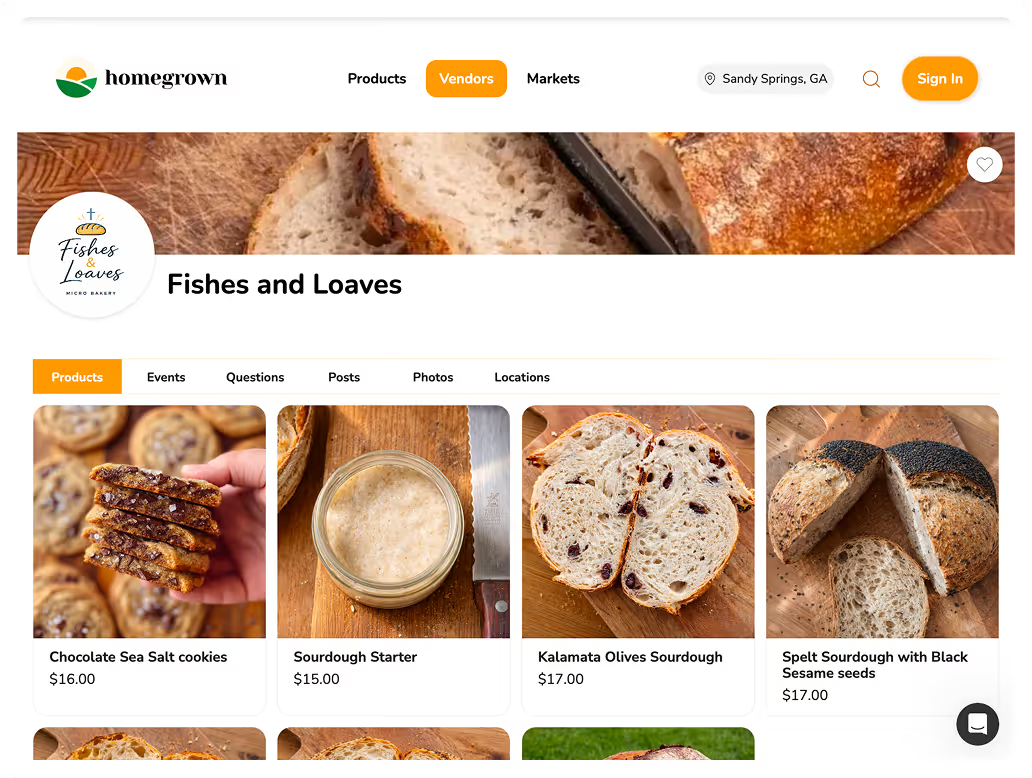
Platforms built for local food sales let you list what you have, accept orders, and manage pickups without building your own ordering system from scratch. Customers in your area can discover your farm and browse your available products without you needing a website or a social media following.
This model works especially well for:
The advantage of a dedicated local food platform over a general e-commerce tool is that it understands how you sell. Weekly availability windows, pickup scheduling, pre-order cutoffs, and the kind of inventory management that changes every few days are built into the workflow rather than bolted on as afterthoughts.
Many small produce vendors run a significant part of their operation through Instagram, Facebook groups, or neighborhood apps like Nextdoor. The flow is simple: post a photo of your harvest, say what you have available and the pickup window, and have people comment or DM to claim products.
This works at small scale and has essentially no overhead. The friction is that it does not scale. At 10 orders per week, scrolling through comments and DMs is manageable. At 40 orders across three platforms, you are trying to figure out who claimed the last pound of cherry tomatoes while your phone keeps buzzing with new messages. Payments become a mess of Venmo requests and "I'll pay you at pickup" promises. And you have no reliable record of who ordered what.
Social media is excellent for building awareness and showing off your harvest — nothing sells produce like a photo of a basket of heirloom tomatoes still warm from the field. Use social to announce availability and build your following. Use something more structured to actually take and manage orders.
You do not have to choose one channel. Many small farms use online pre-orders to lock in orders from regulars during the week, then bring remaining inventory to the market for walk-up sales on Saturday.
The advantage of this approach is significant: you have covered your minimum revenue before Saturday morning. Whatever you sell at the booth is additional income. You know exactly how much to harvest because your pre-orders tell you the floor, and your market experience tells you how much walk-up demand to expect on top of that. Resources from FDA produce handling safety offer more detail here.
Pre-orders also make your market day more efficient. Instead of arranging a full display and staffing the booth for four hours hoping for enough traffic, you can have a stack of pre-packed orders ready for quick pickup plus a smaller display for walk-up customers. Some vendors spend half as much time at market once their regulars shift to pre-ordering. If you are thinking through the transition from market-only to a combined online and in-person model, moving from farmers market to online sales covers exactly that shift.
If you are already selling at market and want to add an online channel, how to sell at a farmers market covers booth strategy and what actually moves. Use the market for discovery and new customer acquisition. Use online ordering for retention and repeat revenue.
Price at or slightly above your farmers market rates — customers are paying for guaranteed availability and the convenience of pre-ordering, which is worth a 10-15% premium. Produce pricing online generally follows farmers market pricing, with some adjustments for the convenience and commitment your online channel provides.
Pricing comparison:
| Product Type | Price Range | Notes |
|---|---|---|
| Small weekly share (1-2 person household) | $18-25 | Best entry point for new customers |
| Standard weekly share (family of 4) | $28-40 | Most popular CSA size |
| Large or premium share (larger families, serious cooks) | $40-55 | Higher commitment, higher value |
| Add-on products (extra quart of berries, large bunch of herbs, a dozen ears of corn) | $3-8 | Great for increasing average order |
| Individual products at market rate | $1.50-5 per pound | Depends on crop and season |
| Specialty or high-value products (heirloom tomatoes, exotic peppers, specialty greens) | $4-8 per pound | Premium pricing is standard |
Bundle pricing often works better than per-item pricing. A $25 weekly share box is easier to sell and easier to fulfill than individual per-item pricing on twelve different vegetables. Bundling smooths your revenue, simplifies your packing process, and lets you fill boxes based on what is at peak harvest rather than trying to fulfill specific product requests when yields are unpredictable.
Do not price below farmers market rates. You are not competing with the grocery store. You are offering fresh, local produce with a direct grower relationship and a harvest-to-table timeline measured in hours, not weeks. If anything, your online prices should reflect the premium of that relationship and the convenience of guaranteed availability.
The math on share pricing: If your standard share box contains $30-35 worth of individual products at market rates and you price it at $28-30, customers feel they are getting a deal while you benefit from guaranteed sales and zero waste. The perceived value of a curated box from a local farm consistently exceeds what people would spend buying the same products individually, which is why CSA shares feel like a bargain to customers even when your margin is healthy.
Batch your orders around your harvest window — open orders once a week, close them before harvest day, and fulfill everything in a single pickup window. The logistics of produce orders are simpler than they sound, but they require a clear system that you follow consistently. The key word is rhythm — establish a weekly pattern and stick to it.
Need more help here? See our guide on starting a CSA.
A typical weekly rhythm looks like this:
Key operational tips:
This weekly touchpoint is also where you build the relationship that keeps people coming back. A short note about what is growing, why this week's tomatoes are exceptional, or what is coming next week goes further than you would expect toward creating loyal, long-term customers.
Use real photos of your actual harvest (not stock images), update your availability every single week, and describe what customers can typically expect rather than promising specific products. Produce is a visual product. More than most things you could sell online, fresh fruits and vegetables sell through images. Good photos do more for your sales than good descriptions ever will.
Photo tips for produce listings:
No, not for whole, unprocessed produce sold directly to consumers. Fresh whole produce sold through farm pickup, farmers market sales, or local delivery sits outside the scope of most cottage food regulations. The exception is if you do any processing before sale — washing and bagging salad greens, cutting fruit, making juice, or combining produce into prepared products. Processing typically triggers different regulatory requirements.
Not practically for most small farms. Fresh produce degrades quickly in transit, even with cold packs. Shipping costs for perishable goods often exceed the product value, and shipping across state lines triggers federal food safety regulations. The realistic model for selling produce online is local: farm pickup, market sales, or short-distance delivery within your area.
Communicate early and honestly. If you know by Tuesday that your CSA boxes will be smaller than usual, send a message before pickup day rather than surprising customers. Build in buffer by growing more variety than your committed shares require, so a bad week for one crop can be offset by a good week for another. If you consistently have short boxes, you may have over-sold shares relative to your growing capacity.
Traditionally, a CSA implies the customer shares some of the farm's risk — a bad crop year means smaller boxes, and that is part of the deal. A subscription box model typically implies more consistency and a retail-like experience. For small farms starting out, the practical distinction matters less than the model itself: customers commit upfront, you deliver weekly produce, and the relationship is ongoing.
Start with pickup. It is simpler, more profitable per order, and dramatically easier to manage. Add delivery once your pickup operation is running smoothly and you have clear demand from customers who cannot make it to your pickup location. The model that works is a milk-run style delivery route: 10-15 stops in a geographic cluster, same route every week.
A simple weekly ordering page works better than a traditional e-commerce platform for produce because your availability changes every week. Look for a platform designed for local food vendors that supports weekly availability windows, pre-order cutoffs, and pickup scheduling. A Homegrown storefront gives you exactly this — a simple ordering link you update weekly that your customers can count on.
This depends entirely on your acreage, crop diversity, and growing conditions. A good starting point is 10-15 shares for a small operation with a quarter to half acre in production. Track what you harvest each week against what your shares require. Scale up only after you have consistently filled your current shares without shortages for at least one full season.
Selling produce online does not require a full website, a complicated e-commerce platform, or a commercial facility. It requires the right model for perishable, seasonal goods: pre-orders taken close to harvest, clear pickup windows, honest communication about what is available, and customers who commit to buying from you on a regular basis.
The farmers who do this well have one thing in common: they built a rhythm their customers could count on. Orders open Monday, close Wednesday, pickup Saturday. Every week, same pattern, same reliability. That consistency is what turns a first-time buyer into a weekly regular.
If you want to explore online selling across different farm product types beyond just produce, the best platform to sell local food online covers the full picture including shelf-stable goods, baked products, and mixed product operations.
When your regulars start asking what you have this week — and they will, once they have tasted what you grow — give them a place to browse and order instead of a text thread. One link, updated weekly, shared with the people who want your food. That is all you need to turn a Saturday market side hustle into a year-round farm-direct operation.