

You already have a food story. You just have not written it down yet.
Think about the last time you bought something at a farmers market. Chances are, you did not pick the vendor with the fanciest packaging or the lowest price. You picked the one who told you something real — how she started making jam from her grandmother's recipe, or how he grows his peppers in the same plot his family has farmed for three generations.
That is a food vendor brand story in action. And it works better than any paid ad you could run.
This is not about marketing jargon, brand strategy decks, or hiring a consultant. It is about answering one honest question: "Why do you make this?" Your answer — told in your own words, in your own voice — is the most powerful free marketing tool you have.
This guide walks you through how to find your story, write it in a few sentences, and put it everywhere that matters.
The short version: Your food vendor brand story is the honest answer to "Why do you make this?" Write it in 3-4 sentences, keep it specific and personal, and put it on your product labels, booth signage, social media bios, and online storefront page. Customers buy from people they connect with, and a real story builds more trust and loyalty than any amount of paid advertising. You do not need a marketing degree to tell your story well — you just need to be honest.
Because people buy from people, not brands. A food vendor brand story gives customers a reason to choose your jar of jam over the one sitting on a grocery store shelf — even when the grocery store jar costs less.
At a farmers market, you are not competing with other vendors on price. You are competing on connection. The vendor who explains why she started making salsa outsells the vendor who just sets jars on a table with a price tag.
This is not just a feeling — research backs it up. According to a Nosto consumer study, 86 percent of consumers say authenticity is important when deciding which brands they like and support. For small food vendors, authenticity is not something you have to manufacture. It is already baked into everything you do. You make your products by hand, in your own kitchen, with ingredients you chose yourself. That is about as authentic as it gets.
Grocery stores compete on price, shelf placement, and brand recognition. You compete on trust, connection, and a story that no corporation can replicate.
A customer who knows your story does not just come back for more. She tells her friend: "You have to try her jam — she started making it from her grandmother's recipe after her kids kept asking for it."
That is word-of-mouth marketing, and it is free. No Facebook ad can replicate the power of one person telling another person why your product matters. Your story gives customers the words to share — a reason beyond "it tastes good." And when you combine your story with other free marketing strategies, you can build a customer base without spending a dollar on advertising.
A good food vendor brand story is specific, honest, and short enough to tell in 30 seconds. It is not a marketing pitch or a mission statement. It is the true answer to why you do what you do, told in a way that makes someone want to try your product.
Not every story needs all five of these, but the best food vendor brand stories touch on at least two or three:
Your food vendor brand story should never sound like it came from a corporate boardroom. Here is what to avoid:
Start by answering five simple questions honestly, then look for the thread that connects your answers. Most vendors already have a great story. They just have not sat down and figured out which parts matter most.
Grab a piece of paper and write down your answers to these questions. Do not edit yourself — just write what comes to mind first.
Once you have answered those five questions, read through your answers and look for the one detail that feels most true to you. Most vendors' stories fall into one of a few categories:
Pick the ONE angle that feels most honest and build your story around it. You do not need all five elements from the list above. You just need the ones that are genuinely yours.
Write it in three parts — how it started, what you make and why, and who it is for — then cut it down to 3-4 sentences. Most vendors try to include too much. The goal is a short, specific story that someone can read in 15 seconds.
Here are four examples using the three-part framework. Use these as templates and fill in your own details.
Baker example: "I started baking sourdough after my daughter was diagnosed with a yeast sensitivity and we could not find bread she could eat. Every loaf is made with a 6-year-old starter and stone-milled flour from a farm 20 miles away. I bake for families who want real bread made with real ingredients."
Jam and preserves vendor example: "My grandmother made strawberry preserves every June, and I spent 15 years trying to get her recipe right after she passed. I use the same variety of berries she grew and cook in small batches of 12 jars at a time. These preserves are for anyone who believes homemade should actually taste homemade."
Hot sauce and specialty product example: "I moved to Texas from Mexico City and could not find a salsa verde that tasted like the one I grew up eating. I started making it for friends, and they would not let me stop. Every jar is made from tomatillos and serranos I source from local farms."
Produce and farm vendor example: "My family has grown tomatoes on this land for four generations. We do not use synthetic pesticides, and we pick everything the morning of market day. If you have ever eaten a tomato that was actually warm from the sun, you know why that matters."
After you write your first draft, run it through these checks:
Everywhere a customer encounters your brand — from your booth sign to your Instagram bio to the label on your product. Your food vendor brand story should follow your customers through every touchpoint, adapted for length but never changed in message.
Here is where to put your story and how long each version should be:
Lead with your story when customers browse, not your price list. The farmers market is where your food vendor brand story has the most power because you are standing right there, face to face, with the person you made your product for.
When someone picks up your product and looks at it, that is your moment. Instead of saying "that's five dollars," try something like this:
"That's our habanero peach jam — I started making it when my neighbor brought me a case of peaches and I had a fridge full of habaneros from my garden. Everything is cooked in small batches right here in [your town]."
That is specific. That is real. And it takes about 15 seconds to say. The customer now knows three things about you: you use fresh local ingredients, you make it yourself, and there is a real story behind the product.
Not every customer will talk to you, and you cannot tell your story to everyone in a busy market. Let your signage do some of the work:
Your best marketing is not what you say about yourself. It is what your customers say about you.
Write the way you talk, show your process, and never use corporate marketing language. The biggest mistake vendors make online is trying to sound "professional" instead of sounding like themselves.
Your story does not have to live in one big post. Social media lets you tell micro-stories — small pieces of your larger story, shared over time.
Your "About" page is the most important page on your storefront besides your product listings. This is where customers go to decide if they trust you enough to buy.
Your core story should be the same everywhere. The details might change depending on the format — shorter on a label, longer on your website, verbal at the booth — but the message stays the same.
If your label says "made from my grandmother's recipe" but your Instagram bio says "artisanal small-batch vendor," you are sending mixed signals. Pick the version that sounds like you and stick with it everywhere.
Even vendors with great products and genuine stories can undercut themselves with these common mistakes:
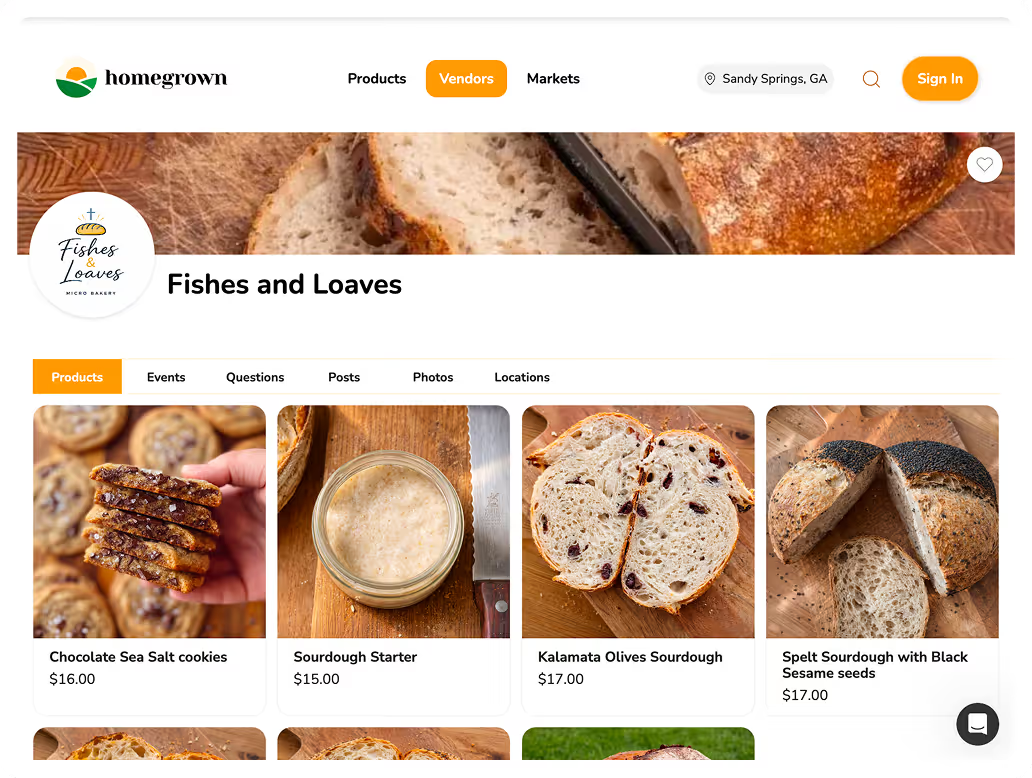
Ready to start selling locally? The easiest way to take local orders and get paid is an online storefront — see the best platform to sell food from home, or set up a Homegrown storefront in about 15 minutes ($10/mo, 0% commission).
Yes, and it might matter even more at a single market. When you only sell at one location, every customer interaction counts. Your food vendor brand story is the thing that turns a one-time buyer into a regular who shows up every Saturday specifically for your booth. A story also helps you stand out in a market where multiple vendors may sell similar products.
Your core story should be 3-4 sentences, which takes about 15 seconds to read or say out loud. That is the version for labels, signage, and conversations at the booth. Your website or storefront About section can have a longer version — up to 200 words — with more detail about your process and background.
You can and should update your story as your business grows, but do it gradually. If you started selling cookies and now you also sell cakes and pies, your story can expand to include that growth. What you should not do is completely reinvent your story every few months. Customers build trust through consistency, and a story that keeps changing feels less authentic.
A strong food vendor brand story is even more important online than in person. At a farmers market, customers can see you, talk to you, and taste your product. Online, your story is the only way to build that personal connection. Vendors with a clear story on their ordering page give customers a reason to choose them over a faceless listing on a larger marketplace.
You tell the story of why you are starting. "I just started" is actually a compelling story angle — you are taking a risk, following a passion, or filling a need you noticed in your community. Customers love supporting someone at the beginning. Be honest about being new, and focus on what motivated you to take the leap. As the ATTRA farm branding guide points out, customers are buying the meaning behind your product as much as the product itself.
Your cottage food status is a legal detail, not a story element. You may need to include required disclaimers on your labels depending on your state's laws, but that is separate from your brand story. If anything, being a cottage food vendor is part of what makes your story real — you are making products in your own kitchen, which is exactly the kind of authenticity customers are looking for.
You are probably wrong. The stories that feel ordinary to you are often the most interesting to your customers. "I have been making bread every weekend for 20 years" sounds boring to you because you have lived it. To a customer buying bread at a farmers market, it says commitment, experience, and consistency. The bar for a good food vendor brand story is not "interesting" — it is "honest and specific." If it is true and it is yours, it is interesting enough.
Your food vendor brand story is not a luxury or a nice-to-have. It is the foundation of everything that makes customers choose you, come back to you, and tell their friends about you. Write yours today — start with those five questions, use the three-part framework, and put it everywhere your customers will see it.