

Your best customers already want to hear from you. The problem is they are not seeing your posts. Social media reach keeps shrinking. Emails sit unopened. But a text message? Almost everyone reads it.
Text message marketing is one of the cheapest and most effective ways for food vendors to fill pre-orders, remind customers about market day, and turn one-time buyers into regulars. You do not need a big budget, a marketing degree, or thousands of followers. You just need a phone, a simple tool, and a list of people who said yes.
This guide walks you through everything: why texting works, what to send, how to collect numbers, what tools to use, how to stay legal, and what mistakes to avoid. You can set this up in one afternoon and start seeing results by your next market day.
The short version: Text message marketing gives food vendors a direct line to their customers with open rates between 90 and 98 percent, compared to about 28 percent for email. You do not need expensive software or a huge subscriber list to get started. Collect phone numbers with a QR code at your booth, pick a simple texting tool, and send one message before each market day. Keep it to one or two texts per week, always include opt-out instructions to stay legal, and only text people who gave you permission. Most vendors start seeing more pre-orders and repeat buyers within the first few weeks.
---
Text messages have the highest open rate of any marketing channel. According to Omnisend's SMS marketing research, SMS open rates range from 90 to 98 percent, and 90 percent of messages get read within three minutes. Compare that to email, where the average open rate in agriculture and food service sits below 28 percent.
For food vendors, this matters more than it does for most businesses. Here is why.
Your messages are time-sensitive. "Fresh sourdough coming out of the oven at 6am — pre-order by tonight" does not work as an email someone reads two days later. It works as a text they read right now.
Your customer list is small and local. You are not trying to reach 50,000 strangers. You are trying to reach the 100 to 300 people who already buy from you. Text marketing is built for exactly this kind of relationship.
Your competition is not doing it. Most food vendors at the farmers market still rely on Instagram posts and word of mouth. A weekly text puts you ahead of every other vendor at your market who is hoping the algorithm shows their post to someone.
The conversion rates are real. SMS conversion rates run between 21 and 30 percent, which is roughly double what email delivers. When you text someone that your strawberry jam is back in stock, a significant portion of those people will actually place an order.
You do not need 10,000 subscribers for text marketing to work. Fifty engaged customers who read every message and show up to buy is more valuable than 5,000 Instagram followers who scroll past your posts.
---
The best text messages from food vendors are short, specific, and useful. Every text should give your customer a reason to act — show up, pre-order, or save the date. Here are the five types of messages that work best.
This is the most common and most effective text for farmers market vendors. Send it the evening before or the morning of your market.
Template: "Hi from [Your Business]! We'll be at [Market Name] tomorrow from 8am-12pm. This week: fresh peach cobbler, blueberry scones, and new lavender shortbread. See you there! Reply STOP to opt out."
Template: "[Your Business] at [Market] today until noon. We brought extra sourdough this week — first come, first served. Reply STOP to unsubscribe."
If you take pre-orders, texting is the fastest way to fill them. Send these early in the week for weekend markets.
Template: "Pre-orders open for Saturday! This week's menu: chicken pot pies ($14), quiche ($12), cinnamon rolls (6-pack, $10). Reply or order at [link]. Reply STOP to opt out."
Template: "Thanksgiving pie pre-orders are live. Pecan, pumpkin, and apple — order by Nov 20. Details: [link]. Reply STOP to unsubscribe."
When you launch something new or a seasonal favorite returns, your text list should hear about it first.
Template: "[Your Business] news: We just added ghost pepper hot sauce to the lineup. Small batch, limited jars. Grab yours Saturday at [Market]. Reply STOP to opt out."
End-of-market surplus? Text your list before you pack up or mark things down.
Template: "Market's winding down and we have 8 loaves of cinnamon raisin bread left. $4 each (normally $7) if you swing by in the next hour. [Market Name], Booth 12. Reply STOP to opt out."
A quick thank-you after market day keeps the relationship warm without being salesy.
Template: "Thanks for stopping by today! We sold out of the apple butter — bringing double next week. See you Saturday. Reply STOP to unsubscribe."
The pattern across all of these: be specific, be brief, be useful, and always include opt-out instructions.
You cannot text people who did not give you their number and their permission. Collecting phone numbers is the foundation of text marketing, and it is simpler than most vendors expect. If you have already been building a customer email list, you know the basics — text signups work the same way.
Print a small sign that says "Join my text list for weekly market updates" with a QR code that links to a simple signup form. You can create a free signup form through most texting platforms, or use a free Google Form. Customers scan it, type their number, and they are on your list in 10 seconds.
This is the easiest method because it requires zero conversation. The sign does the work while you are busy serving customers.
If your customers skew older or less tech-comfortable, a clipboard with a simple form works just as well. Columns for name and phone number. Add a line at the top that says "Sign up for weekly text updates from [Your Business]. Message frequency: 1-2 per week. Reply STOP to opt out anytime."
That last sentence is not optional. You need to tell people what they are signing up for and how to stop.
If you take online orders through a Homegrown storefront or another platform, include a checkbox during checkout: "Text me weekly updates and specials." This captures numbers from people who are already buying from you — the easiest subscribers to convert.
"Join my text list and get $1 off your purchase today" is a simple, honest incentive that works. You are not bribing anyone. You are thanking them for sharing their number. Some vendors offer a free sample or a bonus item instead of a discount.
Keep it casual. "Hey, I send a quick text before each market with what I'm bringing — want me to add you?" That is it. No pitch. No pressure. Most regulars will say yes because they already want to know.
You do not need enterprise marketing software. You need something simple, affordable, and compliant with texting laws. Here are your main options, organized by price.
Google Voice — Free, gives you a dedicated business number, and lets you send individual texts. The catch: you have to send each message manually, one at a time. No bulk sending, no automation, no opt-in management. This works if you have fewer than 20 customers on your list and do not mind the manual work.
These platforms handle the heavy lifting: bulk sending, opt-in/opt-out management, scheduling, and compliance. Most offer pay-as-you-go or monthly plans.
VendorLoop — Built specifically for farmers market and food truck vendors. $29/month for 1,000 messages. Includes QR code signups, automated market-day reminders, and a vendor dashboard. If you want something designed for exactly your use case, this is worth looking at.
When choosing a platform, check these five things:
Start with the simplest tool that handles compliance for you. You can always upgrade later as your list grows.
Every pre-order text in the templates above includes "[link]." That link is where the conversion actually happens — the customer who read your text and wants to order needs to land somewhere that lets them order and pay in one step.
Your Instagram profile gets them to your page, but they still have to DM you to order. That friction kills the urgency the text created.
A Google Form collects order details but not payment. You're matching Venmo requests to form entries while trying to prep for Saturday.
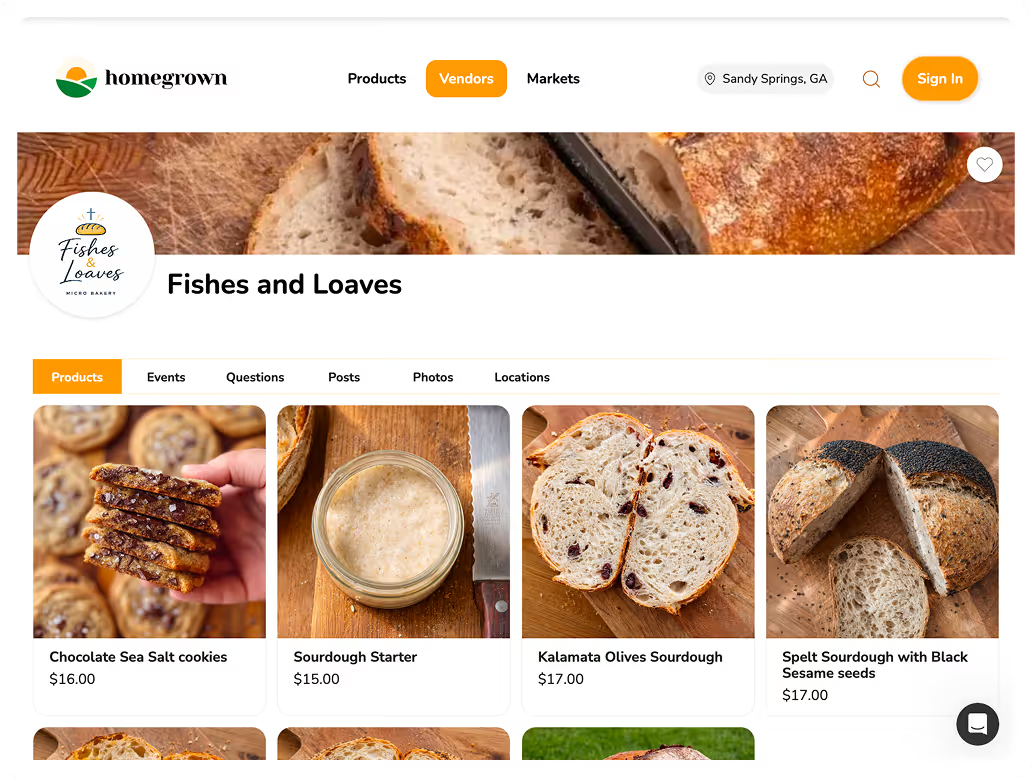
Homegrown ($10/month) gives you one link that works in every text you send. Customers tap it, see your products, order, and pay — the text creates demand, the link fulfills it. When you text "pre-orders open for Saturday," your Homegrown storefront handles the orders that text generates.
Text marketing solves the visibility problem — your customers actually see the message. The ordering link solves the conversion problem — they can act on it immediately without sending you a DM and waiting for a reply. Running texts without a destination that takes payment is like handing out flyers with no phone number.
Homegrown doesn't replace your texting tool — it's where your texting tool sends people. The $10/month covers unlimited orders, and your customer list belongs to you, not to a marketplace algorithm.
Text message marketing is regulated by the Telephone Consumer Protection Act, and the rules are stricter than email marketing. The good news: the rules are straightforward, and following them protects both you and your customers.
Here are the basics, explained in plain English.
This is the most important rule. You must get written consent before sending marketing texts. "Written" includes digital — a QR code signup form, a text-to-join keyword, or a checkbox on an order form all count. A verbal "yeah, text me" at the booth does not count.
According to SlickText's TCPA compliance guide, violations can result in fines of $500 per message, and willful violations can cost up to $1,500 per message. There is no cap on damages, so a class-action lawsuit over a 200-person list could cost you $100,000 or more.
This is not meant to scare you. It is meant to convince you to get proper opt-ins. Use a real signup form and you are fine.
Every marketing text you send must include a way to unsubscribe. The standard is "Reply STOP to opt out" at the end of the message. When someone replies STOP, you must remove them immediately. No exceptions, no "are you sure?" follow-up.
Your signup form or sign needs to include:
The rule is 8am to 9pm in the recipient's local time zone. For most food vendors, this is not an issue — you are sending market reminders during normal hours anyway. But do not schedule a 6am text about your early-bird special.
Do not text customers from your personal phone. Use a texting platform or a separate business number. This keeps your personal number private, creates a professional impression, and makes it easier to manage opt-ins and opt-outs.
The simple version of all these rules: get permission first, tell people what to expect, let them leave anytime, and text during normal hours. If you do those four things, you are compliant.
One to two texts per week is the sweet spot for most food vendors. That is enough to stay top of mind without annoying anyone.
Research shows that 49 percent of consumers are comfortable receiving one promotional text per week. But 53 percent say they will unsubscribe if a business texts them too often. The line between "helpful reminder" and "annoying spam" is thinner than you think.
Here is a practical weekly schedule for a Saturday market vendor:
That is it. Two texts per week, maximum. Some weeks you might only send one. If you do not have anything worth saying, do not send a text just to stay "consistent." Your subscribers will respect you more for respecting their time.
When to send an extra text:
These are exceptions, not the norm. If you find yourself texting more than twice a week regularly, you are texting too much.
Your first text sets the tone for the entire relationship. Keep it short, friendly, and clear about what comes next.
Welcome message template (send immediately after signup):
"Welcome to [Your Business] texts! You'll get 1-2 messages per week with market updates and specials. Reply STOP anytime to unsubscribe. Thanks for joining! — [Your Name]"
First market reminder (send the week after they sign up):
"Hi from [Your Business]! We'll be at [Market Name] this Saturday 8am-12pm. Bringing fresh [products]. Hope to see you there! Reply STOP to opt out."
A few rules for your first messages:
Most text marketing mistakes come from enthusiasm — vendors get excited about the channel and skip the basics. Here are the six mistakes that trip up new food vendors.
This is the biggest mistake and the most expensive one. Adding someone to your text list because they gave you their email, bought from you once, or follow you on Instagram is not the same as getting text opt-in consent. Those are different permissions. Always get explicit text-specific consent through a signup form, text-to-join keyword, or written checkbox.
More than two promotional texts per week will cost you subscribers. Every unsubscribe is a customer who wanted to hear from you but felt overwhelmed. Treat your text list like a privilege, not a megaphone.
"Check out our products this week!" could be from any business in the world. Compare that to "Bringing 30 jars of our small-batch strawberry habanero jam to Saturday's market — they usually sell out by 10am." Specific messages get specific results.
Every marketing text needs "Reply STOP to opt out" or similar language. It is the law, and it is the right thing to do. Most texting platforms add this automatically, which is one more reason to use a real platform instead of your personal phone.
Your personal number should not be your marketing channel. You lose the ability to track opt-ins and opt-outs, you cannot schedule messages, and your customers see your personal number forever. Use a dedicated business number through a texting platform.
This is the most common mistake of all. Vendors research text marketing for weeks, compare platforms endlessly, and never send their first text. Start with 10 phone numbers and one message. You can optimize later. The first text is the hardest one, and it does not have to be perfect.
If you are already using free marketing strategies like social media, local Facebook Groups, and word of mouth, text marketing is the natural next step. It takes 10 minutes a week and reaches more of your customers than any Instagram post.
Turn that attention into actual orders. The easiest way to take local orders and get paid is an online storefront — see the best platform to sell food from home, or set up a Homegrown storefront in about 15 minutes ($10/mo, 0% commission).
Yes, text message marketing is legal for small food businesses as long as you follow the TCPA rules. You must get written opt-in consent before texting anyone, include opt-out instructions in every message, and only text between 8am and 9pm local time. Using a texting platform that handles compliance automatically is the easiest way to stay on the right side of the law.
Text marketing is worth it with as few as 20 to 30 subscribers. Unlike social media, where you need thousands of followers to get meaningful reach, a text list of 50 engaged customers who read every message and act on it is genuinely valuable. Most food vendors start seeing results — more pre-orders, more market-day traffic — within the first month of texting their list.
You can, but you should not. Using your personal number means you cannot manage opt-ins and opt-outs properly, you cannot schedule texts ahead of time, and your personal number is permanently shared with every subscriber. Use a texting platform that gives you a dedicated business number. Most platforms include this in their base plan.
Most food vendors spend $20 to $40 per month on text marketing. Entry-level plans from platforms like SlickText, SimpleTexting, and EZ Texting start around $20 to $29 per month and include 500 to 1,000 messages. If you have 100 subscribers and text twice a week, that is about 800 texts per month. Additional messages typically cost $0.01 to $0.05 each. Some vendors start for free using Google Voice, though it lacks automation and compliance features.
Yes. Every marketing text must include opt-out instructions, and "Reply STOP to opt out" is the standard way to do it. This is required by the TCPA. Skipping it even once is technically a violation. Most texting platforms automatically append opt-out language, which makes this easy to handle.
For farmers market vendors, the best time to text is Thursday evening or Friday morning before a Saturday market. This gives customers time to plan their visit or place a pre-order. For day-of reminders, early morning on market day (between 7am and 9am) works well. Avoid texting before 8am or after 9pm — those are outside the legal window.
Yes, but it costs more. Sending a picture (called MMS, or multimedia messaging) typically costs two to three times more than a regular text message. Photos of your products can be effective — a picture of fresh strawberry shortcake generates more interest than a text description alone. But for most food vendors, well-written text-only messages are more cost-effective. Save photo messages for special occasions like new product launches or holiday specials.
Your customers want to hear from you. They just need an easier way to do it than checking your Instagram feed or remembering which Saturday you are at the market.
Text marketing gives you that direct line. Start small: collect 20 phone numbers this week using a sign or QR code at your booth. Pick a simple texting tool. Send one text before your next market. See what happens.
Most vendors who try text marketing say the same thing: "I wish I had started this sooner." Set up your Homegrown storefront so every text you send has somewhere to send them.