

You already know that people in your town buy homemade food. The question is how to reach them without spending money on ads or building a website from scratch.
Facebook Groups are one of the most overlooked free sales channels for cottage food vendors, home bakers, and farmers market sellers. Unlike Facebook Marketplace — which works more like a product listing board — Groups are community spaces where people already buy and sell from their neighbors. If you sell food on Facebook Groups the right way, you can add 10 to 30 new customers per month without spending a dollar.
This article covers the specific tactics for using local Facebook Groups as a sales channel: how to find the right groups, what to post, how to handle orders, and how to turn one-time group buyers into regulars. If you are looking for guidance on Facebook Marketplace specifically, that is a different channel with different rules — see the full guide on how to sell food on Facebook Marketplace.
The short version: Facebook Groups let you sell food directly to local buyers in community spaces where people are already looking for homemade products. Find 3 to 5 active local buy-and-sell groups, follow each group's posting rules, post with clear photos and simple descriptions 1 to 2 times per week, respond to comments within an hour, and use a consistent pickup system. Groups work best as a complement to a farmers market booth or pre-order system — they bring in new customers who would never find you otherwise.
Facebook Groups work because they are community-driven, not algorithm-driven. When someone joins a local buy-and-sell group, they are opting in to see posts from neighbors selling products. That is fundamentally different from a Facebook Page, where the algorithm decides who sees your content, or Facebook Marketplace, where buyers browse listings from strangers.
Here is why Groups are worth your time as a food vendor:
The biggest advantage of Groups over every other free channel is the built-in local audience. You do not need to "build a following" the way you do on Instagram or TikTok. The group already has the followers, and they already live near you.
Not all Facebook Groups are equally useful for selling food. The groups that generate actual orders fall into three categories, and you should be active in a mix of all three.
These are your primary sales channel. Search Facebook for your town or city name plus "buy and sell," "yard sale," "marketplace," or "community swap." Most towns with 10,000 or more residents have at least 2 to 3 active buy-and-sell groups. Larger metro areas can have dozens.
Buy-and-sell groups are the most direct path to orders because every member joined specifically to buy or sell. When you post homemade salsa or fresh-baked bread in these groups, you are reaching people who are already in a buying mindset.
These are not primarily for selling, but many allow occasional product posts. Think "Eastside Moms" or "Downtown Neighborhood Watch" or your town's general community page. These groups are better for visibility than for direct sales. A well-received post about your products here can drive people to find you in the buy-and-sell groups.
Check each group's rules before posting anything for sale. Some community groups ban all selling. Others allow it on specific days, like "Small Business Saturday" posts. Follow whatever rules they set.
Search for groups like "Local Food Lovers [Your City]," "Home Cooking [Your Area]," or "Meal Prep [Your Region]." These are smaller but higher-intent audiences. The people in a local food group are more likely to pay a premium for homemade products because they already value local, real food.
Start with 3 to 5 active groups. More than that becomes unmanageable, especially when you are also making products, handling orders, and running a farmers market booth. Quality over quantity — it is better to post consistently in 3 groups than to spam 10 groups and get removed from half of them.
Before you request to join, check these four things:
Every Facebook Group has its own set of admin rules, and breaking them is the fastest way to get removed. Read the pinned post or "About" section of every group before your first post. Beyond the official rules, there are unwritten norms that experienced group sellers follow.
Common admin rules you will encounter:
Unwritten rules that keep you in good standing:
What gets you removed from a group:
Getting removed from a group is permanent in most cases. You lose access to that entire audience with no way to get it back.
The difference between a post that generates 15 orders and a post that gets scrolled past comes down to three things: the photo, the description, and the timing.
Your photo is the only thing that stops someone from scrolling. Use natural light, shoot your actual products (not stock photos), and show what the customer will receive. A kitchen counter with 6 jars of peach jam lined up in morning sunlight outperforms a professional studio shot every time, because it looks real and local.
Keep your post description simple and complete. Every sales post should include:
Here is a fill-in-the-blank template you can adapt:
[Product Name] — Fresh batch available this week
[1-2 sentences about the product — what makes it special, what flavor, what is included]
[Allergen note if applicable: Contains [allergens]. Made in a home kitchen under [state] cottage food law.]
Timing matters in Facebook Groups because posts move through the feed quickly. The best times for local buy-and-sell groups are:
Avoid early morning posts. They get buried by the time most group members start scrolling in the evening.
Flash sales create urgency. "I just pulled 3 dozen snickerdoodles out of the oven — first 6 people to comment get a dozen for $12. Pickup tonight in [area]." Flash sales drive fast engagement because of the scarcity and immediacy.
Weekly menus build routine. "This week's menu: blueberry muffins ($8/6-pack), banana bread ($10/loaf), cinnamon rolls ($15/dozen). Orders close Wednesday, pickup Friday." Weekly menus turn casual buyers into regulars because they know exactly when to expect your post.
Most successful group vendors alternate between the two. Flash sales keep things exciting. Weekly menus keep the revenue predictable.
Orders from Facebook Groups come through comments and direct messages, which means the process is manual. That is fine when you are handling 5 to 10 orders per week. It becomes a problem at 15 or more.
A simple order system that works:
Payment options most group vendors use:
Keep a running order sheet. A notebook or a simple spreadsheet with columns for customer name, product ordered, quantity, payment status, and pickup time prevents the chaos of scrolling through 30 DM threads trying to remember who ordered what.
When to graduate to a real ordering system: If you are managing more than 15 orders per week through Facebook DMs, you are spending more time on logistics than on making products. You are copying order details into a spreadsheet, sending individual Venmo requests, confirming payments one by one, and DM-ing pickup details to each customer separately. That workflow breaks at 15 orders — and it completely falls apart at 30.
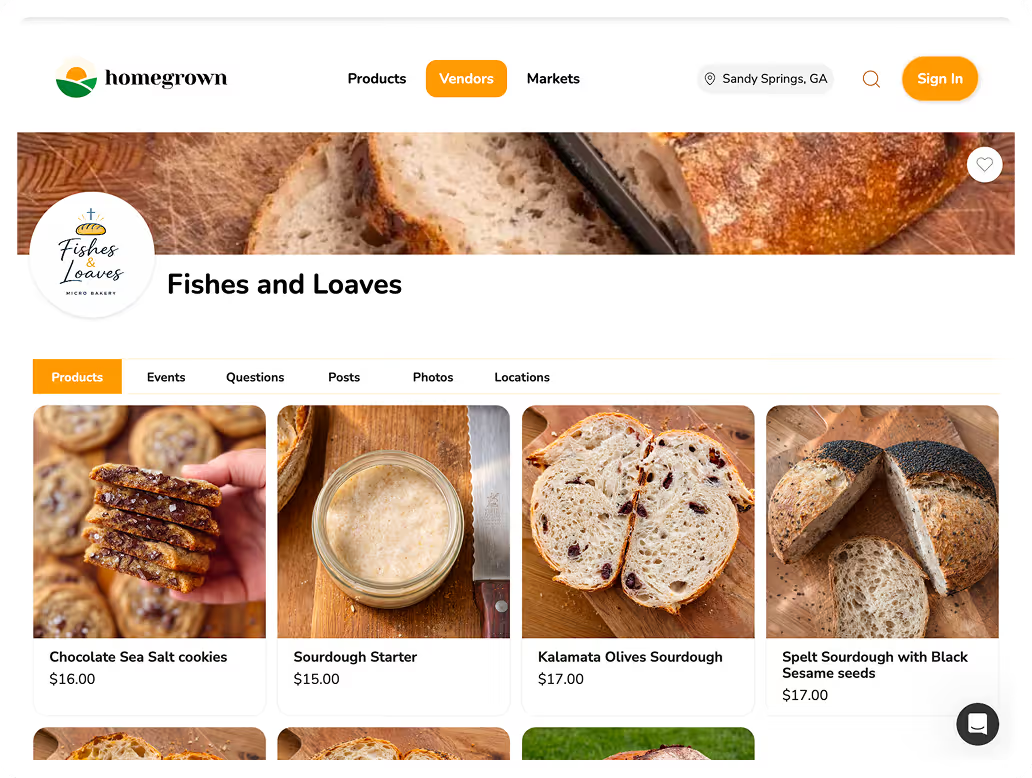
The question is what replaces it. Google Forms collect orders but not payment, so you are still chasing Venmo confirmations manually. Square Online gives you a free storefront but charges 2.9% + $0.30 per transaction and requires building out a product website — overkill when you just need a link to drop in your Tuesday group post. Homegrown is $10/month — list this week's menu with prices and pickup times, share the link in your group post instead of "DM me to order," and buyers select their items and pay when they place the order. When the cinnamon roll slots fill up, the listing closes automatically. It is not a full e-commerce website and will not help you build a brand presence on Google — but for turning "DM me to order" into one link that handles payment and pickup scheduling, it costs less than a single batch of cinnamon rolls.
The same cottage food laws that apply at a farmers market apply to Facebook Group sales. The sales channel does not change the legal requirements — your state's cottage food law governs what you can make, how you label it, where you can sell it, and how much revenue you can earn.
Key legal points for group sellers:
Reputation in a Facebook Group is built the same way it is built at a farmers market: by showing up consistently and treating every interaction like it matters. The vendors who succeed in groups are not the ones with the best photos or the fanciest products. They are the ones who post every week, respond to every comment, and deliver exactly what they promise.
After about 4 to 6 weeks of consistent posting, you will notice a shift. People will tag friends in your posts. They will comment "I need to try this" before you even finish typing the description. That is the "regular" effect — and it only happens through consistent presence.
The goal of selling in Facebook Groups is not to sell in Facebook Groups forever. Groups are a customer acquisition channel — a way to find new buyers. The real goal is to move those buyers onto your own customer list so you are not dependent on a platform you do not control.
Most vendors who struggle in Facebook Groups are making one or more of these mistakes. All of them are fixable.
Yes, as long as you comply with your state's cottage food law. The platform you use to sell — whether it is a farmers market, Facebook Group, or your own website — does not change the legal requirements. Your state law determines what products you can sell, how you must label them, and how much you can earn annually. Look up your state's rules in the cottage food laws by state guide before you start selling.
Post 1 to 2 times per week per group. More than that and group members will start to see your posts as spam, and admins will likely warn or remove you. If you are in 3 to 5 groups, that means 6 to 10 total posts per week across all groups, which is manageable alongside your production schedule.
Yes, and you should. Most vendors sell food on Facebook Groups in 3 to 5 different local groups simultaneously. Each group has a different member base, so a post in one group reaches a different audience than the same post in another. Just make sure you follow the specific rules for each group and avoid copy-pasting the exact same post across all of them on the same day.
Baked goods are the most popular category in local buy-and-sell Facebook Groups — cookies, brownies, bread, cinnamon rolls, and decorated cakes consistently generate the most comments and orders. After baked goods, the strongest sellers are items with a local or specialty angle: small-batch hot sauce, homemade tamales, fresh pasta, seasonal jams, and holiday-specific items like pies and cookie trays. Products that are hard to find in a grocery store do best because they give buyers a reason to buy from a neighbor instead of a store.
Not until you have a consistent customer base. Creating your own group only works if you can get 200 or more people to join and stay active. Most vendors are better off selling in existing high-traffic groups first. Once you have 50 or more repeat customers, you could create a private group for your customer list where you post weekly menus and flash sales exclusively for members. Until then, focus on the groups that already have the audience.
Require payment before pickup. This is the single most effective way to eliminate no-shows. When customers pay through Venmo, Zelle, or Cash App before arriving, they almost always show up. If you accept cash-at-pickup, expect a no-show rate of 10 to 20 percent. For customers who do not show up after paying, set a clear policy: orders are held for 24 hours, then donated or resold. State this policy in your DM confirmation message.
You should not stop using Facebook Groups entirely, but you should reduce your dependence on them once you have a reliable customer list and ordering system outside of Facebook. If you have 50 or more customers on an email or text list and a storefront where they can pre-order directly, Facebook Groups shift from being your primary sales channel to a customer acquisition channel. Use groups to find new buyers, then move them onto your own list. A Homegrown storefront handles the pre-order, payment, and pickup coordination that groups cannot — so you spend less time in DMs and more time in the kitchen.