

Running a cottage food business means every order is personal. When someone places an order for your sourdough loaves or custom birthday cake, they want to know it landed safely — and that you have everything you need to make it right. A solid order confirmation process does exactly that: it removes doubt, prevents mix-ups, and makes your operation feel as professional as any storefront.
The short version: A good order confirmation process sends customers a message within minutes of placing an order, covers the essential details (what they ordered, when to pick it up, how much they owe, and how to reach you), and follows up 24 hours before pickup. Vendors who confirm orders consistently have fewer no-shows, fewer refund disputes, and happier repeat customers. The easiest way to handle this is through an automated storefront that sends confirmations for you.
Confirming orders reduces customer anxiety, prevents miscommunication, and makes your food business look professional — even if you're baking out of a home kitchen.
When customers place orders directly with a vendor — through a text, a Facebook message, or a handwritten form at the farmers market — there's usually a gap. Did the vendor get the message? Did they write it down correctly? Will the order actually be ready on Saturday? That uncertainty creates anxiety on both sides.
A confirmation message closes that gap immediately. The customer knows the order is locked in. You have a written record of what was agreed. And if anything was miscommunicated — the wrong pickup date, the wrong flavor — it surfaces immediately, before you've baked a single thing.
Vendors who send order confirmations consistently report three clear benefits:
The difference between a vendor who sends confirmations and one who doesn't isn't skill — it's systems. You don't need to be a big operation to act like one.
A complete order confirmation covers six key details: what was ordered, the pickup date and time, payment status, your contact information, your cancellation policy, and any special instructions.
If you skip any of these, you're leaving room for confusion. Here's what to include and why each one matters:
| Detail | What to Include | Why It Matters |
|---|---|---|
| Order summary | Product name, quantity, any custom details | Catches mistakes before you start baking |
| Pickup date and time | Exact day, window (e.g., 10am–12pm), location | Prevents customers from showing up at the wrong time |
| Payment status | Amount owed, whether deposit was paid, when the balance is due | Avoids awkward conversations at pickup |
| Your contact info | Phone number or email | Gives customers a direct way to reach you with changes |
| Cancellation policy | How much notice you need, refund or store credit rules | Sets expectations upfront, protects your time |
| Special notes | Allergen info, packaging details, care instructions | Particularly important for custom or specialty orders |
The order summary is the most important piece. Read it back to the customer exactly as you understand it — product name, size, quantity, and any special requests. If the customer asked for "six chocolate chip cookies," confirm "six chocolate chip cookies," not just "your cookie order." Specificity prevents the most common errors.
The best way to send order confirmations is through an automated storefront that handles it instantly. Manual text messages and emails work as a backup, but they require consistent follow-through on your part. Research shows that automated order confirmations reduce customer service inquiries by up to 30% because customers get instant proof their order was received.
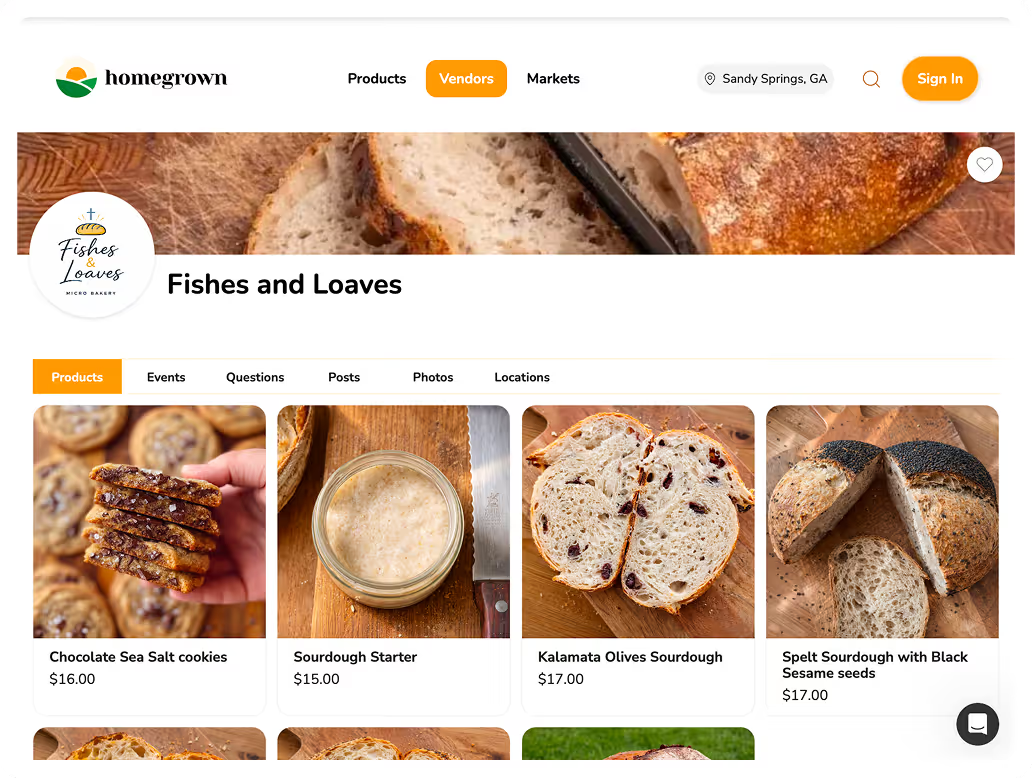
If you take orders through a platform like Homegrown, confirmations go out automatically the moment a customer places an order. The customer gets an email with their order details, pickup time, and payment information — and you don't have to do anything. This is the most reliable option because it removes human error from the process entirely.
Automated confirmations also create a paper trail without extra effort. Every order has a timestamp, a record of what was ordered, and confirmation that the customer acknowledged the details.
If you're still taking orders by hand, a quick text is the next best option. Most customers check texts faster than email, and a short message takes under a minute to send. Keep a template saved in your phone's notes so you don't have to compose one from scratch each time.
A simple structure works fine: confirm the order, confirm the pickup time, confirm the amount owed, and include your number. Send it within an hour of receiving the order — the longer you wait, the more anxious the customer gets.
Email works well for customers who prefer a written record or for larger custom orders where you need to document a lot of detail. The downside is that email is slower and easier to miss. If you go the email route, keep your subject line clear: "Your [business name] order is confirmed" is better than "Hi!" because it's immediately identifiable.
Your confirmation message should be warm and specific, not generic. It should sound like it came from a person, not a form letter — but it should still cover all the essential details clearly.
The tone goal: friendly enough that the customer feels good about their order, professional enough that they trust you'll follow through.
Here's a template that works well for standard orders:
> Hi [Name]! Your order is confirmed: [product and quantity] for pickup on [date] between [time window] at [location]. Total: $[amount] — [paid in full / balance of $X due at pickup]. Any changes? Reach me at this number. Looking forward to it!
Keep it under 200 words. Customers don't need a novel — they need confirmation that you have their order right and know what to do with it.
For email confirmations, a slightly longer format makes sense:
> Subject: Your [Business Name] order is confirmed — pickup [date] > > Hi [Name], > > Thanks for your order! Here's a summary of what I have for you: > > - Order: [product name, quantity, any custom details] > - Pickup: [date], [time window], [location or address] > - Payment: $[total] — [paid / deposit of $X received, balance of $X due at pickup] > > If anything looks off or you need to make a change, reply to this email or text me at [phone number] by [cutoff date/time]. > > My cancellation policy: [X days notice required / deposits are non-refundable / etc.] > > Can't wait for you to try it — see you [day]! > > [Your name] > [Business name]
This format gives customers everything they need to verify their order and know how to reach you. It's also easy to scan — no one reads long paragraphs in a confirmation email.
Yes. Send a reminder 24 hours before pickup. A single confirmation message at the time of ordering is not enough — people forget, schedules change, and a reminder is the difference between a customer who shows up and one who doesn't.
Your reminder doesn't need to be long. Something like:
> Just a reminder — your [product] order is ready for pickup tomorrow, [date], between [time] at [location]. Total due at pickup: $[amount]. See you then! Questions? Text me at [number].
That's it. Short, specific, actionable. If the customer needs to cancel or reschedule, this gives them one last chance to let you know before you're standing at the farmers market with their order and they're nowhere to be found.
For orders that require significant prep time — custom cakes, large batches, made-to-order items — consider sending a second reminder three to four days out as well. This gives both of you time to catch any last-minute issues before the work is already done.
Some vendors also add a brief satisfaction note to the reminder: "If you have any questions about your order before pickup, today is the best day to reach me." This signals that you're responsive and gives anxious customers a natural window to check in.
If you're running a pre-order system with a cutoff date, your reminder schedule might look like this:
Standard orders need a basic confirmation. Custom orders need a detailed one — with the full scope of the work documented and agreed to before you start.
For standard products — a dozen cookies, a loaf of bread, a jar of jam — a short confirmation with the product, quantity, pickup time, and payment info is all you need. You make the same thing every week, so there's not much to clarify.
Custom orders are a different situation. When a customer orders a tiered birthday cake with specific flavors, colors, and decorations, there's real risk in starting work without a confirmed written record. A good custom order confirmation should include:
The goal is that both you and the customer are reading from the same document. If a dispute comes up later — "I asked for vanilla, not chocolate" — your confirmation is your record.
Setting clear expectations for custom orders upfront is covered in detail in the custom order expectations guide, which goes deeper on how to scope and price custom work.
For vendors who take recurring orders, the confirmation process works a bit differently. Check out the recurring orders guide for how to structure standing confirmations without having to send a fresh message every single week.
Avoid starting any custom work based on a verbal or unconfirmed order. Even if the customer seems trustworthy, people's memories of what they asked for are notoriously unreliable. One missed detail on a custom cake can cost you hours of work and real money in ingredients — and leave a customer disappointed.
A quick "here's what I have for your order — does this look right?" message costs nothing. Starting a full custom order without that confirmation can cost a lot.
If you use order cutoff times to manage your workflow — which most vendors who take custom orders should — see the order cutoff times guide for how to communicate those limits clearly.
The right tools eliminate the need to manually track and send every confirmation. Here are the options cottage food vendors commonly use:
Automated storefront (best option)
Text message templates (backup option)
Email templates (good for custom orders)
Spreadsheet tracking (supplement, not replacement)
According to Cornell Small Farms, direct-to-consumer food businesses that use systematic communication tools — including confirmation workflows — have significantly fewer order disputes and better customer retention than those relying on informal communication. Building the habit early, before your volume grows, is far easier than retrofitting a system later.
Getting started: If you're not yet set up with an automated system, build a text template this week and send it for every order you take. Once you've confirmed 10 orders that way, you'll feel the difference immediately — and you'll understand why automation is worth it.
Every option above — text templates, email templates, spreadsheet tracking — requires you to remember, type, and send something for every order. At five orders a week, that is manageable. At fifteen, it becomes the task you dread most about running your business.
Homegrown is $10/month with no percentage fees. When a customer orders through your page, they see exactly what they are getting, pay at checkout, and receive an automatic confirmation with their order details, pickup time, and payment status. You do not send anything. The confirmation goes out the moment payment clears.
Square Online automates confirmations too, but charges 2.9% plus 30 cents per transaction — on $800 in monthly orders, that is over $25 in fees for the same automation Homegrown includes in a flat $10. Etsy sends buyer confirmations, but it takes 6.5% of every sale and the confirmation comes from Etsy's brand, not yours — your customer's experience is with a marketplace, not with your bakery.
Homegrown does not handle verbal orders taken at your booth or replace the personal follow-up you send for complex custom work — a tiered birthday cake still deserves your own message. But for every standard pre-order where the confirmation is the same six details in the same format, the platform handles it faster and more reliably than you can.
Ready to start selling locally? The easiest way to take local orders and get paid is an online storefront — see the best platform to sell food from home, or set up a Homegrown storefront in about 15 minutes ($10/mo, 0% commission).
Send your order confirmation within one hour of receiving the order — ideally within minutes. Customers who order online expect near-instant confirmation. If you're taking orders manually at the farmers market or through text, aim to confirm before the end of the day. The faster you confirm, the more professional your order confirmation process feels and the less likely customers are to follow up wondering if their order was received.
Catch it as soon as possible and send a corrected message. A simple "Just a correction on your order confirmation — the pickup time is 10am–12pm, not 11am–1pm. Sorry for the confusion!" is all it takes. Most customers appreciate the quick fix. The bigger risk is noticing the mistake at pickup time, which is much harder to recover from.
Confirm every order, not just custom ones. A quick text for a standard cookie order takes 30 seconds and prevents a customer from showing up on the wrong day or forgetting entirely. The confirmation habit matters most at scale — once you're taking 20+ orders a week, a single no-show or miscommunication eats into your time significantly. An order confirmation process that covers all orders is worth building from the start.
Keep it simple and specific. State how much notice you need (most cottage food vendors require 48–72 hours) and what happens if the customer cancels within that window (no refund, store credit, or partial refund depending on your policy). For custom orders, note whether deposits are refundable. You don't need legal language — plain English is fine. The goal is that the customer reads it, understands it, and can't say later that they weren't warned.
Batch your confirmations if you need to. If orders come in overnight or while you're busy, set aside 15 minutes each morning to confirm everything from the previous 12–24 hours. If you're using an automated storefront, this happens instantly without any effort on your part. For vendors still working manually, a daily confirmation window is more sustainable than trying to respond to each order the moment it comes in.
Yes, especially for custom orders or products that contain common allergens (nuts, dairy, gluten). If a customer requested an allergen accommodation, call it out explicitly in the confirmation: "Your order is confirmed as dairy-free — made with oat milk." This protects you legally and gives the customer confidence that you heard them correctly. Including allergen information in your order confirmation process also gives you a written record if any questions come up later.
Yes, a template is the right approach — but customize the order details for each customer. The structure stays the same (order summary, pickup time, payment status, contact info, cancellation policy), but the specifics change for every order. A template saves you time without making the message feel impersonal. The customer's name and their exact order in the confirmation is what makes it feel personal, not a custom-written message from scratch each time.
Ready to automate your order confirmation process and spend less time sending messages? Homegrown handles confirmations, reminders, and order tracking automatically so you can focus on what you actually want to be doing — baking.