

You sell out at the farmers market every Saturday. Your sourdough, your hot sauce, your granola — people line up for it. But you are capped at what you can sell in four hours at one booth. Meanwhile, the coffee shop down the street buys granola from a distributor, and the brunch spot two blocks away serves hot sauce from a brand nobody has heard of. Those could be your products on their shelves and menus.
Restaurants and cafes buy from local vendors all the time. But most small food vendors never ask. The gap is not your product. The gap is that you have never walked into a restaurant with samples and a price sheet.
Here is how to start selling your food to local restaurants and cafes, step by step.
---
Short version: Restaurants want unique, local products they cannot get from their regular distributor. Start by identifying 5-10 independent restaurants that fit your product, set your wholesale pricing at 40-50% below retail, schedule a short meeting with the chef or owner, bring samples and a price sheet, and follow up consistently. One reliable restaurant account can generate as much revenue as a full market day with less time, less setup, and more predictable income.
---
About 80 percent of independent restaurants actively seek local vendors for at least some of their ingredients and menu products, according to the National Restaurant Association. You might think restaurants only buy from big distributors. Many do. But independent restaurants, cafes, and brunch spots are constantly looking for products that set their menu apart from every other place in town. Local ingredients are one of the easiest ways they do that.
This is not a niche trend. 65% of consumers prefer local restaurants over chains, and restaurant owners know it. They also know their customers are willing to pay for it. According to a survey by Unilever Food Solutions, 77% of Gen Z diners and 70% of Baby Boomers are willing to pay more for dishes with locally sourced ingredients.
Chefs want products they cannot get from Sysco or US Foods. Your handmade hot sauce, your sourdough, your small-batch granola — these are exactly the kind of products that give a restaurant a reason to put "locally sourced" on their menu. And your market reputation is proof of demand. If customers line up for your product at the booth, a restaurant owner will take that seriously.
The best restaurant targets are independently owned, use the words "local" or "farm-to-table" on their menu, and are within 15 minutes of your kitchen. Not every restaurant is a good target. You want independent restaurants, cafes, bakeries, and brunch spots — places where the owner or chef makes purchasing decisions on the spot, not a corporate office three states away.
Start by looking at restaurants within a 30-minute drive of where you produce. You need to be able to deliver reliably, and long drives eat into your margins.
Look at their menus online before you reach out. You are looking for clues that they already care about local sourcing. Do they mention "farm to table" or "locally made"? Do they serve homemade sauces, house-baked bread, or locally roasted coffee? If they already feature products like yours, they are a natural fit.
Good targets include coffee shops that sell pastries or baked goods at the counter, brunch spots that go through sauces and preserves, farm-to-table restaurants that highlight where their ingredients come from, and specialty food shops or delis that carry local products.
Skip chain restaurants. They have corporate purchasing contracts and will not buy from a local vendor no matter how good your product is.
Start with a list of 5-10 restaurants. You do not need 50 accounts. You need a few good ones.
Before you walk into any restaurant, you need to know your wholesale price. Wholesale is not what you charge at the farmers market. Restaurant wholesale is typically 40-50% below your retail price.
If you sell a jar of jam for $12 at the market, your wholesale price to a restaurant might be $6-7. If you sell a loaf of sourdough for $8, wholesale might be $4-5.
You make less per unit, but you sell in higher volume with far less time spent selling. No booth setup, no standing in the sun for four hours, no packing and unpacking your car. You drop off a box of product and pick up a check.
The math has to work for both sides. The restaurant needs to mark up your product to cover their costs and make a profit. If your wholesale price is too high, they cannot use it. If it is too low, you lose money.
For detailed guidance on setting wholesale prices that work, read our guide on how to set wholesale prices for your food products. For a broader look at pricing across different sales channels, check out how to price food for farmers market, wholesale, and online.
Have a simple one-page price sheet ready before you reach out to anyone. List your products, sizes, and wholesale prices. Keep it clean and professional. This is what you will leave behind after your meeting.
Walk in between 2 PM and 4 PM on a Tuesday or Wednesday with samples and a one-page price sheet — that is how most successful vendor-restaurant relationships start. Do not cold-call a restaurant during lunch rush. Do not show up unannounced during dinner service. Chefs and owners are busy, and interrupting them during their busiest hours is the fastest way to get a no.
Instead, call or email the restaurant to schedule a short meeting. Ask for 10 minutes with the chef or the owner. Tell them you are a local food vendor and you would like to bring some samples. Most independent restaurant owners will say yes to a quick meeting, especially if you mention you sell at a local farmers market.
When you show up, bring three things: samples, your price sheet, and your story.
Samples are the most important. Chefs make decisions with their mouths, not with brochures. If your product is good, the sample does all the selling for you. Bring enough that the chef can taste it properly, not a tiny sliver.
Your price sheet shows them you are serious and organized. It tells them exactly what you offer, in what quantities, and at what price.
Your story is what makes you different from a distributor. You are not a faceless supplier. You are a local vendor who makes this product by hand, sells at the Saturday market, and has customers who drive across town to buy it. That story has value to a restaurant that wants to tell their customers where their food comes from.
Keep the pitch short. Something like: "I make sourdough locally and sell at the downtown farmers market every Saturday. I sell out every week. I brought some samples — would you be open to trying them and seeing if they would work for your menu?"
Then stop talking and let them taste.
If a chef likes your product and wants to move forward, you need to sort out the logistics before the first delivery. These details matter because they are what keep the account running smoothly.
Delivery schedule. How often will you deliver, and on what day? Most restaurants want weekly deliveries on the same day. Pick a day that works for your production schedule and stick to it.
Minimum order. What is the smallest order you can deliver without losing money on the drive? If it costs you $15 in gas and an hour of your time to deliver, a $20 order is not worth it. Set a reasonable minimum — something like $50-75 — and communicate it upfront.
Payment terms. Restaurants typically pay on net 15 or net 30, meaning they pay you 15 or 30 days after delivery. This is standard in the restaurant industry. Do not expect payment on delivery unless you negotiate it. Make sure you send a proper invoice with each delivery.
Labeling and food safety. Make sure your products have proper labels with ingredients, allergens, and your business name. If the restaurant asks for proof of food safety certification or a commercial kitchen license, you need to have it. Some states allow cottage food vendors to sell wholesale to restaurants. Others require a commercial kitchen. Check your state's rules before you start.
If selling to restaurants pushes you past your cottage food production limits, you may need to move into a commercial kitchen. Read When to Move From Your Home Kitchen to a Commercial Kitchen to figure out if that is the right move.
Restaurant accounts that last more than 6 months typically generate $200 to $500 per month in steady wholesale revenue. Getting the first order is the hard part. Keeping the account is about consistency.
Restaurants need to know you will show up on time, every time, with the same quality product. If you deliver sourdough on Tuesdays, you deliver sourdough on Tuesdays. If you promise 20 loaves, you bring 20 loaves. If something goes wrong — you are short on product, you need to change the delivery day — communicate it early. Do not surprise a chef who planned their menu around your product.
After the first few deliveries, check in with the chef. Ask how the product is working. Is it selling? Do they need a different size, a different flavor, or a different quantity? This kind of follow-up builds the relationship and shows you care about more than just dropping off product.
If a product sells well, the chef will reorder without you having to ask. If it does not sell, ask for honest feedback. Maybe the portion size is wrong for their menu. Maybe the price point is too high for their customer. Adjust and try again.
One reliable restaurant account can equal a full market day of revenue. Two or three accounts can replace a market entirely. And unlike a market booth, restaurant accounts generate predictable, recurring income that you can plan your production around.
Restaurant accounts pay net 30. Sometimes net 45. Your rent does not wait that long. The vendors who grow wholesale successfully keep their direct-to-consumer sales running at the same time — market regulars, online pre-orders, repeat buyers who pay upfront every week. That cash flow covers your ingredient costs while you wait for restaurant checks to clear.
The challenge is managing both without doubling your admin work. Restaurant ordering runs on invoices, delivery schedules, and phone calls with kitchen managers. Retail ordering should not. If your market customers are still texting you orders and paying through Venmo, you are running two manual systems instead of one.
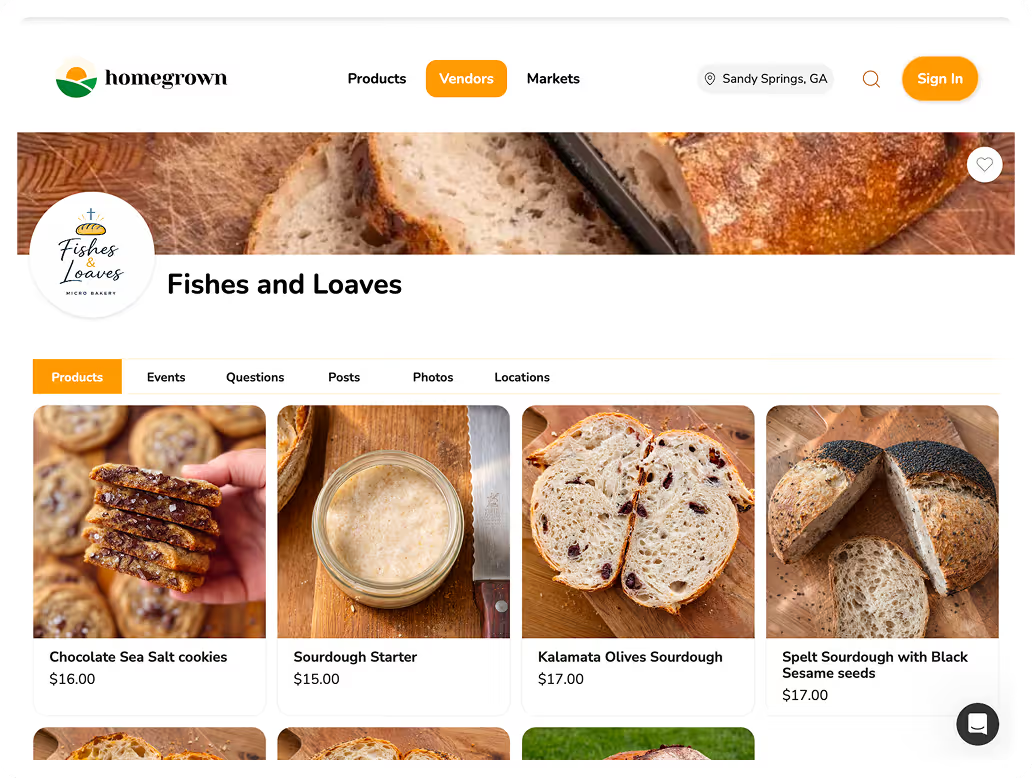
A dedicated ordering page handles the retail side without your involvement. Homegrown is $10/month — customers see your weekly product list, place an order, and pay online. You get a production summary sorted by pickup date. It does not handle wholesale invoicing, restaurant delivery schedules, or net-30 payment terms — that side of the business still runs on your price sheet and a handshake. But for the retail customers who keep your cash flow steady between restaurant payments, it removes the texting and Venmo juggle entirely.
Not every product works for every restaurant. Here is what tends to sell well and where.
Baked goods — bread, pastries, cookies, and muffins sell well to cafes and coffee shops. These are products the cafe would otherwise have to bake in-house or buy from a generic bakery distributor. Your locally made version gives them a selling point.
Sauces, dressings, and condiments — hot sauce, barbecue sauce, salad dressings, and specialty condiments sell to restaurants that want a local angle on their menu. If your hot sauce is already popular at the market, a restaurant can put "made with locally crafted hot sauce" on their menu.
Jams, preserves, and honey — brunch spots, charcuterie-focused restaurants, and specialty food shops use these regularly. Your product replaces a generic brand with something they can tell a story about.
Specialty produce — microgreens, fresh herbs, heirloom tomatoes, and edible flowers are in constant demand from farm-to-table restaurants. If you grow specialty produce, restaurants are one of your best sales channels.
Prepared items — granola, energy bars, trail mix, and snack mixes sell to cafes and shops with a retail counter. These are grab-and-go items that cafes mark up and sell alongside coffee.
The common thread is offering something the restaurant cannot easily make in-house or source from their regular distributor. If Sysco sells a version of your product, you need to compete on quality, uniqueness, or story — not price.
Start with 5-10. You do not need dozens of accounts to make restaurant sales worthwhile. Five restaurants ordering weekly can generate significant revenue. Start small, prove you can deliver consistently, and add new accounts as you build capacity. Taking on too many accounts before you have the production capacity to support them is worse than having too few.
Most will. That is normal. A no usually means the timing is wrong, not that your product is bad. The chef might already have a supplier for that product, or they might not have room in their budget right now. Leave your samples and your price sheet. Follow up in a month. Restaurants change suppliers more often than you think, and the vendor who follows up politely is the one who gets the call when a spot opens up.
In most states, yes. Selling wholesale to restaurants typically requires more than a cottage food permit. You may need a food handler's certificate, a business license, liability insurance, and potentially a commercial kitchen. The requirements vary by state, so check your state's cottage food laws and department of agriculture website. Some states like California, Maine, and New York allow cottage food vendors to sell wholesale. Others do not.
Late payment is common in the restaurant industry. Net 30 sometimes becomes net 45 or net 60. Start by sending invoices promptly with each delivery and including clear payment terms. If a restaurant is consistently late, have a direct conversation with the owner. Be professional but firm. If the problem continues, you may need to switch to payment-on-delivery terms or stop supplying that account. One late-paying restaurant is not worth the cash flow stress.
Yes. Samples are the most effective selling tool when pitching to restaurants and cafes. Chefs make purchasing decisions based on taste, not marketing materials. Bring enough for the chef to taste properly — not a tiny sliver. The cost of a few samples is negligible compared to the value of landing a recurring wholesale account that could generate hundreds of dollars per month.
It depends on your state. Some states allow cottage food vendors to sell wholesale to restaurants, while others require a commercial kitchen for wholesale sales. Check your state's cottage food laws and department of agriculture guidelines before approaching any restaurant. If your state requires a commercial kitchen, shared-use kitchen spaces are available in most metro areas and let you meet the requirement without building your own facility.
A single reliable restaurant account can generate $200 to $1,000 or more per month depending on the product and order frequency. A coffee shop ordering three dozen muffins twice a week at wholesale prices adds up quickly. Two or three steady accounts can match or exceed a full day of farmers market sales with less time spent selling and more predictable income.
Selling to restaurants is one of the best ways to grow beyond the farmers market. One account with a good chef who reorders weekly can change your production schedule, your income, and your confidence that this business is real.