

Most food vendors know reviews matter. But when you are standing at your booth on a Saturday morning, it feels awkward to look a customer in the eye and say, "Hey, would you mind leaving me a Google review?" So you don't ask. And your Google listing sits there with zero reviews while you rely entirely on word of mouth.
Here is the thing: people are happy to leave reviews. They just need you to ask. And there are ways to ask that feel natural, not pushy.
This guide gives you everything you need — what to say, when to ask, where your reviews should live, and how to turn those testimonials into marketing material that brings in new customers.
Here is what you need to know: Reviews are one of the most powerful free marketing tools for food vendors. Ask customers in person right after they compliment your product, make it easy with a direct Google review link or QR code at your booth, and follow up with a simple text or email after purchase. Use the testimonials you collect in your social media posts, booth signage, and website to attract new customers who have never tried your food.
The short version: The easiest way to get reviews as a food vendor is to ask at the moment of delight — right after a customer says they love your product — and make it one tap with a QR code or the direct Google review link. Ask consistently, respond to every review, and a steady trickle will build your reputation faster than you'd expect.
You might think reviews only matter for restaurants and online stores. But if you sell at farmers markets, take custom orders, or sell online through your own page, reviews can be the difference between a stranger trying your product or walking past your booth.
When someone hears about your jam or bread from a friend, the first thing they do is look you up online. If they find a Google listing or Facebook page with positive reviews, they are far more likely to seek you out at the market. According to BrightLocal's Local Consumer Review Survey, 97% of consumers read reviews for local businesses when making decisions, and 85% are more likely to use a business after reading positive reviews. That trust is built before a customer ever tastes your product.
Google uses reviews as a ranking factor. The more reviews your business has, the more likely it is to show up when someone searches "homemade bread near me" or "best jam at farmers market." If you have set up a Google Business Profile, reviews are what make that listing stand out from the rest.
A customer who writes "Best sourdough I have ever had — I drive 30 minutes every Saturday to get it" just gave you a better advertisement than anything you could write yourself. That quote can go on your booth sign, your Instagram, your website, and your email newsletter. Reviews are free content that does the selling for you.
Not all review platforms are created equal for food vendors. Here is where to focus your energy.
This is the most important place for reviews if you want new customers to find you through search. When someone types "homemade food near me" into Google, your Business Profile is what shows up — and the star rating is the first thing they see. Even if you sell from home or only at markets, you can set up a Google Business Profile for your food business.
Many food vendors already have a Facebook page. Facebook reviews (now called "Recommendations") show up when people visit your page, and they are easy for customers to leave. If most of your customers find you through Facebook, this is a good place to build reviews.
Instagram does not have a formal review system, but you can screenshot positive DMs, comments, and texts from customers and share them as posts or stories. This is actually one of the most effective ways to show social proof because people are already scrolling Instagram.
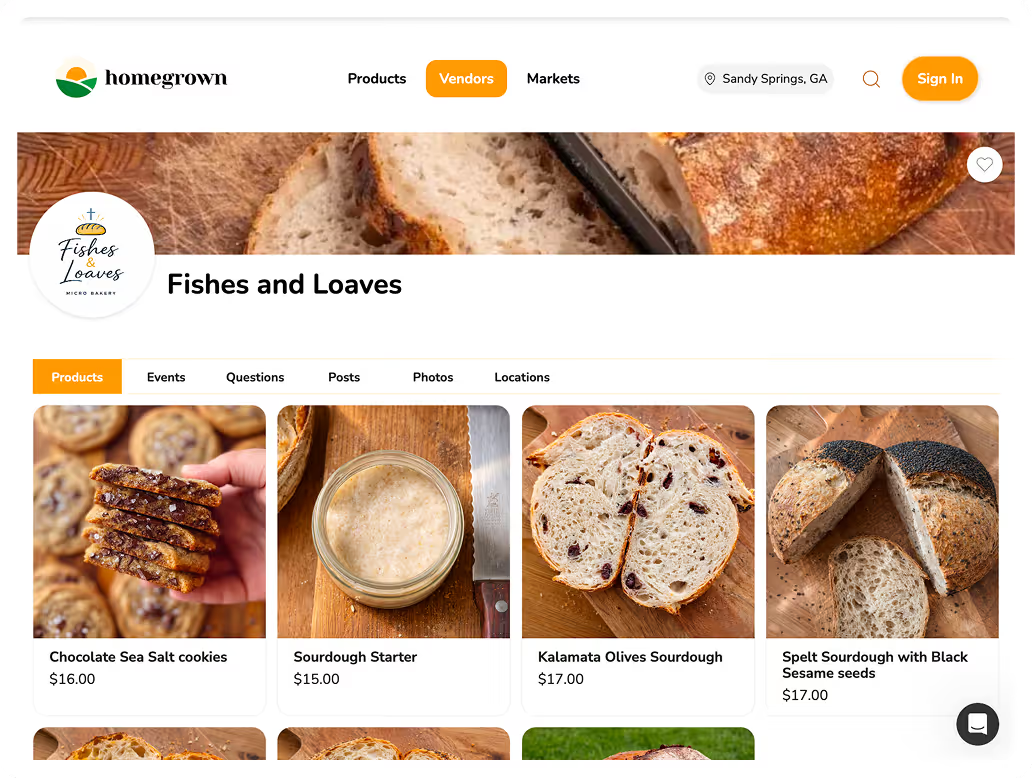
If you have an ordering page, adding a few customer quotes builds credibility. Visitors who land on your page for the first time are much more likely to place an order if they see that other people love your food. Homegrown is $10/month with no percentage fees beyond standard payment processing and gives you a storefront where you can display your best testimonials right next to your product listings — so a new visitor reads the review and places an order in the same visit. Compare that to Etsy, where reviews live on a separate tab customers may never click, or a standalone website builder like Squarespace where you are paying $16 to $33/month and still building everything from scratch. Homegrown does not collect reviews for you — it gives those reviews a home where they actually influence purchase decisions. Customers order for pickup or local delivery, whichever they prefer.
Timing matters. Ask at the wrong moment and it feels forced. Ask at the right moment and customers are happy to help.
This is the easiest and most natural time to ask. When a customer says, "This is the best jam I have ever had," that is your opening. You do not have to manufacture the moment — the customer already gave it to you.
Repeat customers are your best source of reviews. They already like your product enough to come back. When you recognize someone at your booth, acknowledge them: "Hey, welcome back. You came for the sourdough again?" That exchange naturally leads into an ask.
If someone places a custom cake order or buys a dozen jars for holiday gifts and tells you everything was perfect, that is the ideal time to ask. The customer is already expressing satisfaction.
If you have built relationships with regulars over a full season, the end of the market year is a good time to ask. A simple message like "It has been a great season — if you have enjoyed my products, a quick Google review would mean a lot" feels genuine because the relationship is real.
The reason most vendors never ask for reviews is that they do not know what to say. Here are scripts you can use word for word.
After a compliment: "Thank you so much — that means a lot. If you have a minute, I would really appreciate it if you left a quick Google review. It helps other people find me at the market."
For a repeat customer: "You are one of my favorite regulars. If you have not already, a quick review on Google or Facebook would really help my business. I have a QR code right here that takes you straight to the page."
Keep it casual. You are not asking for a favor. You are pointing them to something they would be happy to do.
If you have a customer's phone number from an order, a follow-up text works well:
"Hi [Name], thanks for your order! If you enjoyed the [product], I would love a quick Google review — it really helps my small business. Here is the link: [link]. Thank you!"
Keep it to two or three sentences. Do not write a paragraph. If you are already building a customer email list, you probably have contact information for your best customers.
For email, keep the same casual tone:
"Hi [Name], I hope you are enjoying the [product]. If you have a minute, a quick Google review would mean a lot to my business. It helps new customers find me. Just click here: [link]. Thank you for your support!"
Post on Instagram or Facebook once a month with something like: "If you have tried my [product] and loved it, a quick Google review would mean the world to me. Link in bio."
Do not overdo social media asks. Once a month is enough. The rest of the time, let your product photos and customer testimonials do the talking.
The number one reason people do not leave reviews is that it is too much work. Remove every barrier you can.
Google lets you create a short link that takes customers directly to the review form — no searching, no clicking through menus. Search "Google review link generator" and follow the steps. Save that link everywhere.
Print a small sign with a QR code that links directly to your Google review page. Set it on your table at the market. Customers can scan it with their phone while they are standing right there. A sign that says "Love our [product]? Leave us a review!" with a QR code is simple and effective.
Whether you follow up by text, email, or a printed card in their bag, always include the direct link. Do not tell people to "find us on Google and leave a review." Give them the exact link. Every extra step you add loses customers.
Getting reviews is only half the job. The other half is using them to attract new customers.
Screenshot a great Google review or a kind text message from a customer and post it on Instagram or Facebook. Add text like "This made my day" or "This is why I love what I do." These posts consistently get high engagement because they are authentic. According to research from DemandSage, 93% of consumers read online reviews before making a purchase, so putting reviews where people can see them matters.
Print one or two of your best customer quotes on a small sign for your booth. "Best sourdough at the market — Sarah T." next to your bread display is more persuasive than any description you could write yourself.
Add a "What Our Customers Say" section to your website or ordering page. Three to five short quotes with first names is enough. Visitors who are on the fence about ordering will be nudged by seeing that other people have already tried and loved your food.
When you send emails to your customer list, drop in a testimonial once in a while. "Here is what [Name] said about our new honey lavender jam:" followed by the quote. It reminds your list why they signed up and nudges them to place another order. This pairs perfectly with the strategies in our guide on how to get your first 100 customers.
Negative reviews happen. Even the best food vendors get them. How you respond matters more than the review itself.
A negative review with no response looks worse than the review itself. Respond within 24-48 hours with a calm, professional message: "I am sorry to hear about your experience. I would love to make it right — please send me a message so we can talk about it." Other potential customers reading the exchange will see that you care.
Do not argue in public. After your initial response, move the conversation to a private message, email, or phone call. Resolve the issue one-on-one.
If multiple customers mention the same issue — product was stale, packaging leaked, order was wrong — that is valuable feedback. Fix the problem. Then respond to the review letting the customer know you made changes based on their feedback.
A few common mistakes can undermine your review strategy.
Offering a free cookie in exchange for a five-star review violates Google's guidelines and can get your reviews removed. It also makes the reviews feel fake to anyone reading them. Ask genuinely. If your product is good, people will leave honest, positive reviews without a bribe.
If your "review request" requires customers to create an account, navigate three screens, or download an app, they will give up. One link, one click, done. That is the goal.
When someone takes the time to leave a review, respond. A simple "Thank you so much — this made my day!" shows you appreciate your customers. It also signals to future reviewers that their effort will be noticed. Engaging with reviews is one of the simplest ways to keep repeat customers coming back.
Do I need a Google Business Profile to get reviews?
You do not strictly need one, but it is the single most valuable place for reviews if you want new customers to find you through search. Setting up a Google Business Profile is free and takes about 15 minutes. Even home-based food businesses and market-only vendors can create one using a service area instead of a physical address.
How many reviews do I need before they make a difference?
Even five to ten reviews make a noticeable difference. Research shows that 47% of consumers will not use a business with fewer than 20 reviews, but for a small local food vendor, even a handful of genuine reviews sets you apart from competitors with zero. Focus on getting your first ten, then keep building.
Should I offer discounts in exchange for reviews?
No. Offering incentives for reviews violates Google's guidelines and can result in your reviews being removed. It also makes your reviews look fake to potential customers. Ask genuinely and let the quality of your product speak for itself.
What do I do if someone leaves a negative review?
Respond quickly and calmly. Thank them for their feedback, apologize for their experience, and offer to make it right privately. Do not argue or get defensive. Other potential customers will read your response, and a professional reply actually builds more trust than the negative review takes away.
Can I use customer testimonials in my marketing without permission?
For public reviews (Google, Facebook), you can generally share them since the customer posted them publicly. For private messages, texts, or emails, always ask permission before using them in your marketing. A quick "Hey, I loved what you said about the jam — would it be okay if I shared it on my Instagram?" is all you need.
How do I get reviews if I only sell at farmers markets?
Ask in person at your booth and make it easy with a QR code that links directly to your Google review page. Follow up by text or email if you have their contact information. You can also ask satisfied customers if you can take a quick photo or video of them with your product for social media — that is a form of testimonial too.
What is the best way to ask for a review without being pushy?
Wait for a natural moment — a compliment, a repeat visit, or a successful order. Then use a casual ask: "If you have a minute, a quick Google review would really help my business." Keep it short, genuine, and low-pressure. Most customers are happy to help when they know how much it matters to a small business.