

You have a product people already want to buy. Maybe it is your sourdough, your grandmother's jam, a hot sauce your friends keep begging you to bottle, or cookies that disappear within minutes at every potluck. The leap from "people love this" to "people pay for this" is shorter than you think.
A cottage food business lets you sell homemade food products directly to customers without renting a commercial kitchen, hiring staff, or investing thousands of dollars upfront. Every state in the U.S. has some version of a cottage food law that makes this possible. And thousands of home vendors are already doing it, many of them part-time, earning real income from products they make in their own kitchens.
This guide covers everything you need to know to start a cottage food business, from the legal basics through your first sale and beyond. It is designed as a starting point that connects to deeper guides on every topic, so you can go as deep as you need on the areas that matter most to your situation.
The short version: You can launch a cottage food business in most states for under $300 by confirming your state's cottage food law allows your product, creating a compliant label, pricing at 3-4x your ingredient cost, and selling at a farmers market or through local pickup. You do not need a commercial kitchen, an LLC, or a website to get started. The biggest mistake new vendors make is over-investing in setup before making a single sale. Get legal, get labeled, get selling.
A cottage food business is a home-based food business that operates under your state's cottage food law, which allows you to make and sell certain food products from your home kitchen without a commercial license. The term "cottage food" specifically refers to this legal framework, not just any food made at home.
Every state has its own version of cottage food legislation, and the details vary significantly. Some states are very permissive, allowing dozens of product categories with high or no revenue caps. Others are more restrictive, limiting what you can sell, where you can sell it, and how much you can earn.
> The defining feature of cottage food is simplicity. You use your own kitchen, sell directly to your customers, and operate under a streamlined set of rules designed for small-scale vendors.
What makes cottage food different from other food business models:
Cottage food is not a lesser version of a "real" food business. It is a legitimate, legal business model that thousands of vendors use to earn meaningful income. Some stay at cottage food scale permanently. Others use it as a proving ground before moving to a commercial kitchen.
For a deeper look at the legal landscape, the guide to cottage food laws by state breaks down every state's rules.
Most cottage food laws allow shelf-stable, non-potentially-hazardous foods. That means products that are safe at room temperature and do not require refrigeration. The specific list varies by state, but there is a large core of products that are permitted almost everywhere.
Products allowed in nearly every state:
Products allowed in many but not all states:
Products that are almost never allowed under cottage food:
Some states have expanded beyond traditional cottage food through MEHKO (Microenterprise Home Kitchen Operation) laws, which allow a wider range of products including some that require refrigeration. California's AB 626 is the most well-known example.
> Before you invest a dollar or an hour into your business, verify that your specific product is legal in your specific state. The guide to what foods you can sell under cottage food laws walks through the categories in detail.
For product inspiration, food business ideas from home covers dozens of options organized by product type and difficulty level. And if you are looking at beverages, selling kombucha from home and selling coffee from home each have their own legal considerations worth reviewing.
Starting a cottage food business comes down to a clear sequence of steps. The order matters because each step builds on the one before it. Here is the path from idea to first sale.
Your state's law determines what you can sell, where you can sell it, and how much you can earn. This is not a step you can skip or approximate. The specifics matter.
What to confirm:
The complete breakdown of cottage food laws by state covers all of these variables for every state. You can also check whether you need a cottage food permit or a business license to sell food from home.
The best cottage food product sits at the intersection of four things: legally permitted, shelf-stable and consistent, producible at reasonable volume, and something people actually want to buy.
For a full breakdown of how to approach this decision, how to start a cottage food business walks through product selection in detail.
Most cottage food businesses require very little legal setup, but getting the basics right from day one saves you headaches later.
Every cottage food product needs a label before you sell it. This is the most common compliance mistake new vendors make, and it is also one of the easiest things to get right with a little preparation.
Standard label elements required in most states:
> Getting your label right before your first sale is not optional. It protects your customers, keeps you legal, and builds trust with buyers who read labels carefully.
The complete guide to cottage food labeling rules covers every element in detail, including state-specific disclosure language. The FDA's food safety framework provides additional context on labeling standards, though cottage food businesses are generally exempt from federal FDA requirements.
Your home kitchen is your production facility. You do not need commercial equipment or a separate production room. What you need is a clean, organized workspace and a repeatable process.
You do not need a 30-page formal business plan. You need a one-page document that answers the key questions: what are you selling, who is buying it, where are you selling it, what does it cost to make, what are you charging, and how much do you expect to sell per month?
This exercise forces you to think through the numbers before you invest in inventory. The guide to writing a food business plan for cottage food walks through a simple framework designed for home vendors, not MBA students.
This is the step that matters most, and it is where many aspiring vendors stall. Your goal should be to reach your first sale as quickly as possible, even if everything is not perfect yet.
Your first sale options:
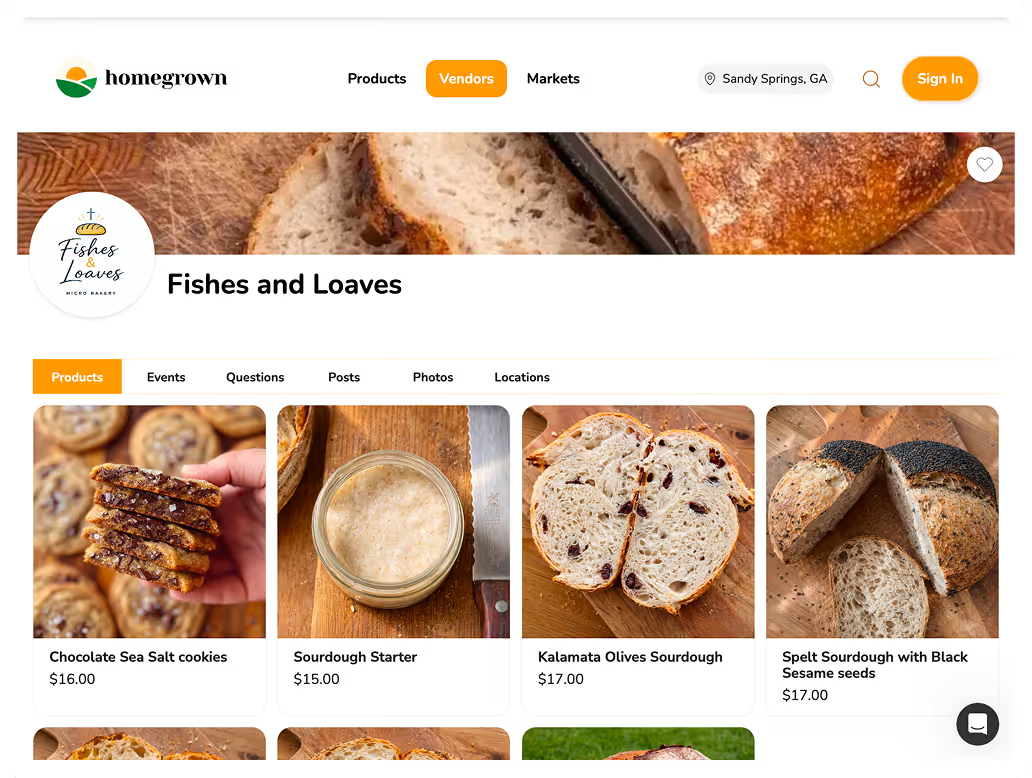
Once you start getting orders from people outside your immediate circle, you need one place where anyone can see what you sell, place an order, and pay — without you managing it through texts. Instagram and Venmo work when your sister's coworker wants two jars of jam, but they fall apart when six people are texting you orders on the same Wednesday night. Facebook Marketplace is designed for selling used furniture, not taking weekly food pre-orders. Etsy takes 6.5% of every sale and is built for shipping — most cottage food customers live nearby and want local pickup. Homegrown is $10/month — list your products with photos and prices, share the link, and customers order and pay in one step. It does not replace a full commercial website or handle wholesale distribution — but for a new cottage food vendor who needs ordering without the overhead, you can set it up in an afternoon.
Most cottage food businesses can launch for $100 to $500. That is not a typo. Because you are using your own kitchen and selling directly to customers, the typical startup costs that sink other food businesses simply do not apply to you.
| Expense | Typical Cost | Notes |
|---|---|---|
| First batch of ingredients | $30-$75 | Enough for 20-50 units depending on product |
| Packaging and containers | $25-$75 | Jars, bags, boxes, or clamshells |
| Labels | $15-$40 | Printed labels or a label printer |
| Farmers market booth fee | $20-$75/week | Varies widely by market |
| Permit or registration | $0-$75 | Many states charge nothing |
| Food safety course | $0-$25 | Required in some states, often free online |
| Basic display supplies | $20-$50 | Tablecloth, signage, business cards |
| Insurance (optional) | $200-$500/year | Product liability; some markets require it |
> The biggest financial mistake new vendors make is spending money on things that do not help them make their first sale: logos, websites, fancy packaging, business cards they never hand out. Spend on ingredients, labels, and a booth fee. Everything else can wait.
For vendors starting with very limited capital, how to start a food business from home with no money walks through strategies for launching with minimal upfront investment. The SBA's guide to starting a small business also provides general resources for new business owners, including information on funding options.
Your state law determines which sales channels are available to you, and the channel you choose shapes your entire business model. Most cottage food vendors use one or two channels, not all of them.
Farmers markets are the most common starting point. They put you in front of buyers who are already looking for local, homemade food. You get immediate feedback, build relationships with repeat customers, and learn what sells. The guide to how to sell at a farmers market covers everything from applying to your first market through optimizing your booth setup.
Home pickup and local delivery are growing fast, especially since 2020. You take orders online or through social media, and customers pick up from your home or a designated location. This model works well for vendors who do not want to commit to weekly market days. How to sell food from home covers the home-based sales model in detail.
Online ordering with local fulfillment combines the reach of online sales with the direct-to-consumer requirement of cottage food law. You list your products online, customers place orders, and you fulfill through pickup or local delivery. How to sell food online walks through the platforms and strategies. Homegrown is built specifically for this model, giving you a storefront where local customers can browse your products and place orders for pickup.
Shipping is restricted or prohibited in many states under cottage food law. If your state does allow it, there are specific packaging, labeling, and product requirements to meet. Can you ship cottage food covers the rules and logistics.
> Start with one sales channel, get it working, and add others once you have a rhythm. Running a farmers market booth, a pre-order system, and a delivery route simultaneously as a brand-new vendor is a recipe for burnout, not growth.
Price your products before you produce inventory, not after. The most common pricing mistake cottage food vendors make is setting prices too low, which leads to working for less than minimum wage and training customers to expect unsustainably cheap food.
The floor price formula:
(Ingredient cost + packaging cost + labor allocation) x 3 = minimum viable price
This 3x multiplier covers your direct costs, your overhead (kitchen utilities, gas to the market, wear on equipment), and a reasonable profit margin. Some vendors use a 4x multiplier, which builds in more margin for growth.
Example: If a batch of 12 jars of jam costs $18 in ingredients and $6 in jars and labels, your cost per jar is $2.00. At a 3x multiplier, your floor price is $6.00 per jar. At 4x, it is $8.00. If similar jams at your local farmers market sell for $9-$12, you have room to price at $8-$10 and feel good about your margins.
Pricing tips for cottage food vendors:
The complete guide to how to price food products goes much deeper on pricing strategy, including how to account for your time and how to raise prices without losing customers. For data on what different products actually earn, most profitable foods to sell at farmers markets breaks down real revenue numbers by product category, and is selling at farmers markets profitable provides an honest look at the numbers.
Yes, cottage food income is taxable. The IRS considers you self-employed, which means you owe income tax and self-employment tax (15.3%) on your net profit. This catches some new vendors off guard, so plan for it from the beginning.
What you need to track from day one:
Sales tax varies by state and sometimes by product. Some states exempt cottage food from sales tax entirely. Others require you to collect and remit it. A few states tax some food products but not others. The guide to sales tax at farmers markets breaks down the rules. If you sell through DMs and Venmo, the question is the same — our guide on sales tax when selling food through DMs addresses the informal selling context specifically.
Tax deductions are a meaningful benefit of running a home food business. You can deduct ingredients, packaging, booth fees, mileage to markets, a portion of your home utilities (for the kitchen you use for production), equipment, and more. Tax deductions for home food vendors covers the deductions specific to cottage food businesses. The IRS self-employment tax center provides official guidance on filing requirements and estimated tax payments.
Bookkeeping does not need to be complicated. A simple spreadsheet tracking income and expenses by category is enough for most cottage food vendors, especially in your first year. The guide to bookkeeping for food vendors walks through a practical system designed for small-scale vendors, not accountants.
> Set aside 25-30% of your net profit for taxes from your very first sale. This is the number one financial surprise that hits new cottage food vendors at tax time. Do not wait until April to think about it.
You have outgrown cottage food when you are consistently hitting your state's revenue cap, when you want to sell products that are not permitted under cottage food law, when you need to sell to retailers or restaurants (wholesale), or when your production volume has exceeded what your home kitchen can handle.
Our guide on when to make your food business official covers the earlier transition from informal selling to proper cottage food registration — a step most vendors should take before worrying about scaling.
Signs it is time to scale:
The next step for most vendors is either renting time in a commissary kitchen or moving to a full commercial kitchen. A commissary kitchen lets you rent commercial kitchen time by the hour, which is a lower-commitment step than leasing your own space. A full commercial kitchen license opens up wholesale, more product categories, and removes revenue caps.
What scaling requires that cottage food does not:
> Do not scale because someone told you that you should. Scale because customer demand is pulling you there and you cannot serve that demand within cottage food limits. Many vendors earn $20,000-$50,000 per year very profitably at cottage food scale without ever needing a commercial kitchen.
The most profitable cottage food products combine high perceived value, low ingredient cost, and strong repeat purchase behavior. Baked goods and preserved foods tend to lead the pack because customers buy them regularly and margins are strong.
High-margin products that sell well at farmers markets:
Niche products with strong margins:
For a comprehensive look at what sells and what the real numbers look like, most profitable foods to sell at farmers markets breaks it all down with actual revenue data from real vendors.
Ready to start selling locally? The easiest way to take local orders and get paid is an online storefront — see the best platform to sell food from home, or set up a Homegrown storefront in about 15 minutes ($10/mo, 0% commission).
In most states, you do not need a traditional business license to start a cottage food business. Some states require a simple registration or a cottage food permit, which is typically a one-page form and a small fee (usually under $50). A few states require completion of a food safety course. The guide to whether you need a business license to sell food from home covers the specifics, and the cottage food permit guide walks through the registration process for states that require it.
Cottage food income varies widely based on your product, pricing, sales frequency, and state revenue cap. A vendor selling at one farmers market per week with average sales of $300-$500 per market day earns $15,000-$25,000 in annual gross revenue. After expenses (typically 30-40% of revenue for ingredients, packaging, and booth fees), net income ranges from $9,000 to $17,000. Vendors selling through multiple channels or at higher price points can earn significantly more. The article on whether selling at farmers markets is profitable provides real numbers from actual vendors.
A cottage food business operates from your home kitchen under a simplified set of rules. A commercial food business operates from an inspected commercial kitchen with full licensing, health department oversight, and no restrictions on products or revenue. Cottage food limits what you can sell (shelf-stable products only in most states), where you can sell (direct to consumer), and sometimes how much you can earn. A commercial license removes those limits but adds significant cost and complexity. The guide to moving from cottage food to a commercial kitchen explains the transition.
Many states now allow online ordering as part of cottage food sales, as long as the final transaction is direct-to-consumer and fulfillment happens locally (pickup or delivery within your area). You cannot typically ship cottage food across state lines. The guide to how to sell food online covers the platforms and strategies, and can you ship cottage food explains the shipping rules. If your state allows online ordering, Homegrown makes it simple to set up a storefront and accept local pre-orders.
No, you do not need an LLC to start a cottage food business. Most cottage food vendors operate as sole proprietors, which requires no formal filing and no separate business entity. An LLC provides personal liability protection, separating your business assets from your personal assets, but it is not a legal requirement for cottage food in any state. Some vendors set one up once their business is generating consistent revenue. The guide to whether you need an LLC to sell food from home covers the pros, cons, and timing.
The most common mistakes are pricing too low (not accounting for labor and overhead), skipping proper labeling (which can result in fines or being shut down at a market), making too many products at launch (start with one or two), not tracking expenses from day one (makes tax time miserable), and spending money on branding and infrastructure before making a single sale. If you are just figuring out how to start a cottage food business, focus on getting legal, getting labeled, getting priced, and getting to your first sale. Everything else can wait.
Food safety in a cottage food business starts with basic kitchen hygiene: clean surfaces, proper handwashing, food-grade containers, and keeping pets out of the kitchen during production. Beyond that, it means knowing your product's shelf life through actual testing, storing ingredients properly, and maintaining consistent recipes so your product is the same every time. Most states do not require home kitchen inspections for cottage food, but that does not mean food safety is optional. It is the foundation of customer trust. The guide to food safety rules for home food businesses covers best practices in detail.
You do not need to have everything figured out before you start. You need to know your state's rules, have a product that is legal and good, create a compliant label, set a fair price, and find your first buyers. That is the whole formula.
The vendors who succeed are the ones who start selling quickly, learn from real customer feedback, and improve as they go. The vendors who stall are the ones who spend months perfecting a logo, building a website, and planning a product line before anyone has paid them a dollar for a jar of jam.
Pick one thing from this guide to do today. Look up your state's cottage food law. Check if your product is on the permitted foods list. Price your first product using the pricing guide. Or just set up your Homegrown storefront and list your first product. The best time to start a cottage food business is right now.