

You've been making food that people want to buy. Maybe it's your sourdough, your grandmother's jam recipe, a granola that everyone at the office fights over, or a hot sauce that your friends keep asking you to bottle. The feedback loop is clear: people like what you make and they'd pay for it.
Starting a cottage food business is the bridge between "people keep asking if they can buy this" and actually taking their money. The good news is that the bridge is shorter than most people think. You don't need a commercial kitchen, a business plan, a website, or a registered LLC to sell your first jar of jam or bag of granola. What you need is to confirm your product is legal, make a compliant label, set a price, and find your first buyers.
The short version: You can launch a cottage food business for $100-300 in most states by confirming your product is legal, creating a compliant label, pricing at 3-4x your materials cost, and selling at a farmers market or through local pickup. Start with one or two products, track your sales from day one, and don't over-invest in infrastructure before you've made your first sale. The legal and registration requirements are simpler than most people expect.
This guide walks through the steps in order — from confirming the legal basics through making your first sales — with an emphasis on getting to that first transaction quickly rather than spending months building infrastructure for a business that hasn't sold anything yet.
🔎 Not sure about your state? Use our free Can You Sell Homemade Food in Your State? checker — pick your state and what you make for an instant answer and the next step.
Cottage food rules vary by state. Select yours for the complete 2026 details — sales cap, allowed and prohibited foods, the required label statement, where you can sell, and how to start:
Your first step is confirming that your state allows what you want to sell. Every state has a cottage food law that allows home vendors to make and sell certain products without a commercial kitchen. But "cottage food" doesn't mean "anything goes." Before you invest time, money, or emotional energy into a product, confirm that your state actually permits what you want to sell.
The fastest way to check: Forrager maintains a current directory of cottage food laws for every state, covering permitted products, revenue caps, sales channels, labeling requirements, and registration rules.
What to confirm before you move forward:
For the complete framework on how cottage food laws work and what the key variables are, cottage food laws by state covers it in detail.
The best cottage food product for a new business sits at the intersection of four things: legally permitted, shelf-stable and consistent, producible at reasonable volume, and something a clear customer wants to buy. The temptation is to sell whatever you make best, but the right product balances all four factors.
Start with one product, maybe two. New cottage food vendors often want to launch with a full product line — six jam flavors, four granola varieties, three types of bread. Resist this urge. Every additional product multiplies your labeling, pricing, inventory management, and production planning. Start with one or two products, sell them well, and add products based on what customers actually request.
Think about add-ins and variations. Once your base product is working, simple variations extend your line without starting from scratch. A baker who nails sourdough can add a seeded version and a cranberry walnut version. A granola vendor can offer an original, a chocolate variety, and a seasonal pumpkin spice. Same production process, different add-ins.
Your home kitchen is your production facility — that's one of the biggest advantages of cottage food. You don't need commercial equipment, stainless steel surfaces, or a separate production room. What you need is a clean, organized kitchen and a repeatable production process.
Kitchen hygiene basics for food production:
These aren't just good practices — they're the foundation of food safety that protects your customers and your reputation. A cottage food business lives or dies on trust, and customers who see (or hear about) a messy, unorganized kitchen won't buy from you again.
Create a standard production process. Write down your recipe in exact measurements. Document the steps. Know how long each stage takes. Produce the same way every time. This isn't about being rigid — it's about consistency. Customers who love what they bought need to get the same product every time they reorder. A recipe that works by "feel" when you're cooking for friends becomes a liability when you're selling to 30 customers who expect the same result.
Track your ingredients and batches. Know what goes into every batch — exact ingredients, exact quantities, and ideally which brand or supplier for each ingredient. This serves three purposes:
Test your shelf life. Before you sell, know how long your product stays fresh and safe. Bake a batch of bread and track when it goes stale. Make a batch of granola and note when it loses crunch. Prepare jam and observe the product over weeks. Your best-by date should reflect actual observation, not a guess. Being conservative here protects your customers and your reputation.
Scale up gradually. Your first batch might be 10 jars of jam or 8 loaves of bread. That's fine. As you learn the process, you'll naturally find efficiencies — you'll batch ingredients more effectively, time your oven better, streamline your packaging. Don't try to go from making 6 loaves for friends to producing 50 for a farmers market on your first attempt. Scale gradually and your quality will stay consistent.
Every cottage food product you sell needs a compliant label — it's the single most common compliance mistake new vendors make, and it's also the easiest to get right with a little preparation. Getting this right before your first sale is straightforward.
Standard label elements required in most states:
The cottage food disclaimer is where most people make mistakes. Many states don't just want you to mention home production — they require a specific sentence, sometimes naming the exact state agency. "Made in a home kitchen" might not be sufficient if your state requires "Made in a home kitchen not inspected by the [State Name] Department of Agriculture." Look up the exact required language and use it verbatim.
Practical label options for getting started:
| Option | Cost Per Label | Best For |
|---|---|---|
| Printed sticker labels (home printer, Canva design) | $0.15–0.40 | Getting started, small batches |
| Pre-printed bags or pouches with clear label panel | $0.30–0.75 | More polished look, moderate quantities |
For a deeper dive on everything that goes on a cottage food label, cottage food labeling requirements covers the full breakdown including state-specific variations and common pitfalls.
Price at 3-4x your materials cost, then adjust based on what the farmers market supports. Pricing is where many new cottage food vendors sabotage themselves. The instinct is to price low — to attract buyers, to seem accessible, to avoid the discomfort of charging what your product is worth. This instinct is wrong and it will cost you money.
Calculate your cost per unit first.
Add up the ingredient cost for one unit of product (one jar, one loaf, one bag). Add the packaging cost per unit — the jar or bag, the label, a tie or seal, any tissue paper or wrapping. This gives you your materials cost per unit. See The Hartford's food vendor insurance guide for additional context.
For most cottage food products, materials cost runs $1-4 per unit. A jar of jam might cost $1.50 in ingredients and $0.60 in packaging. A loaf of sourdough might cost $1.25 in flour and $0.40 in a bag and label. A bag of granola might cost $2.00 in oats, honey, and nuts, plus $0.50 in packaging.
Set your minimum price at 3x-4x your materials cost. If your jam costs $2.10 per jar in materials, your minimum price should be $6.30-$8.40. This markup covers your time, kitchen overhead (utilities, equipment wear), farmers market fees, and leaves room for profit.
Then check market rates. What do comparable products sell for at your local farmers market? What do other cottage food vendors charge? What does the artisan version cost at the grocery store? Your price should be in line with the market for similar products. If the market supports $10 jars of jam and your floor is $6.30, price at $9-10 — not at $6.30.
Never price below your floor. Even if competitors are cheaper, selling below your cost of production is a guaranteed way to build a business that loses money on every sale.
Practical pricing benchmarks for common cottage food products:
| Product | Typical Price Range |
|---|---|
| Jams and preserves (8 oz jar) | $8–12 |
| Artisan bread (per loaf) | $8–14 |
| Granola (8–12 oz bag) | $8–12 |
| Cookies (per dozen) | $10–16 |
| Dry mixes (single batch) | $8–12 |
| Spice blends (2–4 oz) | $6–10 |
| Candies and confections | $8–14 per package |
| Hot sauce (5 oz bottle) | $8–12 |
If you're selling out every farmers market, raise your price. Consistently selling out means demand exceeds supply. Either increase production or increase price. Raising your price by $1-2 when you're already selling out is the simplest way to increase your revenue without producing a single additional unit.
Farmers markets are the most proven starting point — start there or with home pickup, but not both at once. You have a legal product, a compliant label, and a price that covers your costs. Now you need somewhere to sell it.
Farmers markets are the most proven starting point for cottage food businesses. You show up with your products, set up a table, and sell directly to shoppers. The advantages are significant:
The practical requirements: apply to your local farmers market (many have wait lists, so apply early), pay a booth fee (typically $20-75 per market day or a seasonal fee), set up an attractive display, and show up consistently. Consistency matters — customers who come looking for your bread every Saturday will stop looking if you skip weeks.
Home pickup with pre-orders is the other strong starting channel. You announce availability (through text, social media, or a neighborhood app), take orders in advance, produce to those orders, and customers pick up from your home at a designated time. The advantages:
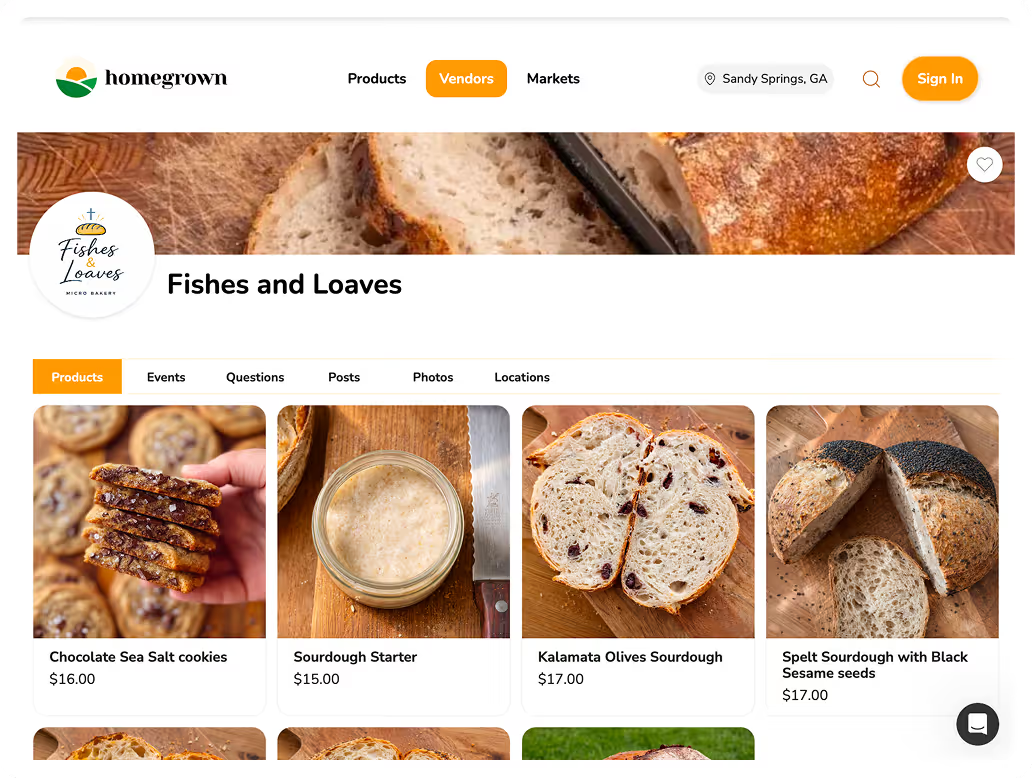
The key to making home pickup work is a reliable way to collect and track orders. At very small scale (5-10 customers), text messages work. Beyond that, the text thread becomes chaotic — who ordered what, who confirmed, who paid, who still needs to pick up. Venmo moves money but includes no order details. Etsy charges 6.5 percent per transaction and is built for shipped products, not porch pickup. Homegrown costs $10/month with no percentage fees beyond standard payment processing (2.9 percent plus $0.30 per transaction) and gives you one link where customers browse your products, order, pay, and choose pickup or local delivery. Homegrown does not register your cottage food permit, create your labels, or handle health department paperwork — it handles the ordering and payment infrastructure so home pickup runs without the group text chaos.
Social media and word of mouth isn't a sales channel by itself, but it's how most cottage food businesses find their first customers. Post photos of your product on Instagram or Facebook, mention availability in a neighborhood group, or tell friends and coworkers. The people who already know your food are your warmest leads.
Start with one channel. The temptation to launch on Instagram, at a farmers market, through Etsy, and with a home pickup operation simultaneously is understandable but almost always a mistake. Each channel requires different logistics, different customer management, and different time commitments. Pick one, learn the rhythm, build a customer base, and then add a second channel once the first is working smoothly.
Sell to people who already know your food first — your network is your first customer base. The goal of the first month isn't to build a profitable business. It's to sell something. Everything after that — optimizing, expanding, systematizing — comes from having real customers and real transactions to learn from.
You don't need most of the things you think you need. New cottage food entrepreneurs often over-invest in preparation. They spend weeks on business plans, logos, websites, and legal structures before making a single sale. Here's what you actually don't need before selling your first product:
The theme here is simple: don't build infrastructure for a business that hasn't made its first sale. Get to the first sale, then build from there based on what you actually need.
Once you know your state's rules, these guides cover the parts that apply almost everywhere:
Want the launch steps for your state? These guides walk through registration, costs, timeline, and what you can sell:
Most cottage food businesses can launch for $100-300. That covers ingredients for your first production batches, basic packaging materials and labels, and potentially a farmers market booth fee. The main investment is time — developing your recipe, making your first batches, and preparing your label and packaging. If you're already making the product for friends and family, your startup cost is essentially just packaging and farmers market fees.
Product liability insurance for cottage food vendors isn't required in most states, but it's worth considering once you're selling regularly. Policies designed for home food businesses typically cost $200-500 per year. Some farmers markets require vendors to carry liability insurance, so check your market's requirements. At minimum, confirm that your homeowner's or renter's insurance doesn't explicitly exclude home food production — some policies do.
This depends on your state's cottage food law. Most states now allow some form of online ordering, typically with the requirement that delivery or pickup happens locally and in-person. Shipping cottage food to out-of-state buyers is generally not permitted under state cottage food exemptions. Check the sales channel restrictions in your state's law. If online ordering is allowed, an ordering platform makes it easy to take pre-orders for local pickup.
If you hit the revenue cap, you have two options: stop selling for the remainder of the year, or transition to commercial kitchen production. Many communities have shared commercial kitchens available for rent by the hour or day, which lets you continue growing without the capital investment of building your own facility. Reaching the cap is actually a good problem — it means your cottage food business is succeeding.
It depends on your product, your farmers market, and how much you can produce. A cottage food vendor who sells $200 worth of product at a Saturday farmers market with $60 in materials and fees is making $140 per Saturday — $560-600 per month from a weekend activity. That's a meaningful side income from a part-time effort. Scaling beyond that requires either increasing prices, increasing volume, adding sales channels, or some combination of all three.
This varies by state and product. Some states exempt cottage food from sales tax. Others require you to collect and remit sales tax on food products. Check your state's specific requirements — and if sales tax does apply, set up a simple system for tracking and paying it from the beginning.
The most common mistake is getting the cottage food label wrong — specifically, missing or incorrectly wording the cottage food disclaimer statement. Every state requires a specific disclosure that the product was made in a home kitchen not inspected by the state, and many states prescribe the exact wording. The second most common mistake is pricing too low, which leads to a cottage food business that generates sales but no actual profit after materials, time, and farmers market fees are accounted for.
The gap between making food for friends and selling food to customers is smaller than it looks. The legal framework exists. The customer base — people who want fresh, local, handmade food — grows every year. The tools to manage orders and payments are simpler and more affordable than ever.
What stops most people isn't regulation or complexity. It's the feeling that they need more preparation, more infrastructure, more polish before they're "ready." They don't. The first sale is the best teacher. Everything after it — refining your product, building your customer list, finding your rhythm — comes from doing, not planning.
Pick your product. Make your label. Show up to a farmers market or announce pickup availability to your neighbors. Make your first sale this month.
When those first customers start coming back — and they will — give them a link instead of a text thread. Homegrown makes it simple for your regulars to see what's available, place orders, and pay ahead. You get a clean order list before you start your production day. They get a confirmation. Everyone knows what's happening.
For a broader look at what building a home-based food business actually looks like day to day — beyond the startup steps — how to sell food from home covers the operational and sales side in detail.
The customers are closer than you think. Start this week.