

Most advice about starting a food business assumes you have thousands of dollars to spend before your first sale. Rent a commercial kitchen. Hire a designer for your logo. Form an LLC. Build a website. Get professional photography. By the time you've checked all those boxes, you're deep in the hole before a single customer has tasted your product.
Here's what that advice misses: you don't need any of it to start. Cottage food laws exist in all 50 states, and they allow home cooks and bakers to sell certain food products directly to customers from their home kitchen. No commercial kitchen rental. No facility permit. No restaurant license. No expensive equipment beyond what you already own.
This changes the math entirely. Instead of needing $5,000 or $10,000 to start a food business, you need somewhere between $0 and $100. That's not an exaggeration. That's the actual cost structure of a cottage food business when you strip away everything that isn't required.
This guide explains exactly how to go from having no startup capital to making your first sale, what costs are truly unavoidable versus what can wait, and how to use early revenue to fund growth so you never need outside money to build this business.
The short version: You can start a food business from home for $0 to $100 using cottage food laws. Your home kitchen is your production facility, labels can be made free with Canva and a home printer, and your first customers come from word of mouth and social media. Start with one product you already make well, sell it to people you know, and reinvest that revenue to grow. No commercial kitchen, no LLC, no website required.
It means you can start a food business from home without significant upfront investment — often for the cost of a grocery trip or less. Let's be honest about the constraint, because "no money" can mean different things to different people.
Starting with truly zero dollars is possible in a narrow scenario. If you already have the ingredients in your pantry, a printer at home for labels, and basic packaging materials (paper bags, plastic wrap, foil), your very first batch can cost you nothing beyond what you've already purchased for personal use.
Starting with very little money — somewhere between $30 and $100 — is the more realistic scenario for most people. That covers:
It doesn't require saving up or borrowing money. It's the kind of amount most people can find by skipping a few restaurant meals or selling something they don't use anymore.
What this guide doesn't mean by "no money." It doesn't mean you'll never spend anything on this business, ever. Ingredients cost money. Packaging costs money. If you want to sell at a farmers market eventually, there's a booth fee. But the approach is different from the traditional "invest first, earn later" model. Instead, you start with what you have, make your first sale, and reinvest that revenue into the next step. You fund the business with the business, not with savings or credit cards.
The reason this works is that cottage food businesses have an extremely low cost floor. The legal structure is designed for exactly this — home producers selling small batches with minimal infrastructure.
Cottage food is the cheapest way to start a food business because it eliminates every major expense that traditional food businesses require. To see why, compare the two models:
| Expense | Traditional Food Business | Cottage Food Business |
|---|---|---|
| Kitchen facility | $300-$1,000/month (commercial rental) | $0 (your home kitchen) |
| Facility permit | $50-$500 | $0 (not required) |
| Health department inspection | Required | Not required |
| Food manager certification | $100-$200 | $0 (not required in most states) |
| Commercial equipment | $1,000-$10,000+ | $0 (use what you own) |
| Business license | $50-$200 | $0 (not required for most cottage food vendors) |
| Minimum startup cost | $5,000-$20,000 | $0-$100 |
Need more help here? See our guide on selling food from home.
The only costs that cottage food law doesn't eliminate are the ones that are genuinely necessary: compliant labels on your products, basic packaging to make them presentable and safe, and ingredients to make the food itself. Everything else is optional, and most of it can wait until the business is generating revenue. The bootstrapping a food startup provides additional guidance on this.
This is why cottage food is the right vehicle if limited capital is your main constraint. It's not a compromise or a lesser version of a "real" food business. It's a legal framework designed specifically for small-scale home producers, and it removes the financial barriers that make other food businesses expensive to start.
Every state allows cottage food sales, but each state has its own list of permitted products, revenue caps, and sales channel rules. Before you make anything for sale, you need to know what your state allows.
Products most states permit under cottage food laws:
Products most states don't permit under cottage food laws:
Revenue caps: Some states limit your annual cottage food sales. Common caps range from $25,000 to $75,000, though some states have no cap at all. At the starting stage this won't affect you, but it's good to know your limit.
Sales channels: Some states only allow direct-to-consumer sales — farmers markets, home pickup, roadside stands. Others permit online ordering with local pickup. A smaller number allow intrastate shipping. Your state's rules determine how you can reach customers.
Check Forrager for your state's specific rules. It has the most complete database of cottage food laws for all 50 states, including permitted foods, revenue caps, registration requirements, and sales channel rules.
For a comprehensive walkthrough of how to navigate the full process, how to start a cottage food business covers every step from legal requirements through making your first sale.
Pick one product you can make today with what you already have. When you have no startup capital, the product selection constraint is straightforward: use what's already in your pantry. What can you make with those ingredients that's permitted under your state's cottage food law?
Pick one product, not five. The instinct is to offer a variety to appeal to more people. Resist it. Starting with a single product keeps your costs minimal, your production simple, and your quality consistent. You can add products later once you've made your first sales and have revenue to invest in additional ingredients.
What makes a good starting product:
Cost examples for common cottage food products:
| Product | Batch Size | Ingredient Cost |
|---|---|---|
| Cookies (pantry staples) | 48 cookies | $4-$8 |
| Bread loaf | 1 loaf | $1-$3 |
| Granola | 1 pound | $5-$10 |
| Jam (in-season fruit) | 8-12 jars | Varies (very low with free fruit) |
Don't overthink this. The first product doesn't need to be perfect or revolutionary. It needs to be something you make well, something people will pay for, and something you can produce with what you have right now. Your sourdough bread, your chocolate chip cookies, your grandmother's jam recipe — whatever you're already known for making.
Your actual costs are far lower than most people assume. Here's exactly what you need to spend and what you don't.
Labels: Free to very low cost. Every cottage food product must have a compliant label before it can be sold. But creating and printing labels doesn't have to cost anything:
For the full breakdown of what every label must include — ingredient lists, allergen declarations, net weight, the required cottage food disclosure statement — cottage food labeling requirements covers this in detail.
Packaging: Minimal to low cost. Your packaging doesn't need to be fancy to start:
State registration: Free or under $50. Some states require cottage food registration. Many require nothing at all — you simply comply with labeling rules and start selling.
Payment processing: Free. Venmo, Cash App, Zelle, and PayPal are all free to receive payments. Cash works too. Square offers a free app with a small percentage per card transaction.
Ingredients: Whatever you have or can afford. Your first batch uses what's in your pantry. Future batches use revenue from sales.
Total realistic startup cost: If you have a printer, pantry ingredients, and basic packaging, your first batch costs $0 to $5 beyond what you already own. If you need to buy everything from scratch, $50 to $100 covers ingredients, packaging, and label supplies.
Use free sales channels — they're also the most effective for your first sales. You don't need to pay for a farmers market booth, advertising, or any marketing tools to get customers. See free small business advice for additional context.
Word of mouth is your most powerful free channel. Tell everyone you know that you're selling. Friends, family, neighbors, coworkers, people at your church or gym or kids' school. Don't be subtle about it. Say "I'm selling my homemade sourdough bread for $8 a loaf — want to try it?" Most home food businesses get their first 10 to 20 customers from people they already know.
Social media costs nothing and works especially well for food. Post photos of what you're making on Instagram, Facebook, or whatever platform your community uses. Show the process, not just the finished product. A video of bread coming out of the oven gets more engagement than a perfectly staged photo.
Community groups are free and hyperlocal. Local Facebook groups, Nextdoor, community message boards — these platforms connect you directly with people in your area who are looking for local food. Post what you're offering, include a clear photo and price, and respond to people who are interested.
Pre-orders with home pickup eliminate waste and cost nothing. Instead of making a big batch and hoping it sells, take orders first and bake exactly what's been ordered. Customers pay when they pick up. No wasted product, no booth fees, no packaging for unsold products.
This is the lowest-risk, lowest-cost sales model: you don't produce anything until someone has already committed to buying it.
Use your first sales to fund the next phase of growth. The goal of your first few sales isn't to make a lot of money — it's to prove that people will pay for your product and to generate working capital.
If your first week of sales brings in $40 to $80, here's how to reinvest:
The pattern is: sell, reinvest a portion of the revenue into something that makes the next round more efficient or profitable, and keep the rest as income. You're funding the business with the business, not with outside capital.
Not at the start — but sooner than most vendors expect. Your first 5-10 customers work fine over text messages and Venmo. But once you have 15+ regulars placing weekly orders, tracking who ordered what, who paid, and when they're picking up becomes its own part-time job. The ordering management starts eating the time you should be spending on production.
The question for a no-money startup is which platform fits the budget you just built from zero.
Google Forms + Venmo is free and fully manual. You build a form, share it, then match Venmo payments to form responses yourself. It works for your first handful of orders. By order 15, you're spending more time tracking than baking — and you have no record if a customer disputes a payment or claims they ordered something different.
Etsy charges 6.5% + $0.20 per listing + payment processing. On a $30 cookie order, Etsy takes about $2.25. That adds up when you're reinvesting every dollar back into ingredients and packaging. Etsy is also designed for shipping nationwide, not local pickup — which is how most cottage food vendors actually operate.
Shopify starts at $39/month. For a business you started with $0-$100, spending $468/year on a platform before you've hit consistent revenue doesn't make financial sense.
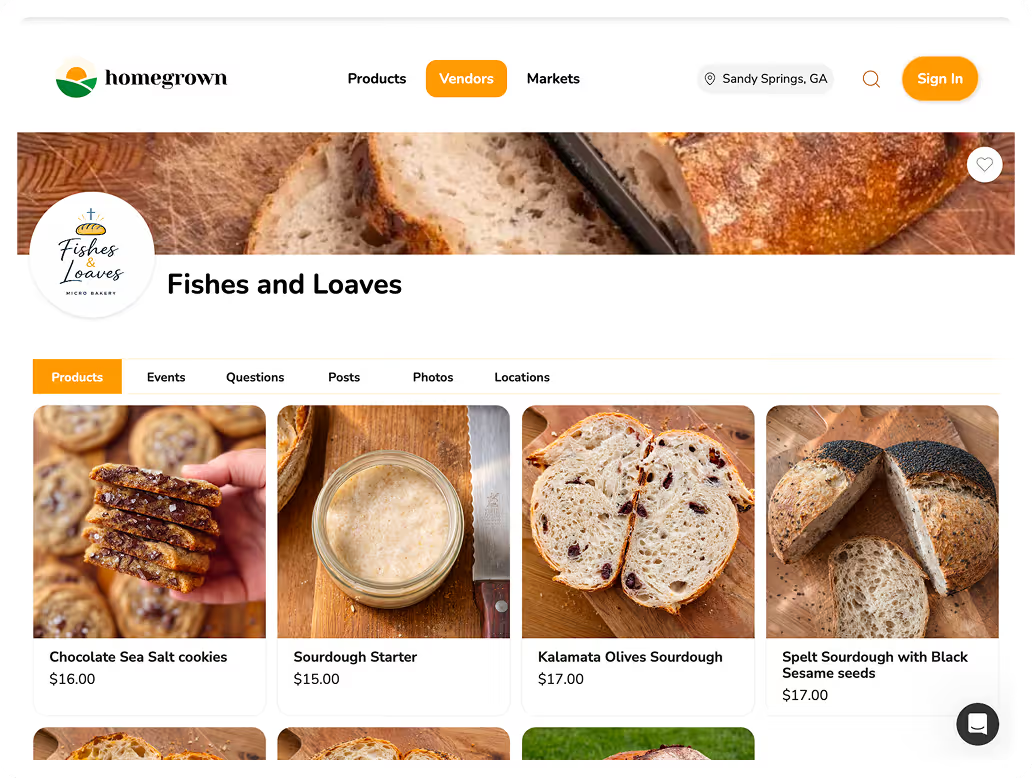
Homegrown costs $10/month and is built for exactly the stage you're at: a home vendor with a growing list of local customers who need a simple way to order and pay. You list your products, set pickup windows, collect payment when customers order, and get a clean list of what to make. Local buyers can also discover you through the Homegrown marketplace, which means new customers without marketing spend. At checkout, customers pick pickup or local delivery.
| Platform | Cost | Best For | Drawback for No-Money Startups |
|---|---|---|---|
| Google Forms + Venmo | Free | First 5 orders | Manual tracking, no payment verification |
| Etsy | 6.5% + fees | Shipping nationwide | Percentage fees eat reinvestment capital |
| Shopify | $39/mo | Large e-commerce | $468/year before first sale |
| Homegrown | $10/mo | Local pre-orders | None for this stage |
Homegrown doesn't handle nationwide shipping, wholesale accounts, or subscription box fulfillment. It's built for vendors selling a set menu to local customers through pickup — the exact model that works for cottage food businesses.
Most vendors add Homegrown when they hit the 10-15 regular customer mark — the point where text-and-Venmo stops scaling. At $10/month, it pays for itself if it saves you even one lost order or one hour of DM management per week.
This list matters because it represents money people spend unnecessarily before they've validated their business.
Every dollar you don't spend on unnecessary infrastructure is a dollar you keep or reinvest into ingredients and packaging that directly support sales.
Nearly. If you have pantry ingredients, a printer, and basic packaging at home, your first batch costs nothing additional. Most people realistically spend $30 to $100 to get properly started with compliant labels, appropriate packaging, and maybe a small registration fee. That's the range — not thousands.
Design your labels in Canva for free, then print them at your local library for cents per page or at a print shop for a few dollars. You can also hand-write labels if your state's requirements are simple enough, though printed labels look more professional.
Some states require cottage food registration before you can sell. Many don't. Where required, the fee is typically $0 to $50 and the process is a simple online form. Check your state on Forrager for the specific requirement.
Yes. Cottage food income is regular taxable income and must be reported. The good news is that your expenses — ingredients, packaging, labels, market fees — are deductible against that income. Track everything from day one using a simple spreadsheet.
When the business tells you to. If you're selling out of every batch and turning away orders, it's time to invest in more ingredients, better packaging, or a farmers market booth. Let demand drive investment, not the other way around.
That's a great problem to have. Once you hit your state's revenue cap or want to sell products that aren't permitted under cottage food, you'd transition to a licensed food business with a commercial kitchen and proper permitting. But start where you are — cottage food lets you validate your product and build a customer base first.
Many cottage food vendors make their first sale within the first week. Your first customers will likely be friends, family, and coworkers who already know your cooking. From there, word of mouth typically brings in new customers within the first month. Most vendors see steady growth over their first three to six months.
Most people who want to start a home food business don't fail because they lack startup capital. They fail because they never start. They get stuck researching permits they don't need, planning infrastructure they can't afford, and waiting until everything is "ready" before talking to a single potential customer.
The money barrier is genuinely, objectively low. A cottage food business can start for the cost of a dinner out. The barriers that actually stop people are not knowing what's legal in their state, overthinking the setup, and not asking anyone to buy.
Start with one product. Learn your state's rules. Tell ten people. Make your first sale. Reinvest the revenue. Tell twenty more people. Everything else — the better packaging, the farmers market booth, the business name, the growing customer list — follows from there.
Start with one product. Tell ten people. Make your first sale. When you're ready to stop managing orders through text messages, set up your Homegrown storefront — $10/month, 15 minutes to set up, and one link you share with everyone who already wants to buy from you.