

People already want your baked goods. Friends ask when you're going to start selling. Neighbors bring it up every time you show up with banana bread. The hard part isn't the baking — it's figuring out how to actually turn it into money.
But when you search for help, most advice starts with writing a business plan, choosing a business entity, and building a Shopify store. That's not what you need. You need to know how to sell cookies this Saturday and get paid for them.
Here's how to start selling baked goods — from deciding what to make and how to price it, to where to sell, how to take orders, and what legal boxes to check.
The short version: Start with 3-5 products you already make well, price them using the formula (ingredients + packaging + your time + 20-30% margin), and sell at a local farmers market or through a Homegrown storefront. Cottage food laws in most states let you sell baked goods from your home kitchen with no commercial license. Most part-time bakers make $500-2,000/month selling at one market per week plus online pre-orders.
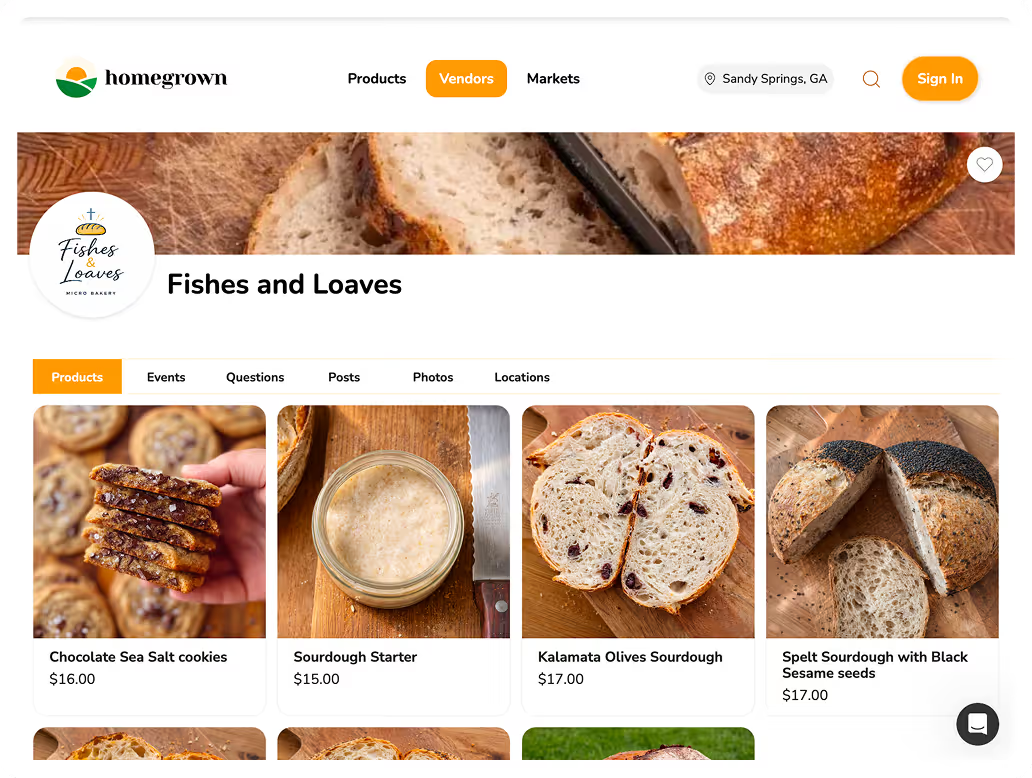
Ready to actually start selling? Take orders and get paid online in about 15 minutes — set up a Homegrown storefront ($10/mo, 0% commission), or compare the best platforms to sell food from home.
Start with 3-5 baked goods you are already known for — the products people already ask you to make. If everyone asks for your cinnamon rolls, sell cinnamon rolls. If your chocolate chip cookies disappear at every potluck, those are your lead product. Don't try to launch with a 20-item menu.
Three to five products is plenty when you're starting out. You want to keep your ingredient costs manageable, your prep time reasonable, and your offerings simple enough that customers can decide quickly. A focused menu also means you get really efficient at making those items — which saves time and money.
There are two basic models for selling baked goods, and they work differently:
Standard items are products you make in batches and sell as-is. Cookies, brownies, breads, muffins, granola. You decide what to make and how much. This works well for farmers markets and online pre-orders.
Custom orders are products made to a customer's specifications — birthday cakes, decorated cookies for events, specialty items. These are higher-margin but require more communication and planning per order. Platforms like Castiron (which closed in late 2025) were built specifically for this.
Most bakers start with standard items because they're simpler to produce and sell. Add custom orders once you have a rhythm.
How much to make for your first market: Less than you think. Seriously. It's better to sell out early and learn what people want than to come home with 10 dozen unsold cupcakes. Start with small batches of your top 3-4 items. You'll learn fast what sells and what doesn't.
The best places to sell baked goods are farmers markets, from your home under cottage food laws, through a Homegrown storefront for pre-orders, and via social media and word of mouth. You don't need a bakery, a retail lease, or even a website. Here are the most practical places to sell baked goods when you're starting out. See professional baking tips and recipes for additional context.
This is where most home bakers make their first real sales. You apply for a booth, pay a fee ($20-75 per market day), show up with your products, and sell directly to customers.
Markets are great for testing products, learning what prices people will pay, and building a customer base. They're also the fastest way to get real feedback — you'll know immediately which items sell out and which sit on the table.
The main downside: you can only sell when the market is open. If your market runs Saturday mornings, your selling window is about 4 hours per week. The rest of the week, customers have no way to buy from you.
For a detailed walkthrough, see our guide on how to sell at a farmers market.
Most states allow you to sell baked goods made in your home kitchen directly to customers. These are called cottage food laws, and they exist in nearly every state.
How it works: customers come to you (or you deliver), they pay, and they leave with their baked goods. Many home bakers start by selling to neighbors, coworkers, church groups, and friends of friends.
The rules vary by state — there are usually limits on what products you can sell, how much you can earn per year, and how items need to be labeled. But for baked goods specifically, cottage food laws are generally favorable. Cookies, breads, cakes, brownies, and similar items are allowed in most states — and cottage food laws by state can help with that.
An online storefront lets customers see what you're selling, place an order, and pay — without you managing everything through text messages.
This is especially powerful when combined with market sales. Take pre-orders online during the week, bake exactly what's been ordered (plus extra for walk-ups), and bring everything to the market on Saturday. You start your market day with guaranteed revenue and zero wasted product.
You don't need a full website or a Shopify store. Platforms built for local food sellers give you a simple link you can share anywhere — text it to regulars, post it on Instagram, print it on your business card.
For platform comparisons, see our guide on the best platform to sell local food online.
Instagram and Facebook are where most home bakers market their products — and for good reason. Baked goods photograph well, people love watching baking content, and local food communities on Facebook are active.
But social media is a marketing tool, not an ordering system. Posting a photo of your cookies and saying "DM me to order" works for your first 5 customers. By customer 15, you're drowning in messages, losing track of who ordered what, and spending more time on your phone than in your kitchen.
Use social media to show off your products and build a following. Then send people to your online storefront to actually order and pay.
Don't underestimate the power of telling people you sell baked goods. Church groups, school events, office breakrooms, neighborhood Facebook groups, community bulletin boards — these are all places where your first customers are already hanging out.
Bring samples. Hand out a card with your ordering link. Tell people what you make and when they can get it. Most successful home bakers built their first 20-30 regular customers entirely through personal connections.
Use this formula: ingredient cost + packaging cost + your time (at least $15-20/hour) + a 20-30% profit margin. Pricing is where most new bakers get stuck — not because the math is hard, but because it feels uncomfortable to charge real money for something you used to give away.
Here's the reality: if you price too low, you'll burn out. You'll resent the time you spend baking because it doesn't feel worth it. You'll cut corners on ingredients to save money. And you'll eventually quit — not because no one wants your products, but because you made it unsustainable.
The basic formula:
Ingredient cost + packaging cost + your time (at minimum $15-20/hour) + a profit margin (at least 20-30%) = your price.
For most home bakers, this means a batch of cookies that costs $8 in ingredients, $2 in packaging, and takes an hour to make should sell for at least $30-40 for a dozen — not the $12 you were thinking. See American Bakers Association for additional context.
| Product | Ingredient Cost | Packaging | Time (1 hr @ $20) | Margin (25%) | Sell Price |
|---|---|---|---|---|---|
| Dozen cookies | $8 | $2 | $20 | $7.50 | $37-40/dozen |
| Loaf of bread | $4 | $1 | $10 | $3.75 | $18-20/loaf |
| 8-inch cake | $12 | $3 | $30 | $11.25 | $55-60/cake |
| Dozen muffins | $6 | $2 | $15 | $5.75 | $28-30/dozen |
The grocery store trap: Your cookies are not competing with grocery store cookies. Grocery store cookies are mass-produced with cheap ingredients in a factory. Your cookies are handmade, fresh, local, and probably significantly better. Customers buying from you already know that. Don't price yourself against a product that isn't your competition.
When to raise prices: Sooner than you think. If you're selling out every time, your prices are too low. If customers never push back on price, you're probably leaving money on the table. Raise prices by $1-2 per item and see what happens — most bakers are surprised to find that nothing changes except their profit.
Set up a Homegrown storefront with one shareable link where customers can see your products, order, and pay — that eliminates the DM chaos entirely. This is the section every other "how to sell baked goods" article skips. But for most home bakers, order management becomes the biggest headache faster than you expect.
Here's what typically happens: You post on Instagram that you're taking orders for Saturday. People DM you. Some text you directly. A neighbor sends a Facebook message. Your aunt calls. Now you have orders scattered across four different apps, no confirmation of who's paid, and you're trying to figure out how many dozen cookies to bake while answering messages.
The solution is simpler than you think. You need a single place where customers go to order and pay. That's it.
An online storefront gives you:
The difference between managing orders through DMs and having an ordering system is the difference between chaos and a business. Even at small scale — even with just 10 regular customers — having one system saves hours every week. The question is which one.
Google Forms + Venmo is free and manual. You build a form, share it, then match Venmo payments to form responses yourself. Works for your first handful of orders. By week three, you're spending more time on order tracking than baking.
Etsy charges 6.5% + $0.20 per listing + payment processing. On a $40 dozen-cookie order, Etsy takes about $3.10 in fees. Etsy is also designed for shipping nationwide — for a home baker doing local pickup, you're paying for a fulfillment model you don't use. And Etsy owns the customer relationship, so you can't build your own buyer list.
Square Online has a free tier and handles local pickup, but it's built for restaurants and retail stores. The setup is more involved than what a home baker selling 5 products per week needs.
Shopify at $39/month is designed for e-commerce businesses shipping nationwide. Most home bakers don't need inventory syncing, carrier integrations, or marketing automation.
Homegrown costs $10/month and does one thing well: lets your customers order and pay through a single link. You list your products, set a pickup window, and share the link everywhere — texts, Instagram, market signage. You get a clean bake list, customers get a confirmation. Local buyers can also find you through the Homegrown marketplace.
| Platform | Cost | Built for Home Bakers | Customer Discovery |
|---|---|---|---|
| Google Forms + Venmo | Free | No (manual tracking) | No |
| Etsy | 6.5% + fees | No (shipping-focused) | Yes (but favors large sellers) |
| Square Online | Free tier | No (restaurant-focused) | No |
| Shopify | $39/mo | No (e-commerce-focused) | No |
| Homegrown | $10/mo | Yes | Yes |
Homegrown doesn't handle nationwide shipping, custom cake consultations with back-and-forth design approval, or wholesale bakery accounts. It's built for home bakers selling a set menu of products to local customers through pickup — weekly batches, market pre-orders, holiday rushes.
Pre-orders change the game for market vendors. When customers pre-order and pay during the week, you know exactly how much to bake. No more guessing whether you need 5 dozen or 12 dozen cookies. No more coming home with unsold inventory. You bake what's ordered, bring it to market, and sell any extras to walk-up customers.
Cottage food laws in most states allow you to sell baked goods from your home kitchen with no commercial license — you just need proper labels and to stay under your state's revenue cap. You need to check two things before you start selling: your state's cottage food law and any local permit requirements.
Cottage food laws allow you to make and sell certain foods from your home kitchen. Nearly every state has one. For bakers, the news is generally good — baked goods (cookies, breads, cakes, brownies, muffins, pastries) are allowed under cottage food laws in most states.
What cottage food laws typically require:
What you typically DON'T need:
Search "[your state] cottage food law" for your specific rules. If you're selling at a farmers market, check with the market organizer about their requirements too — some require additional permits or insurance.
Don't let the legal stuff stop you from starting. For most baked goods sellers, compliance is straightforward: follow your state's labeling rules, stay within the revenue limits, and sell directly to your customers.
Need more help here? See our guide on selling at a farmers market.
Start with friends, family, neighbors, and coworkers — then expand to farmers markets and Instagram. You don't need a marketing plan. You need to tell people you sell baked goods and make it easy for them to buy.
Start with who you already know. Friends, family, neighbors, coworkers, church members, parents from your kids' school. These people already know your baking is good. They just need to know they can buy it and how to order. The food handler certification programs provides additional guidance on this.
Farmers markets are the best customer discovery tool. Every market day, you're putting your products in front of dozens or hundreds of new people. Some will become regulars. Have a sign-up sheet or a QR code at your booth that links to your online storefront — so people who love your stuff can order again next week without coming back to the market.
Instagram works for bakers. Post photos of what you're making. Show the process. Share what's available this week. But always include a link to your storefront in your bio and in your posts. The goal isn't followers — it's customers who order and pay.
Repeat customers matter more than new ones. One customer who orders every week is worth more than 10 people who buy once. Make it easy for regulars to reorder (a shareable link they can bookmark), and focus on keeping them happy. A small, loyal customer base is the foundation of every successful home baking operation.
Part-time home bakers selling at one market per week plus online orders typically make $500-2,000 per month. More dedicated sellers with established customer bases and multiple markets can make $2,000-5,000+. Your income depends on your products, pricing, volume, and how many hours you're willing to put in. Most people are surprised at how quickly it adds up when you price correctly.
In many states, cottage food sales don't require a business license — just a simple registration or permit. However, getting a basic business license is usually $50-100 and makes your operation more legitimate. It can also make it easier to open a business bank account, which helps keep your finances organized.
You can market your baked goods on Instagram and take orders through DMs. It works fine for your first few customers. But it doesn't scale — once you have more than about 10 regular customers, managing orders through DMs becomes a time sink. Most successful bakers use Instagram for marketing and a separate online storefront for ordering and payment.
Cookies, brownies, and breads consistently sell well at markets and through pre-orders. Items that travel well, look appealing, and can be bought as a treat or gift tend to do best. That said, the "best" item to sell is whatever you make well that people already ask you for. Specializing in a few items you're great at beats offering a wide menu of average products.
No — cottage food laws in most states let you sell baked goods from your home kitchen. You typically need proper labeling and must sell directly to customers. If you want to sell through retail stores or exceed your state's revenue cap, then you would need a licensed commercial or shared kitchen.
Set up a Homegrown storefront, add your products and pickup times, and share the link with customers. They order and pay during the week, and you bake exactly what has been ordered. Pre-orders eliminate waste and guarantee revenue before you start baking.
Most states require your name, home address, a complete ingredient list, allergen information, and a "made in a home kitchen" disclaimer on every product. Requirements vary by state, so check your specific cottage food law for the exact labeling rules.
For more on selling food without a physical location, see our guide on how to sell food without a storefront.
Selling baked goods doesn't require a bakery, a business plan, or a Shopify store. It requires baking skills you already have, a few legal checkboxes, and a way for customers to order and pay you. Start this weekend with what you've got — a farmers market booth, a few regulars, and a link to share.
Ready to start taking orders? Set up your Homegrown storefront in 15 minutes and share the link with your first customers today.