

Selling cakes and cupcakes from home is one of the most accessible ways to start a food business. The startup costs are low compared to almost any other business type, the demand is consistent year-round because people always need cakes for birthdays and events, and the product is something you can make in a standard home kitchen with equipment you probably already own.
The short version: You can legally sell cakes and cupcakes from home in most states under cottage food laws. Start by confirming your state's rules, setting up compliant labeling, and pricing at $3 to $5 per cupcake or $45 to $85 for an 8-inch decorated cake. Find your first buyers through social media, your personal network, and a ordering page, and use a structured order form from day one to keep things manageable.
But there's real work in the setup that separates home bakers who make a few dollars here and there from ones who build consistent, sustainable income. Understanding the legal requirements for your state, pricing your products so you actually make money, finding buyers who will pay what your work is worth, and managing orders efficiently — these are the pieces that turn casual baking into a real business.
This guide covers all of it: the legal side, pricing, packaging, finding customers, managing orders, and deciding whether custom work or a standard menu makes more sense for your situation.
Yes, in most states cakes and cupcakes qualify as permitted cottage food products that you can produce and sell from a home kitchen without a commercial license. Cottage food laws were specifically designed to allow home producers to sell items like baked goods directly to consumers, and cakes are among the most commonly listed products in every state's permitted items list.
That said, cottage food laws vary by state, and the specific details matter for cake sellers.
Which products are allowed is the first thing to check. Most states explicitly permit all baked goods including cakes, cupcakes, cookies, and bread. Where it gets tricky is with certain fillings and frostings. A small number of states have restrictions on products with perishable components like fresh whipped cream fillings, custard, mousse, or fresh fruit layers between cake layers. Shelf-stable frostings like American buttercream, Swiss meringue buttercream, and fondant are generally fine everywhere.
Whether registration is required depends on your state. Some states require a simple cottage food permit or registration, which typically costs $25 to $100 and may include a food handling course. Other states require nothing beyond complying with labeling requirements. Check what your state requires before you start taking orders.
Annual sales caps exist in many states, commonly limiting cottage food sales to $25,000 to $75,000 per year. All your cottage food sales across every channel — custom cake orders, cupcake sales at markets, pre-orders through any platform — count toward this single cap. Know your state's limit and track your cumulative sales.
Where you can sell varies. Most states allow in-person direct sales from your home, at farmers markets, and at community events. Some states also permit online ordering. A few restrict cottage food sales to direct, face-to-face transactions only. Understanding your state's rules about sales channels affects how you'll find and serve customers.
Yes — multi-tiered wedding cakes and elaborately decorated celebration cakes are still baked goods and qualify under cottage food in most states the same as a simple sheet cake or a batch of cupcakes. The complexity of your decoration doesn't change the product's classification. The Food Allergy Research & Education (FARE) database provides additional guidance on this.
The only potential complication is the fillings and components issue mentioned above. Here's how common cake types typically classify:
| Cake Type | Cottage Food Status |
|---|---|
| Tiered cake with buttercream layers | Permitted in most states |
| Fondant-covered with gum paste flowers | Permitted (shelf-stable components) |
| Cake with fresh strawberry mousse filling | May not be permitted (perishable) |
| Cake with custard or cream filling | Often restricted (requires refrigeration) |
| Sheet cake with American buttercream | Permitted in most states |
If you're planning to do custom decorated cakes as a significant part of your business, check your state's specific rules about what constitutes a shelf-stable versus perishable baked good. Most states draw the line at anything requiring refrigeration. As long as your fillings and frostings don't require cold storage, you're typically in the clear.
Look up your state's cottage food law through your Department of Agriculture website before investing in cake supplies and taking orders.
Three things: confirm your state permits home-baked cakes, register if required, and set up compliant labeling for every product you sell. The process is typically quick and inexpensive.
Confirm your state permits baked goods sold from a home kitchen. Check whether any ingredient restrictions apply to fillings, frostings, or decorative elements. Confirm that custom decorated cakes don't fall under any special categories in your state.
Register if your state requires it. States that require registration usually have an online application and a modest fee. Some require a food safety course first, which you can typically complete online in a few hours.
Set up your labeling for every product you sell. Cottage food labeling requirements apply to every cake and every batch of cupcakes that leaves your kitchen. Your labels must include:
For pre-boxed cupcakes, the label goes on the box or container. For individual cakes, you can attach a card or adhesive label to the cake box. Design a clean, simple label template that you can customize for different products and print at home on adhesive label stock or card stock.
Price your products to cover ingredients, packaging, and your time — not just ingredient costs. Ingredient costs are often only 20 to 30 percent of what your price needs to cover, and underpricing is the most common and most costly mistake home bakers make.
Everything that belongs in your pricing calculation:
For a broader guide covering pricing and selling all types of baked goods, see how to sell baked goods.
| Product | Typical Price Range |
|---|---|
| Standard cupcake (basic frosting) | $3–$5 each |
| Specialty/custom decorated cupcake | $4–$7 each |
| Cupcakes by the dozen | $28–$55 |
| 6-inch two-layer cake | $35–$55 |
| 8-inch two-layer cake | $45–$85 |
| 8-inch fully custom decorated cake | $75–$150+ |
| Tiered wedding/event cake | $4–$8 per serving |
Wedding and event cakes command higher prices because they involve design consultation, specialty ingredients, structural engineering for tiers, and often delivery coordination. If you're doing custom decorated work that involves three or four hours of design and decorating time, your price needs to reflect that time.
Require deposits on custom orders. For any cake order over $50, require a non-refundable deposit of at least 25 to 50 percent at the time of booking. This protects you against cancellations after you've already sourced specialty ingredients, blocked time on your calendar, and turned down other orders for that date.
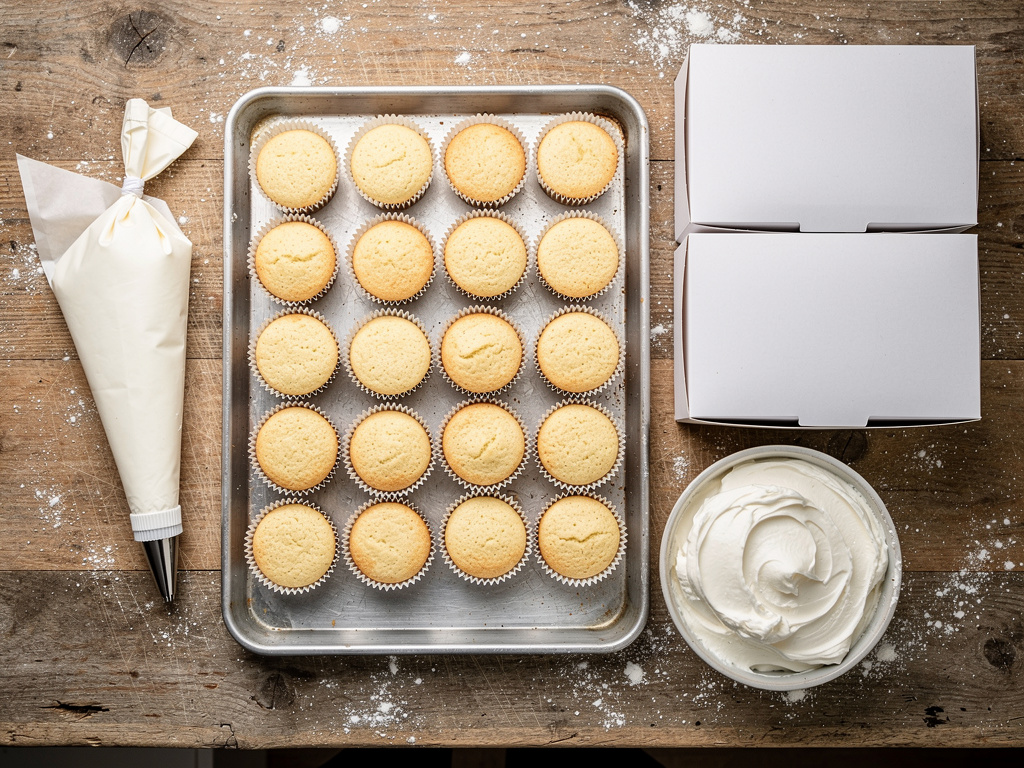
Use sturdy cake boxes that fit with minimal lateral movement and cupcake clamshells with individual cavities — the right packaging prevents transport damage and shapes the customer's first impression of your business. A beautiful cake that arrives damaged is worse than a simple cake that arrives perfect.
For cakes:
For cupcakes:
| Packaging Type | Capacity Options | Key Benefit |
|---|---|---|
| Clamshell containers with cavities | 6, 12, 24-count | Most secure — prevents frosting smear |
| Bakery boxes with cardboard inserts | 6, 12-count | Lower cost per unit |
The Wilton baking supply catalog provides additional guidance on this.
In warm weather, frosting stability becomes a real consideration:
Labels complete the professional presentation. Print adhesive labels for your boxes that include your business name, the required cottage food disclosures, and a clean design that matches your brand.
Post photos of your best work on social media with your pricing and order details — most home cake businesses get their first customers from their existing personal network and local community Facebook groups. Don't underestimate how many people in your existing circle would happily order from you if they knew you were selling.
Your personal network is where most home cake businesses start. A post on social media showing your best work — a beautifully frosted birthday cake, a dozen decorated cupcakes, a close-up of your piping work — with a note that you're taking orders and your pricing will generate initial inquiries from people who already know and trust you.
Social media drives the most consistent demand for home cake businesses. Instagram and Facebook are the primary platforms because cakes and cupcakes photograph exceptionally well. Consistent posting of high-quality photos — close-ups of decoration details, finished cakes from multiple angles, process shots of frosting and assembly — builds a following that converts into orders over time.
Local community Facebook groups are particularly effective for reaching nearby buyers who want local pickup. A photo of a freshly decorated cake posted in a neighborhood group with your pricing and order process generates more inquiries than most paid advertising for local businesses.
Farmers markets offer another consistent sales channel if your local market permits baked goods sales. Some markets allow you to sell cupcakes and pre-sliced cake directly at your booth. Others support pre-orders with pickup at the market. Check your local market's vendor rules for any restrictions on cake sales.
Word of mouth and event referrals drive consistent demand once you've completed a few successful orders. Birthday cakes lead to baby shower cupcakes lead to wedding cake inquiries. Every order you deliver well is a potential referral. Ask happy customers to share a photo on their social media and tag you.
A dedicated ordering page lets you reach buyers beyond your personal network without the manual coordination of DMs. Venmo and Cash App move money but give you no order details — you're still texting about flavors, sizes, and pickup times. Etsy charges 6.5% per transaction and is designed for shipping, not a home baker taking custom cake orders for Saturday pickup. Homegrown is $10/month with no percentage fees beyond standard payment processing and gives you one ordering page where local buyers see your cakes and cupcakes, place orders, and pay upfront. It doesn't design your cakes, schedule your baking, or make the deliveries — it replaces the DM chaos with a structured ordering system.
Use a structured order form for every order — this single step eliminates most of the chaos that overwhelms home bakers. The difference between a home baker who feels overwhelmed and one who runs smoothly is usually the quality of their ordering process, not the number of orders.
Your order form should capture:
Set realistic lead times and communicate them clearly:
| Order Type | Recommended Lead Time |
|---|---|
| Custom decorated cake | 5–14 days |
| Standard cake (set flavors) | 3–5 days |
| Standard cupcakes (set flavors) | 3–5 days |
| Tiered wedding/event cake | 2–4 weeks |
Batch standard orders for efficiency. If you're selling standard cupcakes or simple cakes from a defined menu rather than fully custom work, batching all orders for a given week into one or two baking sessions is dramatically more efficient than baking individual orders on different days. You buy ingredients once, prep once, clean up once, and produce everything in a concentrated window.
Communicate proactively with every customer. Confirm orders when received with a summary of what was ordered, the pickup date and time, and the payment status. Send a reminder a day or two before pickup. Let customers know as early as possible if anything changes.
Start with a standard menu of 3 to 5 flavors in 2 to 3 size options, then add custom work as your skills and demand grow. Both models work as businesses, but they have meaningfully different tradeoffs. Resources from IBISWorld industry data offer more detail here.
| Factor | Custom Orders | Standard Menu |
|---|---|---|
| Revenue per order | Higher | Lower but more consistent |
| Production efficiency | Lower (every order is different) | Higher (batch-friendly) |
| Skill requirement | Advanced decoration skills | Clean, simple frosting |
| Scheduling flexibility | Bake per order | Batch weekly |
| Ingredient predictability | Variable | Consistent |
| Scalability | Harder to scale | Easier to batch and scale |
Custom orders generate higher revenue per order because you're charging for design time, specialty ingredients, and personalized work. But custom work requires design consultation with each customer, sourcing specialty ingredients that you may not keep in stock, more time per order, and a higher skill level.
A standard product menu with set flavors and sizes is simpler to produce and price consistently. Everything uses the same recipes and the same ingredients, which makes production faster and reduces waste. The barrier to starting is lower because you don't need advanced design skills to sell excellent-tasting cupcakes with clean, simple frosting.
Many successful home cake businesses run both models simultaneously — a standard menu for everyday orders and custom work for events and celebrations at a premium price.
Ready to turn this into a real business? The easiest way to take local orders and get paid is an online storefront — see the best platform to sell food from home, or set up a Homegrown storefront in about 15 minutes ($10/mo, 0% commission).
Your earnings depend on your volume, pricing, and product mix. A home baker selling 3 custom cakes per week at an average of $65 each plus 2 dozen cupcakes at $40 per dozen earns roughly $275 per week, or over $14,000 annually. Vendors who sell cakes from home through multiple channels — social media orders, farmers market sales, and pre-orders through a ordering page — often build steadier income than those relying on a single channel.
No. Cottage food laws are specifically designed to let you produce baked goods in your regular home kitchen. You don't need a commercial kitchen license as long as you're operating within your state's cottage food rules. Some states require your kitchen to meet basic cleanliness and organization standards, but the requirements are far simpler than commercial kitchen regulations.
Many home cake vendors handle delivery personally for large or tiered cakes, charging a delivery fee based on distance. Use a non-slip mat on the car seat, drive carefully, and assemble tiered cakes on-site when possible rather than transporting a fully assembled multi-tier cake. Some vendors only offer pickup and let the customer handle transport. Either approach works — just be clear about your policy before the customer books.
Shelf-stable frostings are generally permitted everywhere. This includes American buttercream, Swiss meringue buttercream, Italian meringue buttercream, fondant, royal icing, and ganache. Frostings that require refrigeration — fresh whipped cream, cream cheese frosting in some states, and custard-based frostings — may be restricted depending on your state's rules. Check your state's specific cottage food regulations.
Calculate your ingredient costs for the specific design, estimate your hands-on time for decoration and assembly, add your standard overhead and packaging costs, and apply your hourly rate. For unfamiliar designs, add a time buffer of 25 to 50 percent to your estimated decoration time. It's better to quote slightly higher and deliver a beautiful result than to underprice and feel resentful about the work.
Cottage food laws allow you to sell directly to consumers without a full business license in most states. However, some states require a cottage food permit or registration before you can sell through any channel including social media. Check your state's specific requirements. Regardless of licensing, you must include proper labeling on every product you sell.
Use a platform that lets you list your products with photos and descriptions, set order windows with lead times, and collect payment upfront. A ordering page handles all of this for local food vendors — customers browse your products, place orders, and pay online, and you get a consolidated order list to bake from. This is far more efficient than managing orders through scattered DMs and text messages.
For a home baker ready to start selling cakes and cupcakes, here's the practical path forward.
For the full picture on starting and running a home food business, see how to start a food business from home.