

Farmers markets are the most accessible way to start selling food directly to people who want to buy it. There are over 8,700 farmers markets across the US, and most of them are actively looking for new vendors.
But if you search for advice on how to get started, you'll find articles telling you to write a business plan, get a commercial kitchen, invest in professional signage, and build a brand identity — all before you've sold your first loaf of bread or jar of honey.
This guide is for the person who makes something good and wants to try selling it at a local Saturday market. No MBA required. Just your product, a table, and a willingness to show up.
The short version: You can start selling at a farmers market with a product, a table, and under $500 in startup costs. Most booth fees run $20-50 per market day. Cottage food laws in nearly every state let you sell homemade baked goods, jams, and honey without a commercial kitchen. The real key is using your market booth as a customer acquisition tool — capture contact info and set up online ordering so customers can buy from you between Saturdays.
For most part-time vendors, yes — selling at a farmers market is worth it as both a revenue source and a customer acquisition channel. A typical booth fee runs $20-50 per market day. Add in your ingredient costs, packaging, gas to get there, and the time you spend prepping and selling, and you've got real expenses to cover before anything counts as profit.
A case study from the University of Maryland Extension breaks this down clearly: on a $300 gross sales day, a vendor's costs (booth fee, labor, transport, equipment, insurance, permits) totaled $174 — leaving a net profit of $126. That's not retirement money, but it's not nothing either.
The thing the math doesn't capture is what else you get from a market. You meet 50-100 people face-to-face who are actively looking for local food. Some of them become regulars who order from you every week — not just on Saturdays. The market becomes your customer acquisition engine, and the real revenue grows between market days.
Selling at a market makes sense when you have a product people want, you enjoy the in-person interaction, and you treat each Saturday as an investment in building a customer base — not just a one-day sales event.
Search the USDA National Farmers Market Directory for markets near you, then visit them as a customer before applying as a vendor. Not all markets are the same. A busy downtown market with 60 vendors and live music is a completely different experience from a 12-vendor neighborhood market in a church parking lot. Both can work, but they attract different customers and have different dynamics.
Start by searching the USDA National Farmers Market Directory for markets near you. Then visit them as a customer before you apply as a vendor. Walk the market. See what's being sold, what the prices look like, how much foot traffic there is, and whether there's a gap your product could fill. See National Farmers Market Coalition resources for additional context.
Pay attention to category mix. If a market already has four bakers, it might not need a fifth. Many markets cap categories — they'll only accept a set number of vendors selling similar products. Smaller or newer markets tend to have more open slots and less competition per category.
Also ask about vendor commitment. Some markets offer daily or weekly drop-in spots where you can try it out without a season-long commitment. Others require a seasonal contract (typically 20-30 weeks). For a first-timer, a market with flexible vendor options lets you test the waters without a big commitment.
Most markets require an application — even small ones. You'll typically fill out a form that asks what you sell, how it's made, where it's produced, and whether you have the necessary permits and insurance.
Here's what to expect:
Apply early — popular markets fill up fast, especially for in-demand categories like baked goods and prepared foods. If you're waitlisted, ask if there are substitute vendor opportunities when regulars can't make it.
| Requirement | Details |
|---|---|
| Product description and photos | Clear photos of your products help your application stand out |
| Permits and licenses | Varies by state and product type — the market manager can tell you what's needed |
| Insurance (COI) | General liability coverage, roughly $300-500/year or ~$15/day through FLIP |
| Booth fee | $20-50/day flat fee, or 5-10% of sales |
| Seasonal commitment | Some markets offer drop-in spots; others require 20-30 week contracts |
You need a table, a tent, a cash box, price signs, and a way to accept card payments. Your setup doesn't need to be elaborate. Here's what actually matters:
The essentials:
Worth adding early on:
You don't need a custom tent, branded packaging, or professional signage to start. A clean, well-organized table with clear prices and a friendly face behind it is more than enough.
| Item | Estimated Cost |
|---|---|
| Pop-up tent (10x10) | $80-150 |
| Folding table | $40-60 |
| Tablecloth and signage | $20-40 |
| Cash box with change | $100-150 in starting cash |
| Card reader (Square, etc.) | Free-$50 for the reader |
| Booth fee (per market day) | $20-50 |
| Liability insurance (annual) | $300-500/year |
| Total to get started | Under $500 |
Baked goods, farm-fresh eggs, raw honey, seasonal produce, jams and preserves, and cut flowers are the top sellers at farmers markets. Baked goods (sourdough, cookies, pies), farm-fresh eggs, raw honey, seasonal produce, jams and preserves, and cut flowers consistently rank as top sellers across markets nationwide.
Start with one or two products, not ten. First-time vendors often think they need a full product line. They don't. One great sourdough bread or one type of cookie, made well and displayed attractively, is better than a scattered table with a little of everything. You can always add products as you learn what your customers want.
Pricing rules:
Most vendors selling shelf-stable homemade products at a farmers market operate under their state's cottage food laws — no commercial kitchen required. This is where most first-timers get stuck, not because the rules are complicated, but because they don't know where to look.
Cottage food laws are the most important thing to understand if you're making shelf-stable foods at home. Most states allow you to produce and sell baked goods, jams, honey, dry goods, and candy from your home kitchen without a commercial kitchen license. These laws typically require: — see our guide on cottage food laws by state.
For a comprehensive breakdown of your state's rules, check cottagefoodlaws.com — it's the most up-to-date resource available.
Product-specific rules:
The best first step: Contact the market manager and ask what permits are required for your specific product. They deal with this every season and can point you to exactly what you need.
The vendors who do best at farmers markets are the ones who talk to everyone, offer samples, and capture customer info for between-market sales. Showing up with good products is half the battle. The other half is how you interact with the people walking by your booth.
Arrive early and set up clean. A messy table, crooked signage, or boxes still visible sends the wrong message. Give yourself enough time to set up before the first customers arrive.
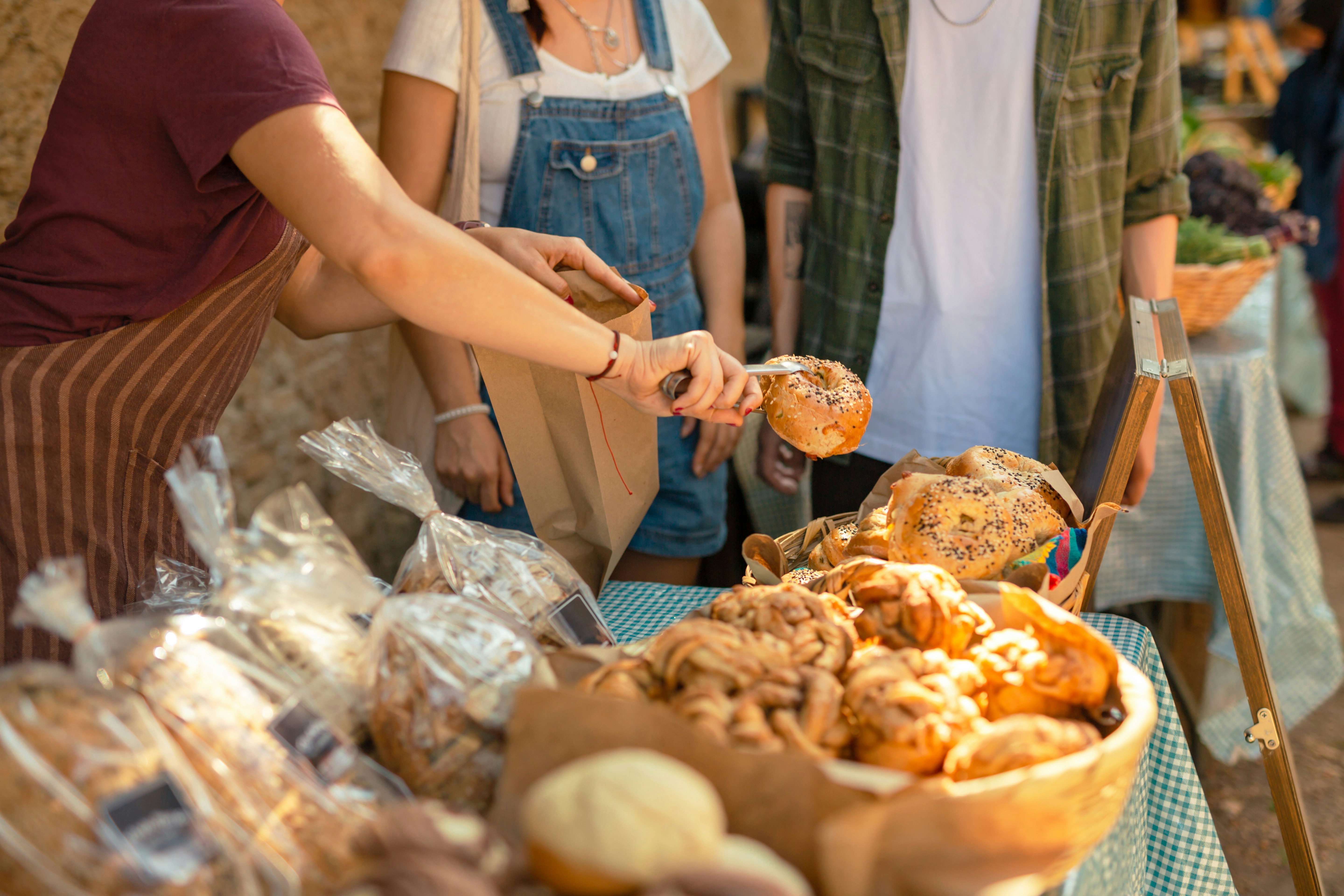
Talk to everyone who slows down. You don't need a sales pitch. Just say hi, tell them what you've got, and offer a sample if your market allows it. The person who wasn't planning to buy cookies might take a sample, love it, and become a weekly regular.
Samples are your best marketing tool (where regulations allow). A small taste of your sourdough or a toothpick-speared piece of your jam on a cracker does more than any sign or business card. People buy what they've tasted.
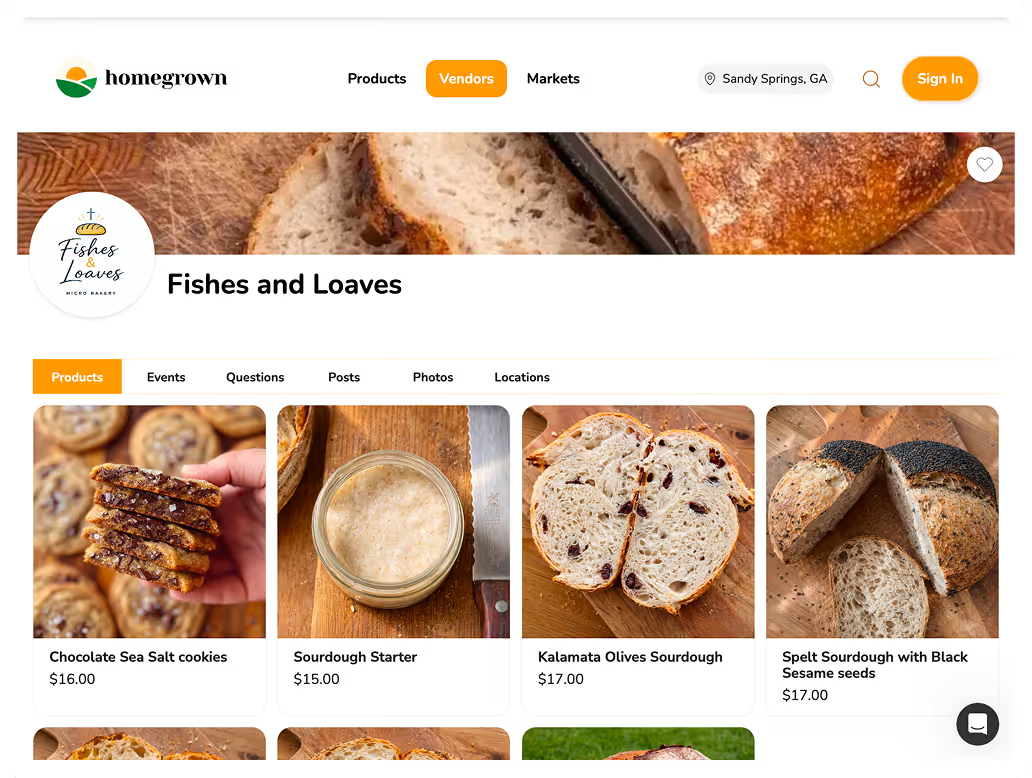
Capture customers for between-market sales. This is the move that separates vendors who stay small from vendors who grow. Put a QR code or a simple sign on your table: "Want to order during the week? Scan here." Every person who signs up for your text list or visits your Homegrown storefront is a customer you don't have to re-sell every Saturday.
For platform recommendations for market vendors, check out our guide on the best ecommerce platforms for farmers market vendors.
Your market booth isn't just a place to sell — it's a place to meet the people who will buy from you all week long.
The Saturday market is where customers find you. What you do the rest of the week is where the real business grows.
Your market regulars are your first online customers. They already know your product and trust your quality. All they need is an easy way to order between Saturdays. The question is how you take those orders without living in your text messages.
Most vendors start with DMs and Venmo — which works until you have 15 people texting "save me two sourdough" on Wednesday night and you are matching payment screenshots to names before you start baking. A Google Form gives you a form but not payment, so you are still chasing Venmo confirmations separately. Square Online starts free but is designed around restaurant-style ordering and a full website — more setup than most market vendors need for between-Saturday orders.
Homegrown is $10/month. You list what you are bringing to market that week, share the link on a QR code at your booth or text it to regulars, and customers order and pay in one step. When the sourdough slots fill, the listing closes. You show up Saturday knowing exactly what to bring, with payment already collected. It is not a full e-commerce website and will not help you sell wholesale to coffee shops — it is an ordering page that turns Saturday foot traffic into midweek revenue. Customers order for pickup or local delivery, whichever they prefer.
Tell every market customer: "If you want to order during the week, here's where to go." Hand them a card, point to your QR code, or just text them your link after the market.
For a full walkthrough on setting up online ordering, see our guide on how to sell farm products online. See food safety basics for market vendors for additional context.
The goal isn't to replace the market — it's to make your market presence the tip of the iceberg. Saturday is where you meet people. Tuesday through Friday is where you fill orders.
Sell more by letting customers order online for booth pickup. The easiest way to take local orders and get paid is an online storefront — see the best platform to sell food from home, or set up a Homegrown storefront in about 15 minutes ($10/mo, 0% commission).
It depends on your state and what you're selling. Many states allow cottage food sales (baked goods, jams, honey) without a business license, though some require a basic sales tax permit. Your market manager is the best first resource — they know exactly what your local market requires.
In most states, yes. Cottage food laws allow home-kitchen production of shelf-stable baked goods like bread, cookies, brownies, and pies (without cream or custard filling). You'll typically need to label your products as "Made in a Home Kitchen" and stay under your state's revenue cap. Check cottagefoodlaws.com for your state's specific rules.
For a basic setup: $150-300 for a tent, table, tablecloth, and signage. Add $20-50 per market day for booth fees and $300-500/year for liability insurance if your market requires it. Your ingredient and packaging costs depend on what you sell. Most vendors can start selling with under $500 in total upfront costs.
Most markets stay open in light rain, but foot traffic drops significantly. A pop-up tent protects your products and you. Whether to go on a rainy day depends on your product (baked goods travel fine, cut flowers might not) and whether you've already prepped inventory. As a general rule: if the market is open, show up. Regulars notice when you're not there, and they might find a new vendor to replace you.
Less than you think. Start with one or two products and bring enough for the market's foot traffic. For a small market (under 500 visitors), that might be 3-4 dozen cookies or 2 dozen loaves of bread. For a larger market, scale up. It's better to sell out early (which creates urgency for next week) than to haul half your inventory back home.
Use a mobile card reader like Square, Stripe Reader, or Tap to Pay on your phone. Most farmers market shoppers expect to pay with a card, and going cash-only means you lose sales. Square is the most popular option among farmers market vendors because it is simple to set up and has no monthly fee — you just pay a small percentage per transaction.
Yes, and this is one of the smartest moves you can make as a farmers market vendor. Set up a Homegrown storefront, share the link with your customers, and let them order and pay during the week. You show up on Saturday knowing exactly what to bring, with revenue already in your bank account. Pre-orders eliminate waste and guesswork.
You don't need a commercial kitchen, a business plan, or a full product line to start selling at a farmers market. You need a product people want, a table to put it on, and one Saturday morning.
Start with one market. Bring one product. Talk to every person who stops. And when they ask if they can order from you during the week, have an answer ready.
Start with one market. Bring one product. And when regulars start asking if they can order midweek, have a link ready instead of a group chat.