

Your informal food business is ready to go official when you hit three milestones: you consistently earn $500 or more per month from food sales, you have 15 or more regular customers, and you spend more time managing the business than actually making food. "Going official" does not mean renting a commercial kitchen or incorporating as an LLC on day one. It means getting a cottage food permit, setting up proper labeling, buying liability insurance, and moving from DM ordering to a real ordering system. These steps cost under $50 per month total and take one weekend to complete.
The short version: Most cottage food vendors sell informally for 3 to 12 months before formalizing. The signs you are ready: you make $500 or more per month, you have repeat customers who are not friends or family, you sell at farmers markets or to strangers online, and managing orders has become a second job. Going official means: (1) register under your state's cottage food law ($0 to $100), (2) create proper labels for every product, (3) get liability insurance ($25 per month), (4) set up an ordering platform like Homegrown ($10 per month), and (5) separate your business and personal finances. Total cost: under $50 per month. The transition takes one weekend and protects your business, your customers, and your personal assets.
"Going official" is not one thing. It is a spectrum from fully informal to fully formal, and most cottage food vendors land somewhere in the middle:
| Level | What It Means | When to Be Here |
|---|---|---|
| Fully informal | Sell to friends, no labels, cash/Venmo, no permits | First 1-3 months, testing demand |
| Cottage food compliant | Registered with state, proper labels, direct-to-consumer | Selling regularly to 10+ customers |
| Structured business | Insurance, ordering platform, separate finances, consistent schedule | Earning $500+/month, selling to strangers |
| Licensed operation | Commercial kitchen, LLC, full insurance, business bank account | Earning $25K+/year, wholesale accounts |
Most vendors reading this article are at level 1 or 2 and wondering when to move to level 3. The answer is: when the informal approach starts costing you more in lost time, lost orders, and risk than the $50 per month it costs to formalize.
You do not need to jump straight to level 4. A cottage food permit, proper labels, insurance, and an ordering platform handle 95% of what a small food vendor needs. The licensed commercial kitchen and LLC come later, when revenue and complexity justify them.
Here are the concrete signals that your food business has grown beyond what informal systems can handle:
At this revenue level, your food business is not a hobby — it is a real income source. The IRS requires you to report self-employment income (the Cornell's farm income tax overview explains exactly what triggers this), and your state may require a cottage food permit. Operating without these is a liability, not a convenience.
At $500 per month, the cost of going official ($50 per month for insurance + ordering platform) is 10% of your revenue. At $1,000 per month, it is 5%. The percentage drops as you grow, making formalization cheaper relative to income over time.
When your customer base includes people who found you on Instagram, Facebook, or at a farmers market rather than through personal relationships, the stakes change. Friends forgive mistakes. Strangers file complaints, leave bad reviews, and sometimes pursue legal action. Proper labeling and liability insurance protect you from the risks that come with selling to people you do not know personally.
If managing DMs, chasing Venmo payments, tracking orders in a notebook, and coordinating pickup takes more than an hour per week, your administrative burden has exceeded what informal systems can handle. An ordering platform eliminates this entire category of work for $10 per month.
The first time you forget a customer's order, double-charge someone, or deliver the wrong product is the moment informal systems have failed. These mistakes cost you customers, revenue, and reputation. A proper ordering system prevents all of them by keeping every order, payment, and pickup detail in one place.
Most farmers markets require vendors to have a cottage food permit, proper labeling, and often liability insurance. If you are selling at markets or events without these, you are either breaking the market's rules or your state's rules or both. Compliance is required, not optional, for market vendors.
When a customer asks about your licensing, permits, or insurance, it signals that your business looks established enough that people expect it to be official. This question is increasingly common as cottage food awareness grows. Having a clear answer ("Yes, I am registered under [state] cottage food law and carry liability insurance") builds trust instantly.
If the thought "what if someone has an allergic reaction?" keeps you up at night, you need insurance. A $25 per month liability policy replaces that anxiety with protection. The peace of mind alone is worth the cost. See our guide to the best cottage food insurance providers for options starting at $299 per year.
Here is the complete checklist for formalizing a cottage food business, in order:
Search your state's cottage food requirements — the CottageFoodLaws.com state directory walks through the distinction between license-exempt and licensed operations, which most states handle similarly even if the specific rules differ.
Look up your state's cottage food law and complete any required registration or permit. Some states require nothing beyond following the law. Others require a simple online registration, a food handler's certificate, or a small fee.
Search "[your state] cottage food permit" to find your state's requirements. If your state has a food freedom law, requirements may be even simpler. See our guide to food freedom states for the least restrictive states.
Every cottage food product needs a label with:
You can print labels at home on Avery labels ($20 for a pack of 300) or use a service like Canva or Vistaprint for more polished designs ($30 to $50). Labels are a one-time design cost that you reprint as needed.
General liability and product liability insurance protects your personal assets if a customer claims your product caused illness or injury. FLIP (Food Liability Insurance Program) offers coverage starting at about $299 per year with instant COI (Certificate of Insurance).
If you sell at farmers markets, most markets require proof of insurance before they let you set up. Getting insured opens doors to markets and events that were previously off-limits.
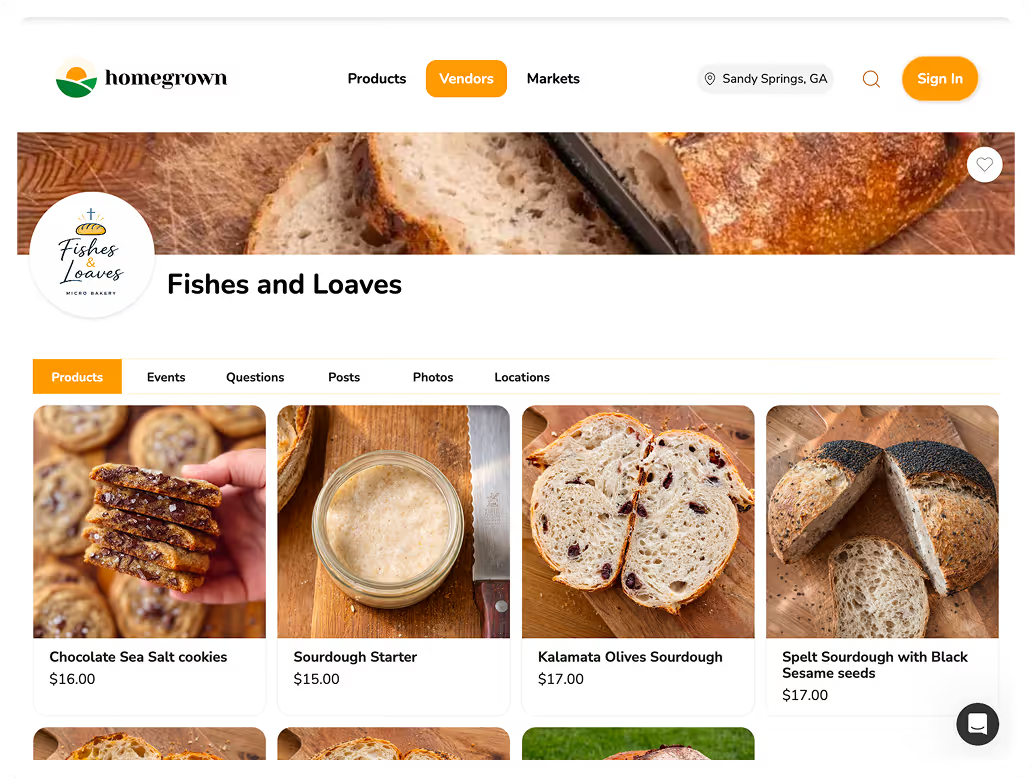
Replace DM ordering with a platform that handles product display, payment processing, pickup scheduling, and order tracking. Square Online offers a free tier but charges 3.3 percent per transaction with no dedicated pickup workflow — it is built for e-commerce shipping, not Saturday market pickup. Etsy charges 6.5 percent per transaction and buries local food vendors among national craft sellers. Homegrown costs $10/month with no percentage fees beyond standard payment processing (2.9 percent plus $0.30 per transaction) and is built specifically for local food vendors who sell for pickup or local delivery. You add your products, set pickup times and locations, and share one link — customers see your menu, order, pay, and choose pickup without messaging you. Homegrown does not register your cottage food permit, create your labels, or file your insurance paperwork — it handles the ordering step that was eating hours of your week in DMs.
Our best platform to sell food from home comparison covers every option from free tools to dedicated ordering platforms, so you can match the tool to your current scale.
Open a free business checking account at your bank. Direct all food business income to this account. Pay all business expenses from this account. This separation makes tax reporting simple and protects your personal finances from business liabilities.
Create a Venmo Business Profile for any Venmo payments you still receive. For details, see our guide on keeping personal and business Venmo separate.
Start a simple spreadsheet or use your ordering platform's dashboard to track:
For tax reporting guidance, see our guide on how to report food sales on your taxes.
| Item | Monthly Cost | Annual Cost |
|---|---|---|
| Cottage food permit/registration | $0-$8 | $0-$100 |
| Labels (ongoing printing) | $5-$10 | $60-$120 |
| Liability insurance (FLIP) | ~$25 | ~$299 |
| Ordering platform (Homegrown) | $10 | $120 |
| Business checking account | $0 | $0 |
| Total | $40-$53 | $479-$639 |
For a vendor doing $500 per month in sales, that is 8 to 10% of revenue. For a vendor doing $1,000 per month, it is 4 to 5%. The cost is minimal relative to the protection, professionalism, and operational efficiency you gain.
Compare that to the cost of NOT going official: lost time managing DMs ($160 to $320 per month in labor value), lost revenue from missed orders ($80 to $160 per month), potential legal exposure from selling without insurance (one claim can cost $10,000 or more), and tax penalties from unreported income.
Going official does not mean doing everything at once. Here is what you can skip for now:
Technically, many vendors do. But informal selling exposes you to tax penalties (unreported income), legal liability (no insurance), and operational chaos (DM ordering at scale). The longer you sell informally, the more risk you accumulate. Going official costs less than one bad week of informal selling gone wrong.
Most farmers markets require a cottage food permit, proper labels, and liability insurance before you can sell. Check with your market's manager for their specific requirements. Getting these in place before your first market is the standard expectation.
One weekend. Saturday: register with your state, design labels, and set up your ordering platform. Sunday: apply for insurance (instant COI from FLIP), open a business checking account, and set up your record-keeping spreadsheet. By Monday, you are fully official and operational.
The products and customers stay the same. What changes is the infrastructure behind the scenes: how orders come in (ordering page vs DMs), how you get paid (platform with automatic payment vs manual Venmo), how you are protected (insurance vs hope), and how you track income (platform dashboard vs memory). The customer experience improves. Your stress level decreases.
Prioritize by impact. Start with your cottage food permit (free in many states) and proper labels ($20 one-time). Add insurance when you start selling at markets or to strangers ($25 per month). Add an ordering platform when DM management becomes painful ($10 per month). You do not need to do everything at once — but do not put it off longer than necessary.
There is no universal legal threshold, but practically: at $600 per year in sales, payment platforms start reporting your income to the IRS. At $1,000 per month, the administrative burden of informal selling exceeds the cost of formalizing. If you are earning income from food sales regularly, you should be official.
An IRS audit of unreported self-employment income results in back taxes, interest, and potentially penalties. A state audit of unlicensed food sales (rare for cottage food but possible) can result in fines and an order to stop selling until you comply. Going official preemptively eliminates both risks.
If you are accepting money for food products on a regular basis, you are running a business regardless of who your customers are. The IRS does not care whether your buyers are strangers or your cousin's coworkers. Practically, selling only to friends carries lower risk of complaints or enforcement, but it does not exempt you from tax reporting or food safety rules. Once you are earning consistently, formalize — it protects you and signals to your buyers that you take your business seriously. The transition from informal to official feels like a big step, but most vendors who make it say the same thing: they wish they had done it months earlier because the structure made everything easier.