

You pulled more honey this season than your family can eat. Friends rave about it. A coworker offered to pay for a jar. Your neighbor asked if she could buy a few to give as gifts. At some point, you stopped wondering if you should sell your honey and started wondering how.
The short version: You can legally sell honey in almost every U.S. state under cottage food or raw agricultural product rules — often with less paperwork than other homemade foods. Label your jars properly (product name, net weight, your name and address), price around $1 per ounce for small jars, and start selling at farmers markets or directly to people you already know. When repeat customers start texting you for refills, give them a single ordering link through a Homegrown storefront instead of managing a group chat.
Here's the problem: most of the advice out there assumes you want to launch a honey brand. Register with the IRS. Build a Shopify store. Design a logo. You have five hives in your backyard and 60 extra jars. You don't need a brand. You need to know what's legal, what to charge, and where to sell.
This guide covers all of it — from labeling requirements to pricing to handling orders when regulars start texting you for refills.
Yes, you can legally sell honey in almost every U.S. state, and the rules are simpler than most beekeepers expect. Honey often gets its own legal category that makes compliance easier than other homemade foods.
Unlike baked goods or jams, honey is frequently classified as a raw agricultural product rather than a processed food. This distinction matters because raw agricultural products typically face fewer regulations than cottage food products. In many states, selling honey from your own hives requires less paperwork than selling a loaf of bread from your kitchen.
What's typically required to sell honey:
What's typically NOT required:
The one thing you need to do right now: Search "[your state] selling honey regulations" and read what your state requires. Every state is different. Texas is famously permissive — you can sell honey with minimal restrictions under their cottage food law. Other states require a specific honey license or inspection. The Local Honey Finder state-by-state guide is a good starting point, but always verify with your state's Department of Agriculture.
When you need more than basic compliance: If you want to sell through retail stores, ship across state lines, or exceed your state's revenue cap, you'll likely need a licensed food facility or additional permits. But for selling locally at markets, from your property, or to your community — cottage food or raw ag product rules cover most small beekeepers.
Every honey jar you sell needs a label with a few key pieces of information, and getting this right is non-negotiable. The good news: the requirements are straightforward.
Federal requirements (apply everywhere):
Important: honey is sold by weight, not volume. This trips up a lot of new vendors. A jar that holds 12 fluid ounces of water holds about 16 ounces by weight of honey, because honey is denser than water. Always weigh your filled jars and label the net weight of the honey, not the jar's volume. The National Honey Board has detailed guidance on proper labeling.
State-specific additions vary but may include:
"Raw" honey labeling: There's no official federal definition of "raw" honey. It generally means the honey hasn't been heated above hive temperature or ultra-filtered. If your honey goes straight from the extractor to the jar with basic straining, you can call it raw. Don't overthink this — most backyard honey is raw by default.
Start simple with labels. A printed label from your home printer on a standard shipping label works fine for your first season. Include the product name, net weight, your name and address, and any state-required disclaimers. You can upgrade to professional labels once you're selling consistently and want a more polished look. Budget about $0.25-0.75 per label depending on whether you DIY or order custom prints.
Price your local, raw honey at roughly $1 per ounce for small jars — that's the baseline most vendors use at farmers markets and through direct sales. Larger jars bring the per-ounce price down slightly.
Common jar sizes and typical price ranges:
| Jar Size | Typical Price Range |
|---|---|
| 8 oz jar | $8-10 |
| 12 oz jar | $10-14 |
| 16 oz (1 lb) jar | $12-16 |
| 2 lb jar | $18-24 |
| Quart jar (3 lb) | $24-32 |
These are averages for local raw honey sold directly. Specialty honeys (wildflower varietals, infused honeys, honeycomb) can command more. Prices also vary by region — urban and suburban markets typically support higher prices than rural areas.
Need more help here? See our guide on selling food from home.
Your actual costs per jar:
| Cost Item | Amount |
|---|---|
| Glass jar with lid | $1.00-2.50 |
| Label | $0.25-0.75 |
| Shrink band (optional) | $0.10-0.15 |
| Booth fee per market day | $20-75 (divided across all jars sold) |
For a typical 12 oz jar, your direct costs are roughly $1.50-3.50. At a selling price of $12, that's $8.50-10.50 in margin per jar. If you sell 30 jars at a single market, that's $255-315 in margin before your time.
Why local raw honey commands a premium. Your honey is not competing with the $6 bear bottle at the grocery store. It's competing with other local, raw honey — and there usually isn't enough of it to meet demand. People buy local honey because they trust the source, believe in allergy benefits, and want to support local beekeepers. Price your honey like the premium product it is.
If you sell through local shops or co-ops, expect to wholesale at 50-60% of your retail price. A jar you sell for $12 at the farmers market would wholesale for $6-7.20 to a shop that marks it up to $12 on their shelf. This works for volume but your margins are thinner — do the math and make sure it's worth it for your supply.
Farmers markets are the single best channel for selling honey — start there and expand as your supply and confidence grow. People go to farmers markets specifically looking for local honey, and the face-to-face interaction builds trust fast.
Booth fees typically run $20-75 per market day. Bring samples — a small tasting jar with craft sticks or disposable spoons converts browsers into buyers faster than anything else.
Tips that work for honey vendors at markets:
For a full walkthrough on market selling, see our guide on how to sell at a farmers market.
The simplest channel with zero overhead. A small table or farm stand at the end of your driveway, a sign on the road, and an honesty box or a way to accept payment. This works especially well in rural and suburban areas where foot or car traffic passes your property.
Some beekeepers put a cooler on the porch with jars, a price list, and a Venmo QR code. No scheduling, no booth fees, no setup time. Resources from American Beekeeping Federation offer more detail here.
Your first 20-30 customers are already in your life. These are people who've tasted your honey, asked for more, or would buy it the moment they knew it was available. Tell them what you have, what it costs, and how to get it. Don't underestimate this channel — word of mouth sells a lot of honey.
Specialty food stores, farm stores, gift shops, and co-ops often look for locally sourced products. Approach them with a sample, your pricing (wholesale at 50-60% of retail), and a professional-looking label. Start with one or two stores and see how it goes. The advantage is consistent volume without your time at a booth every weekend.
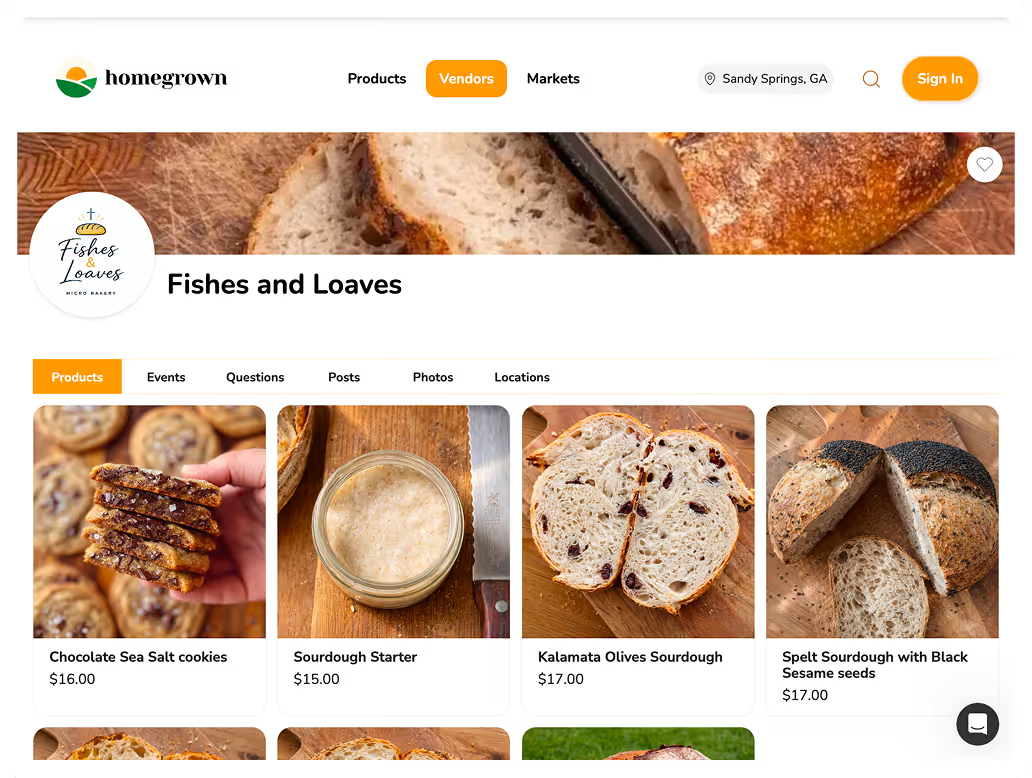
Once you've sold at a few markets, you'll have repeat customers who want to reorder between markets. Rather than managing these through texts and DMs, give them one link where they can see what's available, place an order, and pay. This is especially valuable for honey because supply is limited — when you post that fresh harvest is available, regulars can grab it before you sell out at the next farmers market.
Set up a single ordering link and share it everywhere — that's the fix. Here's why it matters.
You sell at a Saturday market. People love your honey. A few of them ask how they can get more. You swap numbers or Instagram handles. By Tuesday, you have texts from three people, a DM on Instagram, and your neighbor stopped by asking if you have any left.
This is a good problem. It means people want your honey. But managing orders through personal messages gets messy fast. You lose track of who asked for what, you're not sure who's paid, and you spend more time responding to messages than you do working with your bees.
What you actually need is one link. A single URL where customers can see what you have available, select what they want, and pay. You share this link everywhere — text it to regulars, put it on your market signage, post it on social media. Everyone orders through the same place, and you get a clean list of who ordered what.
Pre-orders are a natural fit for honey. Unlike baked goods that you make every week, honey is a seasonal harvest. When you post that the new harvest is available, a pre-order link lets customers claim their jars before you sell out. This is better for you (guaranteed sales, no inventory sitting around) and better for customers (they actually get the honey they want instead of showing up to a sold-out farmers market).
Etsy works if you want to ship honey nationally, but honey is heavy and fragile — shipping costs cut into margins fast, and most small beekeepers sell locally anyway. Etsy also takes 6.5% plus fees per sale. A Google Form is free but does not collect payment — so you are matching form submissions to Venmo payments, which is the same chaos in a different app.
Homegrown is $10/month. List your jar sizes, post that the new harvest is available, and share the link. Customers order and pay before you even start labeling jars. When the spring harvest is claimed, the listing closes — no awkward "sorry, I'm sold out" texts to people who waited too long. Homegrown will not help you sell to grocery stores or ship cases of honey across the state — for that, you need a different setup. But for local pre-orders from people who already know they want your honey, it replaces the group chat for less than the price of one jar per month.
Use scarcity to your advantage — honey's limited seasonal harvest drives demand rather than limiting your business. You harvest once or twice a year, and when this season's honey is gone, it's gone until next year.
This is actually a selling advantage, not a limitation. "Limited harvest" and "seasonal availability" are real — and customers respond to it. Local honey from a specific beekeeper in a specific place is inherently limited, and people value that.
How to manage limited inventory:
Extending your products beyond liquid honey:
Value-add products help you sell more from the same harvest and give customers variety. But don't launch with six products — start with your honey, add one or two once you know what your customers want.
No, most states don't require a specific license to keep bees or sell honey. Some states and counties do require you to register your hives — this is usually free or very cheap and takes a few minutes online. Hive registration helps your state track bee health and disease outbreaks, and it protects you if a neighbor complains. Check with your state's Department of Agriculture for the exact requirements where you live.
A small backyard operation with 3-10 hives can realistically produce 50-200+ pounds of honey per year (depending on your region, weather, and bee health). At $12-16 per pound sold directly, that's $600-3,200+ per harvest season. Add value-add products like creamed honey, infused honey, or beeswax candles and the number goes up. This isn't quit-your-job money for most small beekeepers, but it's meaningful extra income that pays for your beekeeping hobby and then some.
You can, but for a small local producer, it usually doesn't make sense. Shipping honey is expensive (it's heavy), packaging needs to be secure (glass + liquid = risk), and platform fees eat into margins. Most successful small beekeepers sell locally — at farmers markets, through online pre-orders with local pickup, and through word of mouth. You'll make more money per jar and spend less on logistics.
Glass jars are perceived as more premium than plastic and are better for repeat customers who might reuse or return them. Popular options include classic hex jars (the short, wide ones you see at farmers markets), mason jars (familiar, affordable), and Queenline jars (the traditional "honey jar" shape). Buy in bulk to save — a case of 12 hex jars with lids typically runs $15-20.
Most states don't legally require product liability insurance for small honey sales. However, many farmers markets require proof of coverage before you can set up a booth. A basic product liability policy runs $200-500 per year. If you're selling regularly at farmers markets, it's worth the cost for both access and peace of mind.
Store honey in a cool, dry place away from direct sunlight — a pantry or closet works fine. Honey doesn't spoil, but it can crystallize over time, especially in cooler temperatures. Crystallized honey is still perfectly safe and sellable — some customers even prefer it. If you want to re-liquify crystallized honey, gently warm the jar in a warm water bath (not above 110°F to preserve the raw quality).
Yes, and holiday markets can be especially profitable for honey vendors. Honey products make natural gifts, and you can package gift sets with different varieties or pair honey with beeswax candles. Follow the same labeling and cottage food rules as farmers market sales, and check with the event organizer about any additional requirements like proof of insurance or a cottage food permit.
Selling honey doesn't require a business plan, a brand identity, or an e-commerce store. It requires jars, labels, and a way for customers to find you and pay you. The honey is already good — people have been telling you that for years. The regulations are simpler than you think. The demand for local, raw honey far outpaces the supply in most areas.
Start with your next harvest. Label it properly. Bring it to a farmers market or tell your neighbors it's available. And when people start texting you for refills, give them a link instead of a group chat.
Ready to take honey orders without the text message chaos? Homegrown gives you a simple Homegrown storefront where customers can see what's available, order, pay, and choose pickup or local delivery, all in one link. Set it up in 15 minutes and share it before your next harvest.