

You've been making your hot sauce for years. People keep asking for bottles. Someone offered you $20 for a jar of it. When you finally looked into how to sell it, you hit a wall: cottage food laws, FDA regulations, pH testing, acidified foods. It got complicated fast.
The short version: Selling hot sauce has a higher compliance bar than jam or honey because hot sauce is classified as an acidified food. You need to verify your pH is below 4.6 for every batch, and many states exclude acidified foods from cottage food laws — meaning you may need a licensed kitchen or co-packer. But the path is clear: test your pH, label your bottles properly, find your production path (home kitchen, shared commercial kitchen, or co-packer), and price 5 oz bottles at $8-15. The demand for small-batch artisan hot sauce is real and growing.
Here's the clear version: selling hot sauce isn't quite like selling jam or honey. There are real differences in what's required and why. But the path is knowable, the compliance steps are manageable, and there's genuine demand for small-batch, artisan hot sauce that no grocery store can replicate.
This guide covers what the rules actually are, what you need to do to comply with them, how to label and bottle your sauce, what to charge, and where to sell it.
Hot sauce is classified as an acidified food, which means it faces stricter regulation than naturally high-acid or raw agricultural products. Understanding this upfront will save you a lot of confusion.
Honey is a raw agricultural product. Jam is a naturally high-acid food. Both are allowed under cottage food laws in nearly every state because they're inherently safe for home production — the biology works in your favor.
Hot sauce is different. It's what the FDA classifies as an "acidified food" — a low-acid food that has been brought to a safe pH level through the addition of acids (typically vinegar). The problem is that achieving the right pH requires control. If a batch isn't acidified correctly, it can support harmful bacterial growth. This is why acidified foods are regulated differently than jam.
What this means practically:
This doesn't mean you can't sell your hot sauce. It means the path requires a few additional steps compared to jam or honey. Work through those steps and you're in the clear.
You have three main production paths: cottage food (if your state allows it), a licensed commercial kitchen, or a co-packer. Before you sell a single bottle, understand which legal category applies to you.
Cottage food (home kitchen): Check your state's specific law. Some states allow vinegar-based hot sauces under cottage food. Others explicitly exclude all acidified foods. Forrager's state cottage food law directory is the best place to start. Look at your state's list of permitted foods and see if hot sauce, acidified foods, or fermented products are included or excluded.
Licensed kitchen: If your state excludes hot sauce from cottage food, you'll need to produce in a licensed commercial kitchen. Many cities and towns have shared-use commercial kitchens you can rent by the hour. Food business incubators, community centers, and culinary schools often have licensed kitchen space available for rent. This is the most common path for small hot sauce producers.
Co-packer: A co-packer is a licensed commercial food production facility that makes your product under your recipe and sells it to you under your label. You provide the recipe; they do the production in a compliant kitchen. More on this in a dedicated section below. See Chile Pepper Institute for additional context.
Production path comparison:
| Path | Best For | Typical Cost | Minimum Volume |
|---|---|---|---|
| Cottage food (home kitchen) | Local sales, small batches | Ingredient costs only | No minimum |
| Licensed commercial kitchen | Growing vendors, farmers markets | $15-50/hour rental | No minimum |
| Co-packer | Scaling up, retail distribution | $1-3/bottle + setup fees | 100-500 bottles |
Selling at farmers markets: Market rules vary. Some markets require proof of cottage food compliance for any food product. Others are more permissive. Check with your specific farmers market before assuming you can bring your sauce.
Shipping across state lines: Interstate commerce triggers FDA oversight more directly. If you plan to sell and ship nationally, you'll want to be operating from a licensed facility and following full FDA labeling requirements.
Test every batch with a calibrated digital pH meter — your target is below 4.6, and this is non-negotiable for food safety. If you're selling hot sauce, you need to know your product's pH. This is the fundamental food safety issue for acidified foods.
The target: pH below 4.6. At pH 4.6 or below, Clostridium botulinum (the bacterium that causes botulism) cannot grow. This is the same threshold for safe water-bath canning. Your hot sauce needs to hit this mark consistently, batch to batch.
Vinegar-based sauces typically pass easily. Standard distilled white vinegar has a pH of 2.4-3.4. If your sauce is primarily vinegar and peppers, with vinegar as a substantial ingredient, it almost certainly lands well below 4.6. Still — verify it.
Fermented hot sauces require more care. Fermentation is a biological process and results vary. A fermented pepper mash might be pH 3.8, or it might be 4.2, or it might be borderline. Fermented sauces absolutely need pH testing before you sell them.
How to test:
Test every batch. The ingredients you use vary season to season. A pepper's heat level changes, vinegar acidity varies slightly by brand. Don't assume one good test covers all future batches.
Every bottle needs a product name, net quantity, your name and address, a full ingredients list, and an allergen statement at minimum. Hot sauce labeling is more involved than jam or honey because federal FDA requirements apply to most commercially sold hot sauce, even small-batch producers.
Required on every label:
Nutrition facts panel: Federal regulations require a nutrition facts panel for most food products sold commercially. For very small businesses (under $1 million annual sales with fewer than 100 full-time employees), there's a small business exemption from some FDA requirements, but this has nuances. If you're selling primarily at local farmers markets and to friends, the reality is that enforcement at the cottage/artisan level is rare. As you scale, get this right.
Best by date and lot code: Not always legally required at the cottage level, but strongly recommended. A best by date tells customers how long the sauce is good, protects you from liability, and is expected by stores and professional buyers.
Practical label execution:
Use 5 oz woozy bottles with hot fill for vinegar-based sauces — they're the industry standard for artisan hot sauce. The bottle you choose matters for presentation, safety, and customer experience.
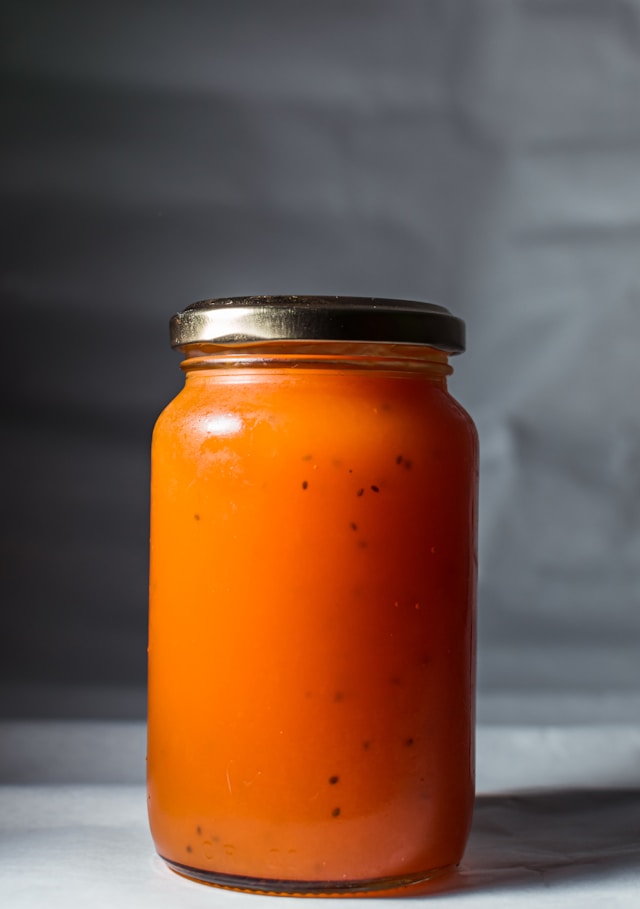
Woozy bottles (the classic Boston round with the long neck and small opening) are the standard for hot sauce. The narrow neck controls pour, the shape is recognizable, and they're available in standard sizes (5 oz is most common for artisan hot sauce). Order in bulk from bottle suppliers online — a case of 144 five-ounce woozy bottles typically runs $40-70.
Hot fill vs. cold fill:
| Method | How It Works | Best For |
|---|---|---|
| Hot fill | Bottle at 190°F+, pasteurizes and creates vacuum seal as it cools | Vinegar-based sauces, shelf-stable products |
| Cold fill | Bottle at room temperature or chilled | Fermented sauces, refrigerated products |
Most small-batch hot sauce vendors use hot fill for vinegar-based sauces. For fermented or refrigerated sauces, cold fill is typical. The Specialty Food Association provides additional guidance on this.
Caps: Metal caps or plastic lined caps work with woozy bottles. Metal gives a cleaner look; plastic is easier to open. Shrink bands over the cap are standard for artisan hot sauce and add a level of professionalism that customers notice.
Price a 5 oz bottle of artisan hot sauce at $8-15 for direct-to-consumer sales — the economics are solid at this range. Small-batch artisan hot sauce commands prices grocery store hot sauce can't touch — and our guide on pricing food products for a farmers market covers the full framework.
Unusual flavor profiles, extreme heat, or premium ingredients (specialty peppers, organic produce) can go $12-20 or more.
Your costs per bottle:
| Cost Item | Amount |
|---|---|
| Bottle + cap | $0.50-1.50 |
| Shrink band | $0.10-0.20 |
| Label (waterproof) | $0.35-1.00 |
| Ingredients | $0.50-2.50 |
| Total | $1.45-5.20 |
At a selling price of $10, your margin is $4.80-8.55 per bottle. Sell 50 bottles at a farmers market day and that's $240-425 in margin before the booth fee. The economics are solid.
Don't price against Tabasco. Mass-produced hot sauce is a commodity. Yours is a small-batch, hand-crafted product with a story. The people buying artisan hot sauce at a farmers market aren't comparing it to the bottle in their refrigerator. They're buying it because it's local, distinctive, and better. Price accordingly.
Check specialty store prices. Your best pricing reference is what small-batch hot sauces sell for at your local specialty food store, farmers market, or online (Etsy, small producers' websites). That's your market.
Farmers markets and local events are the best starting point — the sample-and-sell model works perfectly for hot sauce. Expand into retail and online as your production scales.
Hot sauce is a natural farmers market product — the sample cup and the heat level do the selling. Set up a small tasting station with chips or crackers, a few different heat levels to choose from, and clear labels. Let people try it. A medium-heat sauce and a hot sauce will convert a higher percentage of your traffic than any signage.
Check with your farmers market about their labeling and cottage food requirements before your first day. Markets vary significantly on this.
For a complete guide to setting up and selling at markets, see our walkthrough on how to sell at a farmers market.
Local specialty grocery stores, high-end butcher shops, craft beer stores, and deli counters often carry local hot sauce — especially if it has a clean label and consistent production. Walk in with a sample and a one-page sell sheet (product name, heat level, ingredients, price, wholesale terms). Wholesale at 50-60% of your retail price.
This channel requires professional labeling and consistent supply. If a store puts your sauce on the shelf, they need to be able to reorder reliably.
Hot sauce ships reasonably well — the price point justifies the shipping cost in a way that jam (which can go for $6-9) often doesn't. A $12 bottle of hot sauce with $8 shipping is still a reasonable purchase for someone who loves your products.
Etsy is a natural platform for artisan hot sauce vendors. Your own website, social media direct messages, and food-focused marketplaces are also options. For shipping glass, use:
Regional gift shops, tourist destinations, state-specific product stores, and food gift companies often carry local and regional food products. A locally branded hot sauce can be a natural fit for this channel — especially if you can tie it to your region (peppers grown locally, a distinctive local flavor profile, regional branding).
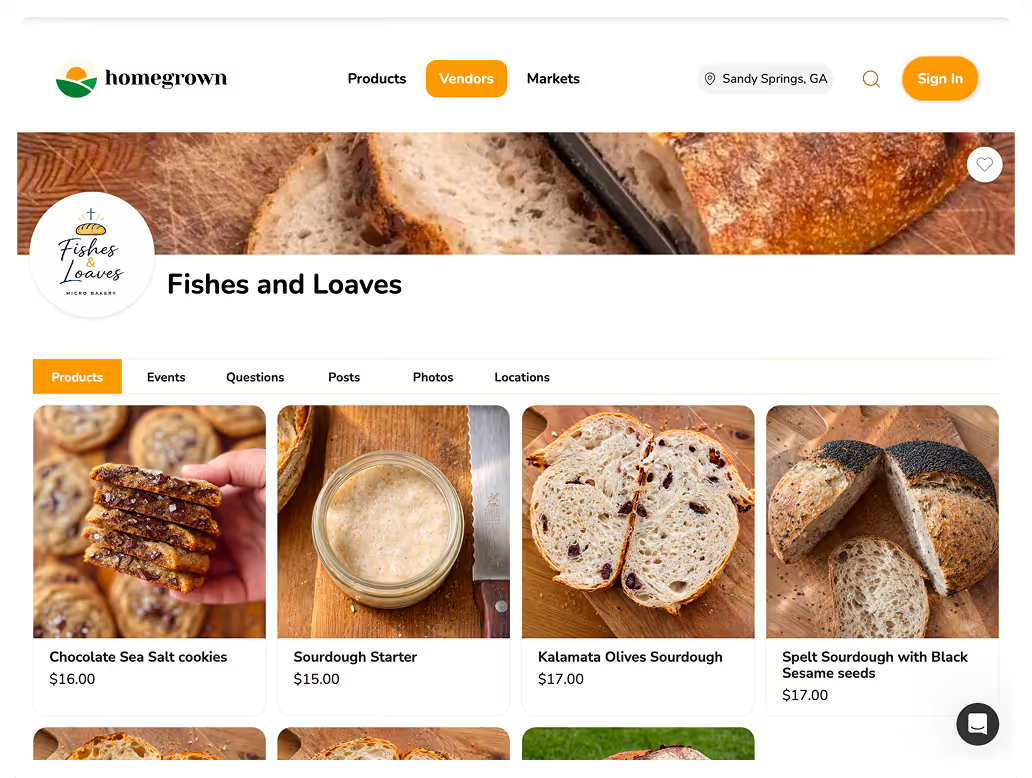
Once people in your circle are asking for refills every few weeks, managing those requests through texts stops working. Etsy charges 6.5 percent per transaction and works for shipped orders to strangers, but it is overkill for the 15 local regulars who just want to reorder their usual three bottles. Venmo moves money but includes no order details — you still track who wants which heat level in a notebook. Homegrown costs $10/month with no percentage fees beyond standard payment processing (2.9 percent plus $0.30 per transaction) and gives you one link where customers see your available sauces, order, pay, and choose pickup or local delivery. Homegrown does not ship your bottles, manage your Etsy listings, or handle co-packer logistics — it handles the local ordering and payment step that replaces the group text.
A co-packer produces your hot sauce in a licensed facility under your recipe and label — it's the most common scaling solution for small hot sauce vendors. If your state doesn't allow hot sauce under cottage food, or if you want to scale without renting kitchen time yourself, this is the path most producers eventually choose.
What a co-packer does: A co-packer (short for contract packager) is a licensed commercial food production facility. You bring your recipe; they produce it in a compliant kitchen with proper equipment and documentation. The finished product comes out under your label.
Why this matters for hot sauce: Co-packers already have the licenses, equipment, and processes for producing acidified foods. You don't need to navigate kitchen licensing yourself — you just rent their production capacity. The proper food labeling from USDA provides additional guidance on this.
What to expect:
How to find a co-packer: Search "hot sauce co-packer" or "food co-packer [your state]." Local food business incubators often maintain referral lists. Some co-packers specialize in hot sauces specifically and can advise on recipe adjustments for safe production.
It depends on your state. Some states allow vinegar-based hot sauces under cottage food laws, while many states explicitly exclude acidified foods from cottage food exemptions. Check your state's specific law — Forrager's cottage food directory has this information. If your state excludes acidified foods, your options are a licensed commercial kitchen or a co-packer.
For commercial sales, yes — a pH below 4.6 is required for shelf stability, and a certified lab test gives you documented proof. For home kitchen production and small local sales, a calibrated digital pH meter is a reasonable starting point — test every batch and keep records. For selling to stores, restaurants, or online nationally, get a formal lab test ($50-150 per sample).
Yes — Etsy has an active market for artisan hot sauce. Your production and labeling need to comply with FDA requirements and your state's laws regardless of the platform. For shipping glass bottles, double-box them with bubble wrap, include a sealed inner bag in case of leakage, and label the outer box "Fragile." Most 5 oz bottles survive standard shipping when packed well.
Unprocessed fresh pepper mash is a different product with a shorter shelf life and different regulatory treatment. Most home vendors focus on finished hot sauce (vinegar-based or fermented and shelf-stable) rather than fresh mash, because shelf stability is what makes the product sellable across channels.
Properly acidified, hot-filled vinegar-based hot sauce typically lasts 1-2 years unopened at room temperature. Fermented hot sauces may have shorter shelf lives depending on the pH and processing method. Once opened, most hot sauces keep 6-12 months refrigerated. Always include a best-by date on your label.
Your startup costs depend on your production path. For cottage food production (where allowed), expect $100-300 for bottles, caps, labels, ingredients, and a pH meter. If you need a licensed kitchen, add $15-50 per hour of rental time. A co-packer run typically requires $500-2,000 upfront for your first batch (setup fees plus 100-500 bottles at $1-3 each).
Yes, but check with your specific farmers market about their requirements first. Some markets require proof of cottage food compliance, a licensed kitchen certificate, or product liability insurance. Hot sauce is a strong farmers market product because the sample-and-sell model works exceptionally well — let people taste it, and the product sells itself.
Selling hot sauce has a higher compliance bar than most cottage food products, but the bar is clear and manageable. Verify your pH, label your bottles properly, find your production path, and get your sauce in front of people who want it.
Start small — sell to the people already asking for bottles. Use their demand to fund a small licensed kitchen run or co-packer batch. Build from there.
When your regulars start asking for refills on a regular basis, give them a link instead of a phone number. An ordering page takes 15 minutes to set up and replaces the text conversations you are managing every time a new batch is ready.