

14 min read
Selling homemade food at farmers markets or through local delivery doesn't require an LLC. Most cottage food vendors start as sole proprietors and never form one. But there are situations where an LLC makes sense — and situations where your money is better spent on insurance.
This guide breaks down what business structure cottage food vendors actually use, when an LLC is worth the cost, and what other legal steps matter more when you're just getting started.
The short version: You don't need an LLC to sell food from home. Most cottage food vendors operate as sole proprietors, which is the default business structure that requires zero paperwork to set up. An LLC starts making sense when your annual revenue exceeds $25,000 to $50,000 or when you're selling at events with higher liability risk. For most vendors earning a few hundred to a few thousand dollars per month at farmers markets, general liability insurance ($200 to $500 per year) provides more practical protection than an LLC.
Most people selling food from home use one of two structures: sole proprietorship or LLC. Here's what each one means in plain terms.
A sole proprietorship isn't something you file for. It's what you already are the moment you start selling food for money. There's no paperwork to create one, no formation fees, and no annual reports to file with the state.
You report business income on your personal tax return using Schedule C. You can open a business bank account, get a business license, and operate under your own name or a DBA (doing business as) name — all without forming an LLC.
The tradeoff is liability. As a sole proprietor, there's no legal separation between you and your business. If someone sued your business, your personal assets (home, car, savings) could theoretically be at risk.
For a cottage food vendor selling jars of jam at a Saturday market, that risk is real but small. Most cottage food operations never face a lawsuit, and the ones that do are usually covered by insurance.
An LLC creates a legal wall between your personal assets and your business. If someone sues your salsa business, they can go after business assets but not your personal savings or home — assuming you've maintained proper separation.
Forming an LLC requires:
An LLC also gives your business more credibility if you're approaching wholesale accounts, commercial kitchens, or retail stores.
Corporations (S-corp, C-corp) and partnerships exist but rarely make sense for cottage food vendors. These add complexity, cost, and paperwork that only pays off at much higher revenue levels. If you're reading this article, you almost certainly don't need either one.
An LLC isn't a universal requirement, but it's worth considering in a few specific situations.
Your revenue is growing past $25,000 to $50,000 per year. At this level, you have meaningful assets in the business worth protecting, and the cost of maintaining an LLC represents a smaller percentage of your revenue.
You're selling at events with higher liability risk. Large festivals, catering jobs, and events where you're serving food directly to large groups carry more risk than a Saturday farmers market booth. An LLC adds a layer of protection.
Your state has low LLC costs. In states where formation and annual fees total under $150 per year, the cost-benefit math works out even at lower revenue levels. In California, where the minimum franchise tax is $800 per year, that same math looks very different for a vendor earning $15,000 annually.
You're scaling beyond cottage food. If you're moving into a commercial kitchen, hiring employees, or selling wholesale to stores, an LLC becomes more important. The complexity and liability of a commercial food operation justify the structure.
You have significant personal assets to protect. If you own a home and have savings you want to shield from any potential business liability, an LLC provides that separation — as long as you maintain it properly.
Most cottage food vendors reading this article fall into one or more of these categories.
You're earning under $25,000 per year. The annual cost of an LLC ($50 to $800+ depending on your state) eats into already thin margins. If you're making $500 a month selling cookies at a farmers market, spending $800 on California's LLC tax doesn't make financial sense.
You're operating under cottage food exemptions with sales caps. Many states cap cottage food sales at $25,000 to $75,000 per year. If your state limits how much you can sell, the liability exposure is naturally limited too. Check your cottage food laws for your state's specific cap.
You're just getting started and testing the market. Don't let LLC formation delay your first sale. You can always form one later once you know the business is viable. Plenty of successful cottage food vendors operated for years as sole proprietors before forming an LLC — or never formed one at all.
The LLC cost is a significant chunk of your profit. If you're netting $5,000 per year and your state charges $300 in annual LLC fees, that's 6% of your profit going to a legal structure. That money might do more for you as liability insurance or better equipment.
You don't need an LLC to sell food from home. What you need is a good product, the right permits, and customers. The legal structure can come later.
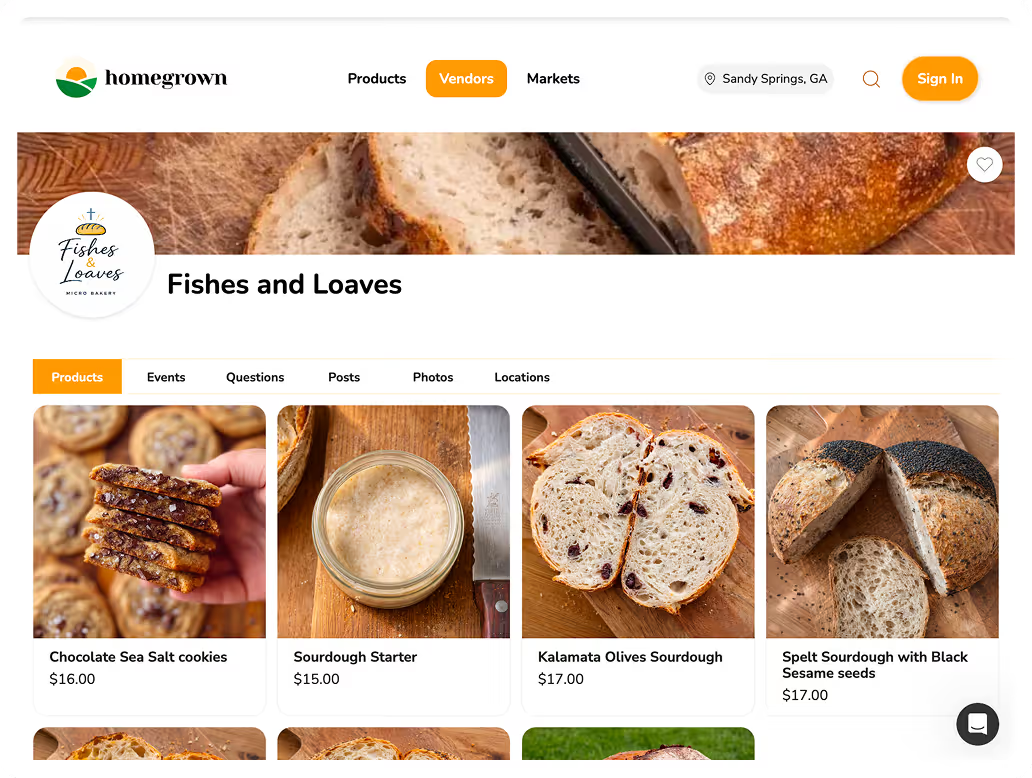
Homegrown is $10/month with no percentage fees beyond standard payment processing and gives you an ordering page where customers browse, order, and pay upfront — no LLC required to start. Compare that to Etsy (6.5% per transaction plus listing fees) or coordinating everything through Venmo and text messages with no order records. Homegrown doesn't file your taxes or handle your permits — it gives you a structured ordering system with built-in payment documentation, which is the kind of record-keeping that actually matters whether you're a sole proprietor or an LLC.
Understanding what an LLC does — and doesn't do — helps you make a smarter decision.
What an LLC protects:
What an LLC does NOT protect:
The biggest misconception: Many people think forming an LLC means they can't be sued. That's not true. An LLC limits what's at stake if you lose a lawsuit. You can still be sued, and defending a lawsuit still costs money regardless of your business structure.
Piercing the corporate veil: If you mix personal and business finances — paying personal bills from your business account, not keeping separate records, or treating business money as your own — a court can ignore your LLC protection entirely. This is called "piercing the corporate veil," and it means your personal assets are back on the table. An LLC only works if you actually operate it like a separate entity.
Here's something most LLC articles won't tell you: for a small cottage food vendor, general liability insurance provides more practical protection than an LLC.
General liability insurance for food vendors typically costs $200 to $500 per year and covers:
Many farmers markets require vendors to carry liability insurance anyway. So you may already be paying for this protection.
Insurance protects you even as a sole proprietor. You don't need an LLC to have insurance. A sole proprietor with good liability coverage is better protected than an LLC owner with no insurance.
Insurance pays for your defense. Even if you have an LLC, you still need to pay a lawyer if someone sues you. Insurance covers those costs. An LLC without insurance means you're paying legal fees out of pocket.
The practical approach for most cottage food vendors: start as a sole proprietor, get liability insurance, and consider an LLC later if your revenue justifies the cost.
If you've weighed the costs and decided an LLC makes sense for your food business, here's the process. You can do this yourself without a lawyer in most states.
You'll typically form your LLC in the state where you live and operate. There's no advantage to forming in Delaware or Wyoming for a cottage food business — that advice is for large corporations, not local food vendors.
Your LLC name needs to be unique in your state. Search your state's business name database (usually through the Secretary of State website) to check availability. The name must include "LLC" or "Limited Liability Company."
File this document with your state's Secretary of State office. Most states let you file online. The filing fee ranges from $50 to $200 in most states.
You'll need to provide:
An EIN (Employer Identification Number) is a tax ID for your business. It's free and takes about 5 minutes to get through the IRS website. You need an EIN if you have an LLC, even if you don't have employees.
Take your articles of organization and EIN to any bank and open a business checking account. This is not optional — you must keep business and personal finances separate for your LLC protection to work.
Most states require:
Miss these deadlines and your state can dissolve your LLC, eliminating your liability protection.
Typical total cost to form and maintain an LLC:
An EIN isn't required for sole proprietors with no employees — you can use your Social Security number for tax purposes. But getting one is free and takes five minutes, so there's almost no reason not to.
Benefits of getting an EIN as a sole proprietor:
Apply for free at IRS.gov. The online application takes about 5 minutes and you get your number immediately.
Before worrying about business structure, make sure you've handled these basics. These are the legal requirements that actually affect whether you can sell food from home.
Cottage food permit or registration. Most states require some form of registration to sell homemade food, and Forrager's state-by-state directory tracks the specific requirements for each. Some require a food safety course. Check your state's cottage food laws for more details.
Business license. Most cities and counties require a general business license to sell anything, including cottage food. This is usually $25 to $100 per year. Learn more about whether you need a license to sell food from home.
Sales tax registration. If your state charges sales tax on food, you'll need a sales tax permit. Some states exempt cottage food from sales tax. Check with your state's department of revenue.
Food handler certification. Many states require at least one food safety course. Some accept online courses that cost $10 to $20 and take a few hours.
Proper labeling. Cottage food products typically need specific label information — your name, address, ingredients, allergens, and a cottage food disclaimer. Getting your labels right is a legal requirement, not optional.
These steps are what actually let you sell food legally. An LLC is about business structure, not food safety compliance. Handle the food-related requirements first.
If you're just getting started, our guide to starting a cottage food business walks through all of these steps in order.
Set up an ordering page and start selling your homemade food products today — no LLC needed to get started.
Ready to turn this into a real business? The easiest way to take local orders and get paid is an online storefront — see the best platform to sell food from home, or set up a Homegrown storefront in about 15 minutes ($10/mo, 0% commission).
No. You can sell baked goods from home as a sole proprietor in most states. You need a cottage food permit or registration and proper labeling, but an LLC is not a legal requirement for selling baked goods. Most home bakers operate for years without one.
LLC formation costs range from $50 to $200 in most states for the initial filing. Annual maintenance fees vary from $0 to $800+ per year depending on your state. California is the most expensive at $800 per year minimum. Many Midwestern and Southern states charge under $100 per year total.
Yes. Farmers markets require vendor applications, food permits, and often liability insurance — but not an LLC. Thousands of farmers market vendors operate as sole proprietors. The market itself doesn't care about your business structure as long as you have the required permits and insurance.
A DBA (doing business as) is just a business name registration. It lets you operate under a name other than your legal name — like "Sarah's Kitchen" instead of "Sarah Johnson." A DBA provides zero liability protection. An LLC is a legal business entity that separates your personal and business assets. You can have a DBA with or without an LLC.
It's not legally required for sole proprietors, but it's strongly recommended. A separate account makes bookkeeping easier, simplifies tax filing, and looks more professional. If you form an LLC, a separate business bank account is essential — mixing personal and business funds can eliminate your liability protection.
After. Start selling first. See if you enjoy the work, if customers want your products, and if the business is viable. You can always form an LLC later. There's no penalty for starting as a sole proprietor and converting to an LLC once you know the business is worth the investment.
Many successful cottage food vendors turn their food hobby into a business as sole proprietors and add an LLC only when revenue justifies the cost. Focus on making great food and finding customers first. The legal structure is the easy part.
An ordering page takes about 15 minutes to set up — no LLC or business structure required to start selling.