

You've been baking cookies for years. People always ask for your recipe. Someone offered to pay you for a batch last Christmas, and you said no — but you're wondering if you should have said yes.
The short answer: selling cookies from your home kitchen is legal in every U.S. state under cottage food laws, and cookies are one of the more straightforward products to start with. They're dry, shelf-stable, and require no commercial kitchen in most states for direct-to-consumer sales.
The short version: You can legally sell cookies from home in all 50 states under cottage food laws — no commercial kitchen needed. Price standard cookies at $2-4 each (or $18-36 per dozen) and decorated cookies at $4-8 each. Label every package with ingredients, allergens, and your contact info. Start selling at farmers markets or through porch pickup, then set up a Homegrown storefront once you have regulars placing repeat orders.
This guide covers what's legal, how to label your packaging, what to charge (including for custom orders), how to package cookies so they sell at a higher price point, and how to handle the holiday rush when your inbox fills up with December orders.
Yes — in every U.S. state, and cookies are among the most permissive cottage food products you can sell.
Cottage food laws exist in all 50 states. These laws allow home bakers to produce and sell certain foods directly to consumers without a commercial kitchen, health department inspection, or food business license. Cookies fall squarely within what's allowed, and for good reason.
Why cookies specifically? They're dry, shelf-stable at room temperature, and carry a very low food safety risk compared to products that need refrigeration. That combination makes them one of the easiest cottage food products to get approved. If you're thinking about starting a home food business and wondering where to begin, cookies are a strong starting point.
What cottage food sales typically allow:
What may still apply:
One exception to note: Cookies with fillings or frostings that require refrigeration — cream cheese frosting, custard fills, fresh cream — may fall outside cottage food rules in your state. Standard dry baked cookies are fine everywhere. Fillings requiring refrigeration are where it gets complicated. If your signature cookie uses cream cheese frosting or a perishable filling, check your state's specific rules before selling.
To look up your state's specific cottage food law, use Forrager's state directory — it tracks what each state allows, revenue caps, labeling requirements, and whether you need a permit or training course.
Every cookie you sell needs a proper label — and cookies have more labeling complexity than many cottage food products, mostly because of allergens. A jar of honey needs five fields on the label. A cookie label needs more, and getting it wrong can create real liability.
What most states require on cottage food labels:
Allergens are the most important label element for cookies.
Most cookies contain multiple of the eight major food allergens: wheat (gluten), eggs, milk, and often tree nuts or peanuts. You're legally required to disclose these in most states. The standard format is a bolded statement at the end of your ingredient list: Contains: wheat, eggs, milk.
If your kitchen also processes peanuts or tree nuts — even if a specific cookie recipe doesn't include them — you may need a "May contain" advisory statement. This is called cross-contact labeling, and it matters when someone with a severe nut allergy is trusting your label to keep them safe.
Don't skip allergen labeling. It protects your customers and protects you. A customer with a wheat allergy who bites into an unlabeled cookie is a liability issue, not just a bad experience.
Ingredient list formatting. List every ingredient, including sub-ingredients. If your recipe uses butter, list "butter (cream, salt)" rather than just "butter." If you use vanilla extract, list "vanilla extract (water, alcohol, vanilla bean extractives)." This level of detail is standard practice and shows customers you take labeling seriously.
Label printing options compared:
| Method | Cost Per Label | Best For | Notes |
|---|---|---|---|
| Canva + Avery sheets | $0.10-0.25 | Starting out | Easiest path, print at home |
| Custom printed labels | $0.25-0.75 | Polished branding | Order from a print shop |
| Thermal label printer | $0.02-0.05 | High volume | $100-200 upfront for the printer |
For most vendors starting out, Canva templates printed on Avery sheets are the easiest path. You can upgrade to custom printed labels once your volume justifies the cost.
Price your cookies based on what you're making and the time involved — not what the grocery store charges. A batch of basic drop cookies prices differently than decorated royal icing sugar cookies that took three hours to finish. Understanding the difference — and pricing accordingly — is what keeps a cookie business profitable rather than a hobby that costs you money.
Standard homemade cookies — chocolate chip, snickerdoodles, oatmeal raisin, double chocolate, peanut butter — typically sell for $2-4 per cookie individually, or $18-36 per dozen.
Regular cookie pricing overview:
| Format | Price Range |
|---|---|
| Individual cookie | $2-4 |
| Half dozen | $8-15 |
| Full dozen | $18-36 |
The range depends on your ingredients, your cookie size, and your local market. A standard 2-3 oz chocolate chip cookie at a farmers market in a suburban area typically sells for $3. Larger cookies (4+ oz) with premium ingredients like Belgian chocolate or macadamia nuts can push to $4-5.
Cost per cookie breakdown:
| Cost Category | Range |
|---|---|
| Ingredients | $0.15-0.50 per cookie |
| Packaging | $0.10-0.30 per bag or sleeve |
| Label | $0.05-0.10 per package |
| Total cost | $0.30-0.90 per cookie |
Margin at $3/cookie with $0.50 total cost: $2.50. At a farmers market with 10 sales per hour, that's $25/hour on cookies alone before factoring booth time and setup. Double or triple that number if you're selling packaged dozens.
Don't price down to grocery store bakery prices. You're selling something made by a person, in a home kitchen, with real ingredients and no preservatives. Grocery store cookies are made by machines in facilities producing thousands of units per hour. Your products are different. Your price should reflect that.
Decorated sugar cookies sell for significantly more than standard cookies — and they should, because the time investment is dramatically higher. Royal icing designs, seasonal shapes, wedding favors, baby shower sets, and corporate gifts all command premium pricing.
Custom cookie pricing overview:
| Format | Price Range |
|---|---|
| Individual decorated cookie | $4-8 |
| Custom dozen | $40-80+ |
| Event orders (wedding favors, corporate gifts) | $100-200+ |
Event orders — wedding favors, corporate gifts, holiday boxes — often price by the box or the set rather than per cookie. A box of 6 custom decorated cookies as a wedding favor might sell for $30-40, which is $5-7 per cookie.
What justifies the higher price? Time. A basic chocolate chip cookie takes 30-40 seconds to portion and bake. A multi-step royal icing decorated cookie might take 5-10 minutes of active decorating time per cookie, plus drying time between layers. That labor cost is real and should be priced accordingly.
A dozen decorated cookies that take 90 minutes of decorating time at even $20/hour labor adds $30 in labor cost alone — before ingredients and packaging. Don't underprice your time. Customers buying custom decorated cookies are paying for your skill, not just your ingredients.
Minimums and deposits for custom orders:
Most custom cookie bakers require:
Set these policies before you start taking custom orders. It's much easier to establish minimums and deposits up front than to add them after customers are used to ordering 4 cookies with no deposit.
Good packaging is what turns a $2 cookie into a $3-4 cookie. Packaging is not optional for cookie vendors — it's part of the product. A cookie in a plain bag sells for $2. The same cookie wrapped in a heat-sealed cellophane bag with a labeled kraft backing card sells for $3-4. Same cookie, different packaging, different perceived value, different price point.
Individual cookie packaging options:
Multi-cookie set options:
Decorated and custom cookie packaging:
Packaging cost comparison:
| Packaging Style | Cost Per Package | Best For |
|---|---|---|
| Cellophane bags (heat-sealed) | $0.15-0.25 | Individual cookies at farmers markets |
| Kraft boxes with window | $0.50-0.75 | Gift dozens, holiday sets |
| Custom printed boxes | $0.75-1.50 | High-volume vendors, branded orders |
| Cookie tins | $1.00-3.00 | Premium holiday products |
Factor packaging into your pricing — a $0.60 box on a dozen $3 cookies adds $0.05 per cookie to your cost. Worth it for the price point it enables. A kraft box with a window that costs $0.60 lets you charge $36 for a dozen instead of $30 in bags. The packaging pays for itself three times over.
Branding tip: A simple sticker with your business name and Instagram handle on every package turns each sale into a mini advertisement. Customers carry your branded package around the farmers market, post it on social media, and bring the box to a party where someone asks where they got those cookies.
You have several strong channels for selling cookies from home, from in-person farmers market sales to online ordering through a Homegrown storefront. The best approach depends on your schedule, your products, and how many customers you're serving.
Farmers markets are one of the strongest channels for cookies. Baked goods are consistent top-selling products at farmers markets, and cookies specifically are easy to display, easy to sample, and move in volume because the price point is low enough for impulse buys.
Strategies that work at farmers markets:
If you're selling at farmers markets, how to sell at a farmers market covers booth setup, pricing strategies, and what actually moves at farmers markets.
Porch pickup costs you nothing in booth fees and works well if you have a neighborhood following or are promoting on social media. Low overhead, zero booth fees, and completely flexible scheduling.
The "DM to order, porch pickup Saturday morning" model is a real and successful approach for home cookie vendors. You bake in batches, post on Instagram or a neighborhood app like Nextdoor, accept orders by Thursday, and have everything bagged and labeled for Saturday pickup. Your porch becomes your pickup counter. Customers text when they arrive, grab their bag, and go.
This model works especially well for custom and decorated cookies where customers are ordering in advance anyway. No need for a booth or a farmers market schedule — just a consistent pickup window and a way to take orders.
Most cottage cookie businesses start this way — and word of mouth is often the most reliable long-term growth channel. Someone buys a batch for a party, the host asks who made them, you hand out your info. The Christmas cookies you gave as gifts become your first paid orders next December.
Word of mouth is slow and then fast. You might sell 3 dozen in your first month and wonder if it's worth it. Six months later you're turning down orders because your December calendar is full. Let it build. Every satisfied customer is a referral waiting to happen, especially around the holidays when people are looking for gifts and party food.
Business cards or a small card with your name, phone number, and Instagram handle tucked into each package helps word of mouth along. When someone at a dinner party asks about the cookies, the host can hand them your card instead of trying to remember your name.
Custom cookies for weddings, baby showers, birthdays, baptisms, graduation parties, and corporate events are a separate business model within cookies — and a high-margin one.
Custom order pricing examples:
| Order Type | Typical Price Range |
|---|---|
| Dozen decorated cookies (baby shower) | $48-60 |
| Wedding favor order (150 guests) | $500-750 |
| Corporate gift boxes (20 boxes) | $600-800 |
These orders justify the time investment and can sustain a cookie business on their own without needing a farmers market booth.
Local event planners, wedding venues, and florists can become referral sources worth cultivating if you do custom work. Drop off a sample box with your card. If they like what they taste, they'll start recommending you to their clients.
Once you have regulars — people who buy every Christmas, every Easter, every time they host a party — managing orders over text and DM stops working. You get buried in messages, lose track of who ordered what, forget to confirm payment, and someone ends up disappointed.
One link where regulars can place and pay for orders removes that friction completely. When your December batch is ready, you post the link. First come, first served. No chasing down Venmo requests. No scrolling through DMs to figure out who ordered two dozen versus one dozen. The question is which tool gives you that link without costing more than the cookies.
Instagram DMs and text messages work fine for your first handful of orders. But once you have 10-15 regulars placing holiday orders through four different message threads, you're spending more time on order management than decorating. There's no payment collection, no capacity limit, and no record of who ordered what — which is how you end up with two customers claiming they ordered snickerdoodles when you wrote down sugar cookies.
Etsy is designed for shipping products nationwide. If you want to sell cookies across the country, it works — but you're paying 6.5% + $0.20 per listing + payment processing, and your local customers have to pay shipping or find the "local pickup" option buried in Etsy's checkout flow. On a $60 holiday cookie order, Etsy takes about $4.30 in fees.
Square Online has a free tier and handles pickup, but it's built for restaurants and retail stores with daily menus, not a cookie vendor who takes weekly pre-orders with a Saturday pickup window.
Shopify starts at $39/month — designed for e-commerce businesses doing nationwide fulfillment. Overkill for a home cookie vendor managing 15-30 local orders per week.
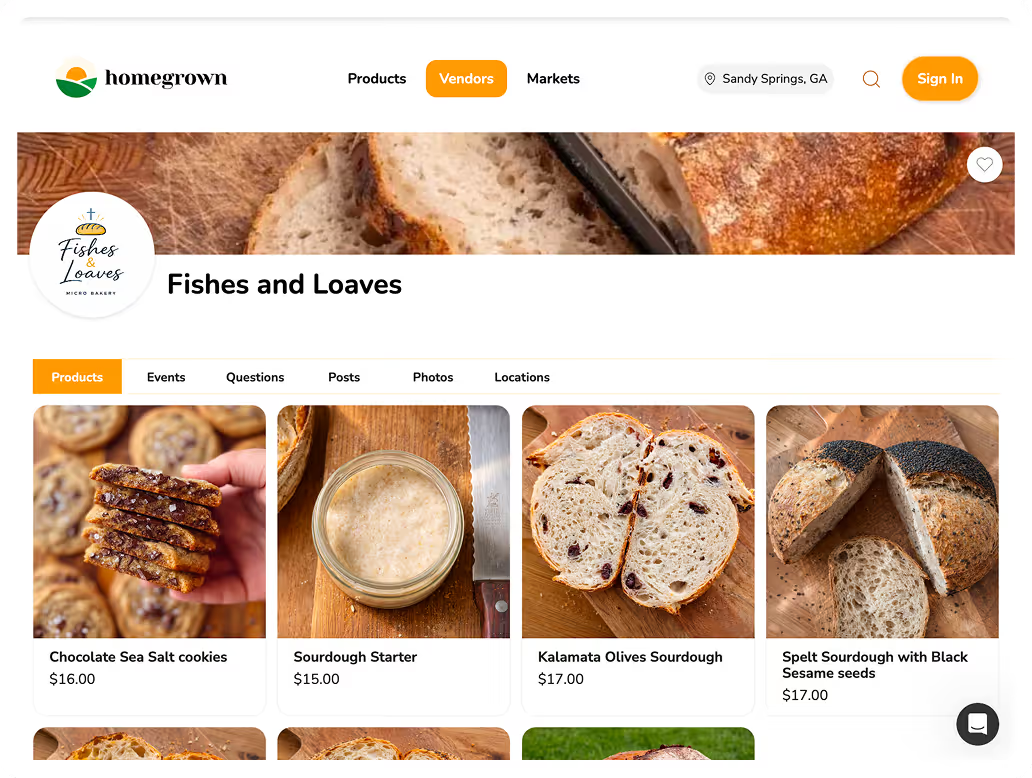
Homegrown costs $10/month and is built for how home cookie vendors actually operate. You list your products, set a pre-order window with a cutoff date, collect payment when customers order, and set a pickup time. During the holiday rush, you can set a capacity limit so you never take on more than you can bake. Local customers can also find you through the Homegrown marketplace without you marketing to them.
| Platform | Monthly Cost | Local Pickup | Capacity Limits | Best For |
|---|---|---|---|---|
| Text/DMs | Free | Manual coordination | None | First 5-10 customers |
| Etsy | Free to list (6.5% + fees) | Buried in checkout | None | Shipping cookies nationally |
| Square Online | Free tier | Yes | No | Restaurants, retail |
| Shopify | $39/mo | With setup | With plugins | Large e-commerce |
| Homegrown | $10/mo | Built-in | Built-in | Local pre-orders with pickup |
Homegrown doesn't handle nationwide cookie shipping, custom order quoting with back-and-forth design approval, or wholesale bakery accounts. It's built for vendors selling a set menu of products to local customers on a regular schedule — weekly batches, holiday pre-orders, farmers market regulars.
Plan ahead and set firm boundaries — the holidays are the biggest opportunity for cookie vendors, but also the most common source of chaos.
Christmas, Valentine's Day, Easter, and Mother's Day all create demand spikes. Everyone wants cookies at the same time. Without a system, you end up with 40 orders taken through DMs, three people who want pickup on the same Saturday morning, and no clear record of who ordered what or who already paid.
Holiday rush checklist:
Holiday planning timeline:
| Holiday | Announce Menu | Order Cutoff | Pickup/Delivery |
|---|---|---|---|
| Valentine's Day | Late January | February 8 | February 12-14 |
| Easter | Early March | 1 week before | Easter weekend |
| Mother's Day | Mid-April | 1 week before | Mother's Day weekend |
| Christmas | Early November | December 15 | December 18-23 |
It depends on your state. Some states require you to register as a cottage food producer, obtain a permit, or complete a food safety training course before you can sell cookies from home. Others just require proper labeling with no registration at all. Very few require an actual kitchen inspection for standard cottage food sales — cookies are typically exempt from inspection requirements. Use Forrager's state directory to look up your state's specific requirements.
Interstate shipping typically falls outside cottage food laws — you'd generally need commercial kitchen production to ship across state lines legally. This is a federal regulation, not a state one, so it applies regardless of how permissive your state's cottage food law is. In-state shipping rules vary by state. For most vendors starting out, local sales through farmers markets, porch pickup, and local delivery are simpler and keep you clearly within cottage food rules.
Any cookie with a filling or frosting that requires refrigeration may fall outside cottage food rules. Cream cheese frosting, custard fills, mousse, and fresh whipped cream often take a cookie outside standard cottage food exemptions because the product is no longer shelf-stable. Buttercream, royal icing, and chocolate ganache are generally fine. Check your state's specific rules if your recipe requires refrigeration after baking.
No — nutrition facts panels are generally not required when you sell cookies from home under cottage food laws. They're required for products sold in retail stores at scale, not at farmers markets or through direct-to-consumer channels. Your label needs ingredients, allergens, your name and address, and a cottage food disclaimer. A full nutrition panel is typically not required for direct sales.
Most dry baked cookies last 1-2 weeks at room temperature in airtight packaging, and 2-3 months frozen. Include a best-by date on your labels and package well. Cellophane bags sealed properly keep cookies fresh significantly longer than open containers or loosely folded bags. For decorated cookies, individual wrapping protects both freshness and the design.
Startup costs to sell cookies from home are low — typically under $100. You likely already own the baking equipment. Your main costs are packaging ($0.15-0.75 per package), labels ($0.10-0.25 each if printing at home), ingredients for your first batches, and possibly a food safety course or cottage food registration fee depending on your state. A farmers market booth runs $20-50 per day in most areas.
Use a single ordering link instead of managing orders through DMs and text messages. Set up a Homegrown storefront where customers can see your available products, select what they want, and pay upfront. This gives you a clear record of every order, eliminates chasing payments, and lets you set capacity limits so you never take on more than you can handle. It's the simplest way to manage cookie orders as a home vendor.
Cookies are one of the most accessible cottage food products you can sell. Legal in every state, high demand, familiar product, and the farmers market already understands what they're buying. You don't have to explain what a cookie is — you just have to make yours worth paying for. For a deeper look at this topic, see starting a cottage food business.
Start where you already have traction: the people who've been asking to buy your cookies for years, the upcoming farmers market season, or the next holiday where custom orders come flooding in. If you're thinking about selling other baked goods too, how to sell baked goods covers the broader picture. You don't need to launch a full business to start. You need one batch, one sale, and one satisfied customer who tells a friend.
The people who love your cookies already know you can bake. Now give them a way to buy — set up your Homegrown storefront in 15 minutes and share the link with your first customers today.