


Someone told you to use Shopify. Maybe you Googled "how to sell online" and every article recommended it. Maybe you even signed up, spent a weekend clicking through settings, and realized you were configuring an online store built for shipping products worldwide — when you just need 40 regulars to pre-order your bread before Saturday.
Shopify is a great platform. It's just built for a different problem than the one you're trying to solve. It's made for online retailers who ship products to strangers across the country. Not for someone who sells at the Saturday market and wants a simple way for customers to order and pay between market days.
The good news: there are platforms built specifically for the way you actually sell — local, pickup-based, affordable at low volume, and set up in minutes instead of days. Here's what works and what doesn't.
The short version: The best Shopify alternative for most farmers market vendors is Homegrown ($10/month) — it gives you a shareable link, handles ordering and payment, supports local pickup, and sets up in 15 minutes. Shopify costs $39-150+/month, takes days to configure, and most of its features are irrelevant for local pickup-based selling. If you sell locally and gross under $2,000/month, a simpler platform saves you money and time.
Shopify's $39-150+/month cost, complex setup, and shipping-focused features make it a poor fit for local vendors who sell through pickup or local delivery at farmers markets. This isn't a knock on Shopify — it's a powerful e-commerce platform. The problem is that its power comes with complexity and cost that doesn't make sense for local, low-volume, pickup-based selling.
The cost doesn't pencil out. Shopify's Basic plan is $39/month. But the real cost for a functional store is higher — most vendors end up spending $80-150/month once you add apps for things like pickup scheduling, subscription management, or simple product customizations. If you gross $400 on a Saturday, Shopify's monthly subscription alone eats 10-37% of a single market day's revenue. That math doesn't work when you're selling homemade granola.
The cost is the part worth doing properly rather than estimating, and we have worked it through in what Shopify really costs a cottage food business with apps and the own-processor penalty included. For a direct comparison against one platform, the head-to-heads are Homegrown against Shopify and Shopify against Big Cartel.
You're paying for features you'll never use. Shopify includes shipping calculators, abandoned cart email automations, international tax settings, SEO tools for competing against Amazon, and inventory systems designed for warehouses. If you sell at the Saturday market and take a few pre-orders during the week, you'll use about 10% of what you're paying for.
The features you actually need aren't built in. Weight-based pricing for produce sold by the pound? That requires an app. Pickup scheduling so customers choose their market or pickup time? App. Weekly inventory updates where you add what's available this week and remove what's sold? Shopify's inventory system wasn't designed for "I have 12 jars of strawberry jam this Saturday." Every farm-specific feature requires a paid third-party add-on.
Setup takes days, not minutes. A non-technical person setting up a Shopify store for the first time should budget 10-20 hours — choosing a theme, configuring settings, adding products, connecting payments, installing apps, and figuring out how pickup works. Most farmers market vendors don't have a spare weekend to spend on website configuration. They have food to make.
The real issue is fit. Shopify is a tool for a specific job: running an online retail store that ships products. If that's what you need, it's excellent. But if you sell locally, primarily through pickup, to a customer base of 20-100 regulars — Shopify is the wrong tool.
Farmers market vendors need six things: a shareable link, payment processing, pickup scheduling, simple inventory management, fast setup, and affordable pricing at low volume. When you strip away all the e-commerce jargon, farmers market vendors need six things:
A link to share. One URL you can text to regulars, post on Instagram, put on a sign at your booth, print on a business card. Customers tap the link, see what's available, and order. That's the entire front end. See G2 e-commerce platform reviews for additional context.
Payment processing. Customers pay when they order. Money goes to your bank account. No more chasing people on Venmo, no more "I'll pay you next week," no more cash-only limitations.
Pickup scheduling. You set when and where — Saturday at the market, Tuesday on your front porch, Thursday at the community center. Customers choose their pickup time when they order. You know exactly what to bring where.
Simple inventory management. Add what's available this week. Remove what's sold out or not in season. This needs to take five minutes, not an hour of inventory management.
Fast setup. You should be able to go from "I just signed up" to "I'm sharing my link with customers" in an afternoon. Ideally in 15 minutes.
Affordable at low volume. If you make $200-800 per market day, your platform shouldn't cost $100+/month. The math needs to work at your current volume — not just when you "scale up."
If a platform checks those six boxes, it's worth considering. If it leads with features like "unlimited bandwidth," "advanced analytics dashboards," or "multi-currency support" — it's solving someone else's problem.
Homegrown, Square Online, Castiron, Local Line, GrazeCart, Barn2Door, and Locally Grown are the platforms that actually work for farmers market vendors, ranked by relevance to how you actually sell.
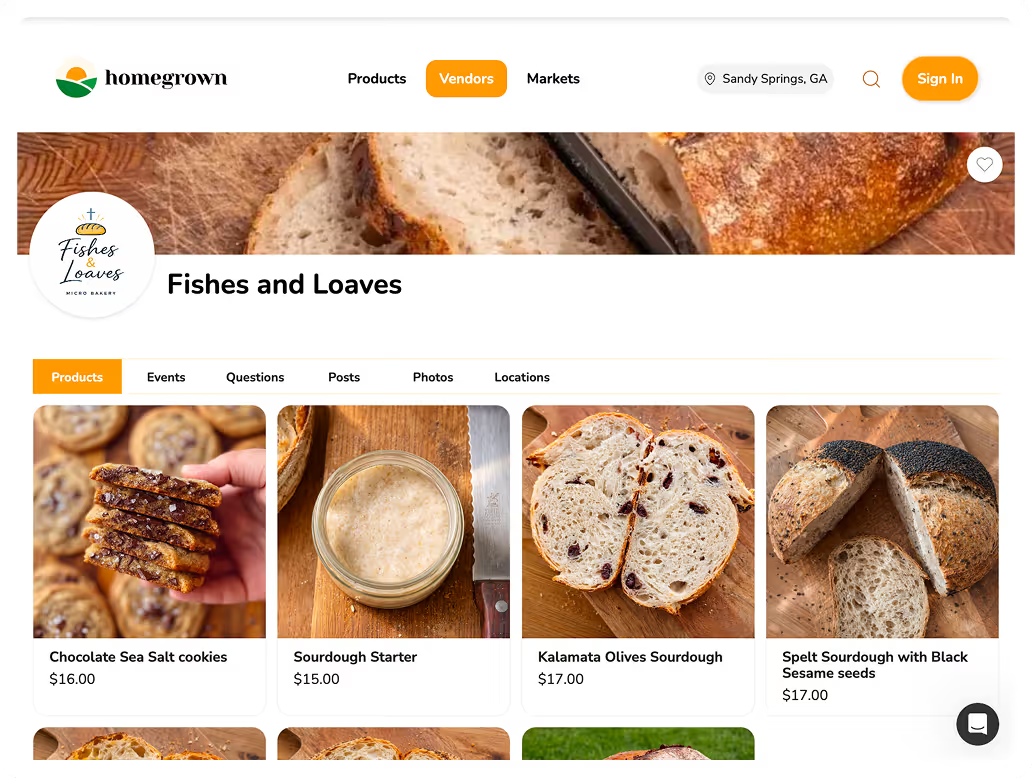
Built specifically for local vendors who sell through pickup or local delivery — at the market, at home, or at a drop point.
Cost: $10/month with a free trial.
What it does well: You set up a storefront in about 15 minutes. Add your products, set your pickup times and locations, share your link. Customers order and pay on their own schedule. You get a clean order list showing exactly what to make and who's picking up where. One link handles everything — share it by text, post it on social media, put it on your market booth sign.
Best for: Farmers market vendors, cottage food sellers, and small producers who sell to 10-100+ local regulars. If your main problem right now is managing orders through texts and DMs and chasing payment through Venmo, this solves that.
Limitations: Not built for nationwide shipping, wholesale, or large-scale subscription box programs. If you're doing $50K+/year and need those features, you'll outgrow it.
For more on selling at markets, see our guide on how to sell at a farmers market.
Many farmers market vendors already use Square for card payments at the booth. Square Online lets you add a free online store connected to the same system.
Need more help here? See our guide on e-commerce platforms for farmers market vendors.
Cost: Free tier available. Paid plans start at $29/month for more features.
What it does well: If you already swipe cards with Square at the market, adding an online store keeps everything in one place — same inventory, same payment processing, same reporting. The free tier lets you list products and accept payments.
Best for: Vendors already using Square POS who want to add basic online ordering without switching systems.
Limitations: The free storefront is limited in design and functionality. Pickup scheduling is basic. It works as a "better than nothing" online option but isn't purpose-built for the farmers market workflow of weekly rotating inventory and pre-orders.
Popular with home bakers and cottage food sellers, especially for custom orders.
Cost: Free plan available with limited features. Paid plans start around $20/month.
What it does well: Handles custom order requests well — birthday cakes, decorated cookies, holiday items where each order needs a conversation. Good gallery-style product displays that show off visual products. The Capterra business software reviews provides additional guidance on this.
Best for: Bakers and food artisans who primarily take custom, made-to-order items. If every order is somewhat unique and involves back-and-forth with the customer about specifics, Castiron was built for that workflow.
Limitations: Less ideal for vendors selling a rotating standard product list (this week's produce, this batch of jam, this Saturday's bread selection). Custom order management is its strength, but weekly pre-order management isn't.
A comprehensive farm e-commerce platform with strong features for farms of all sizes.
Cost: Plans start at $79/month (Core), with Premium at $159/month and Ultimate at $319/month.
What it does well: Full-featured platform built for farms — understands weight-based pricing, CSA subscriptions, wholesale ordering, delivery routes, and multi-location inventory. Strong customer management tools and marketing features.
Best for: Farms doing $2,000+/month in direct sales that need subscription management, wholesale capabilities, and delivery logistics. Good choice if you're growing past the "Saturday market plus a few pre-orders" stage.
Limitations: At $79/month (and up to $319/month for higher tiers), the math doesn't work for most part-time farmers market vendors. If you gross $1,200-2,000/month at markets, Local Line's subscription alone eats 4-7% of your gross revenue before transaction fees. The feature set is also much more than most small vendors need — you'll pay for wholesale tools, route planning, and subscription management you may never use.
Farm-focused e-commerce with particular strength in meat and dairy operations.
Cost: Plans start around $49/month.
What it does well: Understands weight-based pricing (critical for meat sold by the pound), cut-sheet management, and farm-specific inventory workflows. Solid for operations that sell protein boxes or mixed farm shares.
Best for: Small to mid-size meat and dairy farms selling direct-to-consumer. If you're selling quarter beefs, chicken shares, or weekly dairy deliveries, GrazeCart handles the complexity well.
Limitations: Built primarily for meat and dairy producers. If you sell produce, baked goods, jam, honey, or other farmers market staples, most of GrazeCart's specialized features aren't relevant. The $49+/month cost (plus payment processing on top) is also steep for vendors at the lower end of market revenue.
Full-featured farm sales platform with built-in marketing and fulfillment tools.
Cost: $99-299/month plus setup fees.
What it does well: Combines storefront, marketing, and operations into one platform. Handles subscriptions, delivery, shipping, and point-of-sale. Good customer support and onboarding.
Best for: Established farms doing $3,000+/month in direct sales that want an all-in-one platform and are willing to pay for hands-on support.
Limitations: The most expensive option on this list. Setup fees add to the upfront cost. For a part-time farmers market vendor, Barn2Door's monthly cost could exceed what you'd spend on ingredients for an entire market day.
A simpler farm-direct platform with a free tier.
Cost: Free to start. Transaction fees apply.
What it does well: Low barrier to entry. Simple product listings and ordering. Built for small farms and local food operations.
Best for: Vendors who want to test online ordering with zero upfront cost and don't need advanced features.
Limitations: Smaller user base means fewer resources and integrations. Feature set is more basic than other options.
| Platform | Monthly Cost | Setup Time | Pickup Support | Delivery Support | Best For |
|---|---|---|---|---|---|
| Homegrown | $10/month | 15 minutes | Yes | Yes | Part-time vendors, 10-100+ regulars |
| Square Online | Free-$29/month | 1-2 hours | Basic | Basic | Vendors already using Square POS |
| Castiron (closed) | Free-$20/month | 30-60 min | Limited | N/A | Custom order bakers |
| Local Line | $79-319/month | 2-4 hours | Yes | Yes | Farms with wholesale + retail |
| GrazeCart | ~$49/month | 2-3 hours | Yes | Yes | Meat and dairy farms |
| Barn2Door | $99-299/month | Days + onboarding | Yes | Yes | Full-time farms, $50K+/year |
| Locally Grown | Free | 30-60 min | Yes | Basic | Testing online ordering at zero cost |
| Shopify | $39-150+/month | 10-20 hours | Requires app | With apps | Shipping products nationally |
Shopify makes sense if you ship products nationally, consistently gross over $2,000/month online, or are building a food brand beyond your local farmers market. If any of these describe you, Shopify might actually be your best option:
You ship products. If you sell shelf-stable products (hot sauce, honey, spice blends, packaged snacks) and want to reach customers outside your local area, Shopify's shipping tools are genuinely useful.
Your online revenue exceeds $2,000/month consistently. At that volume, Shopify's $39/month subscription is a small percentage of revenue, and the advanced marketing and analytics tools start adding real value. The Better Business Bureau provides additional guidance on this.
You're building a brand beyond your local market. If your goal is to go from "farmers market vendor" to "food brand sold in stores and online nationwide," Shopify is a reasonable foundation to build on.
You have technical comfort or budget for help. If you enjoy configuring websites, or you can hire someone to set up and maintain your store, Shopify's flexibility is a strength rather than a burden.
The break-even question is simple: when your platform's subscription fee is less than 3-5% of your monthly revenue, and you actually use the features you're paying for, you're in the right tool. For most part-time farmers market vendors, that math points to something simpler and cheaper than Shopify.
For a broader look at platforms for your type of business, see our comparison of e-commerce platforms for farmers market vendors.
Selling at markets or a farm stand? Let customers order ahead online. The easiest way to take local orders and get paid is an online storefront — see the best platform to sell food from home, or set up a Homegrown storefront in about 15 minutes ($10/mo, 0% commission).
For most farmers market vendors, yes. Square's free tier, familiar POS integration, and simpler setup make it more practical than Shopify for local, pickup-based sales. The main limitation is that Square Online wasn't specifically designed for the farmers market workflow — weekly rotating inventory, pre-orders, and multi-location pickup. It's a solid "good enough" option, especially if you already use Square at the booth.
Square Online's free tier or Locally Grown's free plan are the lowest-cost entry points. For a dedicated solution built for exactly this use case, Homegrown is $10/month with a free trial — affordable enough that a single pre-order covers the monthly cost.
Yes. Most vendors who switch from Shopify to a simpler platform report it takes less time to set up the new platform than it took to configure Shopify in the first place. Your products, pricing, and customer base transfer over — you just share a new link. The main thing you'll need to re-create is your product listings.
You don't need a traditional website. What you need is an ordering link — a URL where customers can see your products, place an order, and pay. That's different from a full website with an "About" page, blog, and contact form. A simple Homegrown storefront link that handles ordering and payment is all most farmers market vendors need to grow beyond cash-only market-day sales. For more on what that looks like, see our guide on the best platform to sell local food online — and best platform to sell local food online can help with that.
The most affordable Shopify alternative for farmers market vendors is Homegrown at $10/month with a free trial. Square Online has a free tier. Castiron started free with paid plans at $20/month. For most part-time vendors, $10-20/month is the right price range — enough to automate ordering and payment without cutting into your slim margins.
Yes. Many vendors use one platform for ordering (like a Homegrown storefront) and Square for in-person card payments at the farmers market. The key is keeping it simple — one link for online orders, one tool for in-person sales. Don't spread yourself across five platforms trying to be everywhere at once.
Share your new storefront link with your customer list. Most vendors who switch from Shopify report that setup takes less time than configuring Shopify in the first place. Your products, pricing, and customer relationships transfer — you just share a new link. Send a quick text or email to your regulars with the new ordering link.
Shopify is a great tool — just not for this job. If you sell locally, primarily through pickup, and your monthly revenue is under $2,000, you'll save money, save time, and sell more by using a platform built for the way you actually work.
Ready to replace your Shopify setup with something simpler? Homegrown gives you an online storefront where customers order and pay — one link, 15 minutes to set up, $10/month. Try it free and share your link at your next market.