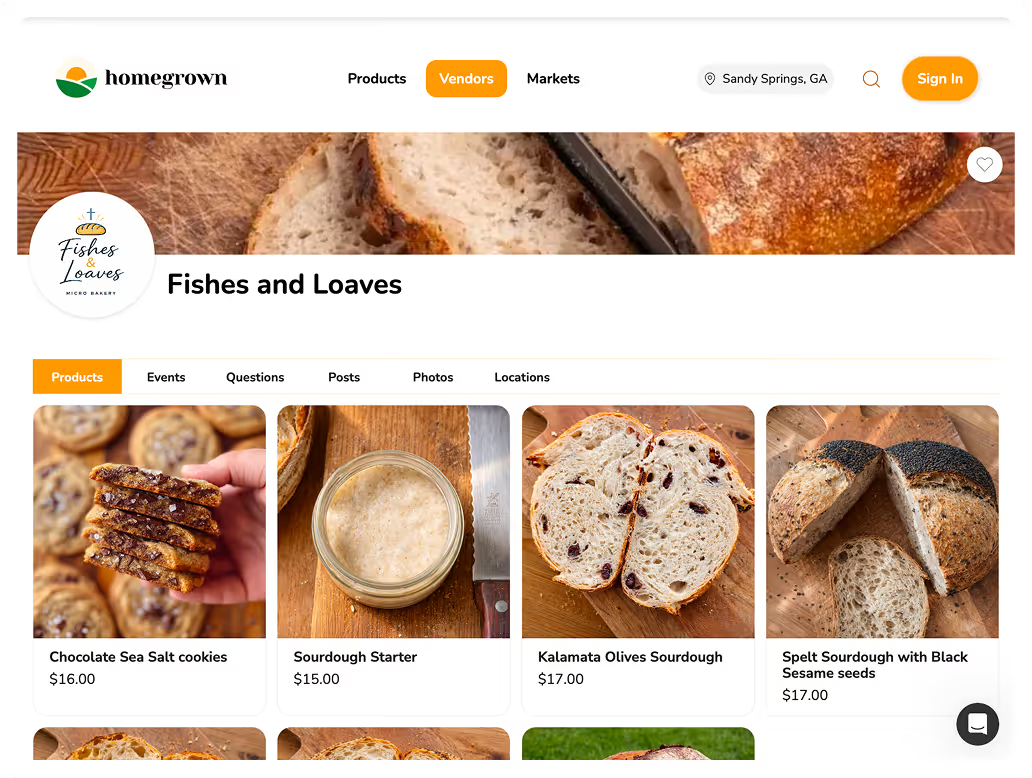


The best CSAware alternative for most small farms and new CSA operators is Homegrown, which gives you the recurring-order machinery of a CSA platform plus a real online storefront for $10 per month flat. CSAware is a serious tool built for established CSAs running multi-share programs at scale, and it earns the price tag if you have hundreds of members and a packing crew. For a farm running a CSA with thirty members, or a homestead launching its first season, paying $150 to $300 a month for software you'll grow into is the wrong place to start. Homegrown gives you subscriptions, scheduled pickups, member communications, and a storefront for one-off items in a single tool, at roughly one-tenth the cost.
The short version: CSAware is purpose-built CSA management software with annual contracts, member portals, harvest planning, and box-packing tools. Pricing is operation-size dependent and typically lands between $150 and $300+ per month plus payment processing on top, often with setup fees and an annual commitment. Homegrown is $10 per month billed annually with payment processing built in at 2.9% + $0.30 per transaction, plus subscriptions, sell-by-weight, multi-pickup scheduling, no platform commission, no shopper fee, and no payout fee. Other CSAware alternatives include FarmSite ($79 to $149 per month, similar CSA focus), Local Line (multi-channel sales platform), and Barn2Door (subscription-heavy, premium pricing). For small farms, homestead operators, and new CSA programs that want recurring orders without locking into expensive software for a year, Homegrown is the simplest path to launching this season.
CSAware is software built specifically for community-supported agriculture operations — farms that sell weekly or monthly produce shares to members across a season. The platform handles the workflows that show up when you scale beyond a spreadsheet: managing hundreds of share members, multiple share types (full share, half share, vegetable-only, fruit-add-on), harvest forecasting against expected yields, generating box-packing lists for the farm crew, scheduling pickup days across multiple drop sites, and emailing members about what's in the box that week.
According to the CSAware website, the platform serves CSAs across North America and is designed to grow with your operation. It is genuinely capable software, and farms running 200+ member CSAs with multiple share types and weekly box variation can get real value out of it.
The challenge is that CSAware is priced and structured for that scale. The pricing page is not public — you contact sales for a quote — and the typical entry-point lands somewhere between $150 and $300 per month (with payment processing additional on top, typically Stripe at 2.9% + $0.30) based on the size of your member base, often with a setup fee and an annual contract requirement. For an established 250-member CSA, that's a small line item. For a 30-member CSA in its first season, that's nearly half the gross subscription revenue going to software before the first weed gets pulled.
The closest like-for-like comparison is Farmigo against CSAware, which is the choice most small CSA operators are actually weighing once they have ruled out the general farm platforms.
The reasons aren't about CSAware being a bad product. They're about the structural mismatch between enterprise CSA software and the way most small farms actually start.
The most common reasons farms shop for alternatives:
If any of these match your situation, the question isn't "is CSAware bad?" — it's whether you're paying enterprise CSA prices for a small CSA workflow that fits in a much simpler tool.
Three alternatives stand out for small farms and new CSAs, each with different tradeoffs.
Homegrown is an online storefront built for local food vendors who sell for pickup or local delivery. Your CSA shares, your weekly egg sales, your honey, your seasonal jam — all in one place, all on one shareable link. Customers pre-order, pay online, and pick up at the time and location you set.
Here's what you get with Homegrown:
Where Homegrown matches CSAware structurally: weekly recurring orders against a pickup schedule, member-style accounts for repeat customers, pickup logistics with location plus time-window selection. Where Homegrown is simpler than CSAware: there's no harvest-planning forecast tool, no automated box-packing list generation by share-type rules, no enterprise-grade member-portal complexity. Those tools matter when you're packing 200 boxes on a Tuesday morning. They're overhead when you're packing 20.
A note on partial shares: CSAware supports complex share-type configurations (full share, half share, fruit add-on, flower add-on). Homegrown handles this today by listing each share type as a separate product (Full Share, Half Share, etc.) and letting members subscribe to whichever fits. It's less elegant than CSAware's share-type rules engine but works for most small CSAs and costs roughly $1,680 less per year.
Pros:
Cons:
FarmSite is the closest CSAware competitor for small to mid-sized CSAs. The pricing is more accessible than CSAware (typically $79 to $149 per month based on operation size), and the feature set is similar — share management, member portals, pickup scheduling, payment processing.
FarmSite makes sense if you're at a scale where CSAware is overkill but you specifically want CSA-purpose-built software, not a general-purpose storefront. The trade is that you still pay $1,000+ per year (plus payment processing on top) for software that only handles your CSA share program — your eggs, honey, and seasonal items still need a separate sales tool.
Pros:
Cons:
Local Line is a multi-channel platform aimed at farms that sell direct-to-consumer plus wholesale to restaurants and grocery. If your farm operation includes wholesale relationships with restaurants, food co-ops, or institutional buyers, Local Line's wholesale tools (custom pricing tiers per buyer, invoicing, B2B order portals) are real value.
For farms that are purely direct-to-consumer with a CSA share program and a few one-off items, Local Line is more than you need. The price reflects that complexity.
Pros:
Cons:
| Feature | Homegrown | CSAware | FarmSite | Local Line |
|---|---|---|---|---|
| Monthly price | $10/mo annual | $150-300+/mo | $79-149/mo | $89-299+/mo |
| Annual contract required | No | Often yes | Sometimes | Often |
| Setup fee | $0 | Common | Sometimes | Sometimes |
| Free trial | 7 days | Demo only | Demo only | Demo only |
| Subscriptions / CSA | Shipping M1-M2 | Yes | Yes | Yes |
| Sell-by-weight | Shipping M1-M2 | Limited | Limited | Yes |
| One-off product sales | Yes | Limited | Limited | Yes |
| Marketplace discovery | Yes | No | No | No |
| Multi-pickup locations | Yes | Yes | Yes | Yes |
| Mobile-first member experience | Yes | Dated | Mid | Yes |
| Wholesale tools | No | Limited | Limited | Yes |
| Card processing | 2.9% + $0.30 | Variable | Variable | Variable |
| Platform commission | None | Varies | Varies | Varies |
| Customer fee at checkout | None | Varies | Varies | Varies |
If you're already running CSAware and considering a switch, the migration depends on where your current data lives and how mid-season your switch is.
The cleanest switch happens between CSA seasons. Export your member list and product catalog from CSAware before your contract renewal date. Set up Homegrown during the gap weeks (we'll help — there's a 7-day trial plus migration support). Re-onboard your members with a single email letting them know the new ordering link. Members who used CSAware to subscribe will need to re-subscribe in Homegrown, but that's a one-time friction in exchange for a recurring savings of roughly $1,800 to $3,600 per year.
Mid-season switches are harder but doable. The trick is running both tools in parallel for a transition period — keep CSAware active for existing members on their current share term, route any new members through Homegrown, then sunset CSAware once existing members rotate to the next season. This adds complexity but avoids breaking commitments to current members.
What you'll need to recreate in Homegrown: share product listings (Full Share, Half Share, etc.), pickup locations (each drop site is a Homegrown pickup location), pickup schedules (each weekly box becomes a recurring subscription), and member accounts (members create their own at first order). What you'll lose: CSAware's automated box-packing list rule engine. What you'll gain: $1,500+ per year, a real storefront for your one-off products, and a marketplace where new shoppers can discover your farm.
No. Homegrown is built for any local food vendor who sells for pickup — sourdough bakers, microgreen farms, soap and candle makers, pet treat makers, specialty food producers, homestead operators, and CSA farms. The subscription functionality enables CSA workflows on top of the general storefront.
Each share type gets listed as its own product. A member subscribes to whichever fits their household. Add-ons (fruit share, flower share, egg share) are also listed as separate products, and members can subscribe to multiple at once. It's less elegant than CSAware's share-type rules engine, but works for the vast majority of small to mid-sized CSAs.
Yes. Members log into their account and can pause, skip, or update their subscription. Vendor-side, you can override member subscriptions if needed.
Sell-by-weight pricing is shipping in M1-M2 of the 2026 roadmap. Variable-weight items can be configured with a base price per unit (per pound, per ounce) and the final price calculates at pickup or fulfillment.
Homegrown is a storefront and ordering platform — it doesn't replace farm management software like FarmOS or Tend. If you use one of those tools for crop planning, it stays separate. Homegrown handles the customer-facing layer: storefront, orders, payments, pickup logistics.
CSAware offers full-service onboarding and support tied to its enterprise pricing. Homegrown's support is leaner — email support, documentation, and a small founding team you can reach directly. For a 30-member CSA, that's usually plenty.
Yes. Some small CSAs have members order each week individually rather than subscribing. Homegrown supports both patterns — members can subscribe for the season or order ad-hoc each week.
If your CSAware bill is $200 per month, that's $2,400 per year. Homegrown billed annually is $120 per year. Net savings: $2,280 per year. Multiply by however many seasons you'd otherwise stay on CSAware.
---
If your CSA program is small, new, or fits inside a simpler workflow, the question isn't whether CSAware is good software. It's whether you should pay enterprise CSA prices for a small-CSA workflow. For most farms in the under-100-member range, the answer is no — and Homegrown gets you the same outcome (recurring orders, pickup scheduling, member management, plus a storefront for everything else you sell) at roughly one-tenth the cost.
Before you commit to anything, you can see exactly what your Homegrown CSA storefront would look like — paste your current product list into our free 60-second storefront preview tool and our AI rewrites it in Homegrown voice instantly. No signup needed.
Start a free 7-day Homegrown trial and have your CSA storefront live before this Saturday's pickup. Customers choose pickup or local delivery at checkout.