

RekoNow is a platform built for REKO rings — local food buying groups where farmers and producers sell pre-orders directly to customers for weekly pickup. The concept originated in Finland in 2013 and has spread to parts of the United States, offering a middleman-free model where producers post products, customers pre-order, and everyone meets at a designated pickup spot.
If you are a food vendor in a REKO ring or considering RekoNow, the platform delivers on the pre-order-for-pickup model. But its pricing — a 10% markup on every item plus $100-$300 per month for a custom website — makes it expensive for small vendors who just want an ordering page.
This guide compares RekoNow to alternatives that give you the same pre-order-and-pickup workflow without the percentage fees.
The short version: RekoNow is built for REKO rings (local food buying groups with weekly pre-order and pickup). The platform charges a 10% markup on item prices and $100-$300/month for a custom website. For individual vendors who want their own ordering page with pre-order capability, Homegrown ($10/month flat, no percentage fees) delivers the same pre-order-for-pickup model at a fraction of the cost. Google Forms (free) works for testing demand. Square Online (free + 2.9% fees) fits Square POS users. RekoNow is best for organized REKO ring groups with multiple producers who want a shared platform.
RekoNow is a digital platform for running REKO rings. A REKO ring is a local food buying group where producers sell pre-orders that customers pick up at a regular time and place — usually weekly. The model originated in Finland as "REjäl KOnsumtion" (Fair Consumption) and has grown into thousands of rings across Scandinavia and parts of North America.
Here is how REKO rings work:
RekoNow's pricing model:
| Component | Cost | Who Pays |
|---|---|---|
| Platform listing | Free | — |
| Item markup | 10% on every item | Customer (added to price) |
| Custom website | $100-$300/month | Vendor |
| App access | Free | Vendor |
The 10% markup is applied to item prices to cover merchant processing and platform fees. On a $50 order, the customer pays about $55 after the markup — similar to the convenience fee model used by platforms like Castiron. The custom website tier ($100-$300/month) adds a branded site integrated with the RekoNow store.
For a vendor doing $500 per month in pre-orders, the 10% markup costs $50 in added fees — the same as what you would pay on Castiron and five times more than a flat $10/month platform.
REKO rings are a genuinely good model for local food sales. The pre-order-for-pickup approach eliminates waste, guarantees sales before production, and removes the uncertainty of a traditional farmers market. But RekoNow's implementation has drawbacks that push vendors toward alternatives.
Here are the main issues:
The core value of REKO rings — pre-ordering for pickup — is not unique to the REKO model. Any ordering platform that lets customers place orders before pickup day delivers the same workflow. The question is whether you need the group infrastructure of a REKO ring or just an ordering page for your own business.
Here are three alternatives that give you pre-order capability without the 10% markup or the $100-$300 website cost.
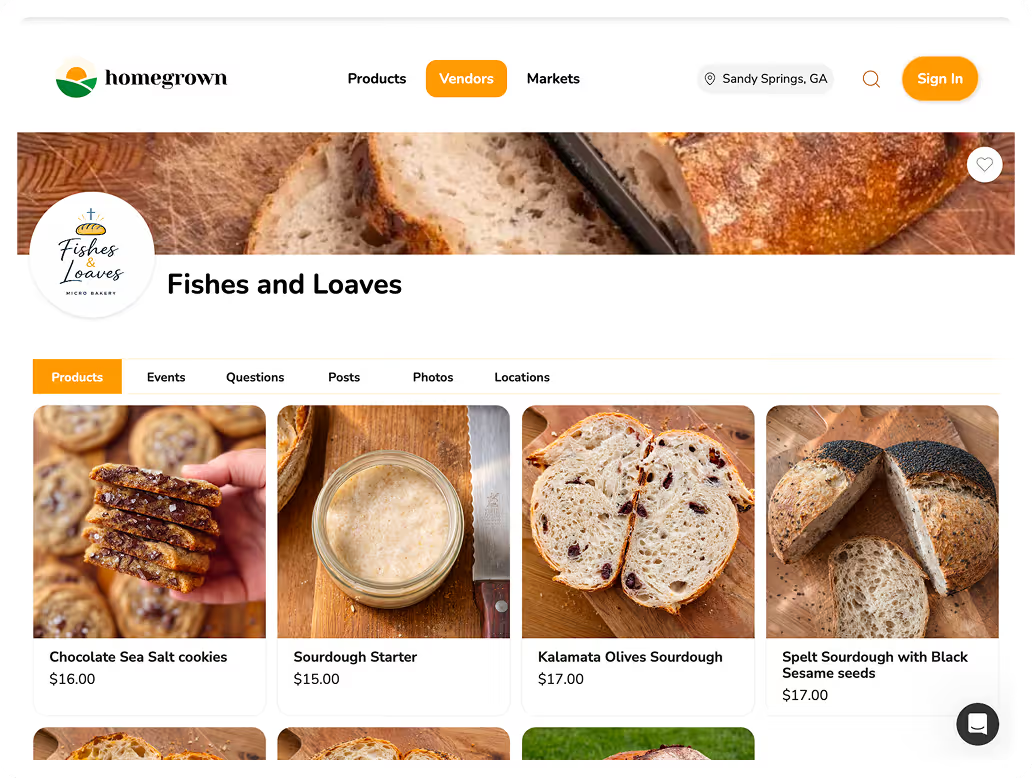
Homegrown is built for small local vendors who sell at farmers markets and want customers to pre-order online for pickup. It delivers the same core workflow as a REKO ring — customers order ahead, you bring exactly what was ordered — without the group structure or percentage fees.
Here is what Homegrown gives you:
The math is clear. At $500/month in pre-orders, RekoNow's 10% markup costs $50. Homegrown costs $10. At $1,000/month, RekoNow costs $100 in markups. Homegrown still costs $10. And you do not need to pay $100-$300/month for a custom website — your Homegrown ordering page is included in the $10 monthly fee.
Homegrown also works for solo vendors. You do not need to organize a group of producers, coordinate a shared pickup location, or manage a REKO ring. You just set up your storefront, share the link, and start taking orders.
If you are looking to get more pre-orders from your farmers market customers, Homegrown gives you a simple link to share at the booth, on social media, and via text.
Start your free trial at Homegrown
Google Forms is the simplest possible pre-order system. It works for vendors testing whether customers will actually pre-order before committing to a platform.
Here is the typical setup:
What works:
What does not work:
Google Forms gives you the pre-order workflow without any cost. But the manual work of tracking orders, managing a spreadsheet, and collecting payments separately adds up as your customer base grows.
Square Online offers a free plan with standard processing fees (2.9% + 30 cents per transaction) and includes pickup scheduling. If you already use Square for card payments at the market, the integration makes sense.
What Square Online includes:
Where it falls short:
Square Online works best for vendors already in the Square ecosystem who want pre-order capability with transparent, predictable fees.
| Feature | RekoNow | Homegrown | Google Forms | Square Online |
|---|---|---|---|---|
| Model | REKO ring platform | Ordering storefront | Order form | Online store |
| Monthly cost | Free (store) / $100-300 (website) | $10/mo (annual) | Free | Free |
| Percentage fees | 10% markup | None | None | 2.9% + 30¢ |
| Cost on $500/mo sales | ~$50 markup | $10 | $0 | ~$17 |
| Pre-order capability | Yes | Yes | Manual | Yes |
| Payment processing | Yes | Yes | No | Yes |
| Works for solo vendors | Not ideal | Yes | Yes | Yes |
| Customer discovery | Within REKO ring | Homegrown marketplace | No | No |
| Order summaries | Yes | Yes | No | No |
| Food-vendor specific | Yes | Yes | No | No |
| Setup time | Varies (ring setup) | 15 minutes | 15 minutes | 1-2 hours |
| Best for | Organized REKO ring groups | Individual market vendors | Testing demand | Square POS users |
The pricing comparison shows the impact of percentage-based fees. At $500/month in sales, RekoNow's 10% markup costs $50 while Homegrown charges $10 flat. The gap grows as your sales increase — at $1,000/month, the difference is $90 per month, or $1,080 per year.
If you have been getting your market regulars to order online between markets, the right ordering tool makes that process simple. You share a link, customers order, and you show up on pickup day knowing exactly what to bring.
REKO rings and individual ordering pages both deliver the pre-order-for-pickup model. The difference is structure.
Join a REKO ring when:
Run your own ordering page when:
Many vendors do both — they participate in a REKO ring for new customer exposure while running their own Homegrown storefront for direct orders from regulars. The REKO ring brings new faces. Your ordering page converts them into repeat customers you own.
The REKO ring concept — which started in Finland and has spread across multiple countries — proves that the pre-order model works for local food sales. The question is just whether you need a group platform or an individual tool to execute it.
If you are currently using RekoNow and want to reduce your costs or run your own ordering system, here is a simple plan:
If you are looking to add online ordering to your existing market business, your own ordering page is the simplest path — no group coordination, no percentage markup, and no $100-$300/month website bill.
And if you want to turn one farmers market into a full week of orders, having your own pre-order link that customers can access any time is the tool that makes that happen.
Start your free trial at Homegrown
A REKO ring is a local food buying group where producers sell pre-orders that customers pick up at a regular time and place, usually weekly. The model originated in Finland in 2013 (REKO stands for "REjäl KOnsumtion" or "Fair Consumption") and eliminates the middleman — producers sell directly to consumers with no surplus or waste because everything is pre-ordered.
RekoNow is free to list and use as a vendor, but the platform applies a 10% markup on all item prices to cover merchant processing and platform fees. Custom websites integrated with the RekoNow store cost $100-$300 per month. On $500/month in sales, the 10% markup adds $50 in fees — five times more than a flat $10/month alternative like Homegrown.
For individual vendors who want pre-order capability without organizing a REKO ring, Homegrown is the best RekoNow alternative. It costs $10 per month with no percentage markup, takes 15 minutes to set up, and gives you your own ordering page where customers pre-order and pay at your exact prices. It works for solo vendors without requiring group coordination.
Yes. Many REKO rings still operate through closed Facebook groups where producers post products and customers comment to order. You can also run a REKO-style pre-order model using any ordering platform — the concept of pre-ordering for weekly pickup does not require RekoNow's specific software. Homegrown, Google Forms, or Square Online all support the same workflow.
REKO rings are widespread in Scandinavia (Finland, Sweden, Norway) but still niche in the United States. Some areas have active rings, particularly in regions with strong local food movements, but the concept has not achieved the same scale as in Nordic countries. If your area does not have an existing ring, starting one requires significant organizational effort.
RekoNow can work for solo vendors, but its platform is designed around the REKO ring model — groups of producers collaborating on shared pickup locations and schedules. Solo vendors may find the group structure adds unnecessary complexity. A simpler ordering page like Homegrown is designed for individual vendors who want to take pre-orders without coordinating with other producers.
In a REKO ring, producers only bring what has been pre-ordered. There is no surplus inventory sitting on a table hoping to sell. This is the same benefit you get from any pre-order system — when customers order before pickup day, you know exactly what to make and how much to bring. You produce to order, not to hope.
The REKO ring concept is powerful — pre-orders eliminate waste, guarantee sales, and remove the uncertainty of traditional market selling. But you do not need a 10% markup or a $100-$300 website to get those benefits.
Homegrown gives you the same pre-order-for-pickup workflow at $10/month flat. Customers order from your page, pay your exact prices, and you know exactly what to bring on pickup day. No group coordination required.
Start your free trial at Homegrown
Pre-orders give you the ability to produce exactly what you have already sold, which eliminates waste and guarantees revenue before you spend a dollar on ingredients. You do not need a complicated platform to start taking pre-orders. A simple online form, a social media post with ordering instructions, or a basic storefront all work. The key is making it easy for customers to place an order and easy for you to fulfill it. Start with one product or one weekly drop, build a rhythm, and add complexity only when your order volume demands it.