

You spent all Saturday at the farmers market. Sold out of your jam by noon, had people asking for sourdough you didn't even bring. By Tuesday, three customers are DMing you on Instagram asking if they can place an order for next week. You're copying Venmo links into text messages, tracking who paid in a notebook, and trying to remember who wanted the strawberry preserves versus the blueberry.
There has to be a better way. And there is — but most "best e-commerce platform" articles are written by the platforms themselves, and they're designed for large farms shipping produce across the country. Not for someone selling locally at the Saturday market or running a small food business from home.
This guide compares the platforms that actually work for farmers market vendors — with real pricing, honest pros and cons, and a focus on what matters most: taking orders between markets without the DM chaos.
The short version: The best ecommerce platform for farmers market vendors depends on your size and budget. For most part-time vendors, Homegrown ($10/month, 15-minute setup) is the most affordable purpose-built option. Larger farms with CSA or wholesale needs should look at Local Line or GrazeCart. Square Online works if you already use Square at the booth. Skip platforms that cost more than your weekly market revenue or take days to set up — you need something simple that captures orders between markets so you stop juggling DMs.
Managing orders through DMs and Venmo breaks down fast once you have more than a handful of regulars. If you've been selling at farmers markets for more than a few months, you know the routine — "Can I order a dozen muffins for Saturday?" "Do you still have the hot sauce?" "Can I Venmo you?"
At first, it feels great. Repeat customers. Loyal fans. But it doesn't scale.
You end up managing orders across Instagram DMs, Facebook Messenger, text messages, and maybe even email. Payments come through Venmo, Zelle, Cash App, or cash at pickup. You're tracking everything in your head, a notebook, or a messy spreadsheet.
This works with three customers. It falls apart at fifteen. Orders get lost. People forget to pay. You forget who wanted what. And you spend more time managing messages than actually making your product.
Here's what most vendors miss: you're only at the market one or two days a week. Your customers want your products the other five days. That's five days of potential revenue sitting on the table.
According to the USDA, direct-to-consumer farm sales hit $2.4 billion in 2023 — a 25 percent increase since 2017 after adjusting for inflation (USDA Economic Research Service). Farmers markets alone have grown from around 1,700 locations in 1994 to over 8,700 today (USDA Farmers Market Growth). Consumers are actively seeking ways to buy directly from local producers. The demand is there. Most vendors just don't have a way to capture it outside of market day.
An online ordering platform changes that. Customers order and pay on their own time — even at midnight — and you fulfill orders on your schedule. No back-and-forth. No chasing payments. Just orders coming in and money hitting your account. If you're exploring ways to sell your products beyond market day, a dedicated storefront is the most reliable path.
The four things that matter most are price, setup speed, built-in payments, and mobile-friendly checkout. Not every platform is built for your situation, so here's what to prioritize.
Your platform should cost a fraction of your monthly revenue, not a chunk of it. Most e-commerce platforms are built for businesses doing tens of thousands per month. If you're making $500 to $2,000 per month at markets, a platform that costs $100 or more per month eats into your margins fast.
And keep in mind: 86 percent of U.S. farms are classified as small family farms, with 72 percent of household income coming from off-farm sources (USDA ERS). Most farmers market vendors aren't running a full-time operation. The platform you choose should reflect that reality.
When evaluating price, consider:
The best platforms for farmers market vendors let you go live in under an hour. If it takes two days to build your storefront, you'll never finish. Between making products, prepping for markets, and everything else on your plate, you need something you can set up in an afternoon. Resources from local food market data offer more detail here.
Built-in payment processing saves you from the headache of setting up Stripe or another provider on your own. Some platforms handle payments for you, while others require separate configuration. For most vendors, look for platforms where customers can pay when they order so you're not chasing anyone down after the fact.
Key payment features to look for:
Your customers are ordering from their phones, so a mobile-optimized storefront is non-negotiable. If your checkout flow isn't simple on a phone screen, you'll lose sales. The fewer steps between "I want this" and "order placed," the better.
Price: $10/month billed annually or $12.50/month billed monthly. 7-day free trial. Transaction Fee: 2.9% + $0.30 per order Best For: Farmers market vendors who want to take orders between markets Setup Time: About 15 minutes
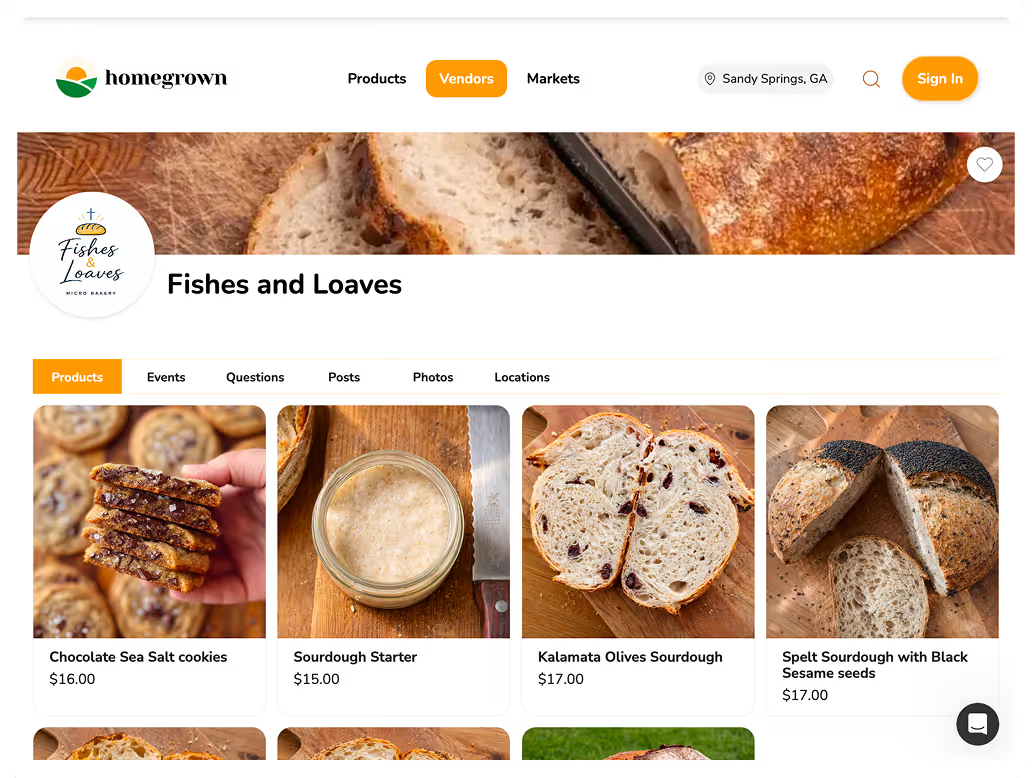
Homegrown is an online storefront built specifically for local food vendors. You add your products, set your pickup or delivery schedule, and share a single link with your customers. They order and pay through your storefront, and you get a dashboard showing exactly what to make and when.
The platform was designed around the "between markets" use case that most vendors deal with — customers who want to order your products outside of market day. Instead of managing DMs and Venmo requests, you send customers one link and let the platform handle the rest.
At $10 per month, it's the most affordable dedicated option on this list. The tradeoff is that Homegrown is a newer platform, so it doesn't have advanced features like subscription boxes or point-of-sale integration yet. But for the core job — taking orders and payments between markets — it delivers.
If you're a pickup-style vendor — customers order ahead, you make it, they come get it — Homegrown is built around that exact workflow. One link, customers browse and pay, you get a clean order list. No website building, no theme customization, no app store.
Who it's best for: Part-time vendors selling at one to three markets who want a simple, affordable way to take online orders. If you're tired of the DM juggle and want something live in 15 minutes, start here.
Price: $79 to $319/month Transaction Fee: 2.0% + $0.20 per order Best For: Established farms with CSA programs and wholesale accounts Setup Time: Several hours to a few days
Local Line is a full-featured farm e-commerce platform with tools for CSA management, wholesale ordering, inventory tracking, and delivery route planning. It's a serious piece of software built for serious farm operations.
The starting price of $79 per month (with payment processing — typically Stripe at 2.9% + $0.30 — additional on top) puts it at nearly eight times the cost of more affordable options, and the feature set reflects that. If you're running a farm with multiple sales channels, wholesale accounts, and complex fulfillment logistics, Local Line can handle it.
But if you're selling sourdough and preserves at the Saturday market, most of those features will go unused — and you'll be paying for them anyway.
Who it's best for: Full-time farms doing $5,000 or more per month in online sales with CSA or wholesale components.
Price: $49 to $299/month Transaction Fee: 0% (uses own payment processor) Best For: Farms selling direct to consumers at volume Setup Time: A few hours to set up
GrazeCart is an e-commerce platform designed for farms selling direct to consumers. Its standout feature is zero transaction fees — they use their own payment processor instead of charging a percentage per sale.
If you're doing enough volume, the zero-percent transaction fee can offset the higher monthly cost. GrazeCart also offers delivery route management, subscription boxes, and a custom website builder.
The $49 per month starting price works for farms with consistent online revenue, but it's a steep entry point for someone testing the waters with online ordering.
Who it's best for: Farms doing consistent direct-to-consumer sales who want to minimize transaction fees.
Price: $99-299/month (billed yearly) plus one-time setup fees ($399-599). Transaction Fee: Custom Best For: Farms ready to invest in a managed sales solution Setup Time: Guided onboarding over several weeks
Barn2Door takes a different approach — they pair their platform with dedicated account managers who help set up and optimize your online sales. Think of it as a full-service solution rather than a self-serve tool.
The upside is white-glove support. The downside is the price. Plans range from $99/month (Entrepreneur) to $299/month (Scale), billed yearly, plus one-time setup fees of $399-599 and payment processing additional on top (typically Stripe at 2.9% + $0.30). Barn2Door is built for farms that view online sales as a major revenue channel worth investing in.
Who it's best for: Established farms ready to make a significant investment in their online sales infrastructure.
Price: Free plan available. Paid plans $29 to $79/month. Transaction Fee: 2.6% to 2.9% + $0.30 per order Best For: Vendors already using Square at the market Setup Time: An hour or two
If you already use a Square reader at your market booth, Square Online is a natural extension. It connects to your existing Square account and lets you create a basic online store with pickup and delivery options.
The free plan is genuinely free — no monthly fee, just transaction fees per order. That makes it a low-risk way to experiment with online ordering.
The catch: Square Online is a general-purpose e-commerce tool, not a farm-specific one. You won't get features tailored to local food vendors, and the setup requires more do-it-yourself configuration than purpose-built platforms.
Who it's best for: Vendors who already use Square and want to add a basic online store without committing to a monthly fee.
Price: $29 to $299/month Transaction Fee: 2.4% to 2.9% + $0.30 per order Best For: Vendors building a brand that extends beyond local markets Setup Time: Several days for a polished setup
Shopify is the largest e-commerce platform in the world, and it's incredibly powerful. Thousands of apps, hundreds of themes, and near-infinite customization. If you want full control over your online presence, Shopify can do almost anything.
The flip side is complexity. Setting up a Shopify store properly takes days, not minutes. Monthly costs add up once you factor in apps for features that farm-specific platforms include by default. And nothing about Shopify is tailored to the local food vendor experience. See local food market trends for additional context.
Who it's best for: Vendors with a strong brand identity who plan to scale beyond local markets and want full control over their online store.
Price: Free to list Transaction Fee: 20 to 30% commission per sale Best For: Vendors who want access to new customers Setup Time: Quick onboarding
Market Wagon is an online farmers market — think of it like an Etsy or DoorDash for local food. You list your products, and Market Wagon handles the marketing, website, and customer acquisition. Customers browse the marketplace, find your products, and order through the platform.
The appeal is exposure. Market Wagon brings buyers to you rather than the other way around. The cost is a significant commission — 20 to 30 percent of every sale goes to the platform.
That commission adds up quickly. On a $20 order, you might lose $4 to $6 to Market Wagon. Over time, many vendors find it more economical to drive customers to their own storefront where they keep more of each sale.
Who it's best for: Vendors who want exposure to new customers and are willing to pay the commission for marketplace traffic. Works well as a supplement to your own storefront, not a replacement.
Homegrown is the most affordable dedicated option at $10/month, while Square Online's free plan has the lowest entry cost. Here's every platform side by side so you can compare the real costs.
| Platform | Monthly Cost | Transaction Fee | Best For | Setup Time |
|---|---|---|---|---|
| Homegrown | $10/mo | 2.9% + $0.30 per order | Simple storefront for farmers market vendors | ~15 minutes |
| Local Line | $79-319/mo | 2.0% + $0.20 per order | Enterprise farm platform | Hours to days |
| GrazeCart | $49-299/mo | 0% | Mid-size DTC farms | A few hours |
| Barn2Door | $99-299/mo + setup fees | Custom | Full-service managed solution | Weeks |
| Square Online | Free-$79/mo | 2.6-2.9% + $0.30 per order | General-purpose store | 1-2 hours |
| Shopify | $29-299/mo | 2.4-2.9% + $0.30 per order | Full website builder | Days |
| Market Wagon | Free to list | 20-30% commission per sale | Marketplace | Quick onboarding |
For a vendor doing $1,500 per month in online sales, here's what the monthly platform cost looks like:
| Platform | Monthly Cost | Transaction Fees | Total Monthly Cost |
|---|---|---|---|
| Homegrown | $10 | ~$43.50 | $53.50/month |
| Square Online (free plan) | $0 | ~$43.50 | $43.50/month |
| GrazeCart | $49 | $0 | $49/month |
| Local Line | $79 | ~$30 | $109/month |
| Market Wagon | $0 | ~$375 (commission) | $375/month |
The cheapest option at low volume is Square's free plan. But once you factor in the lack of farm-specific features and the setup time, purpose-built platforms like Homegrown deliver more value per dollar for most vendors.
Ready to stop juggling DMs and start taking real orders? Homegrown was built for farmers market vendors who want a simple online storefront — live in 15 minutes, $10 a month. Start your free 7-day trial →
Most farmers market vendors should start with Homegrown or Square Online, then upgrade only if they outgrow it. Here's a quick decision framework.
If you're still getting started with the basics, our guide to standing out at a farmers market covers tips for building a loyal customer base.
Even one-market vendors benefit from online ordering. Your customers want to buy between markets — an online platform lets them order on Tuesday for Saturday pickup. It also means you know exactly how much to make, which reduces waste.
Yes, and many vendors do. A common approach is listing on a marketplace like Market Wagon for exposure while maintaining your own storefront on a platform like Homegrown for direct orders where you keep more of each sale.
Social media is great for marketing but terrible for ordering. DMs get lost, payments are manual, and there's no order tracking. A dedicated platform handles ordering, payments, and fulfillment tracking in one place — so you can use Instagram for what it's good at (getting people excited about your products) and send them to your storefront to actually order. For tips on leveraging social media alongside your storefront, check out our social media marketing guide for farmers market vendors.
Requirements vary by state and depend on what you're selling. Most cottage food producers can sell online under their existing cottage food license or permit. The SBA has resources on getting started with online selling, and your state's department of agriculture website will have the specific cottage food rules for your area. If you're making the leap from hobby to vendor, our guide on becoming a farmers market vendor walks through the basics.
The easiest way: share your storefront link. Put it on a sign at your booth. Add it to your business cards. Text it directly to your regulars. Post it on Instagram. Most customers love the convenience of ordering ahead — especially when it means their favorites are guaranteed and they don't have to wait in line.
For most farmers market vendors, the best ecommerce platform options range from free to about $50 per month. Homegrown costs $10/month with a 7-day free trial, Square Online has a free tier, and GrazeCart starts at $49/month. Transaction fees typically add 2-3% per order on top of the monthly cost. At $1,500/month in sales, your total platform cost will usually land between $43 and $110 per month depending on which platform you choose.
Yes, and starting simple is actually the smart move. Most vendors begin with an affordable platform like Homegrown to validate that online ordering works for their business, then upgrade to a more feature-rich option like Local Line or GrazeCart if they scale into CSA programs or wholesale accounts. Your customers just need a new link — the transition is usually painless. The best ecommerce platform for farmers market vendors is the one that fits your current stage, not the one you might need in two years.
You can have a storefront live and taking orders today — most vendors get set up in under an hour. Most of the "best platform" articles you'll find online aren't written for you. They're written by large platforms, for large farms, with large budgets. For a deeper look at this topic, see Shopify alternatives for food vendors. For a deeper look at this topic, see selling farm products online.
If you're a farmers market vendor selling locally — whether it's baked goods, preserves, hot sauce, honey, or anything in between — the right platform should be affordable, fast to set up, and designed for how you actually sell.
Homegrown was built for exactly that. Add your products, set your schedule, share your link. Your customers order and pay on their own time. You spend less time managing DMs and more time doing what you love.
Your first 7 days are free. Start your storefront today →