

Local Food Marketplace is an e-commerce platform built for food hubs, CSA programs, and multi-producer operations. The software handles everything from wholesale ordering to delivery routing to harvest list generation — and starts at $129 per month for a single producer.
If you are a small food vendor who sells at one or two farmers markets and wants to take online orders, Local Food Marketplace is almost certainly more platform than you need. It is built for organizations coordinating dozens of producers, managing institutional sales, and running complex logistics. A solo vendor selling cookies, bread, or produce at a Saturday market does not need harvest lists, delivery routing, or a $129/month software bill.
This guide compares Local Food Marketplace to alternatives that give small vendors a simple ordering page without enterprise-level pricing.
The short version: Local Food Marketplace starts at $129/month for producers and $149/month for food hubs, with add-ons pushing costs to $200-$400+/month. It is designed for multi-producer food hub operations, not individual market vendors. For a small vendor who just needs an ordering page, Homegrown ($10/month flat, no transaction fees) does the job at a fraction of the cost. Google Forms (free) works for testing demand. Square Online (free + standard fees) fits Square POS users. Local Food Marketplace makes sense for food hubs — it is overkill for a one-person food business.
Local Food Marketplace is enterprise-level e-commerce software for local food operations. The platform manages the entire supply chain from producer to customer, including aggregation, wholesale, retail, and delivery.
Here is what the platform includes:
Local Food Marketplace pricing:
| Plan | Monthly Cost | What You Get |
|---|---|---|
| Producer Starter | $129/mo | 1 distribution day, 1 producer |
| Producer Standard | $169/mo | 2 distribution days |
| Producer Premium | $249/mo | 5 distribution days |
| Food Hub Starter | $149/mo | 1 distribution day, 20 producers |
| Food Hub Standard | $249/mo | 2 distribution days, 40 producers |
| Food Hub Premium | $349/mo | 3 distribution days, 60 producers |
Add-ons include Advanced Inventory ($49-$99/month), Advanced Logistics ($49-$99/month), Subscriptions and Farm Shares ($99-$199/month), and SMS messaging ($49/month). A producer using the Standard plan with a couple of add-ons could easily spend $250-$350 per month.
For context, that is 25-35 times the cost of a flat $10/month ordering page — and most of those features are irrelevant to a vendor who sells at a Saturday market.
Local Food Marketplace is genuinely good software — for the operations it is designed to serve. The problem is fit. Small food vendors searching for an alternative usually discover that the platform is built for a different scale of business than theirs.
Here are the specific mismatches:
The Ohio Ecological Food and Farm Association's platform comparison highlights how different local food platforms serve different scales — from simple direct-to-consumer tools to full food hub management systems. Local Food Marketplace sits firmly on the food hub end of that spectrum.
If you are a solo vendor, you are paying for infrastructure you will never use. The right tool matches your actual business, not the business you might become in five years.
Here are three alternatives that give individual food vendors an ordering system without food hub pricing.
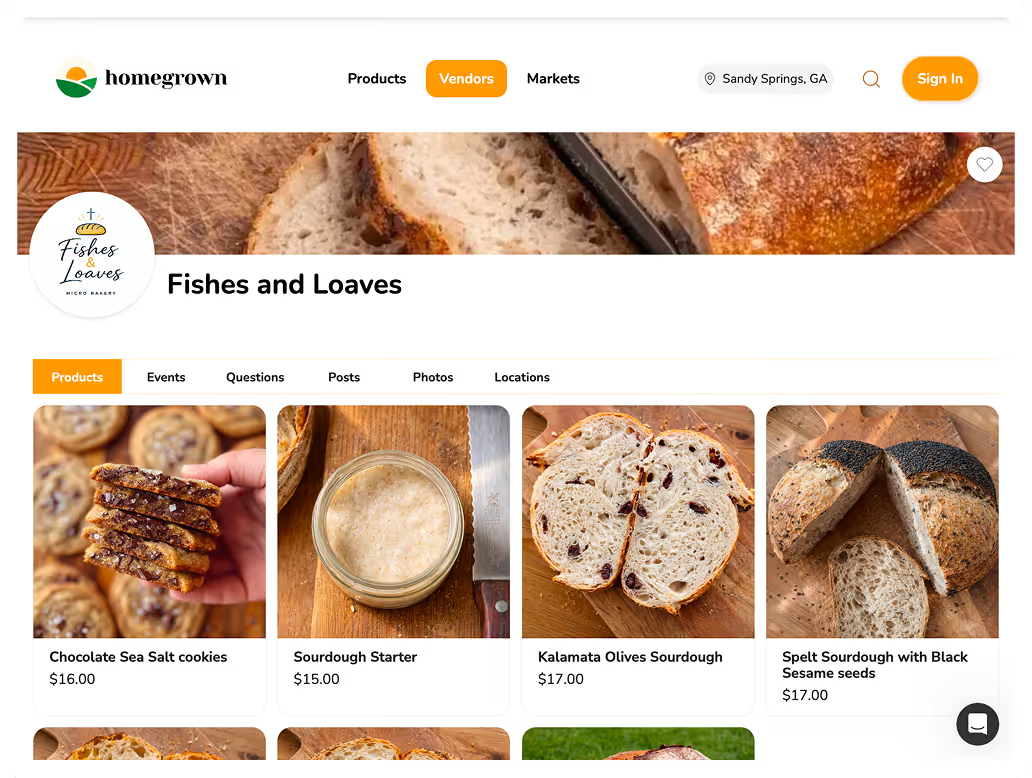
Homegrown is built for small local vendors who sell at farmers markets and want customers to order online. Where Local Food Marketplace manages multi-producer food hubs, Homegrown gives individual vendors their own ordering page.
Here is what Homegrown includes:
The pricing difference is dramatic. Local Food Marketplace's cheapest producer plan costs $129/month. Homegrown costs $10/month. That is $1,428 per year saved — enough to buy ingredients for an entire season of production. And Homegrown includes everything a small vendor actually needs: product listing, ordering, payment processing, and pickup day management.
Homegrown takes 15 minutes to set up. No distribution day configuration, no producer portals, no delivery routing. You add your products, set your prices, share your link, and start taking orders.
If you are considering whether you need a website, a marketplace, or just an order form, a simple ordering page like Homegrown covers what most small vendors actually need — without the complexity of enterprise software.
Start your free trial at Homegrown
Google Forms costs nothing and works for vendors testing whether customers will pre-order. It is the simplest approach to online ordering.
Here is the setup:
What works:
What does not work:
Google Forms is a reasonable starting point for a vendor who wants to test demand before committing to any platform. It is infinitely cheaper than Local Food Marketplace's $129/month minimum and proves whether your customers will actually pre-order.
Square Online offers a free plan with standard processing fees (2.9% + 30 cents per transaction). If you already use Square at the market, the integration is seamless.
What Square Online includes:
Where it falls short:
Square Online is the best option for vendors already in the Square ecosystem. The free plan with transparent processing fees is dramatically more affordable than Local Food Marketplace for a single vendor.
| Feature | Local Food Marketplace | Homegrown | Google Forms | Square Online |
|---|---|---|---|---|
| Built for | Food hubs, multi-producer ops | Individual market vendors | Anyone | General e-commerce |
| Monthly cost | $129-$349+ | $10/mo (annual) | Free | Free |
| Transaction fees | Standard processing | None | None | 2.9% + 30¢ |
| Setup time | Days to weeks | 15 minutes | 15 minutes | 1-2 hours |
| Works for solo vendors | Overkill | Yes | Yes | Yes |
| Multi-producer management | Yes | No | No | No |
| Harvest/pack lists | Yes | No | No | No |
| Delivery routing | Yes | No | No | No |
| SNAP/EBT support | Yes | No | No | Yes |
| Customer discovery | No | Homegrown marketplace | No | No |
| Order summaries | Yes | Yes | No | No |
| Best for | Food hubs (20+ producers) | Solo market vendors | Testing demand | Square POS users |
The comparison makes the distinction clear: Local Food Marketplace is food hub software. Homegrown, Google Forms, and Square Online are vendor tools. If you are coordinating 20 producers and delivering to institutions, Local Food Marketplace is worth the price. If you are a single vendor selling at a Saturday market, you are paying for 90% of features you will never use.
The Food Systems Leadership Network's discussion on food hub software confirms that choosing the right platform depends on scale — tools built for food hubs serve food hubs, while individual producers need simpler, more affordable options.
Local Food Marketplace is the right choice when:
Local Food Marketplace does not make sense when you are a solo vendor selling $500-$2,000 per month at local markets. The features are wrong, the price is wrong, and the complexity is wrong for that scale.
If you are unsure which tool fits your business, ask yourself these questions:
Most small food vendors should not build a Shopify store either — for the same reason Local Food Marketplace is overkill. You need the minimum viable tool that takes orders and processes payments. Everything else is overhead.
If you are a vendor who wants to add online ordering to your existing market business, start with the simplest tool that works. You can always upgrade later if your business grows to food hub scale. But most part-time vendors never need that — and that is perfectly fine.
Start your free trial at Homegrown
Local Food Marketplace starts at $129/month for individual producers and $149/month for food hubs. Add-on modules like Advanced Inventory ($49-$99/month), Advanced Logistics ($49-$99/month), and Subscriptions ($99-$199/month) can push total costs to $250-$400+ per month. All plans are prepaid annually, though monthly billing is available by request.
No. Local Food Marketplace is designed for food hubs and multi-producer operations, not individual vendors selling at local markets. The features (harvest lists, delivery routing, producer portals) and pricing ($129+/month) are built for organizations coordinating 20-60 producers. A solo vendor would pay 13 times more than Homegrown while using less than 10% of the available features.
For individual food vendors who want a simple ordering page, Homegrown is the best Local Food Marketplace alternative. It costs $10 per month with no transaction fees, takes 15 minutes to set up, and includes everything a small vendor needs — product listing, online ordering, payment processing, and pickup day summaries.
Yes. Local Food Marketplace includes SNAP/EBT payment acceptance, which is particularly relevant for food hubs serving low-income communities. If SNAP/EBT support is essential for your business, this is one of Local Food Marketplace's genuine advantages over simpler platforms that do not support government food assistance payments.
Yes, but it is not cost-effective. The Producer Starter plan costs $129/month for a single producer with one distribution day. For comparison, Homegrown costs $10/month and provides an ordering page with payment processing — which is all most solo producers need. Local Food Marketplace's value comes from multi-producer coordination, not from serving individual vendors.
Local Food Marketplace includes harvest lists, delivery routing, multi-producer management, wholesale pricing tiers, institutional invoicing, SNAP/EBT support, and producer portals. These features serve food hubs coordinating dozens of producers for wholesale and institutional sales. Homegrown focuses on what individual vendors need: a simple ordering page, payment processing, order summaries, and customer management — at $10/month instead of $129+.
No. Local Food Marketplace (localfoodmarketplace.com) is e-commerce software for food hubs and multi-producer operations. LocalHarvest (localharvest.org) is a free directory that helps consumers find local farms and CSA programs. They serve completely different purposes — one is operational software, the other is a discovery platform.
Local Food Marketplace is powerful software for food hubs. But if you are a one-person food business selling at local markets, you do not need food hub software. You need an ordering page.
Homegrown costs $10/month flat — no percentage fees, no add-on modules, no enterprise pricing. Set up your ordering page in 15 minutes and give your customers a simple way to pre-order from you.
Start your free trial at Homegrown
The right tool for your food business depends on your sales volume, your customer base, and how you prefer to work. A full marketplace platform makes sense if you are coordinating with multiple vendors or running a food hub. But if you are a single vendor selling directly to local customers, a simpler and less expensive tool will serve you better. Match your software to your current operation, not the operation you hope to have someday. You can always upgrade later, but overpaying for features you do not use drains cash you could spend on ingredients and marketing.