

You make something people love. Maybe it's sourdough, hot sauce, beeswax candles, or small-batch granola. Your customers keep asking the same question: "Do you have a website where I can order?"
So you search "best e-commerce platform" and every article tells you to build a Shopify store. Or a WooCommerce site. Or a Squarespace page.
But here's the thing — you don't ship nationwide. You don't need warehouse inventory syncing or carrier rate calculations. You sell locally, customers pick up in person, and you just need a way for people to order and pay without managing it all through DMs and Venmo.
This guide covers the e-commerce platforms that actually make sense for local vendors — from simple storefronts you can set up in 15 minutes to full-featured websites for when you're ready to scale.
The short version: The best ecommerce platform for local vendors depends on how you sell. If you just need your regulars to order and pay online, a simple Homegrown storefront ($10/month) or Square Online's free tier gets you live in under an hour. If you want a full branded website, Shopify or Wix offer more flexibility at higher cost and longer setup. Skip platforms built for nationwide shipping — local vendors need local pickup, simple checkout, and easy reordering, not carrier integrations and warehouse tools.
Local vendor e-commerce is fundamentally different from general online selling because you don't ship products — your customers pick up in person or get local delivery. That single difference changes which features matter and which platforms make sense. Here's why the standard "best e-commerce platform" advice misses the mark for vendors like you.
Most e-commerce platforms are built around shipping. Shipping rate calculators, carrier integrations, tracking numbers, return labels. The entire user experience is designed around getting a physical product from point A to point B across the country.
As a local vendor, you don't need any of that. Your customers pick up at the farmers market, at your kitchen, or at a designated drop-off point. Maybe you offer local delivery within a few miles. Either way, you need a platform that handles local pickup and scheduling — not one that asks you to configure UPS and FedEx rates during setup. Farmers markets and direct sales channels keep growing because consumers want that local connection (Farmers Market Coalition).
Your customers don't need convincing — they need a convenient way to order. General e-commerce is built to convert strangers, but your situation is the opposite.
Product pages optimized for search engines. Detailed descriptions to convince someone who's never heard of you. Abandoned cart emails to win back browsers who didn't buy. None of that matters when your customers have already tasted your jam, bought your bread at the farmers market, or heard about your hot sauce from a friend.
That means you don't need a complex website with SEO-optimized product pages and marketing funnels. You need a clean ordering page and a link to share. The simpler the path from "I want this" to "order placed," the better. According to the USDA, direct-to-consumer food sales reached $9 billion through a variety of marketing channels in recent years, with local pickup and farmers markets driving the bulk of that growth (USDA Economic Research Service).
Repeat customers are the backbone of a local vendor business. The same people showing up every Saturday, ordering the same products week after week. The right platform makes reordering easy and frictionless — not a maze of pages and menus every time a customer wants their usual. Resources from small business planning checklist offer more detail here.
Standard "best e-commerce platform" lists don't work for local vendors because they recommend platforms built for nationwide shipping. Search "best e-commerce platform" and you'll find the same names in every article: Shopify, BigCommerce, WooCommerce, Wix, Squarespace. These are genuinely good platforms — for the right business. But the USDA reports that local food sales now top $17.5 billion annually, with farmers markets and direct-to-consumer channels driving much of that growth (USDA Census of Agriculture). Local vendors have different needs than businesses shipping nationwide.
They're all built for businesses that ship products to customers across the country or around the world. For a local vendor, that means you're paying for features you'll never use and navigating setup steps that don't apply to you.
Here's what that looks like in practice:
There's a better way — but you have to know it exists. Alongside the big-name platforms, there are simpler tools designed specifically for local selling. The key is matching the platform to how you actually do business.
There are two main categories of e-commerce platforms, and understanding the difference saves you from picking the wrong one. Before comparing specific platforms, here's what sets them apart.
Full website platforms like Shopify, Wix, and Squarespace give you a complete online presence:
Simple storefront platforms like Homegrown and Square Online's free tier give you an ordering page:
Neither type is objectively better. If you're building a brand with a strong online presence — blog content, story page, custom design — a full website makes sense. If you just want your regulars to order from you online without the DM back-and-forth, a simple storefront gets the job done faster and cheaper.
Most local vendors start with a simple storefront and upgrade later if the business grows to warrant it.
Price: $10/month billed annually or $12.50/month billed monthly. Transaction Fee: 2.9% + $0.30 per order Type: Simple storefront Setup Time: About 15 minutes
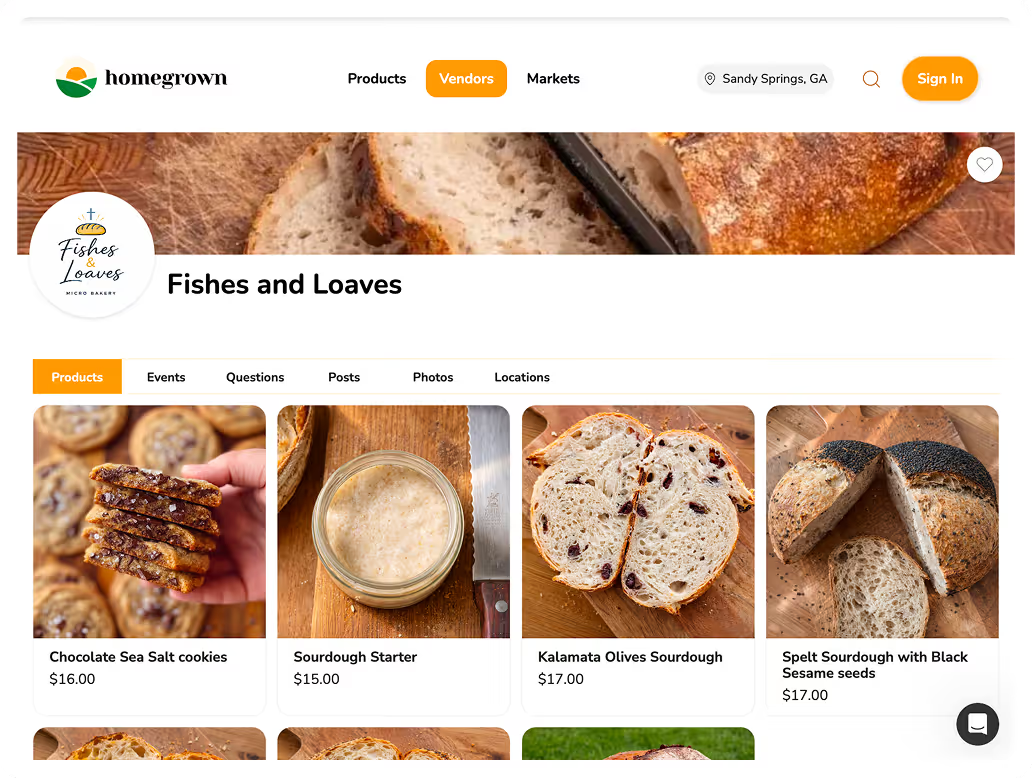
Homegrown is the best ecommerce platform for local vendors who sell food and want the fastest path to taking orders online. You add your products, set your availability and pickup schedule, and share a single link with customers. They browse, order, and pay through your Homegrown storefront. You get a dashboard showing incoming orders.
The platform strips away everything a local vendor doesn't need — no shipping configuration, no complex website builder, no theme customization rabbit holes. You get a clean, mobile-friendly storefront that does one thing well: letting your customers order and pay without the back-and-forth.
At $10 per month, it's the most affordable dedicated platform on this list. The tradeoff is that it's a newer platform focused specifically on food vendors — so if you sell non-food products or want a full website, it's not the right fit.
Best for: Local food vendors who want to sell food locally or between farmers markets. Cottage food producers, bakers, jam makers, sauce makers, anyone selling local food products who wants ordering live in under an hour.
Price: Free plan available. Paid plans $29 to $79/month. Transaction Fee: 2.9% + $0.30 per order (free plan) Type: Full website with free tier Setup Time: 1 to 2 hours
Square Online is the best free option for vendors who already use a Square reader at the farmers market. If you want to test online ordering without committing to a monthly fee, Square Online's free plan is hard to beat. You get a basic online store with local pickup and delivery options, and it connects directly to your Square account.
The free plan works for getting started, but the store design is limited and generic. It's not built specifically for local food vendors — you'll be working within a general-purpose template. Paid plans unlock better design options but jump to $29 per month.
Best for: Vendors who already use Square and want to add online ordering at zero additional monthly cost.
Price: $29 to $299/month Transaction Fee: 2.4% to 2.9% + $0.30 per order Type: Full website Setup Time: Several days for a polished setup
Shopify is the most powerful all-around e-commerce platform, but most local vendors won't use even half its features. It handles virtually any type of online selling with thousands of themes, apps, and integrations. If you want full control over your online brand, Shopify can build whatever you envision.
The caveat for local vendors: most of Shopify's power goes unused. You're paying for a platform built to handle international shipping, multi-warehouse inventory, and complex marketing automations. Setup takes days, not minutes, and monthly costs climb quickly once you add apps for features that niche platforms include by default.
Best for: Vendors with a strong brand identity who plan to scale beyond local farmers markets or need a full content-driven website alongside their store. The Nolo small business guides provides additional guidance on this.
Price: $17 to $159/month Transaction Fee: Varies by plan Type: Full website Setup Time: A few hours to a day
Wix is the most approachable full website builder for non-technical vendors. It's a drag-and-drop website builder with e-commerce capabilities built in. If you want a full website — about page, photo gallery, blog, contact form — alongside your Homegrown storefront or online store, Wix makes it approachable.
The e-commerce features are decent but not as deep as Shopify. Wix works well when the website matters as much as the store — think a local baker who wants to showcase their products, share their story, and take orders all in one place.
Best for: Vendors who want a complete website with ordering capability and prefer a visual, drag-and-drop builder.
Price: $27 to $65/month Transaction Fee: 3% on Business plan, 0% on Commerce plans Type: Full website Setup Time: A few hours to a day
Squarespace delivers the most polished visual design out of the box. If visual presentation matters to your brand — artisan products, handcrafted products, photography-heavy businesses — Squarespace is the best-looking option.
E-commerce functionality includes local pickup, basic inventory management, and integrated payments. The Commerce Basic plan ($33/month) removes Squarespace's 3% platform fee, but Stripe's payment processing (2.9% + $0.30 per transaction) still applies on top, making it competitive at higher volumes.
Best for: Brand-conscious vendors where visual identity and design quality are priorities alongside e-commerce.
Price: Free for up to 5 products. Paid plans $14.08 to $99/month. Type: Embeddable storefront Setup Time: 30 minutes to an hour
Ecwid lets you add e-commerce to a website you already have, rather than building a new one. Instead of creating a standalone website, it's a store widget you embed into an existing site. If you already have a WordPress blog, a Wix site, or even just a Facebook page, Ecwid adds e-commerce functionality on top of it.
The free plan covers up to five products, which may be enough for a small local vendor testing the waters. Paid plans add more products and features like automated tax calculation and abandoned cart recovery.
Best for: Vendors who already have a website or social media presence and want to add ordering without starting from scratch.
Price: Free to list Transaction Fee: 20 to 30% commission per sale Type: Marketplace Setup Time: Quick onboarding
Market Wagon trades high commissions for customer exposure — it's an online farmers market where buyers discover you. You list your products on their marketplace, and they handle the customer-facing website, marketing, and logistics coordination. Customers browse Market Wagon like they'd browse a virtual farmers market, and they can discover your products alongside other local vendors.
The draw is exposure — Market Wagon brings buyers to you. The cost is steep. A 20 to 30 percent commission on every sale means $4 to $6 on a $20 order goes to the platform. Over time, most vendors find it more cost-effective to drive customers to their own Homegrown storefront.
Best for: Vendors who want new customer exposure and are willing to pay the commission. Works best as a supplement alongside your own storefront, not as your only sales channel.
Here's a side-by-side look at what each platform costs for the best ecommerce platform for local vendors. Monthly fees and transaction costs vary widely, so this table makes it easy to compare.
| Platform | Monthly Cost | Transaction Fee | Type | Setup Time |
|---|---|---|---|---|
| Homegrown | $10/mo | 2.9% + $0.30 | Simple storefront | ~15 min |
| Square Online | Free–$79/mo | 2.9% + $0.30 | Full website (free tier) | 1–2 hours |
| Shopify | $29–$299/mo | 2.4–2.9% + $0.30 | Full website | Days |
| Wix | $17–$159/mo | Varies | Full website | Hours to a day |
| Squarespace | $27–$65/mo | 0–3% | Full website | Hours to a day |
| Ecwid | Free–$99/mo | Varies | Embeddable store | 30 min–1 hr |
| Market Wagon | Free to list | 20–30% commission | Marketplace | Quick onboarding |
For a local vendor doing $1,000 per month in online sales, here's the total monthly cost including fees:
| Platform | Monthly Fee | Estimated Fees | Total Monthly Cost | Notes |
|---|---|---|---|---|
| Square Online (free) | $0 | ~$29 | $29/month | Free tier |
| Homegrown | $10 | ~$29 | $39/month | Simple storefront |
| Wix | $17 | Varies | $17+/month | Depends on plan |
| Squarespace | $33 | $0 | $33/month | Commerce plan, no transaction fee |
| Shopify | $29 | ~$25 | $54/month | Basic plan |
| Ecwid (free) | $0 | Varies | $0–29/month | Limited to 5 products |
| Market Wagon | $0 | ~$250 | $250/month | 20–30% commission adds up fast |
Looking for the simplest way to start taking orders locally? Homegrown gives you a storefront in 15 minutes — products, payments, and pickup scheduling built in. Set up your storefront →
The right platform depends on what you need most. Here's a quick decision guide based on common local vendor situations:
No — most local vendors do better with a simple storefront. A single ordering page you share with customers is all you need if your buyers already know you. Full websites make sense when you're building a brand, creating content, or need to be found through search engines. But if your customers just need a place to order, a simple Homegrown storefront is faster, cheaper, and easier to maintain.
Yes, switching platforms is straightforward. Starting simple doesn't lock you in. Most vendors start with an affordable, easy platform and upgrade as their business grows. Your products, prices, and customer relationships transfer — you just share a new link.
Farmers market vendors have specialized needs, and several platforms are designed for that workflow. Platforms like Homegrown, Local Line, and GrazeCart handle the farmers market schedule and pickup logistics. Our guide to becoming a farmers market vendor covers the full process of getting started.
Requirements depend on your state and what you're selling. Most cottage food producers — home bakers, jam makers, sauce makers — can sell online under their existing cottage food license or permit. The SBA has a helpful overview of getting started selling online, and your state's department of agriculture website will have the specific cottage food rules for your area. Our guide to becoming a vendor covers the basics of getting started.
Share your storefront link everywhere — that's the fastest way to shift customers from DMs to online ordering. Here's where to put it:
Most customers prefer the convenience once they try it.
Homegrown is the best ecommerce platform for local vendors who sell food products. It's built specifically for local food vendors with pickup scheduling, simple checkout, and a storefront you can set up in 15 minutes. For non-food products or vendors who need a full website, Square Online or Shopify may be a better fit.
You can start for free with Square Online or Ecwid's free tier, though both have limitations. Homegrown costs $10/month and gives you a dedicated storefront without product limits. Full website builders like Shopify ($29+/month) and Wix ($17+/month) cost more and take longer to set up. Avoid marketplace models like Market Wagon if you want to keep your margins — their 20-30% commission eats into profits quickly.
You don't need the e-commerce platform that every "best of" list recommends. You need the one that fits how you actually sell — locally, to customers who already know your name, with pickup instead of shipping. For a deeper look at this topic, see best platforms to sell food online. For a deeper look at this topic, see selling farm products online. For a deeper look at this topic, see Shopify alternatives for food vendors.
Start with something simple and affordable. Get your products online. Share the link. Once you're taking orders and seeing what your customers want, you'll know if and when it's time to upgrade to something bigger.
Homegrown was built for local food vendors who want to start taking orders without the complexity. Add your products, set your schedule, share your link. Fifteen minutes from now, your customers can start ordering.