

Every guide about selling farm products online reads like it was written for a 500-acre operation with a full-time marketing team. They tell you to invest in SEO, set up Google Ads, build a farm website, and subscribe to a $100-a-month ecommerce platform.
That's great if you're shipping grass-fed beef to customers three states away. But if you're the person with 20 chickens in the backyard, a half-acre vegetable plot, or a dozen beehives in the back field, that advice is wildly overcomplicated for what you actually need.
You already have customers. They text you asking if eggs are available. They flag you down at the farmers market to ask when the tomatoes are coming in. They message you on Facebook wanting to know if you have any honey left.
The problem isn't demand. It's that managing all of that through texts, calls, and cash at pickup doesn't scale past a handful of regulars. This guide is for small-scale farmers who want a simple way to let existing customers order and pay online — without building an ecommerce empire.
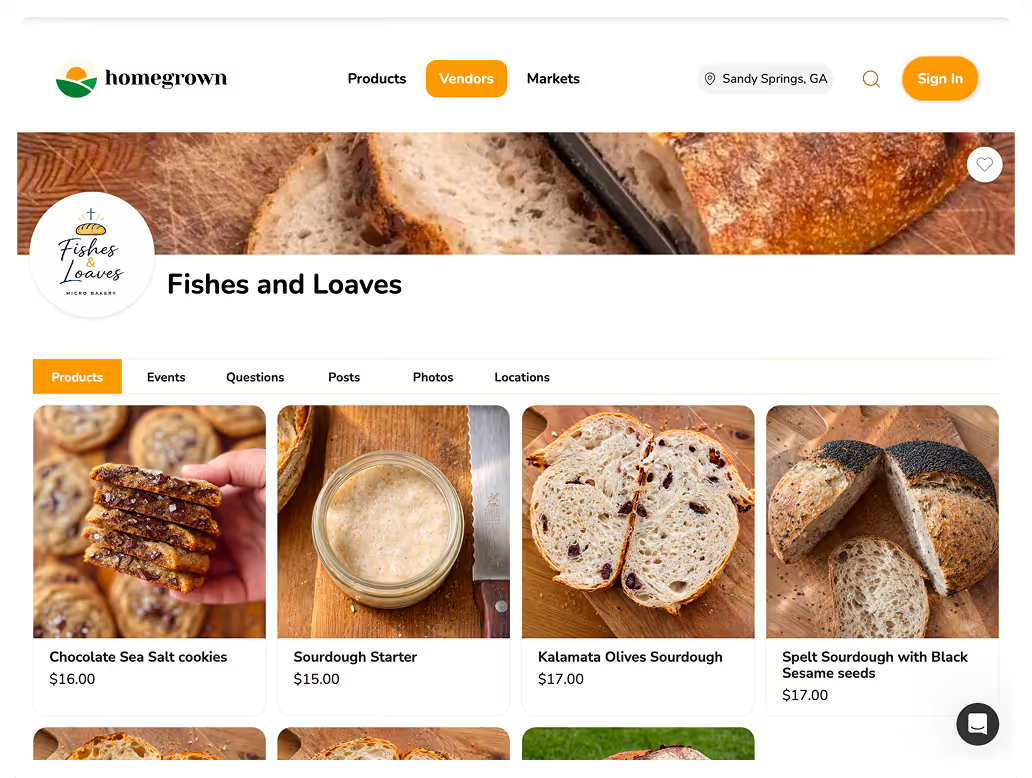
The short version: You don't need a fancy website or an expensive platform to sell farm products online. Pick three to five products your customers already ask for, set up a simple Homegrown storefront in under 15 minutes, choose a pickup option, and share your link with the people who already buy from you. Most vendors can go from zero to taking online orders in a single weekend.
Selling farm products online is different because perishability, seasonality, and weight variation create challenges that shelf-stable cottage food doesn't have. If you've read other guides about selling food online, you might be wondering what makes your situation unique.
But those same challenges actually make online ordering easier in some ways.
Seasonal products actually simplify your Homegrown storefront rather than complicate it. Unlike a jam maker who sells the same six flavors year-round, your product lineup rotates. Strawberries in spring. Tomatoes and peppers in summer. Squash and sweet potatoes in fall. Eggs and honey year-round.
This sounds like a complication, but it's actually simpler than managing a huge permanent catalog. You just update what's available each week. Think of it like a weekly chalkboard menu — except it's online, and customers can order from it at midnight.
The key is picking a platform that makes updating easy. If it takes you fifteen minutes to swap out three products every Monday morning, that's a system that works. If it takes an hour of wrestling with product pages and inventory settings, that's a system built for Amazon vendors, not farmers.
Freshness works in your favor because it drives customers to order quickly. Fresh produce has a pickup window. Lettuce picked Tuesday morning needs to be in someone's hands by Wednesday or Thursday. Eggs are good for weeks but customers want them fresh.
This natural urgency actually works in your favor. When customers pre-order through your Homegrown storefront, you know exactly what to harvest. Pick what's already sold. No extra trips to the farmers market hoping someone buys that last flat of strawberries. No waste from overproduction.
Pre-orders turn your farm sales from "grow it and hope" into "sell it and pick it." That's a fundamentally better way to run a small farm operation.
You can sell most farm products online with minimal friction — the key is knowing which ones are ready to list right now and which need extra planning. Not everything requires the same level of legwork.
These products can be listed on your Homegrown storefront today with little to no regulatory hurdles:
These products require additional regulatory steps before you can sell them online:
Start with whatever you're already selling. If people are texting you for eggs and tomatoes, those are your first online products. You can add the more regulated products later once you've got the system working.
Start selling farm products online in four steps — you can realistically be taking orders within a weekend. Here's the practical part.
Choose three to five products that your customers already ask for — don't try to put everything online at once.
Look at what people request most between farmers market days or through messages. Those are your best products for online ordering. If you get three texts a week asking about eggs and two about honey, that's your starting lineup.
Need more help here? See our guide on selling food online.
For produce, start with products that have a reasonable pickup window:
Pick a simple, affordable platform — for most small-farm vendors, a basic Homegrown storefront is all you need. This is where most guides lose small farmers by recommending platforms that cost $50-100+ per month and are built for operations shipping nationwide.
There are three tiers of platforms, and for most small-farm vendors, the first tier is plenty:
| Platform Type | Cost | Best For | Examples |
|---|---|---|---|
| Simple storefronts | $10-20/month | Local vendors selling to existing customers | Homegrown — live in 15 minutes |
| Farm-specific platforms | $49-299/month | Vendors doing $5,000+/month with subscriptions and delivery routes | Barn2Door ($99/month + setup), GrazeCart ($49/month) |
| Full ecommerce platforms | $30-80/month | Vendors needing a complete website with unlimited customization | Shopify |
For most small-farm vendors doing under $3,000 per month, the simple storefront tier is the right starting point. Farm-specific platforms like Barn2Door and GrazeCart are built for larger operations with CSA subscriptions and delivery routes — powerful but expensive and complex for a vendor with 20 chickens and a vegetable plot. Shopify is designed for nationwide e-commerce shipping, not Saturday farm pickup. Homegrown costs $10/month with no percentage fees beyond standard payment processing (2.9 percent plus $0.30 per transaction) and is built for exactly this scenario — customers see your available products, order, pay, and choose pickup or local delivery from one link. Homegrown does not manage CSA subscriptions or build you a full farm website, but it lets you offer pickup or local delivery and handles the online ordering that replaces the "text me if you want eggs this week" workflow.
For a detailed comparison of specific platforms and pricing, check out our guides on the best platforms for selling food online and best ecommerce platforms for farmers market vendors — and pricing your farm products can help with that.
Set up farm pickup as your starting fulfillment method — it's the simplest option and your customers are already local. No shipping labels, no cold-chain logistics, no packing peanuts. Someone drives to your farm or meets you at the farmers market.
Here are the three main fulfillment options:
Pick one option to start. You can always add more later.
Your Homegrown storefront gives you one link — get it in front of the people who already buy from you. See Farm Bureau market intelligence resources for additional context.
Here are the three fastest ways to share your link:
You're not marketing to strangers. You're giving the people who already know your farm a better way to buy from it.
Handle seasonal availability by updating your Homegrown storefront weekly and training your customers to expect a regular rhythm. Seasonality is the biggest difference between farm products and other food businesses — here's how to make it work online instead of fighting it.
The regulations that apply depend on whether you're making farm-direct sales or cottage food sales — they operate under different rules, and the distinction matters.
Cottage food laws cover food prepared in a home kitchen — baked goods, jams, honey, candies, sauces. These laws specify what products are allowed, set revenue caps, and define where you can sell. All 50 states have some form of cottage food law, though the details vary widely.
Farm-direct sales cover agricultural products sold directly from the farm to the consumer. Fresh produce, eggs, and unprocessed farm products generally face fewer restrictions than processed foods. The rules focus more on where and how you sell than on the product itself.
Here's the practical breakdown:
| Product | Regulation Level | Key Details |
|---|---|---|
| Produce | Generally unrestricted | No license needed to sell produce you grew in any state |
| Eggs | Minimal requirements | Most states allow direct farm sales for small flocks. Check your state's flock-size thresholds |
| Honey | Cottage food laws | Shelf-stable and straightforward to sell |
| Meat | Heavily regulated | Requires processing at an inspected facility. State exemptions exist for small producers selling within state lines |
| Dairy | State-dependent | Raw milk sales legal in 32 states with varying restrictions |
| Value-added products | Cottage food laws | Jams, pickles, sauces made from your farm products typically fall under cottage food laws |
If you're already selling at a farmers market, you've likely already navigated most of these requirements. Moving your sales online doesn't change what you're allowed to sell — it just changes how customers order.
For a comprehensive look at cottage food laws by state, check cottagefoodlaws.com or the Institute for Justice state reforms page.
No. A simple Homegrown storefront gives you a product page and a checkout — that's all most vendors need. You don't need a homepage, blog, or "About Our Farm" page to start taking orders. A single ordering link that you text to customers or put in your Instagram bio does the job.
In most states, yes. You're not shipping eggs through the mail — you're letting customers order online and pick them up from your farm or at the farmers market. The online ordering part doesn't change the regulations around your egg sales. If you're legally allowed to sell eggs at your farm gate today, you can take those same orders online. See Beginning Farmers resources for additional context.
Sell by the unit or bundle whenever possible — it's the simplest approach. This is a common concern for produce and meat vendors. There are a few approaches that work:
For most small farm vendors, selling by the unit or bundle is the simplest option.
That's actually your strength, not a weakness. Seasonal products create natural urgency — when the peaches are ready, people order because they know the window is short.
Update your Homegrown storefront weekly with what's available. Turn off products when they're done for the season. Your regular customers will appreciate the honesty, and the rotating selection keeps them checking back every week to see what's new.
A simple Homegrown storefront runs $10-20 per month plus standard card processing fees (around 2.5-3%). If you're selling $500 a month in eggs and produce, you're paying roughly $15 for the platform and $15 in processing fees. That's $30 total to stop managing orders through text messages.
Farm-specific platforms like Barn2Door ($99-299/month plus setup fees) and GrazeCart ($49-299/month) are built for larger operations doing thousands in monthly sales. They're more than most small-scale vendors need.
In most cases, selling farm products online does not require a separate business license beyond what your state already requires for direct farm sales. If you're already selling at a farmers market or from your farm gate, you likely have the permits you need. The online component changes how customers order, not what you're allowed to sell. Check with your state's Department of Agriculture for specifics.
Text your existing customers a direct link to your Homegrown storefront and let them know they can browse what's available and order anytime. Most vendors find that once customers place their first online order, they prefer the convenience and keep coming back. A QR code at your farmers market booth also helps capture new online orders between market days.
You don't need a farm website, a marketing plan, or a $100-a-month platform to sell your farm products online. You need a simple link where your existing customers can see what's available, place an order, and pay — without texting you back and forth.
Pick your best-selling products. Set up a simple Homegrown storefront. Share the link. You can be taking online orders by this weekend.
Ready to get started? Homegrown helps local farm vendors set up a Homegrown storefront in 15 minutes — orders, payments, and pickup all handled. Set it up this weekend.