


GrazeCart is a specialized platform built for farm-direct meat sales, and it does that specific job well. If you're coordinating custom beef cuts, managing half-animal and quarter-animal orders with processing facilities, running a meat CSA subscription, or tracking variable-weight pricing across cuts of beef and pork, GrazeCart has features specifically designed for the complexity of that product type. The platform handles cut-sheet management, processor coordination, hanging weight tracking, and the kind of specialized inventory logic that meat-focused farm operations require.
But a significant number of vendors who encounter GrazeCart while searching for a farm direct sales platform aren't in the custom meat business. They're cottage food producers selling baked goods and preserves at a Saturday market. They're produce vendors who want a simple way to take pre-orders for booth pickup. They're mixed farm vendors selling eggs, honey, and vegetables who found GrazeCart in a search and quickly realized it was built for a different kind of operation. For those sellers, GrazeCart is either too expensive for what they need, too oriented toward meat-specific logistics, or simply not built for the products they're selling.
This guide covers the main GrazeCart alternatives, explains honestly who each one is built for, and helps you match the right tool to your actual business and product type.
The short version: If you're not selling custom-cut meat, GrazeCart is almost certainly not the right platform for you. For cottage food producers and farmers market vendors doing pre-orders with local pickup, the Homegrown storefront is the best fit — $10 per month flat with no percentage fees beyond standard payment processing, and built-in local customer discovery. For vendors already using Square, Square Online adds online ordering at no extra monthly cost. GrazeCart only makes sense if custom meat processing, cut-sheet management, and variable-weight pricing are central to your operation.
GrazeCart is a farm e-commerce platform designed specifically around custom meat sales and protein-direct-to-consumer workflows. The platform's core functionality centers on the specialized needs of farms selling beef, pork, lamb, and poultry directly to customers — particularly farms that offer custom processing options.
Comparing these two directly? Our head-to-head on Local Line vs GrazeCart puts both pricing models side by side.
Two other comparisons are worth having if GrazeCart is on your list: Barn2Door against GrazeCart, which is the closest match on scope, and Homegrown against GrazeCart if what you actually need is pickup and local delivery rather than cut sheets.
The key features that differentiate GrazeCart from general farm platforms include:
Plans typically start around $99 to $149 per month, with higher tiers available for additional features and larger operations. This pricing reflects the specialized nature of the platform and the complexity of the workflows it manages.
For a farm that sells custom beef and pork direct-to-consumer — managing individual cut preferences for dozens of customers, coordinating pick-up dates tied to processing schedules, tracking the difference between hanging weight pricing and final cut weight — GrazeCart's toolset addresses genuine complexity that general platforms handle poorly or not at all. The difference between a customer ordering a quarter beef with specific cut instructions versus ordering a jar of jam is enormous in terms of backend logistics, and GrazeCart is built for that first scenario.
For a cottage food producer selling cookies and granola, a small farm vendor selling produce and eggs, or a farmers market vendor whose product lineup doesn't include custom-cut meat, GrazeCart is priced for problems you don't have. The specialized meat features that justify the subscription cost provide zero value when your products don't require cut-sheet management or processing coordination.
Product mismatch is the most fundamental reason. GrazeCart is built around the specific workflows of meat sales — custom cuts, processing coordination, variable weights, whole and half animal pricing structures. If you're not selling meat, or if your meat sales are simple pre-packaged cuts that don't require custom processing coordination, these features add interface complexity and cost without any corresponding benefit. A cottage food producer selling jam and cookies has no use for cut-sheet management. A produce vendor selling tomatoes and herbs has no need for processor coordination. The platform's greatest strength becomes irrelevant when your products don't match its specialization.
The price point is significant for vendors at small scale. At $99 to $149 per month, GrazeCart represents substantial overhead for a vendor whose monthly revenue might be $800 to $2,000. When a meaningful portion of the platform's feature set doesn't apply to your product category, the cost-to-value ratio tilts unfavorably. You're effectively paying for meat logistics infrastructure that sits unused while you manage a simpler operation. See food e-commerce market research for additional context.
No local customer discovery is a gap shared by GrazeCart and most farm management platforms. The platform manages existing customer relationships and order logistics effectively, but it doesn't help new buyers discover your products. If you're still building your customer base — which most small vendors and cottage food producers are — a platform with a consumer-facing discovery component provides value that GrazeCart doesn't offer. You need a separate marketing channel to drive customers to your GrazeCart storefront, which means additional effort and cost beyond the subscription.
The platform is overkill for informal pre-order and pickup operations. For vendors doing simple weekly pre-orders and booth pickup at a farmers market, the full GrazeCart infrastructure is substantially more than the situation requires.
Here is a summary of why vendors seek alternatives:
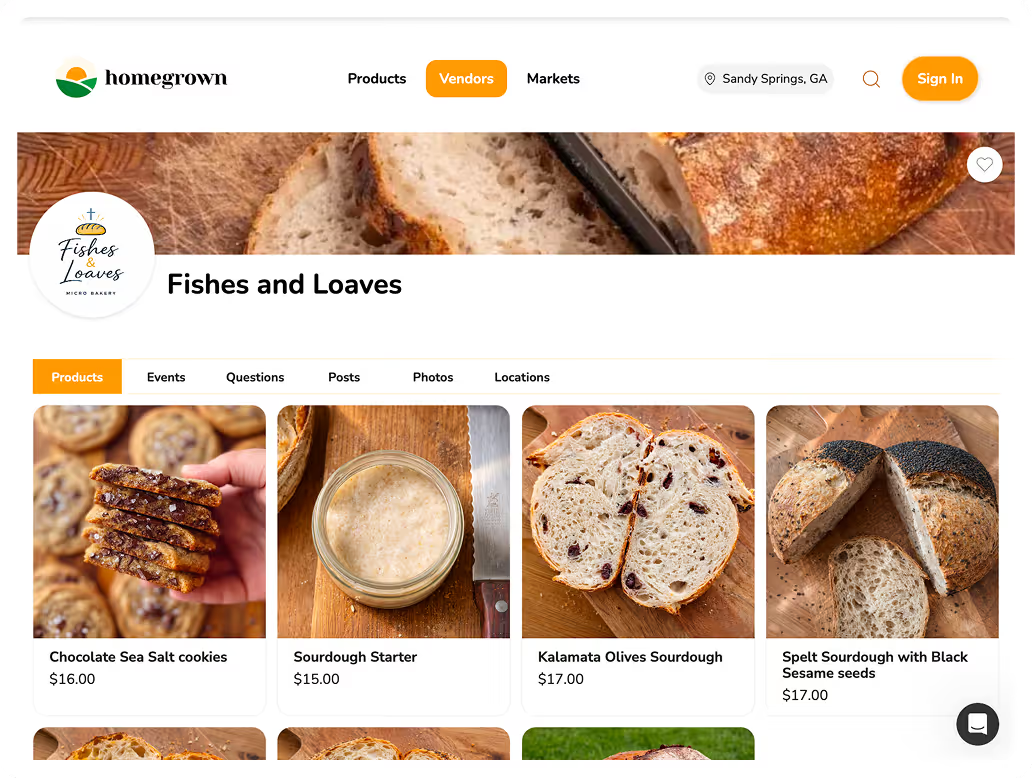
Homegrown is the best alternative for vendors selling any type of local food through pre-orders with local pickup. Cottage food vendors, produce farmers, bakers, and mixed-product vendors list their products with photos and descriptions, accept pre-orders from local customers, and collect payment through the Homegrown storefront. Local buyers can discover producers through the marketplace, which means the platform actively helps you find new customers rather than just managing the ones you already have.
The model is fundamentally different from GrazeCart's. Homegrown costs $10 per month flat with no percentage fees beyond standard payment processing. Compared to GrazeCart's $49 per month plus per-transaction fees on top, the difference is significant for small vendors whose monthly revenue might be $500 to $2,000.
Homegrown handles the pre-order workflow that farmers market vendors actually use every week regardless of product type. Customers browse your products, place their order before your cutoff, and pick up at your booth on market day. You get a consolidated order summary for production planning and a pickup list for market morning. The platform manages order cutoffs automatically and gives customers a visual shopping experience with product photos and descriptions that converts better than a text thread or a Google Form.
The local discovery component is the biggest differentiator from GrazeCart and most other farm platforms. New customers in your area can find you through the Homegrown marketplace without you needing to drive them there through separate marketing efforts. For vendors who are still building their customer base, this is genuinely valuable.
What Homegrown doesn't do is manage custom cut-sheet meat orders, processing facility coordination, or the variable-weight pricing logic that GrazeCart specializes in. It's purpose-built for the pre-order and local pickup model across all food types, and it does that job extremely well.
Best for cottage food producers, farmers market vendors, produce sellers, and small farms doing pre-orders with local pickup across any food product type.
The free, fully manual approach that works for any product type. You create a Google Form with your product options, and customer responses automatically populate a linked Google Sheet that serves as your order tracker. You share the form link through social media, text messages, or a QR code at your booth, and customers fill it out themselves.
This works reliably at small scale — roughly under 30 orders per market cycle. There's zero cost, infinite flexibility in how you structure the form, and you can customize it for any product category. Whether you're selling baked goods, produce, dairy, specialty items, or even simple pre-packaged meat cuts, a Google Form handles the order collection identically. The linked spreadsheet becomes your packing list, your production plan, and your pickup tracker.
The limitations are consistent regardless of product type:
Best for any vendor testing pre-orders for the first time at small scale before committing to a platform, regardless of product type.
Square Online lets you build a simple e-commerce storefront that integrates with the Square point-of-sale system. It supports all product types — baked goods, produce, meat, dairy, specialty items — and handles pickup order management. Customers can order online for pickup, and payment processes through Square using the same account and reporting dashboard you use at your booth.
The basic plan is free with standard Square transaction fees of 2.9 percent plus $0.30 per online transaction. Paid plans starting around $29 per month remove Square branding and add features like custom domains and advanced site customization.
The main advantage is integration with your existing Square setup. If you're already using Square for walk-up sales at the farmers market, adding Square Online means your in-person and online sales data appears in the same dashboard. Your inventory syncs across both channels, and your financial reporting is consolidated.
The limitations for food vendors are that Square Online isn't food or farm-specific, doesn't include local customer discovery, and doesn't have any of the specialized meat processing features that GrazeCart offers. You're building a general e-commerce site rather than using a tool designed for any specific food workflow. For vendors who aren't already in the Square ecosystem, there's limited reason to choose it over food-specific alternatives.
Best for vendors already using Square for in-person sales who want a consistent payment flow across both channels, regardless of product type.
Local Line is a farm-specific direct sales platform designed for small to mid-size farms selling across multiple channels — online store, CSA programs, farmers markets, and wholesale accounts. Unlike GrazeCart's meat-specific focus, Local Line covers all farm product types including produce, dairy, meat, eggs, and specialty items.
Local Line's Core plan starts at $79 per month, which works out to $950 per year when billed annually. The Premium plan runs $159 per month or $1,920 per year billed annually. And the Ultimate plan costs $319 per month or $3,830 per year billed annually. While this is more expensive than the free alternatives on this list, it's generally comparable to or less than GrazeCart for farms that need multi-channel management across diverse product types. See direct-to-consumer food trends for additional context.
Local Line's advantage over GrazeCart for non-meat-specialist farms is that its feature set applies equally to all product types. CSA management, wholesale ordering, online storefront, and inventory tracking all work for produce, dairy, baked goods, and meat without being optimized specifically for one category. For a diversified farm selling vegetables, eggs, and some meat products, Local Line provides relevant tools across the entire product lineup.
What Local Line doesn't do is handle the custom cut-sheet logic, processor coordination, or variable-weight pricing that GrazeCart specializes in. If custom meat processing is central to your business, GrazeCart's specialized tools serve that need better. Local Line also doesn't include built-in local consumer discovery, so you still need separate marketing to drive customers to your storefront.
Best for small to mid-size farms with diverse product types that want a proper online storefront, CSA management, and multi-channel order tracking without needing meat-specific processing features.
Shopify is a general-purpose e-commerce platform that can be configured for farm direct sales, local pickup orders, and subscription products through third-party apps. It supports all product types and is the most flexible option on this list, but it requires the most setup work.
Shopify's Basic plan costs $39 per month plus transaction fees. You get a full e-commerce storefront with product listings, checkout, inventory management, and a large ecosystem of apps that can add almost any functionality — including meat-specific tools, subscription management, and local pickup workflows.
The advantage of Shopify is maximum flexibility. If you have a diverse product catalog, want to sell both locally and through shipping, or have specific workflow needs that farm-specific platforms don't accommodate, Shopify can be configured to handle it. Several meat-focused Shopify apps provide cut-sheet management and custom ordering features that approximate some of GrazeCart's functionality, though with more setup required.
The disadvantages for small food vendors are significant:
Best for vendors who want maximum flexibility and are willing to invest the setup time, or vendors whose product catalog extends beyond local food sales.
| Platform | Monthly Cost | Local Discovery | Product Types | Meat-Specific Features | Best For |
|---|---|---|---|---|---|
| GrazeCart | $99-$149+ | No | Meat-focused | Yes — cut-sheets, variable weight, processor coordination | Farms with custom beef/pork/cut-sheet operations |
| Homegrown | $10/month flat | Yes | All food types | No | Cottage food, produce, farmers market vendors |
| Google Forms + Sheets | Free | No | All types | No | Very small scale, testing pre-orders |
| Square Online | Free-$29+ | No | All types | No | Vendors already using Square |
| Local Line | $79-$319/mo | No | All farm types | No | Small farms with multi-channel storefronts |
| Shopify | $39+ | No | All types | Via apps | Vendors wanting maximum flexibility |
This isn't a takedown of GrazeCart. It's a genuinely good platform that solves real problems for the operations it was designed to serve. GrazeCart is likely worth the investment if two or more of the following describe your operation:
The vendors who get the most value from GrazeCart are the ones whose businesses genuinely revolve around custom meat processing and direct-to-consumer protein sales.
The right tool depends on your actual product type and current operational complexity, not on which platform has the most features or came up first in a search. Resources from platform migration best practices offer more detail here.
Yes. Simple pre-packaged meat cuts (like frozen ground beef or sausage links with fixed prices) can be sold on any platform that supports food products, including the Homegrown storefront, Square Online, or Shopify. GrazeCart's specialized features are only necessary when you're managing custom cut-sheet orders, variable-weight pricing, and processing facility coordination.
Google Forms and Google Sheets is completely free but requires manual payment collection. The Homegrown storefront is the cheapest purpose-built alternative at $10/month with no percentage fees beyond standard payment processing. Both options cost dramatically less than GrazeCart's $99-$149 per month minimum.
Yes. Vendors can set up their Homegrown storefront with products available for different pickup locations and market days. The platform handles pre-order cutoffs for each market cycle, so customers ordering for a Saturday market get a different cutoff than those ordering for a Wednesday market.
You can export your customer contact information from GrazeCart before canceling. Then notify your customers about the new ordering process through email or at the farmers market. Most vendors find the transition takes one to two market cycles for customers to adjust to the new workflow.
Currently, no single platform combines GrazeCart's cut-sheet management and variable-weight pricing with a consumer-facing local discovery marketplace. For vendors selling both custom meat and other local food products, using GrazeCart for the meat program alongside the Homegrown storefront for local discovery and other products is a practical approach.
Common signs include spending more than 30 minutes per week managing the spreadsheet, regularly getting more orders than you can fulfill because you can't limit quantities, losing track of who has paid, and getting customer complaints about the ordering experience. When the manual process starts costing you time or sales, it's time to move to a purpose-built platform.
Shopify is the most flexible option for vendors who need both local pickup and national shipping from the same platform. Square Online also supports both fulfillment methods. The Homegrown storefront is optimized specifically for local pre-orders and pickup, so if shipping is a significant part of your business, you may want to pair it with a shipping-capable platform.
If you're a small vendor or cottage food producer who found GrazeCart while searching for a way to sell food online and realized it wasn't built for your products, the clearest path forward matches your tool to your actual situation.
If you're just starting with pre-orders and want to test the concept with zero cost, use Google Forms. It works for any product type, it's free, and it teaches you what you actually need from a more structured system.
Once you're running pre-orders consistently and want payment processing, customer discovery, and proper order management without a monthly subscription, move to Homegrown. It handles the workflow that farmers market vendors use every week across all food types and gives you infrastructure that grows with your business.
If your operation evolves into a structured farm with CSA management, wholesale accounts, and multi-channel sales across diverse product types, revisit Local Line at that point. You'll know exactly what features you need because you'll have outgrown the simpler tools in specific, identifiable ways.
For a step-by-step guide on setting up your pre-order workflow regardless of which platform you choose, see how to take pre-orders. If you're also evaluating other farm platforms, see the comparisons for Barn2Door and Local Line.
Don't over-invest in a specialized tool when your business doesn't require the specialization. The vendors who make the best platform decisions are the ones who choose based on what they're actually selling today, not on which platform has the most impressive feature list. Start simple, use what works for your product type, and upgrade when the limitations of your current tool are costing you more than the next tool would charge.