

Barn2Door is one of the better-known platforms for farm direct sales, and it has earned that reputation for the operations it was designed to serve. Farms running CSA subscriptions, weekly delivery routes, and multi-channel order management at meaningful volume get genuine value from what Barn2Door offers. The platform handles subscriber management, delivery logistics, online storefront setup, and customer communication in a way that makes sense for farms operating at that scale.
But a large number of people searching for Barn2Door alternatives aren't running that kind of operation. They're cottage food producers selling jam at a Saturday market. They're beginning farmers who want a simple way to take pre-orders for booth pickup. They're home bakers managing a couple dozen orders per week through text messages and looking for something slightly more organized. For vendors at this scale, Barn2Door's pricing, feature complexity, and operational focus don't align well with what they actually need.
The short version: If you're a cottage food producer or small farmers market vendor, Barn2Door is likely more platform than you need. Homegrown is purpose-built for the pre-order and local pickup model that small vendors actually use — $10 per month flat with no percentage fees beyond standard payment processing, and it includes local customer discovery. For zero-cost testing, start with Google Forms and Google Sheets. If you already use Square at your booth, Square Online adds online ordering with minimal setup. Save Barn2Door or Local Line for when your operation grows into delivery routes, CSA subscriptions, and multi-location logistics.
This guide covers the main alternatives to Barn2Door, explains honestly who each one is built for, and helps you match the right tool to your actual business — not the business you might have someday, but the one you're running right now.
Barn2Door is a farm management and direct-sales platform designed for mid-to-large farms running structured customer programs — CSA subscriptions, delivery routes, and multi-location operations. Its pricing starts at $99 per month, making it a poor fit for small vendors whose monthly revenue may be $800 to $2,000.
Its core functionality centers on:
The platform includes an online storefront, delivery management tools, and customer communication features that tie all of these functions together.
The pricing reflects this scope:
| Plan | Monthly Cost | Setup Fee | Annual Total |
|---|---|---|---|
| Entrepreneur | $99/month | $399 one-time | $1,587 first year |
| Business | $159/month | $499 one-time | $2,407 first year |
| Scale | $299/month | $599 one-time | $4,187 first year |
The setup fee is the line most people do not see coming, and we have worked through what Barn2Door actually costs in year one with the one-time charge included. If you are down to one comparison rather than shopping the whole category, the head-to-heads are Local Line against Barn2Door, Barn2Door against GrazeCart, GrownBy against Barn2Door, and Homegrown against Barn2Door.
For farms with steady subscriber volume, multiple delivery zones, and the logistics complexity that comes with running a full direct-to-consumer program, Barn2Door's toolset earns its cost. Features like route optimization, subscription management, and automated customer communications save enough time and reduce enough errors to pay for themselves at sufficient scale.
For a small vendor taking 10 to 30 pre-orders per week with a simple pickup-at-booth model, those same features represent monthly overhead for tools you'll never use. The monthly subscription alone would consume a significant percentage of revenue for many cottage food producers and small farmers market vendors, making the math difficult to justify regardless of how good the platform is.
Cost, feature overhead, a poor fit for pickup-based workflows, and the lack of customer discovery are the four main reasons. These aren't reflections of Barn2Door's quality — they reflect the mismatch between what it offers and what smaller operations need.
If you're still figuring out the basics of operating legally and getting your home food business established, see how to start a food business from home before investing in any platform.
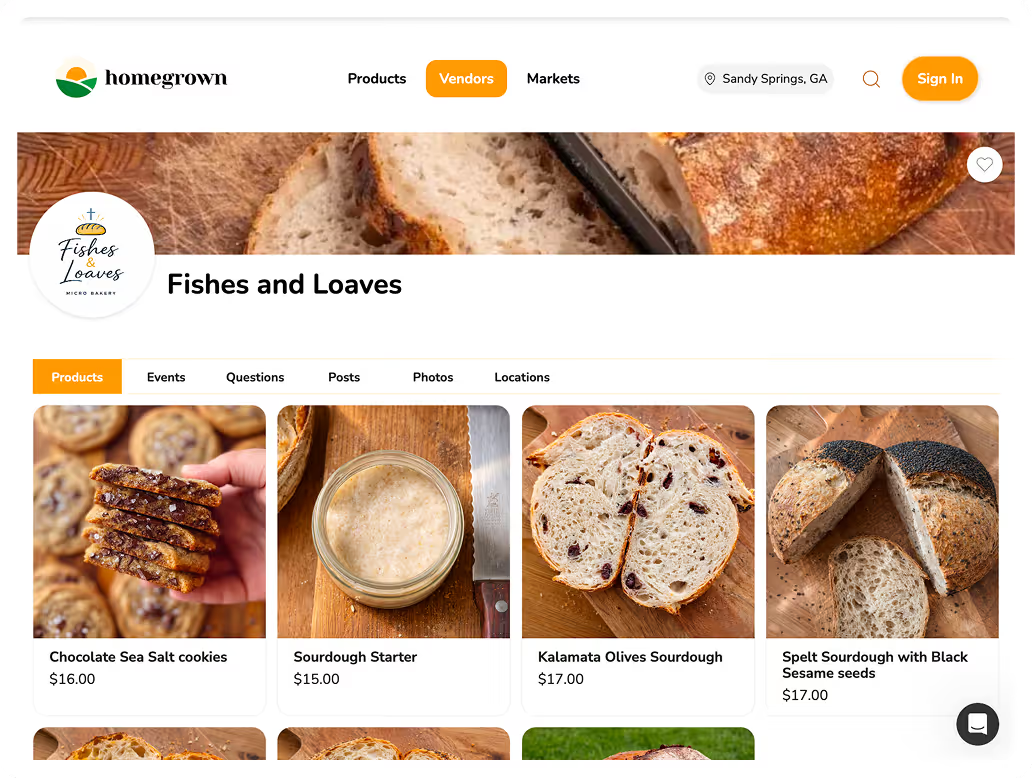
Homegrown is the closest fit for small vendors because it's built specifically for the pre-order and local pickup workflow — which is how most cottage food producers and farmers market vendors actually sell. At $10 per month flat with no percentage fees beyond standard payment processing, it costs a fraction of Barn2Door's $99 per month minimum, and it includes local customer discovery.
Homegrown is built specifically for local food producers doing pre-orders with local pickup. Cottage food vendors, small farmers, and farmers market vendors list their products with photos and descriptions, accept pre-orders from local customers, and collect payment through the platform. Customers discover local producers through Homegrown's marketplace, which means the platform actively helps you find new buyers rather than just managing the ones you already have.
The model is fundamentally different from Barn2Door's. At $10 per month with no percentage fees beyond standard payment processing, Homegrown costs less in a full year than Barn2Door's one-time setup fee alone. For small vendors whose monthly revenue might be $800 to $2,000, that difference between $10 per month and $99 per month is significant.
Homegrown handles the pre-order workflow that farmers market vendors actually use: customers browse your products, place their order before your cutoff, and pick up at your booth on market day. You get a consolidated order summary for production planning and a pickup list for market morning. The platform manages order cutoffs automatically and gives customers a visual shopping experience that converts better than a text thread or a Google Form.
What Homegrown doesn't do is manage CSA subscriptions or the kind of multi-channel logistics that larger farm operations require. It does let you offer local delivery with route planning alongside pickup. It's purpose-built for the pre-order and local pickup model, and it does that specific job extremely well.
Best for cottage food producers, farmers market vendors, and small farmers doing pre-orders with booth or neighborhood pickup.
Yes — Google Forms and Sheets is the best zero-cost option for vendors testing pre-orders for the first time or running very small operations. It works reliably up to about 30 orders per market cycle, but you'll outgrow it once you need payment processing, inventory limits, or customer confirmations.
You create a Google Form with your product options, and customer responses automatically populate a linked Google Sheet that serves as your order tracker. You share the form link through social media, text messages, or a QR code at your booth, and customers fill it out themselves.
This works reliably at small scale — roughly under 30 orders per market cycle. There's zero cost, infinite flexibility in how you structure the form, and you can share the spreadsheet with a helper who assists with packing or market-day logistics. The linked spreadsheet becomes your packing list, your production plan, and your pickup tracker all in one place.
The limitations are real. Google Forms doesn't process payment, so you're either collecting cash at pickup or using a separate payment platform like Venmo. There's no way to limit quantities per item, which means you can receive more orders than you can fulfill if a product becomes popular. There's no automated confirmation to customers. And every order requires you to monitor the sheet manually, which becomes time-consuming as volume grows. Most vendors who start with Google Forms outgrow it within a few months of consistent pre-ordering.
Best for vendors testing pre-orders for the first time or running a very small operation where the manual coordination is still manageable.
If you already use Square for walk-up sales at your farmers market booth, Square Online is the path of least resistance for adding online ordering — your payments, inventory, and reporting stay in one ecosystem.
Square Online lets you build a simple e-commerce storefront that integrates with the Square point-of-sale system that many market vendors already use for in-person card transactions. Customers can order online for pickup, and payment processes through Square using the same account and reporting dashboard you use at your booth.
The basic plan is free with standard Square transaction fees of 2.9 percent plus $0.30 per online transaction. Paid plans starting around $29 per month remove Square branding and add features like custom domains and advanced site customization.
The main advantage is integration with your existing Square setup. If you're already using Square for walk-up sales at the market, adding Square Online means your in-person and online sales data appears in the same dashboard, your inventory syncs across both channels, and your financial reporting is consolidated. For vendors who value that consistency, it's a genuine benefit.
The limitations for food vendors are that Square Online isn't food-specific, doesn't include local customer discovery, and requires more setup effort than food-specific platforms. You're building a general e-commerce site rather than using a tool designed specifically for the local food pre-order workflow.
Best for vendors already using Square for in-person sales who want a consistent payment flow across both channels. The farm e-commerce platform reviews provides additional guidance on this.
Local Line fits small to mid-size farms that need a structured online storefront with CSA management and multi-channel order tracking — similar to Barn2Door but with a slightly more accessible interface for smaller operations.
Local Line is a farm-specific direct sales platform that originated in Canada and has expanded into the US market. It's designed for small to mid-size farms selling through a mix of channels including an online store, CSA programs, farmers market sales, and wholesale accounts. The platform handles order management, inventory tracking, and customer communication with an interface that's generally considered more accessible for smaller operations than Barn2Door's.
| Local Line Plan | Monthly Cost | Annual Cost |
|---|---|---|
| Core | $79/month | $950/year |
| Premium | $159/month | $1,920/year |
| Ultimate | $319/month | $3,830/year |
Local Line's advantages over Barn2Door include a slightly more accessible interface for smaller operations and a broader range of farm-specific features at the lower pricing tiers. For small farms that need a proper online storefront and CSA management tools but find Barn2Door's pricing and complexity hard to justify, Local Line is worth evaluating.
Like Barn2Door, Local Line doesn't include built-in local consumer discovery and still requires a monthly subscription commitment. For cottage food vendors and very small farmers market operations, it's more infrastructure than necessary.
Best for small to mid-size farms that want a structured online storefront, CSA management, and multi-channel order tracking.
If you're comparing cooperative-owned farm platforms specifically, GrownBy is the main farmer-owned co-op option — our GrownBy alternative comparison breaks down how their 2 percent transaction fee stacks up against flat-fee platforms at different sales volumes.
| Platform | Monthly Cost | Local Discovery | Pre-Order Support | Payment Built-In | Best For |
|---|---|---|---|---|---|
| Barn2Door | $99-$299/mo + setup fees | No | Yes | Yes | Mid/large farms with delivery routes, CSA |
| Homegrown | $10/month flat | Yes | Yes | Yes | Cottage food, market vendors, small farmers |
| Google Forms + Sheets | Free | No | Manual | No | First-time pre-orders, very small scale |
| Square Online | Free-$29+ | No | Yes | Yes | Vendors already using Square POS |
| Local Line | $79-$319/mo | No | Yes | Yes | Small/mid farms wanting a structured storefront |
Barn2Door is worth the investment when your operation has CSA subscribers, delivery routes, and multi-location logistics. This isn't a takedown of Barn2Door — it's a good platform that solves real problems for the operations it was designed to serve. If your farm has the following characteristics, Barn2Door is likely worth the investment.
If two or more of these apply to your operation, Barn2Door's monthly cost is justified by the operational time it saves. The mistake isn't using Barn2Door — it's using it before your operation has grown to the point where its features matter.
The right tool depends on your current operation, not the operation you're planning to have eventually. Here is how to match your tool to your stage.
| Your Situation | Best Tool | Why |
|---|---|---|
| Just testing pre-orders | Google Forms + Sheets | Free, teaches you what you actually need |
| Cottage food vendor at farmers market | Homegrown storefront | Built for pre-order + pickup, $10/month flat with no percentage fees |
| Already using Square at booth | Square Online | Keeps payments and reporting consolidated |
| Small farm needing CSA + storefront | Local Line | Structured online store + subscription management |
| Mid/large farm with delivery routes | Barn2Door | Route optimization + multi-location logistics |
Choosing a platform based on where you might be in two years means paying for features you don't need right now and potentially outgrowing the tool anyway as your actual needs become clearer. For a deeper look at this topic, see selling food online. For a deeper look at this topic, see e-commerce platforms for farmers market vendors.
If you're a cottage food producer or farmers market vendor taking pre-orders for local pickup, Homegrown fits your workflow directly. It's built for the exact use case of listing products, accepting pre-orders, collecting payment, and managing pickup — with the added benefit of helping local customers discover your products through the platform.
If you want to test pre-orders with zero financial commitment, start with Google Forms and Google Sheets. Set up a form, share the link with your customers, and manage the orders through the spreadsheet. Once your volume outgrows the manual coordination, you'll have clear data about what you need from a more structured tool. See e-commerce platform cost comparison for additional context.
If you already use Square for in-person market sales and want a simple online ordering addition, Square Online is the path of least resistance. Your payment setup, reporting, and customer data are already in the Square ecosystem, and adding online ordering keeps everything consolidated.
If you're running a small farm and need a structured online storefront with CSA management and multi-channel capabilities, evaluate Local Line before committing to Barn2Door. Compare the feature sets at your specific scale and see which platform's tools align with how you actually sell.
If you're running a mid-size or larger farm with delivery routes, CSA subscribers, and multi-location logistics, Barn2Door is likely the right investment. The cost is proportional to the operational complexity it manages, and the time savings justify the subscription.
For a step-by-step guide on setting up your pre-order workflow regardless of which platform you choose, see how to take pre-orders.
Ready to start selling locally? The easiest way to take local orders and get paid is an online storefront — see the best platform to sell food from home, or set up a Homegrown storefront in about 15 minutes ($10/mo, 0% commission).
Barn2Door's Entrepreneur plan starts at $99 per month billed annually with a $399 one-time setup fee. The Business plan runs $159 per month with a $499 setup fee. The Scale plan costs $299 per month with a $599 setup fee. All plans require annual billing, making the minimum first-year commitment approximately $1,587.
Homegrown costs $10 per month flat with no percentage fees beyond standard payment processing. There's no setup fee and no per-transaction platform fee on top of payment processing. Compared to Barn2Door's $99 per month minimum plus a $399 setup fee, that's a significant difference for small vendors whose monthly revenue might be $800 to $2,000.
Yes, and many vendors do. A common combination is using Homegrown for pre-orders and customer discovery, Square for walk-up payments at the farmers market booth, and Facebook Marketplace for supplemental reach. The key is making sure your inventory tracking accounts for orders coming through all channels so you don't oversell.
Barn2Door generally makes financial sense when your direct-to-consumer operation generates at least $3,000 to $5,000 per month in revenue and involves delivery logistics, CSA subscriber management, or multi-location coordination. Below that volume, the monthly subscription represents too large a percentage of revenue to justify.
Most platform transitions are straightforward because your customer relationships exist independently of any tool. Export your customer contact list from your current system, set up your products in the new platform, and announce the change to your customers. The transition typically takes a week of setup and one market cycle to smooth out. Let customers know where to find you going forward.
Yes. Homegrown works for any local food vendor doing pre-orders with local pickup, whether that pickup happens at a farmers market booth, a community location, your front porch, or any other local spot. The platform is designed around the pre-order and pickup workflow, not specifically around farmers market attendance.
For small vendors, the most important features are simple product listing, reliable order intake, payment processing, and a clear pickup or fulfillment workflow. Local customer discovery is a bonus that helps grow your business. Features like delivery route optimization, CSA subscription management, and multi-location inventory tracking are valuable for larger operations but unnecessary overhead for vendors doing pre-orders with local pickup.
If you're a small vendor or cottage food producer evaluating your options, the clearest path matches your tool to your current stage.
If you're just starting with pre-orders and want to test the concept, use Google Forms. It's free, it works, and it teaches you what you actually need from a more structured system by showing you where the manual process breaks down.
Once you're running pre-orders consistently and want payment processing, customer discovery, and proper order management without a monthly subscription, move to Homegrown. It handles the workflow that farmers market vendors use every week and gives you infrastructure that grows with your business.
If your operation evolves into structured farm delivery, CSA management, and multi-channel sales, revisit Local Line or Barn2Door at that point. You'll know exactly what features you need because you'll have outgrown the simpler tools in specific, identifiable ways.
Don't over-invest in infrastructure before your business needs it. The vendors who make the best platform decisions are the ones who choose based on what their operation looks like today, not what they hope it will look like in two years. Start simple, use what works, and upgrade when the limitations of your current tool are costing you more than the next tool would charge.