

Pre-orders change the economics of a food business in a fundamental way. Instead of producing a batch of inventory based on your best guess about demand and hoping enough people show up to buy it, you know what's already sold before you make it. That shift from guessing to knowing affects everything — how much you produce, how much you waste, how reliably you earn, and how confidently you plan your week.
For farmers market vendors and cottage food vendors, pre-orders add a layer of committed revenue on top of walk-up sales. Your Saturday morning starts with orders already in hand rather than just hope. Your most loyal customers get the products they want without racing to the farmers market at opening. And your production schedule gets tighter and more efficient because you're making what's been ordered, not what you think might sell.
The short version: Pre-orders let you produce to known demand instead of guessing, which reduces waste and adds 20 to 40 percent to your weekly revenue. Start with a pay-at-pickup model for lower friction, set a consistent weekly cutoff (Thursday evening for Saturday farmers markets), and list your products on an ordering page with photos, prices, and pickup details. Even 10 to 15 pre-orders per week meaningfully improves your production planning and revenue predictability.
This guide covers how to set up pre-orders for a food business from scratch. The two main models, what to include in your listings, which tools to use and the honest tradeoffs between them, how to handle pickup logistics at the farmers market, and how to promote your pre-order option to the customers who are most likely to use it. Even if you only start with a handful of pre-orders per week, the improvement in predictability and revenue is worth the effort.
Pre-orders eliminate the biggest inefficiency in farmers market selling: producing based on guesswork. When customers commit to buying specific products before you produce them, you know exactly how much to make of each product. Your ingredient purchases match actual orders rather than estimated demand.
Walk-up sales at farmers markets have an inherent inefficiency that every vendor deals with. You produce based on a guess about how many customers will show up, how much they'll buy, and which products they'll choose. Whatever doesn't sell by the end of the farmers market is either discounted, donated, eaten by your family, or thrown away. Over time, this means you're consistently either underselling — running out of popular products early and leaving money on the table — or overproducing and watching your margins get eaten by waste.
The revenue impact compounds over time. Pre-orders create a floor of committed income you can count on before you even set up your booth. If you know that 20 orders worth $300 are waiting for pickup, your farmers market day starts with $300 already earned. Everything you sell to walk-up customers is revenue on top of that guaranteed base. Many vendors find that pre-orders add 20 to 40 percent to their weekly revenue without requiring any additional market days.
Pre-orders also convert occasional buyers into consistent ones. A customer who places a pre-order has invested a small amount of planning and commitment into your business. That level of engagement makes them significantly more likely to order again next week and the week after that. Over a season, your pre-order customers become your most reliable revenue source because they've built your products into their weekly routine.
The two main pre-order models — pre-pay in advance and pay at pickup — each have clear advantages, and the right choice depends on your stage and customer base. Here's an honest comparison:
| Feature | Pre-Pay in Advance | Pay at Pickup |
|---|---|---|
| No-show rate | Near zero | 5–10% |
| Customer friction | Higher (requires online payment) | Lower (just a reservation) |
| Cash flow | Money before production | Money at farmers market |
| Setup required | Online payment processing | No additional setup |
| Best for | Established vendors with loyal base | New vendors testing pre-orders |
| Conversion rate | Lower (higher commitment) | Higher (lower barrier) |
With pre-pay, customers pay at the time they place their order — before you produce anything. By the time you start baking or making, the money is already in hand and the demand is confirmed. Toast's guide to online ordering systems breaks down why pre-payment reduces no-shows by up to 90%.
The biggest advantage of pre-pay is that no-shows essentially disappear. When customers have already paid, they almost always show up to collect their order. This makes your planning extremely clean — every order that comes in is a guaranteed pickup.
Pre-pay also improves your cash flow. You have money coming in before you spend it on ingredients, which is especially helpful if you're operating on thin margins.
The downsides are real though. Pre-pay requires online payment processing, which means transaction fees and a setup step that some vendors find intimidating. Some customers are hesitant to pay for food they haven't received yet, especially from a vendor they don't know well. And you need a refund process in case you have to cancel an order.
Need more help here? See our guide on the best platform to sell local food online.
With pay-at-pickup, customers reserve products through your pre-order system but don't pay until they come to your booth on farmers market day. You set their order aside and they pay in person using whatever payment method you normally accept — cash, card, or both.
The main advantage is lower friction. Customers don't need to enter payment information online. They're just saying "I want this" and committing to come get it. This converts more customers into pre-orders because the barrier to entry is minimal.
The downside is that some percentage of customers who reserve products won't show up. For most vendors, this no-show rate runs 5 to 10 percent, which is manageable but worth accounting for.
For most vendors starting out with pre-orders, pay-at-pickup is the easier and more customer-friendly model. As your pre-order base grows and you develop relationships with reliable customers, transitioning to pre-pay becomes more attractive because it eliminates no-shows entirely.
Set your order cutoff 1 to 2 days before farmers market day and stick to it every single week without exceptions. Every pre-order system needs a clear cutoff — the last point at which customers can place an order before you start producing for the week.
For Saturday farmers markets, the most common cutoff is Thursday evening or Friday morning. This gives you enough time to finalize your ingredient purchases, plan your production batch, and bake or prepare everything before market day. For Sunday farmers markets, a Wednesday or Thursday cutoff provides the same buffer.
The specific time matters less than the consistency. If your cutoff is Thursday at 8 PM, it's Thursday at 8 PM every week. Don't accept orders after your cutoff, even when a loyal customer messages you late. Doing it once creates the expectation that the cutoff is flexible, and flexibility in this case leads to a system that erodes over time.
Communicate the cutoff clearly in every place your pre-orders exist:
Each product you offer for pre-order needs enough detail that customers know exactly what they're ordering without having to ask follow-up questions. Vague listings generate messages, and managing clarification texts defeats the purpose of an organized system.
Here's what every pre-order listing needs:
You have several options for managing pre-orders, and the right choice depends on your volume, comfort with technology, and how much manual work you're willing to do each week.
The lowest-tech approach is having customers text, message, or email you their order. You confirm each one individually and track everything in a notebook or spreadsheet. This works at very low volume — roughly 5 to 15 orders per week — with a tight, trusted customer base. A free Google Form can collect orders more reliably than DMs, though you still need to track payments separately.
It breaks down as volume increases. Once you're handling 20 or more orders per week, tracking everything manually becomes a real time drain. There's no automated confirmation, no centralized order list, and no way for customers to see what's available without asking you directly.
A step up from direct messages. You create a Google Form with your product options, prices, quantity fields, and pickup details. Customer responses populate a Google Sheet for production planning.
This works at medium volume but breaks down when customers want product photos, when you need to limit quantity per product, or when you want automated order confirmation. Google Forms doesn't handle payments, so this is pay-at-pickup only.
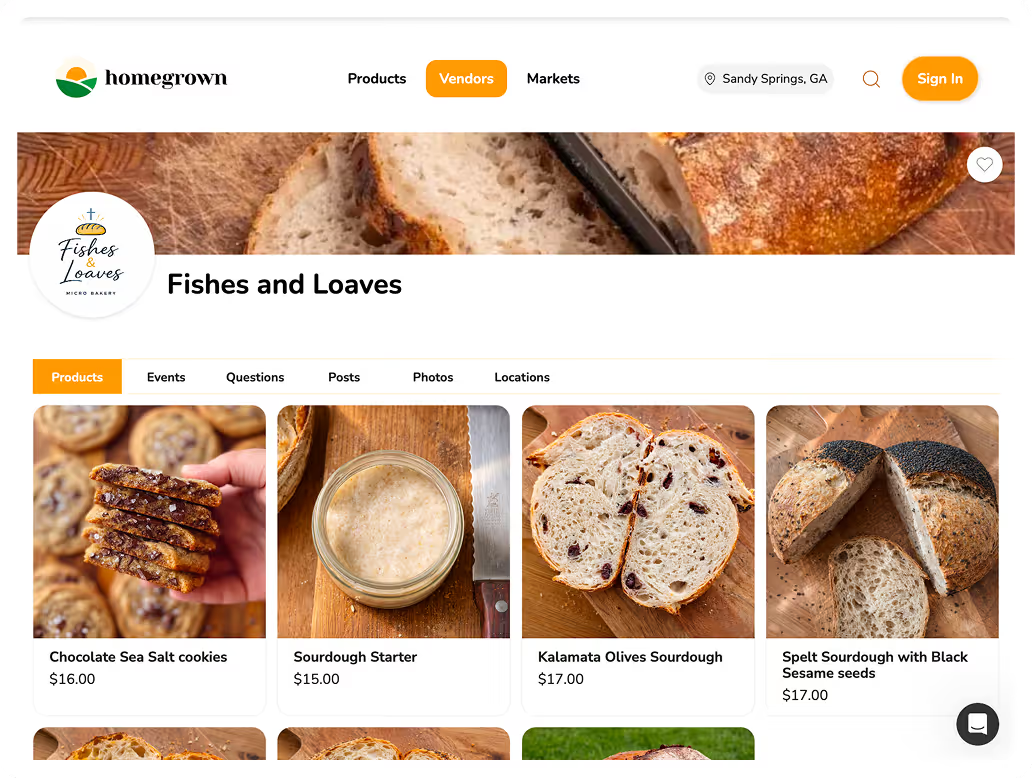
Homegrown is $10/month with no percentage fees beyond standard payment processing (2.9% + $0.30) and is built specifically for local food vendors taking pre-orders for in-person pickup or local delivery. You list your products with photos, prices, descriptions, and pickup or delivery details. Customers browse your ordering page and place their order directly. You get a clear order summary before farmers market day.
Homegrown handles both pay-at-pickup and pre-pay models, manages order cutoffs automatically, and gives customers a visual shopping experience rather than a blank form. Compare that to Etsy (6.5% per transaction, built for shipping) or Square Online (monthly fees plus transaction fees, built for full e-commerce). You don't need a website or any technical setup — your ordering page is ready in 15 minutes and you share the link on social media, in text messages, or on a QR code sign at your booth. Homegrown doesn't handle shipping, manage your social media, or build a full website — it handles the pre-order and payment step.
Here's how the three tools compare at different volumes:
| Weekly Orders | Best Tool | Why |
|---|---|---|
| 5–15 | Text/DM/Email | Simple, free, manageable at low volume |
| 15–30 | Google Forms or Homegrown | Need centralized tracking, customer self-service |
| 30+ | Homegrown | Automatic cutoffs, product photos, inventory limits, payment options |
Smooth pickup logistics start before the farmers market opens. Pack and label everything in advance so pre-order customers can collect their order in under a minute — the whole point of pre-ordering is convenience.
Set a hard production cap on each product and enforce it strictly — when you hit capacity, the product shows "sold out" and customers learn to order early next week. This is a better experience than scrambling to fulfill more orders than you can handle.
If demand consistently exceeds your capacity, you have three options:
All three are valid responses, and the right choice depends on your goals and constraints. Merchant Maverick's processing comparison breaks down the actual fees per transaction across the major providers.
For pay-at-pickup models, factor in your no-show rate when planning production. If roughly 5 to 10 percent of reservations go unclaimed, accept that some products will be available for walk-up customers and factor that into your overall production math.
Pre-orders only generate revenue if customers know they exist. Start promoting to the customers most likely to use them — the ones who already buy from you at the farmers market — and expand outward.
At your booth:
On social media:
Direct outreach:
Pre-orders don't replace your walk-up farmers market sales — they add a layer of committed revenue on top of whatever you sell to customers who show up without ordering. Your booth still functions as a walk-up sales point for new customers and spontaneous buyers. The difference is that you start every farmers market day with a base of known revenue.
The combination of pre-orders and walk-up sales is more powerful than either channel alone. Pre-orders give you predictable revenue and efficient production. Walk-up sales give you the opportunity to attract new customers, sample products, and build relationships that eventually convert into pre-orders. Each channel feeds the other. For a deeper look at this topic, see managing orders for a food business. For a deeper look at this topic, see selling food online. For a deeper look at this topic, see building a customer email list.
Ready to start selling locally? The easiest way to take local orders and get paid is an online storefront — see the best platform to sell food from home, or set up a Homegrown storefront in about 15 minutes ($10/mo, 0% commission).
Most vendors see 5 to 10 pre-orders per week in the first few weeks, growing to 15 to 30 within a couple of months of consistent promotion. Start small and let the system grow. Even 5 pre-orders per week meaningfully reduces waste and gives you a revenue floor before farmers market day.
Products that consistently sell out early at the farmers market are the best candidates — sourdough bread, popular cookie flavors, seasonal jam. These are the products customers are most motivated to guarantee through pre-ordering. Start with your top one or two sellers and expand from there.
Don't allow changes after the cutoff. Your cutoff exists so you can plan production accurately. If a customer contacts you after the cutoff, politely let them know the deadline has passed and encourage them to order early next week. Making exceptions undermines the system.
Set production caps on each product in your listing so this doesn't happen. When a product hits capacity, it shows as sold out. If you consistently sell out before the cutoff, that's a signal to either increase production or raise prices. Both are good problems to have.
Yes. Pack and label all pre-orders separately before the farmers market opens. Your walk-up inventory is whatever you produce beyond your pre-order commitments. Never sell a pre-ordered product to a walk-up customer — that creates a terrible experience for the customer who planned ahead and shows up to find their order short.
No. Pre-orders already offer the customer a benefit — guaranteed availability of their favorite products. Adding a discount devalues your products and reduces your margin on what should be your most predictable revenue stream. The convenience of pre-ordering is the incentive. Let that be enough.
Make the transition gradually. Start offering pre-pay as an option alongside pay-at-pickup. As customers get comfortable with your products and your reliability, more will choose to pre-pay. Once most of your regulars are pre-paying, you can make it the default. Tools like Homegrown support both models, so you don't need to switch platforms.
The simplest path to your first pre-orders looks like this. Start with the pay-at-pickup model because it has lower friction for both you and your customers. Pick one or two products to offer as pre-orders — your most popular products or the ones that consistently sell out early. Set a weekly cutoff that gives you enough production time between the cutoff and farmers market day. Create your listing on your ordering page, a Google Form, or even just a text thread with your regulars — whatever you'll actually use consistently. Post about it at your next farmers market and share the link on social media. Then adjust your quantities, your product lineup, and your process based on what you learn in the first few weeks.
Pre-orders don't need to be your entire sales model to be worth doing. Even 10 or 15 committed orders per week changes the math on waste, production planning, and revenue predictability in a meaningful way. The vendors who do best with pre-orders are the ones who start small, stay consistent, and let the system grow as their customer base learns to use it.