

You've got products to sell. You've probably got people who already want to buy them. Now you're Googling "farmer marketplace" because you want to put your stuff online somewhere.
Here's the problem: the word "marketplace" means different things depending on who's using it. Some platforms are actual marketplaces where shoppers browse and find you. Others are storefronts where you send your existing customers to place orders. And most of the "top 10 platforms" articles are written by the platforms themselves, so they're not exactly giving you an unbiased comparison. If you sell under cottage food laws, your platform options may also be limited by your state's rules on online sales.
This guide breaks down the actual options — what each one does, what it costs, and which type makes sense for where you are right now.
The short version: If you already have customers (even just 5-10 regulars), you need a Homegrown storefront — not a marketplace. A storefront lets customers order and pay through one link you share everywhere. Marketplaces like MarketWagon or Facebook Marketplace can help you find new customers, but they are not built to manage your existing orders. Most vendors do best with a simple storefront for their regulars and a marketplace listing for extra visibility.
A marketplace helps buyers find you. A Homegrown storefront lets you send existing customers to one link to order and pay. Before you sign up for anything, you need to understand the difference between these two things. It will save you months of frustration.
A marketplace is a platform where buyers browse and discover vendors. Think of it like a farmers market — people show up to shop, and they find you because you're there. Online examples: MarketWagon, LocalHarvest, Etsy, and Facebook Marketplace. Selling at a farmers market works the same way — shoppers come to the market and discover you there.
A storefront is your own online shop where you send people who already know about you. Think of it like having your own farm stand — customers come because you told them where to go. Online examples: Shopify, Barn2Door, GrazeCart, Homegrown.
Here's why this matters: most small farmers and local vendors already have customers. You've got neighbors who buy eggs every week, regulars at the Saturday market, people who text you on Thursday asking what's available. You don't need a platform to find you new buyers. You need a better way to handle the buyers you already have.
If you're drowning in text messages and DM orders, a storefront solves that problem. A marketplace doesn't.
If you have no customers yet and need people to find you, a marketplace can help — but most online farm marketplaces are still small enough that they won't drive significant traffic on their own.
The honest answer for most vendors: you probably need a storefront, and you might also benefit from listing on a marketplace or two for extra visibility.
Online farmer marketplaces work like a digital farmers market — shoppers browse and find you. Shoppers browse, find products they want, and buy from various vendors. You list your products, and the platform handles some or all of the customer-facing experience.
MarketWagon is the closest thing to a true online farmers market. It operates like a local grocery delivery service — customers browse products from multiple local farms and vendors, place one order, and MarketWagon coordinates the delivery through regional hubs listed on the USDA local food portal.
How it works: You list your products, set your prices, and bring your products to a local hub on delivery day. MarketWagon handles the customer-facing ordering and delivery logistics.
Cost: 15% commission on sales. No monthly fee. You only pay when you sell.
The catch: MarketWagon isn't available everywhere. They operate in 30+ states but coverage is concentrated in the Midwest and East Coast. And 15% is a meaningful cut — on a $7 dozen of eggs, that's over a dollar per sale.
Best for: Vendors who want to reach new customers without managing their own delivery or online presence. Works well as a supplemental sales channel alongside your existing direct sales.
One of the oldest farm directories online. LocalHarvest has been connecting consumers with local farms since 2003.
How it works: You create a farm profile listing your products, location, and how customers can buy from you. It functions more as a directory than a transactional marketplace — most sales still happen off-platform.
Cost: Premium listings start at around $75 per year.
The catch: The platform looks dated, and the traffic it sends to individual farms varies wildly by region. Some farmers report good leads; others hear crickets.
Best for: Getting a basic online presence if you don't have one. Think of it as a digital Yellow Pages listing for farms.
You already know Facebook. Marketplace lets you list products for local pickup, and it has an enormous built-in audience.
How it works: List your products, respond to messages, arrange pickup. That's it. No fancy features, no farm-specific tools.
Cost: Free.
The catch: No ordering system, no payment processing, no inventory management. Every sale is a manual conversation. If you're already overwhelmed by DM orders, Facebook Marketplace just adds more DMs to manage. And there's no way to set recurring orders or manage a regular customer list.
Best for: Testing demand in your area and finding new customers. Not great as your primary sales tool once you have more than a handful of buyers.
Etsy works well for shelf-stable farm products — honey, jams, sauces, baked goods, soaps. Not practical for fresh produce or anything perishable that can't ship.
How it works: List products, Etsy handles payment processing, you ship to the buyer.
Cost: $0.20 per listing plus 6.5% transaction fee plus payment processing fees. Adds up to roughly 10-12% of each sale.
The catch: Etsy's audience is massive, but you're competing with thousands of other vendors. Standing out requires good photos, competitive pricing, and managing reviews. It's a real commitment to do well.
Best for: Vendors selling shelf-stable products who want access to a national (or international) audience and are willing to handle shipping.
Farmish — Free listings, newer platform focused on connecting local food buyers with farms. Limited geographic coverage so far, but growing.
GrownBy — Commission-based platform focused on CSA-style ordering. Good if you want to run a subscription model.
Open Food Network — Free, open-source platform. More popular in Australia, UK, and Europe than the US, but available here.
Marketplaces sound perfect in theory — just list your stuff and customers will find you. In practice, most online farm marketplaces are still building their buyer base. They don't have the foot traffic of a Saturday farmers market, and they're nowhere close to the audience of Amazon or Instacart. Directories like Eat Wild can help customers find pasture-based farms in their area, but the volume of leads varies widely by region.
That doesn't mean they're useless. Listing on a marketplace costs little or nothing, and any extra exposure helps. But don't count on a marketplace as your primary sales channel. Think of it as supplemental — a way to reach new people, not a replacement for serving the customers you already have.
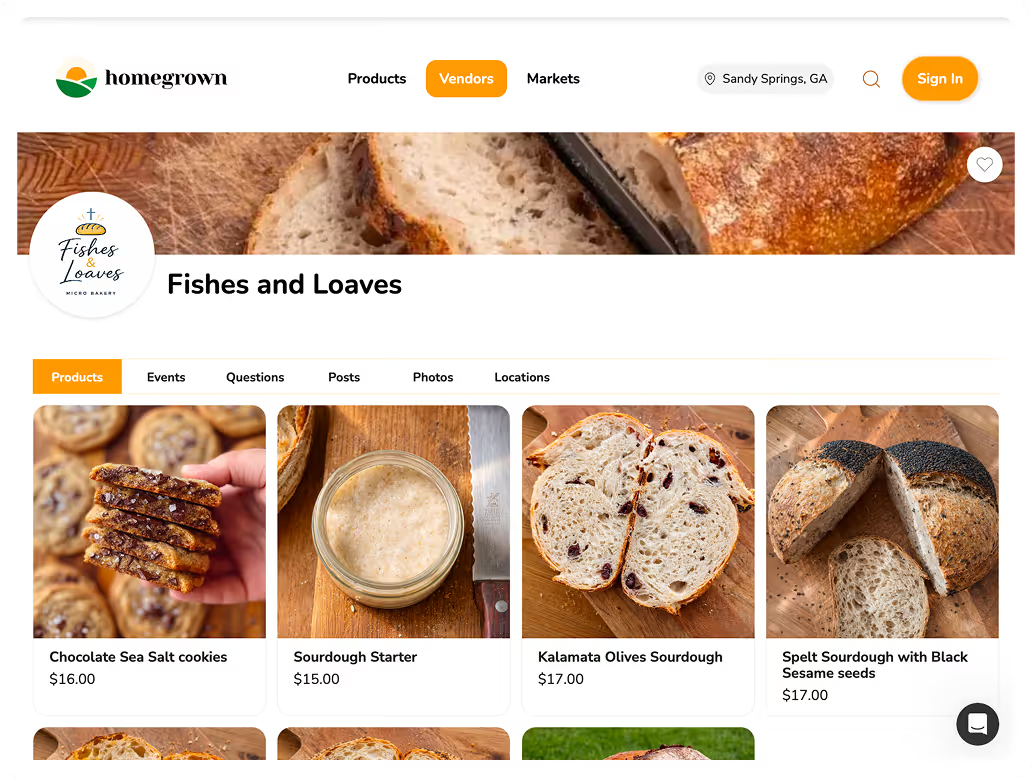
A Homegrown storefront is your own online shop — you share the link with customers who already know you. You share the link with your customers — post it on Instagram, text it to regulars, put it on a sign at the market — and they order from you directly.
For most small vendors, this is the tool that actually changes your day-to-day. Instead of managing orders through text messages, DMs, and spreadsheets, customers go to your link, pick what they want, and pay. You get a clean order list and money in your account.
Built specifically for farms. Full-featured platform with online ordering, subscription management, delivery scheduling, and integrations with QuickBooks, Mailchimp, and more.
Cost: $99-299/month (billed yearly) plus one-time setup fees ($399-599).
Best for: Farms doing $50,000+ per year in direct sales that need professional-grade tools. If you're running a full-time farm business with multiple sales channels, Barn2Door can handle the complexity.
Not ideal for: A part-time vendor selling $500/month in eggs and produce. The monthly cost and feature complexity are overkill for small operations.
Popular with farms that do both retail and wholesale. Good tools for managing restaurant accounts alongside consumer sales.
Cost: Plans start around $49/month.
Best for: Farms that sell to both individual customers and restaurants or stores. The wholesale features (price lists, minimum orders, invoicing) are strong.
Not ideal for: Vendors who only sell direct to consumers and don't need wholesale tools.
Farm-focused e-commerce with a strong feature set. Good balance of capability and usability.
Cost: Plans start around $49/month.
Best for: Small to mid-size farms that want a farm-specific storefront with more features than basic platforms but less complexity than Barn2Door.
The biggest name in e-commerce. Extremely powerful, not built for farms.
Cost: Plans start at $39/month.
Best for: Vendors who want maximum customization and don't mind a learning curve. Works well if you're selling shelf-stable products and shipping nationwide.
Not ideal for: Local vendors doing farm pickup or market sales. Shopify isn't built for local pickup windows, weekly inventory that changes based on harvest, or the kind of flexible ordering that farm sales require. You can make it work, but it takes significant setup.
For a deeper dive on why general platforms fall short for local vendors, check out our guide on the best ecommerce platforms for farmers market vendors.
Built specifically for local vendors who sell through pickup — at the farm, at markets, or at community drop points.
Cost: $10/month with no percentage fees beyond standard payment processing.
Best for: Part-time vendors and small farmers who already have customers and just need a simple way to take orders and payments. Set up a storefront in 15 minutes, share your link, and customers order on their own schedule.
Not ideal for: Large operations that need wholesale management, shipping logistics, or complex subscription tools.
For a full walkthrough on setting up online ordering, see our guide on how to sell farm products online.
| Platform | Type | Monthly Cost | Best For |
|---|---|---|---|
| MarketWagon | Marketplace | 15% commission | Finding new customers via delivery |
| LocalHarvest | Directory | ~$75/year | Basic online presence |
| Facebook Marketplace | Marketplace | Free | Testing demand, finding local buyers |
| Etsy | Marketplace | ~10-12% per sale | Shelf-stable products you can ship |
| Homegrown | Storefront | $10/month | Part-time vendors with local regulars |
| GrazeCart | Storefront | ~$49/month | Small-to-mid farms wanting to grow |
| Local Line | Storefront | ~$49/month | Farms selling retail and wholesale |
| Barn2Door | Storefront | $99-299/month | Full-time farms doing $50K+/year |
| Shopify | Storefront | $39+/month | Shipping shelf-stable products nationally |
The right choice depends on whether you need to find new customers or serve the ones you already have. Here's a simple framework based on where you actually are:
"I have no customers yet and need people to find me." List on MarketWagon (if available in your area), put up a LocalHarvest profile, and post on Facebook Marketplace. These cost little or nothing and get you some visibility. But also start building your customer base offline — neighbors, farmers markets, word of mouth. Online marketplaces supplement that effort; they don't replace it.
"I have 10-30 regulars who order through texts and DMs." You need a storefront, not a marketplace. You already have the customers. What you need is a better way to take their orders so you're not drowning in messages every Thursday evening. A simple storefront like Homegrown or a more full-featured one like GrazeCart gets those orders organized and payments collected automatically. You can also create a free listing on LocalHarvest so new customers searching for local farms in your area can find you and get directed to your storefront.
"I sell at markets and want online ordering between market days." A storefront with pickup options. Let market customers scan a QR code at your booth, order from you during the week, and pick up at the next market or at your farm. This is where the real money is — your market booth becomes a customer acquisition tool, and your storefront handles the between-market sales.
"I'm ready to scale to 100+ customers or start shipping." Look at Barn2Door or Local Line for farm-specific features at scale. Or Shopify if you're shipping shelf-stable products nationally. At this level, the monthly cost is justified by the volume.
The combo approach: There's nothing stopping you from listing on a marketplace for discovery AND running a storefront for your core ordering. Many vendors do exactly this — MarketWagon or Facebook for finding new customers, their own storefront for serving regulars.
Yes, and many vendors do. The main thing to watch is inventory management — if the same dozen eggs is listed on MarketWagon and your own storefront, you need to make sure you don't sell them twice. For small-volume vendors, this is usually manageable. For larger operations, look for platforms that sync inventory across channels.
If you already have customers (even just 5-10 regulars), you need a storefront. If you have no customers and need to build from scratch, a marketplace can help with discovery — but you should also be building your customer base through markets, word of mouth, and social media.
Facebook Marketplace is free but requires manual management for every order. Homegrown starts at $10/month and handles ordering and payment automatically. The "cheapest" option depends on how you value your time — managing 20 orders per week through Facebook DMs takes hours that a $10/month storefront would eliminate.
MarketWagon handles delivery logistics in their service areas. Most storefronts are set up for customer pickup (at the farm, at farmers market, or at a designated spot). Some platforms like Barn2Door support delivery, but you'd be handling the delivery yourself or hiring a driver.
Share your storefront link everywhere — text it to regulars, post it on Instagram, put it on a sign at your farmers market booth. When someone texts you to order, reply with your link. Most customers prefer the convenience of ordering on their own schedule once they see how easy it is.
No. A Homegrown storefront gives you a shareable link where customers can see your products, place an order, and pay. That is all most vendors need. If you already have a website, you can link to your storefront from it. But you do not need to build or maintain a full website to sell farm products online.
In most states, yes — as long as customers order directly from you and pick up in person. A Homegrown storefront where customers place orders and pick up from you generally fits within cottage food regulations. Marketplace intermediaries may not qualify under some state laws, so check your state's specific cottage food rules.
Finding the right place to list your farm products online comes down to one question: do you need customers to find you, or do you need a better way to serve the customers you already have?
If it's both, start with the tool that solves your biggest headache today. For most vendors juggling text message orders and cash payments, that's a simple storefront that handles ordering and payment in one link.
Looking for the right farmer marketplace to list your products? Most vendors discover that the marketplace they need is actually a storefront — one link where your existing customers can browse, order, and pay without you managing DMs. Homegrown is built for exactly this: a simple product listing page for local food vendors who sell through pickup at the market or at home. List your farm products, share the link, and let customers order on their schedule.