
A Blog Cover Single Image
A Client Image
Evan Knox
Cofounder, Homegrown
E-commerce
March 7, 2026

Best Apps for Farmers Market Vendors in 2026

What apps do farmers market vendors actually need? If you search online, most lists recommend 15 to 20 tools across a dozen categories. That is overwhelming for a part-time vendor who sells at one or two markets per week.

The truth is that most small vendors need five or six apps at most — and most of them are free. You need a way to get paid, a way to take pre-orders, a way to stay in touch with customers, and a weather app that tells you whether Saturday is worth setting up for.

This guide covers the best apps for farmers market vendors in 2026, organized by what you actually need them for. Every recommendation is practical for a one-person operation with a limited budget.

The short version: The essential app stack for a small farmers market vendor is Square (free payment processing), Homegrown ($10/month for online ordering with customer discovery), Canva (free for social media graphics), Kit (free email marketing up to 10,000 subscribers), Google Sheets (free inventory tracking), and AccuWeather (free hyperlocal weather). Total cost: $10 per month. Everything else is optional.

Payment Processing Apps

You need a way to accept card payments at the market. Cash-only vendors lose sales to customers who do not carry cash — and that is most customers in 2026.

Square — Best Overall Payment App

Square is the most widely used payment app at farmers markets. The free plan includes everything a small vendor needs.

  • Cost: Free app. 2.6% + 15 cents per in-person tap or swipe. First card reader free.
  • Key features: Accept chip, tap, and swipe payments. Digital receipts. Sales tracking and reporting. Offline mode works if WiFi drops.
  • Why it works for vendors: No monthly fee. Works on your phone. The free card reader gets you started immediately.
  • Limitation: Transaction fees add up at higher volumes. A vendor processing $2,000/month pays about $52 in Square fees.

SumUp — Best Budget Card Reader

SumUp is the simplest card reader option with no monthly fee and a slightly higher transaction rate.

  • Cost: 2.75% per in-person transaction. Card reader about $54.
  • Key features: No monthly fee or subscription. Simple card reader pairs with phone app.
  • Why it works for vendors: Lowest entry barrier for vendors who just need basic card acceptance without a full POS system.
  • Limitation: Higher per-transaction rate than Square. Fewer features and reporting tools.

Venmo, CashApp, or Zelle — Best as Backup

Peer-to-peer payment apps work as a backup for customers who do not have a card or prefer to pay by phone.

  • Cost: Free to receive with personal accounts. Business Venmo charges 1.9% + 10 cents per transaction.
  • Key features: Customers scan a QR code at your booth. No card reader needed.
  • Why it works for vendors: Zero hardware cost. Most customers already have one of these apps.
  • Limitation: Messy for bookkeeping. Not professional as a primary payment method. Venmo and CashApp transactions above $600/year trigger 1099-K reporting.

For a deeper look at payment options, read our guide on how to accept payments at a farmers market.

Online Ordering and Pre-Order Apps

Taking pre-orders between markets is the single biggest upgrade most vendors can make. Customers order and pay before market day, so you know exactly what to prepare and you show up with sales already locked in.

Homegrown — Best for Pre-Orders With Customer Discovery

Homegrown gives each vendor their own ordering page where customers browse products, place orders, and pay before pickup at the market.

  • Cost: $10/month (annual) or $12.50/month (monthly). No transaction fees beyond standard Stripe processing.
  • Key features: Your own ordering page in 15 minutes. Marketplace discovery through the Homegrown directory. Order summaries for each pickup day. Customer list you own.
  • Why it works for vendors: The marketplace discovery is the differentiator. Customers searching for local food in your area find you through the directory — you do not have to drive all your own traffic.
  • Best for: Any vendor who wants to get market regulars to order online between markets.

Start your free trial at Homegrown

Square Online — Best for Square POS Users

If you already use Square at the market, Square Online lets you add an online store that syncs with your existing account.

  • Cost: Free plan with 2.9% + 30 cents per online transaction.
  • Key features: Online store connected to your Square dashboard. Pickup scheduling. Unified sales tracking across in-person and online.
  • Why it works for vendors: No second login or system to manage. Everything lives in one place.
  • Limitation: Not food-specific. More setup time than Homegrown. No marketplace discovery.

Google Forms — Best Free Pre-Order Tool

Google Forms costs nothing and works for vendors testing whether customers will pre-order before committing to a paid platform.

  • Cost: Free.
  • Key features: Create a form with your weekly products. Share the link. Orders arrive in a spreadsheet.
  • Why it works for vendors: Zero risk. Proves the concept before you spend money.
  • Limitation: No payment processing (collect separately). No inventory limits. Becomes unwieldy past 15-20 orders per week.

Social Media and Marketing Apps

Social media is how most small vendors build awareness and stay top of mind between markets. You do not need to be on every platform — pick one or two and post consistently.

Canva — Best Free Design Tool

Canva is the easiest way to create professional-looking graphics for Instagram, Facebook, market signs, and price tags without any design experience.

  • Cost: Free (2 million+ templates, 5GB storage). Pro: $15/month for expanded assets and brand kit features.
  • Key features: Drag-and-drop templates for social posts, Stories, flyers, labels, and banners. Works on phone or desktop.
  • Why it works for vendors: The free plan handles everything a part-time vendor needs. Create a market-day post in five minutes using a template.

Buffer — Best Free Social Scheduling Tool

Buffer lets you schedule social media posts in advance so you are not opening Instagram every day during market season.

  • Cost: Free (up to 3 channels, 10 posts queued per channel). Paid plans from $6/month per channel.
  • Key features: Schedule posts to Instagram, Facebook, and TikTok from one dashboard. Analytics on what performs.
  • Why it works for vendors: Batch-create posts on Sunday night and schedule them for the week. No daily app time needed.

InShot — Best Free Video Editor

InShot is the simplest phone-based video editor for creating Reels, TikToks, and Stories from market clips.

  • Cost: Free (with watermark). Pro: about $4/month or $35/year.
  • Key features: Trim video, add music, captions, and transitions. Optimized for vertical video formats.
  • Why it works for vendors: Film a 30-second harvest clip or market setup video and edit it in five minutes on your phone.

Email and Customer Communication Apps

Email is the most reliable way to reach your regular customers. Social media algorithms change; email goes directly to their inbox.

Kit (formerly ConvertKit) — Best Free Email Tool

Kit offers the most generous free plan of any email marketing tool — 10,000 subscribers at no cost.

  • Cost: Free up to 10,000 subscribers. Paid plans from $25/month.
  • Key features: Simple email broadcasts, signup forms, subscriber tags. Clean interface built for non-technical users.
  • Why it works for vendors: 10,000 free subscribers is more than any small market vendor will ever need. Send a weekly "here is what I am bringing Saturday" email to your regulars at zero cost.

Mailchimp — Best Known Email Tool

Mailchimp is the most recognized email marketing platform but has reduced its free plan limits.

  • Cost: Free (500 contacts, limited sends). Paid plans from about $13/month.
  • Key features: Email templates, signup forms, basic analytics, audience segmentation.
  • Why it works for vendors: If you already use Mailchimp, it works fine. The reduced free plan (500 contacts) is sufficient for most small vendor lists.
  • Limitation: Free plan limits tightened in January 2026. Kit is more generous for new users starting from scratch.

Bookkeeping and Accounting Apps

You need to track income and expenses for taxes. The IRS does not care that your food business is a side hustle — if you make money, you report it.

Wave — Best Free Accounting App

Wave is the only genuinely free accounting app with real double-entry bookkeeping, not just expense tracking.

  • Cost: Free (Starter plan). Pro: $16/month for automatic bank imports and recurring invoices.
  • Key features: Unlimited income and expense tracking. Invoicing. Profit and loss reports. Receipt scanning on mobile.
  • Why it works for vendors: The free plan does everything a vendor earning under $50,000 per year needs. No credit card required.

QuickBooks Solopreneur — Best for Tax Prep

QuickBooks Solopreneur separates business from personal spending and generates the reports your accountant needs at tax time.

  • Cost: About $20/month (often 50% off first year for new users).
  • Key features: Automatic expense categorization. Mileage tracking for market-day drives. Schedule C generation. Bank sync.
  • Why it works for vendors: If you drive to multiple markets, the mileage tracking alone can save you hundreds on your tax return.
  • Limitation: Not free. Wave covers the basics at no cost for vendors who do not need mileage tracking or advanced reports.

Inventory and Production Tracking

Google Sheets — Best Free Inventory Tracker

Google Sheets is the most widely used inventory tool among small food vendors. It is free, works on your phone, and does everything a simple tracking system needs.

  • Cost: Free with a Google account.
  • Key features: Track what you made, what you brought, what you sold, and what you need for next week. Dozens of free templates exist for market-day tracking.
  • Why it works for vendors: Works offline on mobile. Shareable if you have a partner or helper. No learning curve.

Airtable — Best Spreadsheet Upgrade

Airtable is a step up from Google Sheets for vendors who want more structure in their tracking without learning full database software.

  • Cost: Free (unlimited bases, 1,000 records per base). Plus: $10/month.
  • Key features: Link tables together (connect products to ingredients to production batches). Custom views, filters, and forms.
  • Why it works for vendors: If you track 20+ products across multiple markets, Airtable's linked tables prevent the spreadsheet chaos that Google Sheets creates at scale.

The University of Missouri Extension's catalog of agriculture apps lists over 200 tools across farm management categories — useful for vendors who want to explore beyond the basics.

Weather Apps

Weather determines whether market day is worth attending. A reliable weather app is not optional for outdoor vendors.

AccuWeather — Best for Market-Day Decisions

AccuWeather's MinuteCast feature predicts precipitation minute by minute for the next two to four hours — exactly the information you need at 6 AM on a Saturday.

  • Cost: Free (with ads). Premium: about $4/month.
  • Key features: Hyperlocal hourly forecasts. MinuteCast precipitation predictions. Severe weather alerts.
  • Why it works for vendors: Knowing whether rain starts at 9 AM or 11 AM is the difference between setting up or staying home. MinuteCast answers that question.

Weather Underground — Best for Hyperlocal Data

Weather Underground pulls data from 250,000+ private weather stations, giving you readings from a station potentially a mile from your market location.

  • Cost: Free (basic). Paid tier removes ads.
  • Key features: Personal weather station data. True hyperlocal conditions versus regional averages.
  • Why it works for vendors: Especially useful in areas with microclimates where the regional forecast does not match what happens at your specific market location.

The Complete Vendor App Stack

Here is what the full setup looks like at each budget level:

BudgetAppsMonthly Cost
Free onlySquare (payments) + Google Forms (orders) + Canva (design) + Kit (email) + Google Sheets (tracking) + AccuWeather$0
Under $15/monthSquare + Homegrown (ordering + discovery) + Canva + Kit + Google Sheets + AccuWeather$10/month
Under $35/monthSquare + Homegrown + Canva + Kit + QuickBooks Solopreneur (accounting) + AccuWeather$30/month

For most part-time vendors, the under $15/month stack covers everything. You get card payments, online ordering with marketplace discovery, professional social graphics, email marketing to unlimited subscribers, inventory tracking, and hyperlocal weather — all for $10 per month.

Local Line's overview of the best software for farmers covers additional categories for larger operations, but most small market vendors will never need wholesale pricing tools, route optimization, or farm management databases.

If you are ready to add online ordering to your existing market business, Homegrown is the simplest place to start. Set up your ordering page in 15 minutes and give your customers a way to pre-order from you between markets.

Try Homegrown free for 7 days

Frequently Asked Questions

What is the best free app for farmers market vendors?

Square is the best free app for farmers market vendors. The free plan includes card payment processing, sales tracking, digital receipts, and a free card reader — with no monthly fee. For online ordering, Google Forms works free for testing pre-orders. For design, Canva's free plan covers social media graphics and market signage. For email marketing, Kit offers free service for up to 10,000 subscribers.

Do I need an online ordering app for my farmers market business?

Not immediately, but it is the single biggest upgrade most vendors make. Online ordering lets customers pre-order and pay between markets, so you show up with sales locked in. It reduces waste (you make only what is ordered), builds a customer list, and creates revenue between market days. Start with Google Forms (free) to test demand, then upgrade to Homegrown ($10/month) for a proper ordering page.

What payment app do most farmers market vendors use?

Square is the most widely used payment app at farmers markets. The free plan, no-cost card reader, and offline mode make it the standard choice. SumUp is a simpler alternative with a slightly higher transaction rate (2.75% versus Square's 2.6%). Some vendors use Venmo or CashApp as backup options, but these are not ideal as primary payment methods.

How much do vendors spend on apps and tools per month?

Most small farmers market vendors spend $0 to $30 per month on apps and tools. A free stack (Square, Google Forms, Canva, Kit, Google Sheets, AccuWeather) costs nothing. Adding Homegrown for online ordering brings the total to $10/month. Adding QuickBooks Solopreneur for accounting brings it to $30/month. Enterprise tools like Barn2Door ($99+/month) and Local Line ($99+/month) are overbuilt and overpriced for part-time vendors.

Do I need a weather app for farmers market vending?

Yes. Weather directly affects market attendance and your decision to set up. AccuWeather's MinuteCast feature predicts precipitation minute by minute, which helps you decide at 6 AM whether the market is worth attending. Weather Underground provides hyperlocal data from private stations near your market location. Both have free plans.

What is the best email app for farmers market vendors?

Kit (formerly ConvertKit) offers the most generous free plan — up to 10,000 subscribers at no cost. Mailchimp is more widely known but reduced its free plan to 500 contacts in January 2026. For a vendor sending a weekly "what I am bringing Saturday" email, Kit's free plan covers everything you need indefinitely.

Start With the Basics

You do not need 20 apps to run a farmers market business. Start with the free essentials (Square, Canva, Kit, Google Sheets, AccuWeather), add Homegrown for online ordering when you are ready ($10/month), and skip everything else until your business demands it.
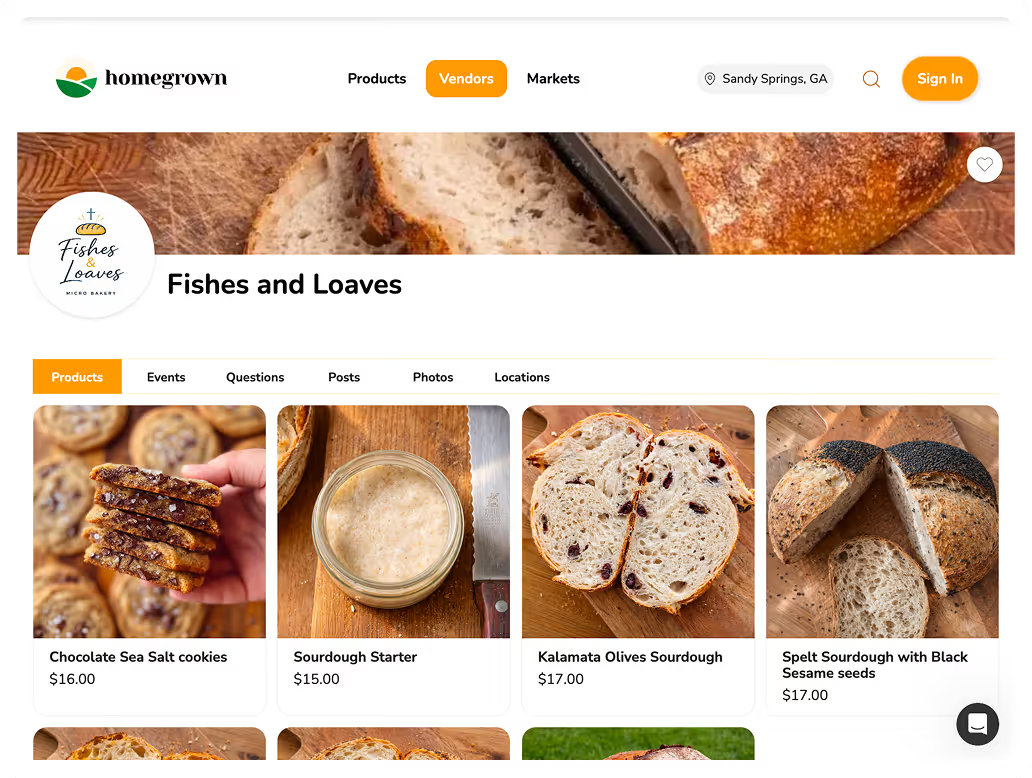
Start your free trial at Homegrown

About the Author

Evan Knox is the cofounder of Homegrown, where he works with hundreds of small food vendors across the country to sell online. He and his Co-founder David built Homegrown after seeing how many local vendors were stuck taking orders through DMs and cash-only sales.

Your Store Could Be Live Tonight

15 minutes. That's all it takes. Add your products, share your link, and start taking orders. Free for 7 days.