


Facebook Marketplace puts your homemade food in front of local buyers who are already browsing for things to buy in their area. It's free, it doesn't require a website or storefront, and it reaches people within a few miles of you who might never discover your products otherwise. For cottage food producers and home bakers looking to test demand, reach new customers, or supplement farmers market income with additional sales, Marketplace is a legitimate and accessible channel that's worth understanding.
But it has real limitations that shape how you should use it. There's no built-in payment processing for food, no storefront or product catalog, no way to notify past buyers when you have new inventory, and no order management beyond message threads. Every sale requires manual coordination — messaging back and forth about details, confirming pickup times, arranging payment separately. That's manageable for a handful of sales per week, but it doesn't scale gracefully and it shouldn't be your only sales channel.
The short version: Facebook Marketplace is a free, effective way to reach local buyers and test demand for your products, but it works best as a supplemental channel alongside a farmers market booth or a structured pre-order system. Confirm your products are legal under your state's cottage food law, take clear product photos in natural light, write descriptive listings with round pricing, and respond to inquiries within a few hours. Use Marketplace to generate first-time buyers, then channel them toward your more structured sales venues for repeat business.
This guide covers how to list food on Facebook Marketplace effectively, what products sell well, how to handle orders and payment, where the legal requirements apply, and how to think about Marketplace as one piece of a broader approach to selling food locally.
Yes, if your products qualify under your state's cottage food law. The legal framework that governs your food sales applies regardless of where you sell, and Facebook Marketplace doesn't enforce compliance for you — that responsibility falls entirely on you.
Cottage food laws vary significantly by state, but they generally allow the sale of shelf-stable, non-potentially-hazardous foods made in a home kitchen. Baked goods, jams, jellies, candy, granola, dried herbs, honey, and similar products are commonly permitted. Foods that require refrigeration, raw meats, dairy products, and certain other categories are typically not covered under cottage food exemptions and cannot be legally sold without a licensed commercial kitchen.
Before you list anything on Facebook Marketplace, you need to confirm several things:
For a broader overview of getting your home food business set up legally, see how to start a food business from home.
Selling food you're not legally permitted to sell creates real liability regardless of the platform. Getting the legal side right before worrying about listings and marketing protects you and gives you confidence that every sale you make is above board.
Lead with clear, well-lit photos of your actual product — this is the single most important element that determines whether buyers click on your listing. Then write a descriptive title that matches how local buyers search, include all necessary details in the description, and set a firm, round price.
Photos are the single most important element of your listing. Facebook Marketplace is a visual platform, and buyers scroll through dozens of listings making split-second decisions about what looks worth investigating. A clear, well-lit photo of your actual product — not a stock image — is what stops the scroll. Use natural light, a clean background like a simple countertop or cutting board, and show the product as a customer would receive it.
Photo tips by product type:
Your title should use plain, descriptive language that matches what local buyers would actually search for. "Homemade Blueberry Jam — Local Pickup" is more searchable and more effective than "Fresh Artisan Berry Preserves." Keep it simple, include the product name, and add "local pickup" or your town name to signal that you're nearby. Resources from Facebook Marketplace policies offer more detail here.
The description needs to include everything a buyer needs to decide whether to purchase and how to proceed:
Set a firm, reasonable price. Facebook Marketplace buyers are accustomed to negotiating prices on used goods, but food is different. Price your product confidently at what it's worth and don't invite haggling. Round numbers like $8, $12, or $15 reduce friction and signal that you're running a real food business, not clearing out unwanted items from your garage.
For the category, list under the food or grocery section if it's available in your local Marketplace. If a direct food category isn't available, check what other local food vendors are using — "Garden & Outdoor" and "Health & Beauty" are common alternatives depending on the product.
The same labeling and product rules that apply when you sell at a farmers market apply when you sell through Marketplace. Facebook doesn't check your compliance — that responsibility is entirely yours.
Your products still need proper cottage food labels with:
Cottage food laws are state-specific, and most don't authorize interstate commerce. Stick to local sales and local pickup within your state. Even if a buyer in a neighboring state messages you about shipping, that sale likely falls outside your cottage food authorization.
Your permitted product list applies regardless of the sales channel. If your state allows jams and baked goods but doesn't cover hot sauces, fermented foods, or products requiring refrigeration, those restrictions hold whether you're selling at a farmers market, through Facebook Marketplace, or out of your front door.
For a full overview of what cottage food labels must include in your state, see cottage food labeling requirements.
Respond within a few hours, confirm specific details upfront, and get a firm commitment before prepping any custom or large order. Speed and clarity are the two factors that most affect whether a Marketplace inquiry converts to an actual sale.
Cash at pickup or Venmo/PayPal prepayment are the two most practical options. Facebook Marketplace does not process payments for food listings, so you'll handle payment separately.
| Payment Method | Processing Fee | Confirms Commitment | Best For |
|---|---|---|---|
| Cash at pickup | None | No | Small standard orders |
| Venmo | None for personal | Yes | Prepayment on custom orders |
| PayPal | None for personal | Yes | Prepayment on custom orders |
| Zelle | None | Yes | Prepayment, no app needed |
Avoid complicated payment arrangements or platforms you're not familiar with. The simplest method that both you and the buyer are comfortable with is the best choice.
Choose a pickup approach that balances your convenience with your comfort level on privacy — home pickup for neighborhood sales, public meeting points for buyers you don't know, or your farmers market booth to channel Marketplace interest toward your established venue.
Logistics tips:
High-margin, easy-to-understand, visually appealing products priced under $25 sell best. Seasonal and limited items create urgency, and bundles encourage larger purchases.
Marketplace has no repeat customer tools, no storefront, no order management, and algorithm-dependent reach. It works for supplemental sales but shouldn't be your primary channel.
| Feature | Facebook Marketplace | Farmers Market Booth | Homegrown ($10/mo) |
|---|---|---|---|
| Repeat customer tools | None | Face-to-face relationships | Customer notifications |
| Product catalog | Individual listings only | Your booth display | Full storefront |
| Order management | Message threads | In-person | Integrated system |
| Payment processing | Manual (cash/Venmo) | Square or cash | Built-in |
| Customer discovery | Algorithm-dependent | Foot traffic | Local marketplace |
| Scalability | Limited (5-6 orders) | Moderate | High |
Use Marketplace to generate awareness and first-time buyers, then channel those customers toward your farmers market booth or your ordering page for repeat business. This is the most effective way to use the platform.
Marketplace is good for:
Marketplace is less ideal for:
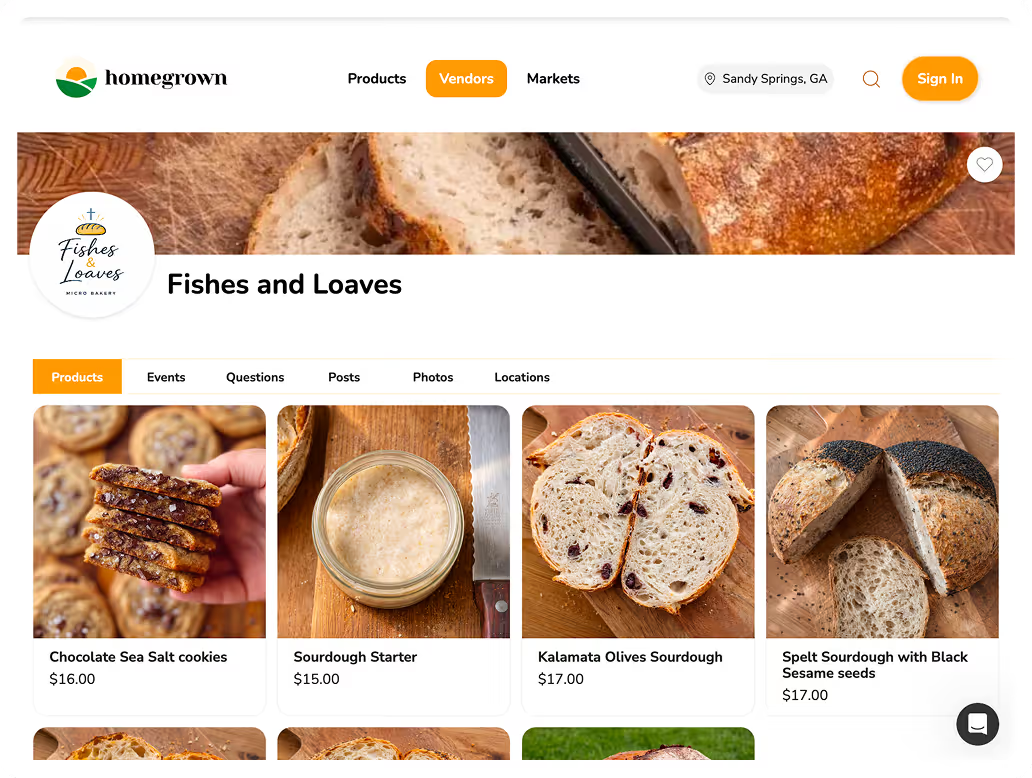
A more structured channel gives you the infrastructure that Marketplace doesn't provide. A farmers market booth puts you in front of the same customers week after week. Homegrown is $10/month with no percentage fees beyond standard payment processing (2.9% + $0.30) and gives customers a real ordering page where they browse your products, pay, and choose pickup or local delivery — no back-and-forth messaging required. Compare that to Etsy (6.5% per transaction, built for shipping) or continuing to coordinate everything through Marketplace DMs. Homegrown doesn't list you on Facebook, manage your social media, or handle shipping — it replaces the manual coordination with a structured ordering system that builds recurring revenue. See USDA safe food handling resources for additional context.
The strongest approach uses Marketplace to generate initial awareness and first-time buyers, then channels those customers toward your more structured sales venues. A buyer who discovers your jam through a Marketplace listing and loves it becomes a regular market customer or a weekly pre-order subscriber — and that ongoing relationship is worth far more than any single Marketplace sale.
Yes, in most jurisdictions you need the same business license and cottage food compliance that applies to any food sales channel. Facebook Marketplace doesn't check or enforce food safety regulations — compliance is entirely your responsibility. Check your state's cottage food law and your local business license requirements before listing.
Price your products firmly at round numbers and don't engage with haggling. Food is different from used goods — buyers expect fixed pricing. If someone offers less than your listed price, a polite "my prices are firm" is sufficient. Don't lower your price to make a single sale, because that devalues your product for future transactions.
Post new listings weekly if you're actively using Marketplace as a sales channel. Fresh listings get better algorithmic placement than older ones. If you have the same products each week, create new listings rather than relying on old ones. Include the current week or date range in your title to signal freshness.
Yes, baked goods are one of the most commonly sold cottage food products on Marketplace and one of the best-performing categories. Cookies, brownies, bread, cakes, and pastries all sell well because buyers understand them instantly and they photograph attractively. Confirm that your specific baked goods are covered under your state's cottage food law before listing.
Be transparent and confident. Mention that you operate under your state's cottage food law, that your products are properly labeled with ingredients and allergen information, and that you follow food safety best practices. If a buyer asks about your kitchen or process, a brief honest answer builds trust. Never be evasive about food safety — transparency is your strongest credibility tool.
Yes, as a supplemental channel. Marketplace reaches local buyers who may not attend your market, helps you move extra inventory during slow weeks, and can test demand for new products before you bring them to your booth. The key is treating it as an addition to your existing channels, not a replacement.
Include a card or note with every Marketplace order pointing buyers to your farmers market schedule or your ordering page for pre-orders. Mention your regular sales channels in your Marketplace listing description. The goal is to move one-time Marketplace buyers into your structured sales ecosystem where you can build ongoing relationships.
If you want to test Facebook Marketplace as a sales channel, start small and evaluate before committing significant time.
Confirm your products are legal to sell under your state's cottage food law and that your labels meet the requirements. Take good photos of your product in natural light — this is the highest-leverage thing you can do for your listing. Write a clear description that includes the product name, price, pickup area, ingredients, and how to order. Post your first listing and see what kind of response it generates.
When inquiries come in, respond quickly and specifically. Confirm the details, arrange a pickup time and location, and follow through reliably. Track your Marketplace sales alongside your other channels so you can evaluate whether the time you spend on coordination is justified by the revenue it produces.
Give it three or four listings before deciding whether it's worth continuing. A single listing might not get traction for reasons unrelated to your product — timing, algorithm, competition from other listings in your area. A few listings over a couple of weeks gives you enough data to see whether there's real demand and whether the logistics work for your situation.
Facebook Marketplace isn't going to replace a farmers market booth or a structured pre-order system for most food vendors. But as a free, low-effort way to reach local buyers, test new products, and supplement your existing sales channels, it's worth experimenting with. The vendors who use it most effectively treat it as one tool in a broader approach rather than their entire sales strategy.