


What tools does a cottage food business actually need? If you sell cookies, bread, jam, or baked goods from your home kitchen under your state's cottage food law, the answer is simpler than most "best tools" lists suggest.
You need a way to take orders, a way to understand your state's rules, a way to label your products, and a way to track your money. That is it. Everything else is optional until your business demands it.
This guide covers the best tools for cottage food businesses in 2026 — organized by what you actually need them for, with pricing for every recommendation.
The short version: The essential cottage food tool stack is Homegrown ($10/month for ordering with marketplace discovery), Forrager (free for state law lookup), Canva plus Avery (free for label design and printing), Wave (free for bookkeeping), and Kit (free email marketing for up to 10,000 subscribers). Total cost: $10 per month. Add BakeProfit (free) for recipe costing and you have everything a home-based food vendor needs to operate legally and efficiently.
Taking orders online is the single biggest upgrade most cottage food vendors make. It eliminates DM chaos, reduces no-shows, and collects payment before you spend time and ingredients making the product.
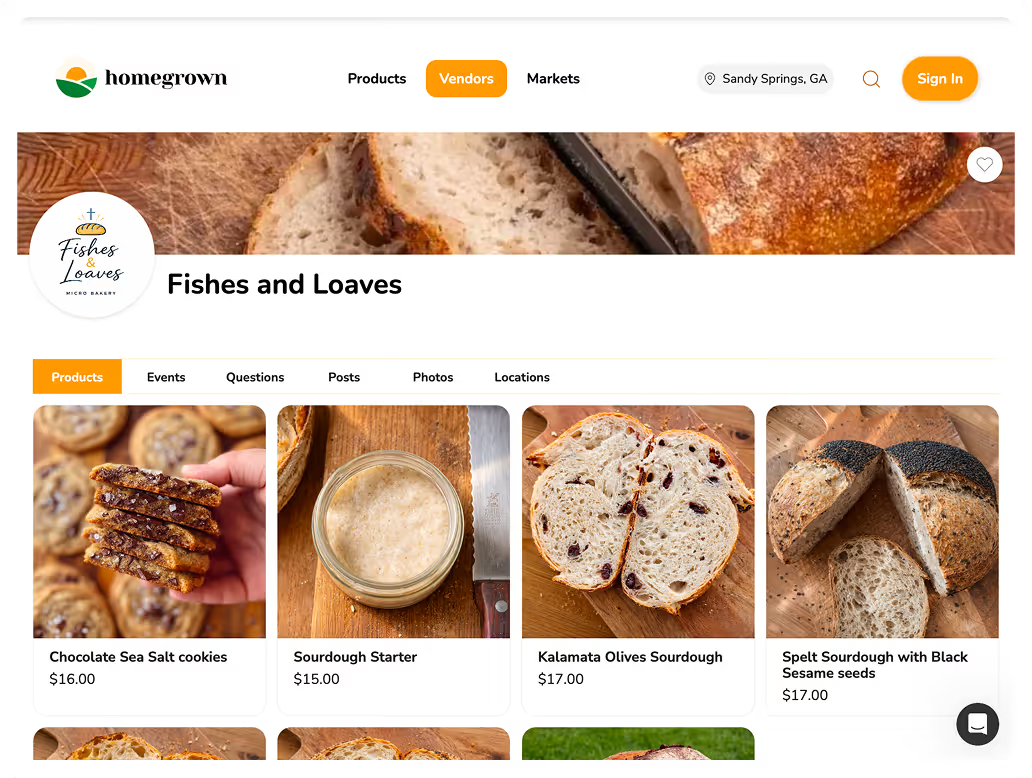
Homegrown gives each vendor their own ordering page where customers browse products, place orders, and pay before pickup.
If you are deciding whether you need a website, a marketplace, or just an order form, a simple ordering page with marketplace visibility covers both bases for most cottage food vendors.
Start your free trial at Homegrown
Bakesy is designed specifically for home bakers who take custom orders — birthday cakes, wedding cookies, and made-to-order treats.
Square Online offers a free plan with standard processing fees. If you already use Square for in-person sales, the integration is seamless.
Butterbase combines recipe costing, inventory management, and order tracking in one platform — designed specifically for home bakers.
Every cottage food vendor needs to understand their state's rules — what you can sell, where you can sell it, how much you can sell, and what needs to be on your labels. Getting this wrong can mean fines or having to shut down.
Forrager is the most comprehensive free resource for cottage food laws in the United States. It covers every state with detailed breakdowns.
CottageCMS maintains state-by-state cottage food law pages with recent legislative updates — like new laws passed in 2025 that expand what cottage food vendors can do.
Your state agriculture or health department website is the primary legal authority. Forrager and CottageCMS are excellent for research, but always verify against official state sources before you start operating.
Resources like the Georgia Department of Agriculture's cottage food FAQ and Purdue University's home-based vendor guide show how specific requirements vary — from labeling allergens to listing required statements to understanding internet sales rules. Your state has similar official resources.
Most cottage food laws require specific information on your labels — typically your business name, home address, ingredients list, allergen warnings, and a "made in a home kitchen" disclaimer. Getting labels right is not optional.
Canva is the easiest way to design professional-looking food labels without any graphic design experience.
Avery sells label sheets that work with any home inkjet or laser printer, and offers free design software to format your labels.
While most cottage food vendors are legally exempt from nutrition labeling, some choose to include nutrition facts anyway. Several free tools generate FDA-format labels:
For vendors who sell at retail or want to appear more professional, these tools generate proper labels in minutes. For cottage food at farmers markets, nutrition labels are typically not required.
The IRS considers cottage food income taxable regardless of how small the business is. Track your income and expenses from day one — it saves you pain at tax time and tells you whether your business is actually making money.
Wave is the only genuinely free accounting app with real double-entry bookkeeping.
QuickBooks Solopreneur is worth the cost if you want automated tax prep and mileage tracking.
Knowing what each product costs to make is the foundation of profitable pricing. Most cottage food vendors guess — and most guess wrong.
BakeProfit offers six free calculators with no signup required — the fastest way to understand your actual costs.
Butterbase's free plan includes recipe costing alongside order management — useful if you want one tool for pricing math and order tracking.
Email is the most reliable way to reach your regular customers. A weekly "here is what I am making this week" email drives more pre-orders than social media.
Kit offers free email marketing for up to 10,000 subscribers — far more generous than any competing free plan.
Mailchimp reduced its free plan significantly — now limited to 250 contacts and 500 sends per month.
The same Canva account you use for labels works for Instagram posts, Facebook graphics, and market-day announcements. Use pre-made templates to create social content in minutes.
InShot is the simplest phone-based video editor for creating baking videos, market-day clips, and behind-the-scenes content.
Here is what the full setup looks like at each budget level:
| Budget | Tools | Monthly Cost |
|---|---|---|
| Free only | Google Forms (orders) + Forrager (laws) + Canva (labels + social) + Wave (bookkeeping) + BakeProfit (costing) + Kit (email) | $0 |
| Under $15/month | Homegrown (ordering + discovery) + Forrager + Canva + Wave + BakeProfit + Kit | $10/month |
| Under $30/month | Homegrown + Bakesy (custom orders) + Canva + Wave + BakeProfit + Kit | $20/month |
| Under $45/month | Homegrown + Bakesy + Canva + QuickBooks Solopreneur + BakeProfit + Kit | $40/month |
For most cottage food vendors, the under $15/month stack covers everything. You get online ordering with marketplace discovery, state law compliance, professional labels, free bookkeeping, recipe costing, and email marketing to unlimited subscribers — all for $10 per month.
Most cottage food vendors do not need to build a Shopify store. You need the minimum set of tools that lets you take orders, stay legal, and track your money. Start with the free tools, add Homegrown when you are ready for online ordering, and upgrade everything else only when your business demands it.
For cottage food vendors who sell at farmers markets, Homegrown is the best ordering platform at $10 per month flat with marketplace discovery. For vendors who take custom orders (cakes, specialty items), Bakesy is designed specifically for that workflow at $9.99 per month. Square Online is the best free option with standard transaction fees.
Not necessarily. Most cottage food vendors do better with a simple ordering page than a full website. A tool like Homegrown gives you an ordering page in 15 minutes without the complexity of building and maintaining a website. If you want to add online ordering to your existing business, start with the simplest tool available.
Canva (free) for designing labels and Avery label sheets (about $10-$20 per 100+ labels) for printing at home. Most cottage food laws require your business name, home address, ingredients list, allergen warnings, and a "made in a home kitchen" disclaimer on every product. Design the label once in Canva, then print on Avery sheets with your home printer.
Forrager (forrager.com/laws) is the most comprehensive free database of cottage food laws by state. CottageCMS (cottagecms.com/state-laws) tracks recent legislative changes. Always verify against your state's official agriculture or health department website before you start selling.
Wave is the best free bookkeeping tool. The free Starter plan includes unlimited income and expense tracking, invoicing, and profit and loss reports. It handles everything a cottage food vendor earning under $50,000 per year needs. QuickBooks Solopreneur ($20/month) is worth upgrading to if you need mileage tracking and automated Schedule C generation.
Most cottage food vendors should spend $0 to $15 per month on tools. A free stack (Google Forms, Forrager, Canva, Wave, BakeProfit, Kit) costs nothing. Adding Homegrown for online ordering with marketplace discovery brings the total to $10 per month. Enterprise tools and complex platforms are unnecessary at the cottage food scale.
Running a cottage food business does not require expensive software or complex systems. Start with the free tools — Forrager for laws, Canva for labels, Wave for bookkeeping, BakeProfit for pricing, and Kit for email. Add Homegrown when you are ready for online ordering with customer discovery.