

What is the best online ordering platform for a farm stand? Most recommendation lists push enterprise tools like Barn2Door, Local Line, and GrazeCart — platforms that cost $99 to $399 per month and are built for full-time farms with delivery routes, wholesale accounts, and CSA subscribers.
If you run a small roadside farm stand that sells produce, eggs, honey, or baked goods seasonally, those platforms are overkill. You do not need variable-weight pricing, wholesale invoice management, or delivery route optimization. You need a simple way for customers to pre-order and pay before they pick up at your stand.
This guide compares online ordering platforms that actually fit small farm stand operations — based on what they cost, what they do, and what a stand operator realistically needs.
The short version: Small farm stands doing under $50,000 per year in seasonal sales cannot justify $99-$399/month platform fees. The best options are Homegrown ($10/month flat with marketplace discovery), EatFromFarms ($9-$15/month with farm-specific features), Square Online (free with transaction fees for Square POS users), and Google Forms (free for testing demand). Enterprise platforms like Barn2Door, Local Line, and GrazeCart make sense for full-time farms — not seasonal roadside operations.
Before comparing platforms, it helps to understand what a small farm stand operation actually looks like — because most e-commerce platforms are designed for a different kind of business.
Here is what most small farm stands have in common:
Given this profile, here is what a farm stand actually needs from an online ordering platform:
And here is what a farm stand does NOT need:
Most farm e-commerce platforms are built around those enterprise features. That is why they cost $99 to $399 per month — and why they are a poor fit for a stand selling tomatoes and corn on a country road.
Here is how the major options stack up for small farm stand operations.
| Platform | Monthly Cost | Transaction Fees | Setup Fee | Best For |
|---|---|---|---|---|
| Homegrown | $10/mo (annual) | None | None | Solo vendors wanting discovery |
| EatFromFarms | $9-$15/mo | Stripe rates | None | Farms with existing customers |
| Square Online | Free-$49/mo | 2.9% + 30 cents | None | Square POS users |
| Google Forms | Free | None | None | Testing demand |
| GrazeCart | $124+/mo | 2.9% + 30 cents | $249 POS | Meat farms (variable weight) |
| Barn2Door | $99-$299/mo | Card rates | $399-$599 | Full-time farms with guided setup |
| Local Line | $99-$399/mo | 2.5-2.9% + 30 cents | None | Wholesale + retail farms |
The price gap is enormous. A small farm stand paying $10/month for Homegrown spends $120 per year on its ordering platform. The same stand on Barn2Door's entry plan spends $1,587+ in the first year (including setup fee). That is 13 times more — for a stand that uses maybe 10% of the features.
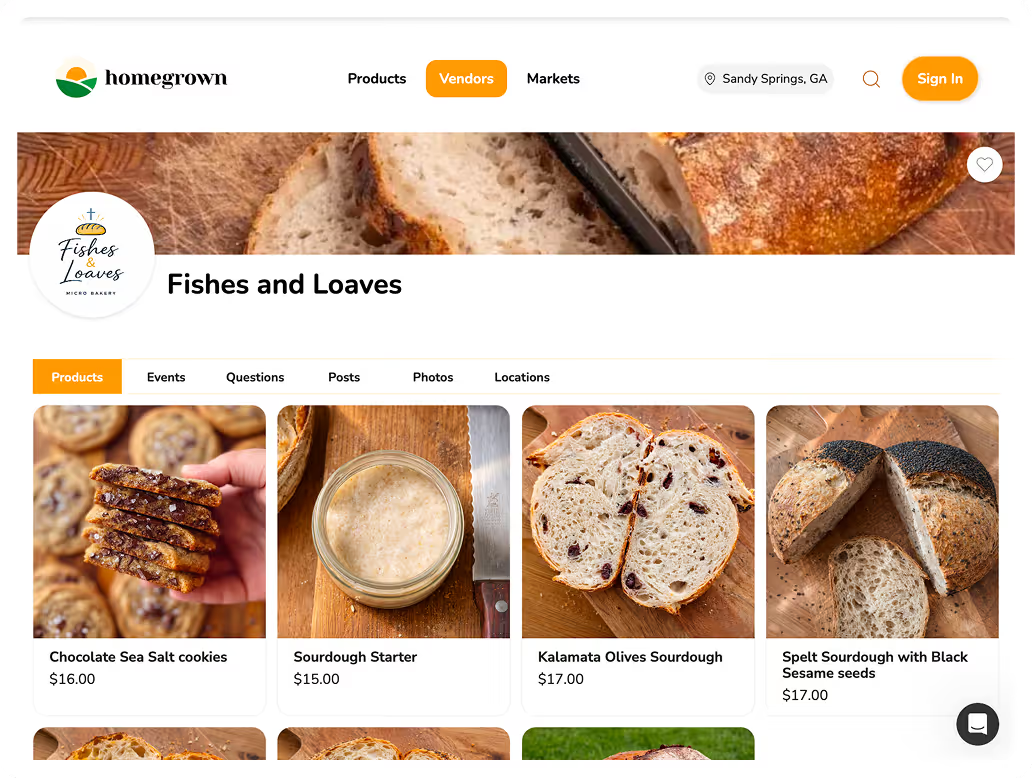
Homegrown is built for small local vendors who sell at farmers markets, farm stands, and similar direct-to-consumer channels. It gives each vendor their own ordering page with built-in marketplace discovery.
What makes it work for farm stands:
The marketplace discovery is the differentiator. EatFromFarms and Square Online give you a storefront, but nobody finds it unless you market it yourself. Homegrown puts your stand in a directory where customers browsing for local food can discover you.
At $10/month with no transaction fees, Homegrown is the most affordable purpose-built platform for farm stand operators. A stand selling $1,000/month keeps every dollar minus standard payment processing — no commission, no percentage, no add-on fees.
Start your free trial at Homegrown
EatFromFarms gives each farm a subdomain storefront (farmname.eatfromfarms.com) with inventory management, order tracking, and pickup scheduling at $9 to $15 per month.
What makes it work for farm stands:
The limitation is discovery. Your store lives on a subdomain that nobody finds organically — you must share the link directly. For a stand with an established local customer base, this works fine. For a stand trying to attract new customers, the lack of any directory or marketplace is a real gap.
EatFromFarms' farm-specific features (inventory management, pick lists, bundles) are genuinely useful for produce stands with fluctuating availability. If you manage 30+ items that change weekly, the inventory tools save time compared to a simple ordering page.
Square Online offers a free plan with standard processing fees (2.9% + 30 cents per transaction). If you already use Square at your stand, the integration is seamless.
What makes it work for farm stands:
Where it falls short for farm stands:
Square Online is the right choice specifically for vendors who already process payments through Square at their stand. The unified tracking across in-person and online sales is genuinely valuable for understanding your total business. But if you do not already use Square, the general-purpose platform is harder to set up than food-specific alternatives.
Google Forms costs nothing and proves whether your customers will actually pre-order before you commit to any platform.
Here is the setup:
What works:
What does not work:
Google Forms is the right starting point for a farm stand operator who is not sure whether customers will pre-order. Run it for a month. If customers use it, upgrade to a paid platform. If they do not, you have spent nothing.
Barn2Door, Local Line, and GrazeCart are good platforms — for the operations they are designed to serve. But they are a poor fit for small farm stands, and here is the math that proves it.
The cost math does not work. A small farm stand averaging $6,500 per year in revenue would spend $1,188 to $3,588 per year on Barn2Door (18-55% of revenue). Even a mid-size stand doing $47,000 per year would spend 2.5-7.6% of revenue just on platform fees — before ingredients, booth costs, and labor.
The features are irrelevant. Variable-weight pricing, wholesale B2B price lists, delivery route optimization, barcode scanning, and multi-location hub management are designed for farms doing $100,000+ with employees, delivery trucks, and institutional buyers. A stand selling tomatoes, corn, and jam does not need any of this.
Seasonal billing hurts. Enterprise platforms charge monthly whether you sell or not. A farm stand that closes from November through March still pays $99-$399 per month for five months of zero revenue — that is $495 to $1,995 wasted during the off-season. Platforms with lower monthly costs ($10/month) or no monthly fees (Google Forms, Square Online free plan) make seasonal economics work.
Cornell Small Farms' comparison of farm e-commerce platforms reinforces this point — the right platform depends on your operation's scale, product mix, and sales volume. What works for a diversified farm with CSA subscribers and restaurant accounts does not work for a roadside stand with a cash box and a handwritten sign.
If you are deciding between these options, ask yourself these questions:
Oregon State Extension's guide on farm direct marketing and on-farm sales facilities covers the broader picture of running a successful farm stand — from site selection to customer flow. The online ordering platform is one piece of a larger operation, and it should be the simplest, most affordable piece.
Most farm stand operators are better served by reading about how to add online ordering to an existing market business than by evaluating enterprise farm software. The goal is pre-orders and payments — not a technology project.
If you are debating whether you need a website, a marketplace, or just an order form, the answer for most farm stands is simple: an order form with payment processing. Everything else is overhead you do not need yet.
Google Forms is free but requires manual payment collection. Among paid platforms, Homegrown is the cheapest at $10 per month flat with no transaction fees. EatFromFarms costs $9-$15 per month. Square Online has a free plan with 2.9% plus 30 cents per transaction. Enterprise platforms like Barn2Door ($99+/month), Local Line ($99+/month), and GrazeCart ($124+/month) are significantly more expensive.
Not necessarily. If your stand does well with walk-up traffic and cash sales, you may not need online ordering at all. Online ordering becomes valuable when customers ask to pre-order, when you want to reduce waste by harvesting only what is sold, or when you want to reach customers who do not drive past your stand. Start with Google Forms to test demand before committing to a paid tool.
You can, but it is overkill for most farm stands. Shopify starts at $39 per month and is designed for shipping physical products nationally — not for local pickup at a roadside stand. The setup is more complex than food-specific platforms, and you pay transaction fees on every order. Most farm stand operators should not build a Shopify store when simpler options exist.
Farm stands need: a simple ordering page, pre-order capability, payment collection, easy weekly product updates, and low monthly cost. Farm stands do NOT need: variable-weight pricing, wholesale price lists, delivery routing, barcode scanning, CSA subscription management, or multi-producer hub tools. Match the platform to what you actually do, not what enterprise software offers.
A general rule is to keep platform costs under 5% of monthly revenue. For a stand doing $1,000/month, that means under $50/month — which rules out Barn2Door, Local Line, and GrazeCart. Homegrown at $10/month is 1% of $1,000 in sales. For seasonal stands, look for platforms with low fixed costs so you are not paying $99+/month during months when you have zero revenue.
For most small farm stands, no. Barn2Door's entry plan costs $99/month plus a $399 setup fee — over $1,587 in the first year. The platform's strongest features (guided onboarding, delivery routing, subscription management) serve full-time farms doing $100,000+ annually. A seasonal stand doing $6,500-$47,000/year would spend 3-24% of revenue on platform fees alone. Simpler alternatives at $10-$15/month deliver the core ordering and payment features that small stands actually need.
Some platforms let you pause or cancel monthly. Homegrown, EatFromFarms, and Square Online all operate month-to-month with no long-term contracts. You can sign up in April and cancel in November if your stand is seasonal. This is significantly better than annual plans on enterprise platforms where you pay year-round whether you sell or not.
You do not need enterprise farm software to take pre-orders at your farm stand. You need a simple ordering page that customers can find, a way to collect payment, and a platform that does not eat your margins.
Homegrown costs $10/month flat — no commission, no percentage fees, no setup fees. Set up your ordering page in 15 minutes, get discovered by local customers through the Homegrown directory, and keep more of what you sell.