

Every cottage food vendor starts the same way. You track orders in a notebook or a spreadsheet, collect payments through Venmo or cash, and manage customers through text messages and Instagram DMs. It works. Until it doesn't.
The real question isn't whether free tools can run a food business. They can, and they do, every single day. The real question is when those free tools start quietly costing you more than paid software ever would.
The short version: Most vendors outgrow their free tool setup somewhere between 10 and 20 orders per week. The signs show up as missed orders, hours spent on admin, and customers who give up because the process is confusing. The first thing worth paying for is an ordering and payment system, which typically runs $10 to $30 per month and pays for itself within the first few weeks by saving you time and catching orders you would have lost.
Free tools make perfect sense when you're starting out. You have no revenue yet, no guarantee the business will stick, and no idea how many orders you'll actually get. Spending money on software before you've sold a single loaf of bread or jar of jam feels like a gamble.
And honestly, free tools work fine at small scale. When you're filling five orders a week, a text thread with each customer is manageable. A simple spreadsheet can track what's coming in and going out. Venmo or Zelle handles payment without fees eating into thin margins.
Here are the most common free tools cottage food vendors rely on:
| Tool | What Vendors Use It For |
|---|---|
| Google Sheets or Excel | Order tracking, inventory counts, customer lists |
| Venmo / Zelle / Cash App | Collecting payments |
| Text messages | Taking orders, confirming pickup times |
| Instagram DMs | Fielding inquiries, taking custom orders |
| Facebook Messenger | Communicating with repeat customers |
| Notebook or planner | Tracking what sold, what to bake next |
| Calculator app | Adding up order totals manually |
| Personal calendar | Scheduling bake days and pickups |
There's nothing wrong with any of these tools on their own. The problem is what happens when your volume grows and you're juggling all of them at once. For more details, see our guide on .
Most vendors start with free tools because they're accessible, familiar, and low-risk. That's a smart move. The mistake is staying with them too long after the cracks start showing.
Free tools stop being free when they start eating your time. According to a Salesforce survey, small business owners lose an average of 96 minutes per day on manual administrative tasks that software could handle automatically. For a cottage food vendor juggling spreadsheets, payment apps, and text threads, those lost minutes add up fast.
Here are the moments when free tools start costing you real money:
The tipping point usually hits between 10 and 15 orders per week. Below that, the friction is annoying but manageable. Above that, every missed order and wasted hour is money walking out the door.
You've outgrown your free tools when the system depends entirely on your memory and availability. If you get sick for two days and orders fall apart, that's a system problem, not a you problem.
Watch for these warning signs:
| Warning Sign | What It Means |
|---|---|
| 15+ orders per week | Too many threads to manage by hand without errors |
| Chasing 3+ payments per week | Customers aren't paying upfront because there's no checkout |
| No customer list or contact info | You can't reach past buyers for new product drops |
| Can't set order cutoffs | Customers order at 11 PM for a 7 AM pickup and expect it done |
| Duplicate or conflicting orders | Two people claim the last pie because you didn't track inventory |
| You dread checking your phone | Admin overwhelm means the business is running you, not the other way around |
| Customers ask "is there a website?" | They want a simpler way to browse and order |
Other signs that your free setup is holding you back:
If three or more of these apply to you, it's time to upgrade. Not because free tools are bad, but because your business has grown past what they can handle.
Not everything needs to change at once. Upgrade the tool that causes the most friction first, then add others as your budget and comfort level allow.
Here's the priority order most vendors should follow:
Priority 1: Ordering and payment system
This is the single most impactful upgrade. A dedicated ordering system lets customers browse your products, place orders, and pay in one step. No more text threads. No more chasing payments. No more manually tallying totals.
A good ordering system also lets you set order cutoff times so customers can't place a last-minute order you can't fulfill. It tracks what sold and how much, giving you data you'd never get from a notebook.
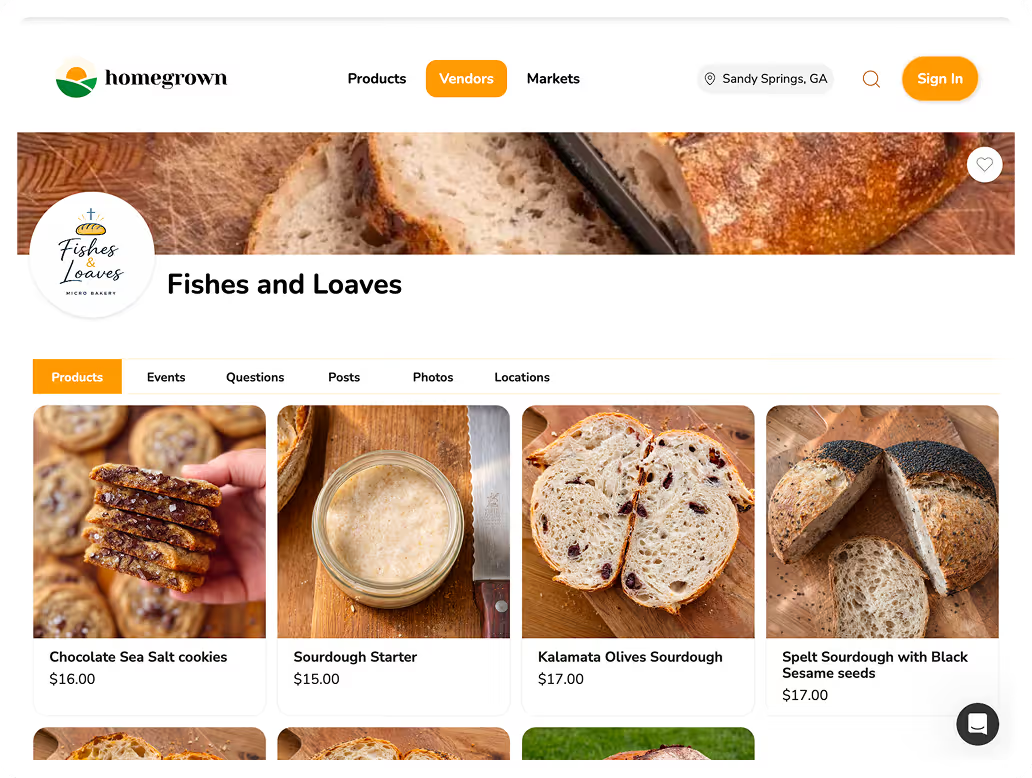
A Homegrown storefront costs $10 per month and gives you a shareable ordering page, built-in payment processing, and automatic order tracking, all designed for cottage food vendors and farmers market sellers.
Priority 2: Customer communication
Once your ordering system handles the transactional messages ("your order is confirmed," "ready for pickup"), you can focus communication on relationship building. This might mean:
Priority 3: Bookkeeping and expense tracking
When you're doing five orders a week, tracking income in a spreadsheet is fine. When you're doing 20 or more, a basic bookkeeping tool like Wave (free) or QuickBooks Simple Start ($15/month) saves time at tax season and helps you actually see your profit margins. For more details, see our guide on VIP Customer Experience Food Vendor.
Here's a summary ranked by priority:
| Priority | What to Upgrade | Why It Matters Most |
|---|---|---|
| 1 | Ordering and payments | Eliminates the biggest time drain and captures revenue you're currently losing |
| 2 | Customer communication | Builds repeat business and saves you from answering the same questions repeatedly |
| 3 | Bookkeeping | Gives you real numbers on profit, costs, and growth |
| 4 | Scheduling and production planning | Helps when you're managing multiple bake days or market appearances |
Don't try to overhaul everything in one weekend. Pick the first priority, get comfortable with it, then move to the next.
Most cottage food vendors can upgrade their entire tool stack for $10 to $50 per month. That's less than the cost of one missed order per week.
Here's what the most common paid tools cost:
| Category | Tool | Monthly Cost | What You Get |
|---|---|---|---|
| Ordering and payments | Homegrown storefront | $10/mo (annual) | Ordering page, payment processing, order tracking, cutoff times |
| Ordering and payments | Square Online | Free-$29/mo | Online store with payment processing |
| Email marketing | Mailchimp | Free (up to 500 contacts) | Email campaigns, basic automation |
| Bookkeeping | Wave | Free | Invoicing, expense tracking, reports |
| Bookkeeping | QuickBooks Simple Start | $15/mo | Full accounting, receipt scanning, tax prep |
| Social scheduling | Buffer | Free (up to 3 channels) | Schedule posts across platforms |
| Design | Canva | Free (basic) / $13/mo (Pro) | Labels, social graphics, menus |
Now let's do some simple ROI math.
Say you're currently losing one $35 order per week because a customer's DM got buried or they gave up on your ordering process. That's $140 per month in lost revenue.
A $10/month ordering system pays for itself in the first week, and you keep the other $130.
Or consider the time angle. If you spend 8 hours per month copying orders from texts into a spreadsheet, chasing payments, and manually confirming pickups, and a paid tool cuts that to 2 hours, you just freed up 6 hours. Even if you value your time at only $15 per hour, that's $90 per month worth of time back in your pocket.
The math almost always works out. A $10 to $30 monthly investment that saves you 5 or more hours and prevents 2 or more missed orders is one of the easiest business decisions you'll make.
Switching tools feels scary because you've built habits around your current system, and your customers have too. The good news is you don't have to flip a switch overnight.
Here's a step-by-step approach:
A few things to keep in mind during the transition:
If you're ready to make the switch, set up your Homegrown storefront in about 15 minutes. Add your products, share the link with your customers, and let the system handle the ordering, payments, and tracking while you focus on what you actually enjoy: making great food.
When you're managing orders from your storefront, farmers market sales, and maybe a wholesale account, a dedicated system also helps you manage multiple sales channels without things slipping through the cracks.
If you're filling more than 10 to 15 orders per week and spending more than 2 hours on admin tasks like order tracking and payment follow-ups, paid tools will save you time and money. The threshold isn't about revenue size. It's about whether your free tools are creating friction that costs you orders or hours. Even a vendor doing $500 per month in sales benefits from a $10 ordering system that prevents missed orders and eliminates payment chasing.
An ordering and payment system is almost always the right first upgrade. It solves the two biggest problems at once: it gives customers a simple way to place and pay for orders, and it gives you automatic tracking without spreadsheets. Everything else, like email marketing, bookkeeping, and scheduling, can stay free a while longer. The ordering system is where the ROI shows up fastest.
Absolutely. Most vendors use a mix. Your ordering system might be paid, but you can keep using Canva's free tier for labels, Buffer's free plan for scheduling social posts, and Wave for free bookkeeping. The goal isn't to pay for everything. It's to pay for the one or two tools where free versions are actively costing you time or revenue.
Most cottage food vendors spend between $10 and $30 per month on software after their first upgrade. A Homegrown storefront runs $10 per month on an annual plan. If you add a paid email tool or bookkeeping software later, you might reach $30 to $50, but that's the upper range for most small vendors. Start with one paid tool and add others only when you feel a specific pain point.
Most customers prefer a simpler process. Texting back and forth to place an order is more work for them, too. When you switch to an ordering page, frame it as an upgrade that makes their life easier: they can browse your full menu, pick what they want, and pay in one step. Give them a week or two of overlap where both methods work, and almost everyone adapts without complaint.
Most food business software runs month to month, so you're not locked into a long contract. If you try a tool for a month and it doesn't fit, cancel it and try something else. The risk of spending $10 to test a new tool for 30 days is far lower than the risk of continuing to lose orders and burn hours on a system you've outgrown. Many tools also offer free trials so you can test before committing.
No. Waiting for a specific revenue milestone is one of the most common mistakes vendors make. A TAB survey found that business owners spend 68% of their time working in the business on daily tasks, leaving only 32% for growth. The sooner you automate the repetitive admin work, the sooner you free up time to actually grow. If you're losing even one order per week or spending 2 or more hours on tasks a $10 tool could handle, the upgrade pays for itself immediately.