


You have regulars who order every week. You have customers who showed up once and disappeared. You have someone who mentioned a nut allergy three months ago, and you really hope you remember that before their next order.
All of this lives in your head right now. Maybe some of it is in a text thread or scribbled on a sticky note. That works until it doesn't — and for most cottage food vendors, it stops working around the time you hit 20 or 30 customers.
The good news is you don't need expensive software to organize your customer information. A free spreadsheet does the job. A simple CRM spreadsheet gives food vendors everything they need to track who buys what, how often they order, and what matters to each customer. You can set one up in under 30 minutes, and it will pay for itself (in time saved and sales recovered) within a few weeks.
The short version: A CRM is just a system for tracking your customers — their names, contact info, order history, preferences, and allergies. You don't need Salesforce or HubSpot. A Google Sheets spreadsheet with 8 to 10 columns covers everything a cottage food vendor needs. Set it up once, update it after every farmers market or delivery, and use it to identify your best customers, bring back lapsed buyers, and personalize your follow-ups. When you outgrow the spreadsheet (usually around 100+ customers), that is the time to consider paid tools.
A CRM — customer relationship management — is a system for keeping track of your customers and every interaction you have with them. While full CRM software exists for food businesses, a cottage food vendor doesn't need that level of complexity. For a cottage food vendor, that means knowing who buys from you, what they order, how often they come back, and anything else that helps you sell more and serve them better.
You might think CRMs are for tech companies and sales teams with 10,000 leads in a pipeline. They are. But the core idea scales all the way down to a vendor selling sourdough at the Saturday farmers market.
Here is what a simple CRM spreadsheet helps you do:
Most vendors already do some version of this in their heads. The spreadsheet just makes it reliable, searchable, and something you can act on.
A cottage food vendor with 40 regular customers and a well-maintained spreadsheet CRM will outsell a vendor with 100 customers and no system — because they know exactly who to follow up with, when, and about what.
Your spreadsheet needs enough columns to be useful but not so many that updating it feels like homework. Nine columns is the sweet spot for most food vendors.
| Column Name | What to Track | Why It Matters |
|---|---|---|
| Customer Name | First and last name | Personalization — greeting someone by name builds loyalty |
| Phone Number | Mobile number | Primary contact channel for most local food customers |
| Email Address | Personal email | For sending menus, specials, and ordering links |
| Products Ordered | List of what they have bought | Shows preferences so you can suggest similar products |
| Order Frequency | Weekly, biweekly, monthly, one-time | Identifies regulars vs. one-time buyers |
| Last Order Date | Date of most recent purchase | Flags lapsed customers who need a follow-up |
| Allergies/Dietary | Nut-free, gluten-free, vegan, etc. | Safety and service — never forget a dietary restriction |
| Notes | Birthday, preference for extra spicy, always picks up late | The personal details that turn a transaction into a relationship |
| Total Spend | Running dollar total | Identifies your VIP customers by revenue |
| Referral Source | How they found you (market, Instagram, friend) | Shows which channels bring in the best customers |
You can add more columns later if you need them — a "preferred pickup day" column or a "signed up for text updates" flag, for example. But start with these ten and you will have more useful customer data than 90 percent of cottage food vendors.
Keep one row per customer, not one row per order. Update existing rows when someone orders again rather than adding a new row. This keeps your spreadsheet manageable and makes it easy to see each customer's full history at a glance.
Setting up your CRM spreadsheet takes about 20 to 30 minutes. This Zapier spreadsheet CRM guide walks through the same concept with a free template you can copy. Here is the process using Google Sheets (it works the same way in Excel or Apple Numbers).
Type each column name into Row 1:
Set up a rule to highlight customers who have not ordered in 30+ days:
Now lapsed customers jump out visually every time you open the spreadsheet.
Start with the customers you know best — your weekly regulars. You probably have 5 to 10 people you can add from memory right now. Fill in what you know and leave blanks for what you do not. You will fill in the gaps as you interact with each customer.
Click on the "Last Order Date" column header, then go to Data > Sort sheet > Sort sheet by column F (Z to A). This puts your most recent customers at the top, which is the view you will use most often.
Pro tip: Create a second sheet tab called "Order Log" if you want a detailed record of every individual order. Keep the main Customers tab as your one-row-per-person CRM, and use the Order Log for transaction-level detail.
A CRM spreadsheet is not just a record-keeping tool — it is a sales tool. The data you collect tells you exactly where to focus your energy for the biggest return.
Sort your spreadsheet by the "Total Spend" column (highest to lowest). The top 10 to 15 names on that list are your VIPs. These are the customers who keep your business running.
What to do with this information:
Building a VIP customer experience does not require a formal loyalty program. It just requires knowing who your best customers are and treating them accordingly.
Filter or sort by "Last Order Date" to find customers who have not ordered in 30 or more days. These are people who liked your products enough to buy at least once — they just need a nudge.
Effective reactivation messages:
A single reactivation text to 10 lapsed customers can generate 3 to 5 orders. That is real revenue from a 10-minute task.
Your "Notes" and "Products Ordered" columns are goldmines for personalization. When you know that a customer always orders the mild salsa (never the hot), that their kid's birthday is in April, or that they mentioned wanting to try your pickles next time — you can reference that in your messages.
Personalized outreach converts at 2 to 3 times the rate of generic messages. And it does not take more time — it just takes information you already have in your spreadsheet.
The "Referral Source" column reveals where your best customers come from. If most of your high-spending regulars found you at the farmers market, double down on your market presence. If Instagram is bringing in one-time buyers who never come back, you know not to over-invest there.
You can also use your CRM to ask for referrals from your happiest customers. Sort by total spend, pick your top 20, and send each one a personal message asking if they know anyone who might enjoy your products.
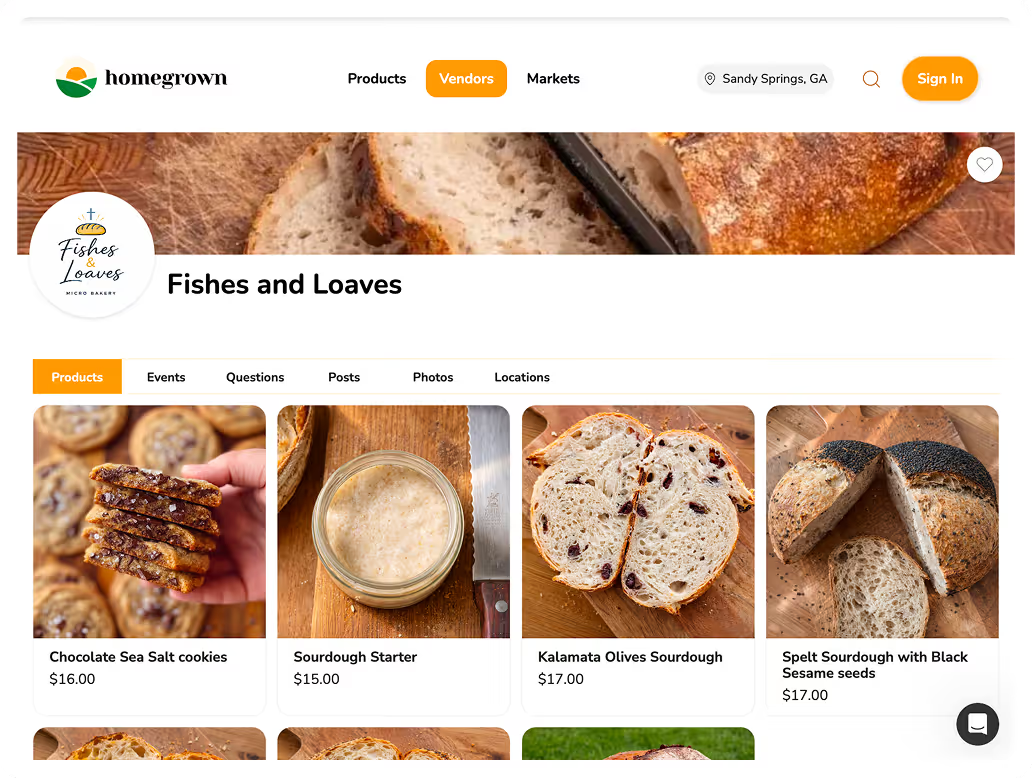
Your CRM becomes even more powerful when you pair it with a Homegrown storefront. Instead of manually tracking every order, your storefront handles payments and order details automatically. Your spreadsheet then becomes the layer on top — where you add the personal notes, preferences, and follow-up reminders that turn one-time buyers into regulars.
Update your CRM after every selling interaction — not once a month when you finally get around to it. The data is only useful if it is current.
Here is a realistic update schedule for most cottage food vendors:
The weekly review is the most important habit. It takes 10 minutes and it is where the CRM actually drives sales. Without the review, the spreadsheet is just a database. With the review, it is a sales plan.
Practical timing tips:
Vendors who update their CRM weekly retain 30 to 40 percent more repeat customers than those who rely on memory alone. The difference is not the data — it is the follow-up actions the data makes possible.
A spreadsheet CRM works great until it doesn't. Here are the clear signals that you have outgrown it:
If you hit two or more of those signals, it is time to look at dedicated tools. The transition from free to paid does not have to be expensive or complicated — check out this guide on when to upgrade from free to paid tools for a practical framework.
The goal is not to stay on a spreadsheet forever. The goal is to start simple, learn what data actually matters to your business, and upgrade when the spreadsheet becomes a bottleneck rather than a shortcut.
Most cottage food vendors can run a spreadsheet CRM for their first 6 to 12 months without any issues. By then, you will know exactly what features you need in paid software — and you will not waste money on tools you do not use.
Most of the data you enter into your spreadsheet — customer name, phone number, email, products ordered, order date, total spent — already exists in the ordering process. You are copying it from text threads and Venmo notifications into rows. The real upgrade is not better CRM software. It is an ordering system that captures customer data automatically every time someone buys.
Homegrown is $10/month with no percentage fees. Every order creates a customer record with name, contact info, products ordered, and payment — no manual entry. Your customer list builds itself as people order. You keep your spreadsheet for personal notes, allergy flags, and follow-up reminders, but the transaction data stops being your typing assignment.
Square has a customer directory, but it charges 2.9% plus 30 cents per transaction and is designed for restaurant POS, not cottage food vendors managing weekly pre-orders. Etsy captures buyer information but takes 6.5% of every sale and puts your local business in a national marketplace where customer relationships belong to the platform, not you.
Homegrown does not replace your personal CRM notes — birthday reminders, "prefers mild salsa," and "always picks up late" still need your spreadsheet. But it eliminates the data entry that makes the spreadsheet feel like homework, which is the reason most vendors stop updating it.
Google Sheets is the best option for most cottage food vendors. It is free, works on any device, syncs automatically, and lets you access your customer data from your phone at the farmers market. Microsoft Excel works if you already use it, but the cloud syncing is clunkier on mobile. Apple Numbers is fine for iPhone users but harder to share if you ever bring on help.
Yes — and 10 customers is actually the perfect time to start. Building the habit with a small list is easier than trying to reconstruct 50 customers' order histories from memory six months from now. The spreadsheet takes 20 minutes to set up and 5 minutes per week to maintain at that size. Start now so the system is ready when your customer base grows.
Not directly, but your spreadsheet is where the email list comes from. Export the email column, paste it into a free email tool like Mailchimp or Brevo, and send your weekly menu or special offers from there. Your CRM's "Products Ordered" and "Notes" columns help you segment your list — so you can send the jam announcement to jam lovers and the bread notification to bread buyers.
Keep one row per customer regardless of how they order. If Sarah buys sourdough at the farmers market on Saturday and orders cookies through your Homegrown storefront on Wednesday, both go in the same row. Update the "Products Ordered" column with everything she has bought and update the "Total Spend" with the combined total. The goal is a complete picture of each customer, not a separate record for each channel.
Do not store credit card numbers, Social Security numbers, or any payment credentials in a spreadsheet. Payment processing should happen through a secure platform — never through your CRM. Also avoid storing sensitive health information beyond basic allergy and dietary notes. Stick to the information that helps you sell and serve better: names, contact info, order history, preferences, and personal notes.
An order log records every individual transaction — one row per order. A CRM spreadsheet records every customer — one row per person. Your CRM is the big picture: who are your customers, what do they like, how much have they spent in total, and when did they last buy. An order log is the detail: what was ordered on which date for how much. Some vendors keep both (in separate sheet tabs), but the CRM is the one that drives sales growth.
If you run your food business solo, keep it to yourself. If you have a partner, family member, or helper who interacts with customers — at the booth, during deliveries, or handling orders — share view or edit access through Google Sheets. The more people who can update the spreadsheet after customer interactions, the more complete your data becomes. Just make sure everyone follows the same format so the data stays clean.
Ready to pair your new CRM with a storefront that handles ordering and payments automatically? Set up your Homegrown storefront and give your customers a simple way to order between farmers markets — so your spreadsheet fills itself with repeat buyers instead of one-time visitors.