You have been selling at farmers markets, filling online orders, maybe even doing pop-ups. But you are still the one behind the table every weekend, packing every box, and driving every delivery. At some point, you start wondering: is there a sales channel where someone else handles the shelf space or the logistics?
That is exactly what food co-ops and food hubs do. Co-ops put your products on retail shelves without the slotting fees that chain grocery stores charge. Food hubs collect your products alongside other local vendors and distribute them to restaurants, schools, and grocery stores so you do not have to run deliveries yourself. Both channels are built for vendors like you — small, local, and making something worth selling.
The problem is that almost everything written about co-ops and food hubs is aimed at consumers or large-scale operations. Nobody explains how a cottage food producer or part-time vendor actually gets in, what it costs, or whether it is worth the effort. This guide does.
The short version: Food co-ops are member-owned grocery stores that prioritize local products and typically do not charge slotting fees, making them more accessible than chain retailers. Food hubs are aggregation businesses that collect products from multiple local vendors and handle distribution, usually taking a 15-30% commission. To sell through a food co-op, you generally need product liability insurance, proper licensing, a UPC barcode, and consistent supply. Food hubs have lighter requirements and handle logistics for you. For most small vendors, a food hub is the easier entry point — then you add co-op shelf space once you have professional packaging and insurance in place.
What Are Food Co-ops and Food Hubs?
Food co-ops and food hubs are two different channels for getting your products to customers without running your own retail operation. They serve different functions, and understanding the difference matters before you spend time applying to either one.
What Is a Food Co-op?
A food co-op is a member-owned grocery store that prioritizes local, ethically produced, and specialty food products. Co-ops are run by and for their community — members pay a small annual fee to join, and the store's buying decisions are driven by member preferences rather than corporate planograms.
What makes co-ops relevant to you as a vendor:
- They actively seek local products. Co-ops want to stock food from nearby producers. That is a core part of their mission, not an afterthought.
- No slotting fees. Unlike chain grocery stores that charge thousands of dollars just to get your product on a shelf, most co-ops do not charge shelving fees to suppliers. This removes one of the biggest barriers to retail placement.
- Smaller and more personal. You are not pitching a corporate buyer. You are usually talking to a store manager or a local purchasing coordinator who can actually make decisions.
- Steady demand. Once your product is on a co-op shelf, customers buy it week after week without you standing behind a booth.
What Is a Food Hub?
A food hub is an aggregation and distribution business that collects products from multiple local producers, stores them, and delivers them to buyers. Think of it as a shared logistics operation for small vendors who cannot afford their own warehouse and delivery truck.
Food hubs serve a different purpose than co-ops:
- They handle the middleman work. You deliver or drop off your product at the hub. The hub takes care of storage, order fulfillment, and delivery to buyers.
- Their buyers are institutions and businesses. Food hub customers include restaurants, school cafeterias, hospitals, grocery stores, and sometimes individual consumers through online ordering.
- They range from nonprofit to for-profit. Some food hubs are community-run nonprofits. Others are private businesses operating as local distributors.
- Lower barrier to entry. Food hubs generally have lighter requirements than co-ops because they handle packaging, presentation, and customer-facing logistics themselves.
How Are They Different From Each Other?
The simplest way to think about it: a co-op gives you retail shelf space, and a food hub gives you wholesale distribution.
- Food co-op = your product sits on a store shelf. Customers pick it up, read your label, and buy it just like they would at any grocery store. You need professional packaging, a UPC barcode, and consistent inventory.
- Food hub = your product goes into a pool with other vendors. The hub sells it on your behalf to restaurants, institutions, and other buyers. Your packaging requirements are lighter because the end buyer is often a commercial kitchen, not a retail shopper.
- Co-ops sell directly to consumers. You set a wholesale price and the co-op marks it up for retail.
- Food hubs sell to businesses and institutions. The hub takes a commission from each sale rather than marking up your price.
- Co-ops require more from you upfront (insurance, barcodes, professional labels). Food hubs require less but take a larger cut of each sale.
Why Should You Consider Selling Through a Co-op or Food Hub?
Selling through a food co-op or food hub gives you recurring revenue without the weekly time commitment of a farmers market booth or the logistics burden of running your own delivery operation. These channels exist specifically to connect local vendors with local buyers — and they are growing.
Here is what makes these channels worth considering:
- No shelving fees at co-ops. Chain grocery stores charge slotting fees that can run into the thousands. Co-ops typically charge nothing to put your product on the shelf, which makes retail placement accessible for small vendors.
- Steady, recurring orders. Instead of hoping for foot traffic on a Saturday morning, your product sells every day the store or hub is open. You restock on a schedule rather than gambling on weather and attendance.
- Access to customers you cannot reach at a farmers market. Not every potential customer goes to farmers markets. Co-op shoppers and food hub buyers are actively looking for local products, but they shop during the week, not on Saturday mornings.
- Food hubs handle distribution for you. If you have been driving orders to restaurants or coordinating your own wholesale deliveries, a food hub takes that off your plate entirely.
- Real volume. Neighboring Food Co-ops alone purchase over $30 million in local products annually. That is money flowing from co-op shelves to small, local vendors every year.
- Stepping stone to larger wholesale accounts. A track record with a co-op or food hub gives you credibility when you approach larger retailers or distributors later.
What Does It Take to Get Your Products Into a Food Co-op?
Getting your products into a food co-op requires professional packaging, proper documentation, and a product that fills a gap on their shelves. The process is more structured than selling at a farmers market, but it is far more accessible than pitching a chain grocery store.
Requirements You Should Expect
Most food co-ops require the following from vendors:
- Product liability insurance. This is the most common requirement and the one that catches small vendors off guard. Most co-ops want to see $1-2 million in general liability coverage. Policies for cottage food and small food businesses typically cost $300-600 per year.
- Proper licensing. You need whatever license your state requires for the type of food you are selling — a cottage food permit, food handler's certificate, or commercial kitchen license. Co-ops will ask to see documentation.
- UPC barcode on your packaging. Co-ops use point-of-sale systems that scan barcodes. You will need a UPC code for each product. A GS1 company prefix (the standard barcode system) starts at around $250 for a single barcode.
- Professional packaging and labeling. Your product needs to look like it belongs on a retail shelf. That means a printed label (not handwritten), a complete ingredient list, allergen information, net weight, and your business name and address.
- Consistent supply. Co-ops need to know you can keep the shelf stocked. If your jam sells out every two weeks, they need confidence you can deliver more on a reliable schedule.
- Food safety documentation. Some co-ops ask for a food safety plan, HACCP documentation, or proof of food safety training. This varies by co-op and product type.
How to Approach a Co-op
The application process for most co-ops follows a predictable pattern:
- Research which co-ops are near you and what they already carry. Visit the store. Walk the aisles. Look at the local vendor section. Note what categories are underrepresented — if they have 12 hot sauce brands but zero local granola, that tells you something.
- Identify your product's unique angle. Co-ops want products that are local, specialty, or fill a gap on their shelves. "I make jam" is not compelling. "I make small-batch elderberry jam with berries I forage in [county name] and nobody else in this store carries it" is compelling.
- Download and complete their vendor application. Most co-ops have a vendor application on their website or available at the customer service desk. Fill it out completely — missing information slows the process.
- Bring samples with finished packaging. When you meet with the buyer, bring your actual product in its retail-ready packaging. They want to see what will sit on the shelf, not a mason jar with a handwritten label.
- Be ready to discuss pricing and supply. Know your wholesale price, your suggested retail price, and how frequently you can deliver. Co-ops typically mark up products 30-50% above your wholesale price.
What About Cottage Food Products?
Whether a co-op will carry cottage food products depends on two things: your state's cottage food laws and the co-op's own vendor policy.
- If your state allows cottage food sales at retail locations, a co-op may be willing to carry your products. Some states specifically permit cottage food sales through brick-and-mortar stores, not just direct-to-consumer channels.
- If your state limits cottage food to direct-to-consumer only, most co-ops will not carry your products because the sale goes through their register, which may not qualify as a direct transaction.
- Some co-ops accept cottage food products regardless, especially smaller co-ops that prioritize hyperlocal sourcing. The only way to know is to ask.
- If your cottage food products do not qualify, your path forward is a commercial kitchen. Renting shared kitchen time (typically $15-25 per hour) lets you produce under a commercial license and opens the door to co-op placement.
What Does It Take to Sell Through a Food Hub?
Selling through a food hub is generally easier to start than selling through a co-op because the hub handles most of the customer-facing logistics for you. You produce the food and deliver it to the hub. They do the rest.
How Food Hubs Work for Vendors
The vendor experience at most food hubs follows this flow:
- You apply and get approved. Food hubs have applications, but they are typically less demanding than co-op vendor applications. Many hubs are specifically designed to support small and beginning farmers.
- You deliver or drop off your product at the hub. Some hubs have regular drop-off days. Others arrange pickups from your location if you are within their service area.
- The hub stores your product. Depending on the hub, this may include cold storage, dry storage, or frozen storage.
- The hub markets and sells your product to buyers. Buyers include restaurants, school districts, hospital cafeterias, grocery stores, buying clubs, and sometimes individual consumers through an online marketplace.
- You get paid after the sale. The hub collects payment from buyers, takes their commission, and pays you the remainder. Payment terms vary — some hubs pay weekly, others monthly.
Commission and Fee Structures
Most food hubs take a commission on each sale rather than charging you a flat fee. The percentage varies, but here is what to expect:
- Food hub commission: 15-30% of the sale price. This is the most common structure. If your product sells for $10, the hub keeps $1.50-3.00 and you receive $7.00-8.50.
- Some hubs charge flat membership or listing fees instead of (or in addition to) a percentage commission. Annual membership fees range from $50 to $500 depending on the hub.
- Compare this to produce auctions, which charge 9-12% commission — lower than food hubs but with less marketing and distribution support.
- The commission covers real services. The hub is handling storage, marketing, order management, delivery logistics, invoicing, and payment collection. If you were doing all of that yourself, you would spend far more than 15-30% of your time and money on those tasks.
Finding a Food Hub Near You
Food hubs exist in almost every state, but they are not always easy to find because they do not advertise the way retail stores do.
- USDA Local Food Directories. The USDA maintains a searchable directory of food hubs across the country. Search by state or zip code.
- State extension services. Your state's cooperative extension office (usually run through a university) often has a list of local food hubs and producer aggregation programs.
- Search directly. Try "[your state] food hub" or "[your county] food hub" in Google. Many food hubs are small operations with simple websites, but they show up in local search results.
- Ask at your farmers market. Other vendors at your market may already sell through a food hub and can tell you which ones are active in your area.
How Do You Price Your Products for Co-ops and Food Hubs?
You need a wholesale price that leaves room for the co-op or food hub to take their cut while still making the sale profitable for you. If you have only ever sold direct-to-consumer at farmers markets or online, this is a pricing adjustment you cannot skip.
Here is how the math works:
- For co-ops: You set a wholesale price. The co-op adds a markup of 30-50% on top of your price to get the retail shelf price. If your wholesale price is $6, the co-op sells it for $7.80-9.00. You receive $6.
- For food hubs: You set a sale price. The hub takes a commission of 15-30% from that price. If your price is $8, the hub keeps $1.20-2.40 and you receive $5.60-6.80.
- Your direct sales price sets the ceiling. If you sell a jar of jam for $10 at the farmers market, your wholesale price to a co-op needs to be low enough that their marked-up retail price does not significantly exceed $10. Otherwise, customers will just buy from you directly.
- Do not undercut your own direct sales prices. If a co-op sells your jam for $8 and you charge $10 at the farmers market, your market customers will feel overcharged. Keep retail pricing consistent across channels.
For a deeper breakdown of how to set wholesale prices, read How to Set Wholesale Prices for Your Food Products. And for a broader look at pricing across multiple channels, see How to Price Food for Farmers Market, Wholesale, and Online.
Food Co-op vs Food Hub vs Farmers Market: Which Is Right for You?
Each channel has different demands on your time, money, and production capacity. The right choice depends on where you are in your business right now.
Here is how they compare:
- Farmers market — Time commitment: high (full day per market). Startup cost: $260-815 per season. Revenue: immediate, $200-800 per market day. Control: high, you set everything. Volume: limited to what you can sell in one day.
- Food hub — Time commitment: low (drop off product). Startup cost: $50-500 membership. Revenue: steady but slower (monthly payments). Control: low, hub sets buyer relationships. Volume: moderate, depends on buyer demand.
- Food co-op — Time commitment: low (deliver to store). Startup cost: $500-1,500 (insurance, barcodes, packaging). Revenue: steady and recurring. Control: moderate, you set wholesale price. Volume: consistent, limited by shelf space.
Start at a farmers market if you are just beginning, need to test products, build a customer base, and get real-time feedback. The learning curve is steep but short, and you start earning from day one.
Add a food hub when you have consistent production volume and want to reach restaurants, schools, and institutions without managing your own delivery logistics. Food hubs are the lowest-barrier wholesale channel.
Pursue co-op shelf space when you have professional packaging, product liability insurance, and a reliable production schedule. Co-op placement is steady, recurring retail revenue without you standing behind a counter.
For a deeper comparison of farmers markets and online selling, read Farmers Market vs. Online Store: Which to Start First.
Can You Use Multiple Channels at the Same Time?
Yes, and most successful food vendors do. The strongest small food businesses are not locked into a single channel — they layer channels so that each one feeds the others.
Here is how multi-channel selling works in practice:
- Farmers market for face-to-face sales and brand building. This is where new customers discover you. They taste your product, hear your story, and decide to buy. No other channel gives you that level of personal connection.
- Food hub for wholesale volume. Once you have consistent production, a food hub puts your product in front of restaurants, schools, and institutions without you driving deliveries or managing invoices.
- Co-op for steady retail revenue. Your product sells every day the store is open, not just on market days. Customers who shop at the co-op during the week become regulars without you being present.
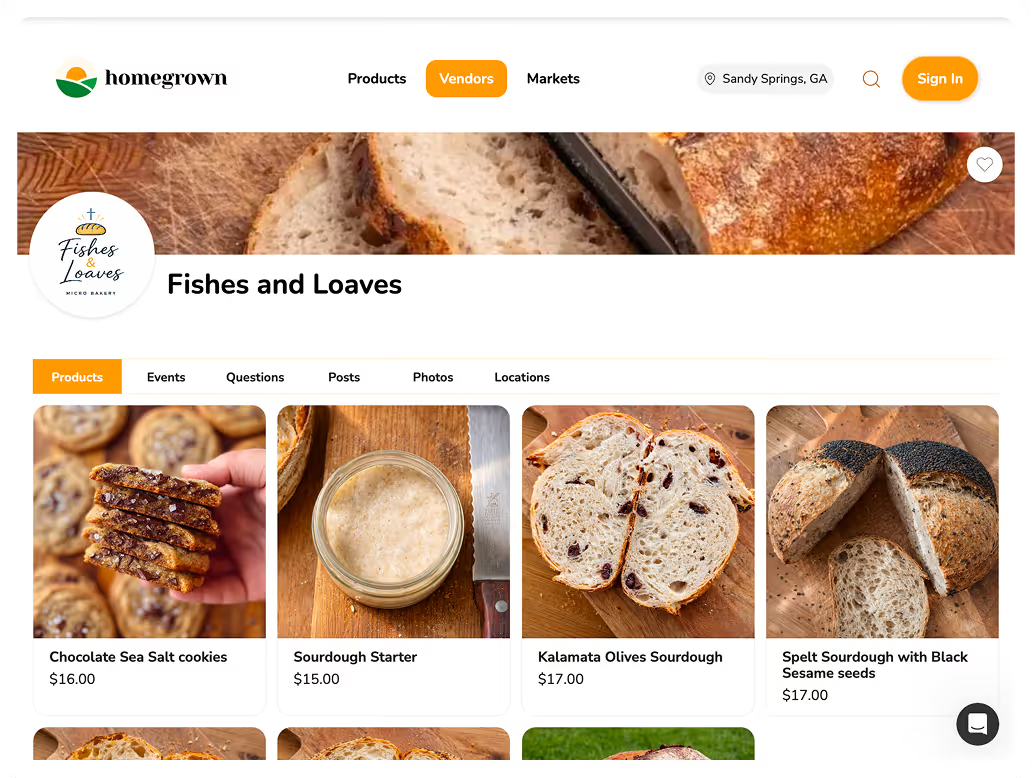
- Online store for repeat orders and schedule flexibility. An ordering page lets customers reorder between market days, place holiday orders, and buy on their own schedule — and it captures the direct-to-consumer margin that co-ops and food hubs take a cut of. Homegrown is $10/month with no percentage fees beyond standard payment processing, which matters when you are already giving up 15-30% to a food hub or 30-50% markup to a co-op on your wholesale channel. Your direct online sales keep 100% of the margin. Compare that to Etsy, which charges 6.5% per transaction on top of listing fees — adding yet another middleman cut to a business where margins are already split across channels. Homegrown does not replace your co-op or food hub relationships — it gives you a direct channel where the customers you meet at markets and through word of mouth can reorder without a middleman.
The progression most vendors follow is: farmers market first, then online store, then food hub, then co-op. Each step requires a bit more infrastructure, but each one also adds revenue you were not capturing before.
For strategies on moving your market customers to online ordering, read How to Convert Market Customers to Online Customers. And for a look at how co-op and food hub sales compare to selling directly to restaurants and cafes, that guide covers the restaurant sales channel in detail.
Want to add an online store to your sales channels? Set up an ordering page and take orders online alongside your co-op and food hub sales.
The Bottom Line
Food co-ops and food hubs are two of the most accessible wholesale and retail channels for small food vendors, and they are designed for exactly the kind of business you are building — local, small-scale, and product-driven.
If you are just starting to explore beyond farmers markets, here is the simplest path forward:
- Find a food hub in your area. The requirements are lighter, the barrier to entry is lower, and the hub handles logistics you would otherwise manage yourself. This is the easiest way to test wholesale without a major upfront investment.
- Once you have consistent production and professional packaging, approach a local co-op. Bring samples, fill out their vendor application, and show them what makes your product different from what is already on their shelves.
- Layer channels as you grow. Farmers market for new customer acquisition. Food hub for wholesale volume. Co-op for steady retail. Online store for repeat orders between market days.
You do not have to choose one channel forever. The vendors who build sustainable food businesses are the ones who diversify — and co-ops and food hubs are two of the best places to start.
Ready to sell your food online alongside your co-op sales? Set up your ordering page and give your customers a way to reorder anytime.
Frequently Asked Questions
Do food co-ops charge slotting fees like regular grocery stores?
No. Most food co-ops do not charge slotting or shelving fees to suppliers. This is one of the biggest differences between co-ops and chain grocery stores, where slotting fees can cost hundreds or thousands of dollars per product. Co-ops prioritize local products and make shelf placement accessible to small vendors.
Can I sell cottage food products at a food co-op?
It depends on your state's cottage food laws and the co-op's vendor policy. Some states allow cottage food sales through retail stores, which means a co-op can carry your products. Other states restrict cottage food to direct-to-consumer sales only. If your state does not allow retail cottage food sales, you would need to produce in a commercial kitchen to sell through a food co-op.
How much commission do food hubs take?
Most food hubs take a commission of 15-30% of the sale price. Some hubs charge a flat annual membership fee instead, typically ranging from $50 to $500. The commission covers storage, marketing, order management, delivery logistics, and payment collection — services you would otherwise handle yourself.
Do I need a UPC barcode to sell at a food co-op?
Most co-ops require a UPC barcode on your packaging because they use point-of-sale scanning systems. A GS1 company prefix, which is the standard barcode system, starts at around $250 for a single barcode. Some smaller co-ops may make exceptions for local vendors, but plan on needing a barcode for any co-op placement.
How do I find food hubs near me?
Start with the USDA Local Food Directories, which maintain a searchable database of food hubs by state. Your state's cooperative extension service is another reliable source. You can also search "[your state] food hub" or "[your county] food hub" directly. Other vendors at your farmers market may already sell through a local food hub and can point you in the right direction.
Is selling through a food hub more profitable than a farmers market?
It depends on your definition of profitable. At a farmers market, you keep 100% of the revenue but spend a full day selling and give up time you could spend producing. A food hub takes 15-30% of each sale but handles distribution, marketing, and delivery for you. If you can produce more product with the time you save by not staffing a booth, a food hub can generate more total revenue even after the commission. The two channels work best together — markets for direct sales and brand building, food hubs for wholesale volume.