

Recurring orders are the best thing that can happen to a small food vendor. They mean predictable income, less guessing about how much to bake, and customers who already trust your products. But the moment you start managing those orders through a mess of text messages, DMs, and mental notes, things fall apart fast. Recurring orders food vendor tracking does not need to be complicated, but it does need to be intentional.
The short version: Build a simple system for tracking recurring orders before you hit 10 regular customers. Start with a spreadsheet if you need to, but move to an online storefront like Homegrown as soon as you have 10 to 15 repeating orders per week. Automate payment collection, set a weekly cutoff for changes, and never rely on memory or text threads to manage who ordered what.
Recurring orders fall apart because most cottage food vendors never build a system for them. Orders come in through text messages, Instagram DMs, Facebook comments, Venmo request notes, and in-person conversations at the farmers market. There is no single place where everything lives, so things get lost. As this small business order tracking guide puts it, one missed order or miscounted product can snowball into unhappy customers and lost revenue.
Here is what the "text message chaos" problem actually looks like in practice:
The core problem is not forgetfulness. It is the lack of a centralized system. When orders live in five different apps and your memory, mistakes are inevitable. At 5 recurring orders, you can probably keep it together. At 15, you are going to start dropping balls. At 25, it becomes unmanageable without a real system.
> "Every vendor who has lost a recurring order to a missed text message knows the real cost is not one sale. It is the trust you spent weeks building."
A good recurring order system has three parts: the customer places their order once, payment is collected automatically, and you see everything in one place. Over 60% of consumers now order delivery or takeout at least weekly, and many of those are repeat orders that need tracking. That is it. No chasing people down, no scrolling through old messages, no guessing.
Here is what the workflow looks like when it is set up right:
The difference between this and the text message approach is night and day. You go from reactive (responding to messages all week) to proactive (checking one dashboard and executing).
What you stop doing when you have a real system:
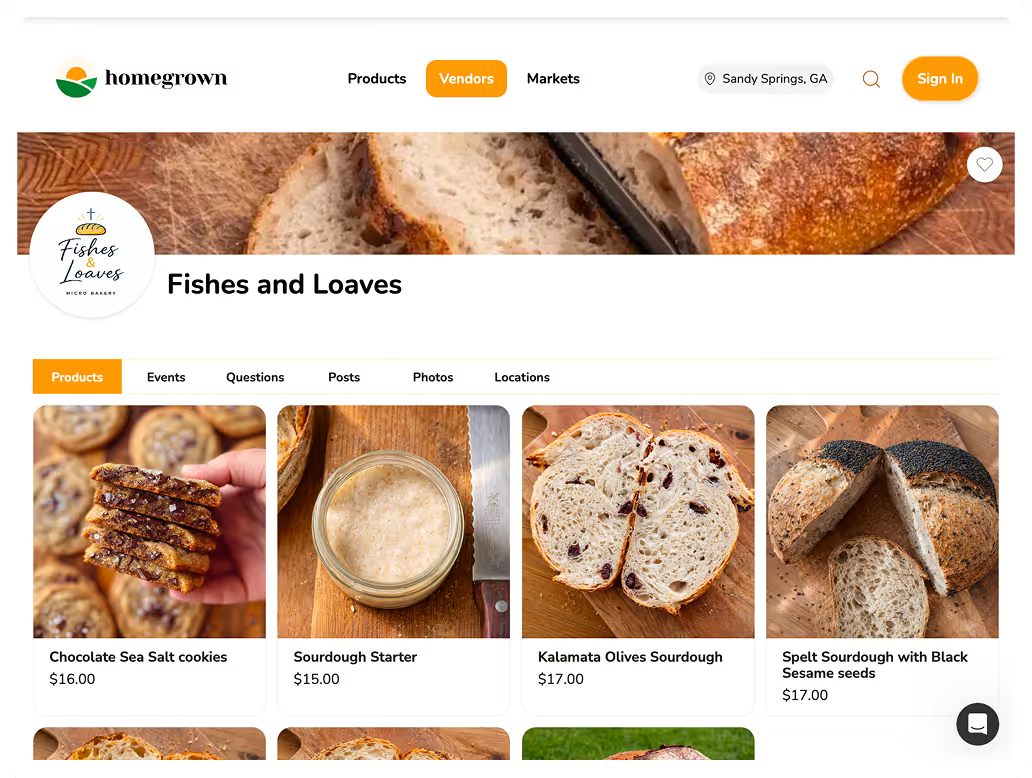
A Homegrown storefront handles all of this for you. Customers order and pay through your storefront, you see everything in one dashboard, and recurring orders process automatically.
> "The best recurring order system is one where you spend zero time managing orders and all your time making products."
If you are not ready for an online storefront yet, a spreadsheet is your best starting point. A well-organized Google Sheet can handle up to about 15 recurring orders before it starts breaking down. Beyond that, manual tracking takes more time than it saves.
Here is a simple Google Sheets setup that works:
Columns to include:
Weekly checklist approach:
When to upgrade from a spreadsheet:
| Number of Recurring Orders | Recommended System |
|---|---|
| 1-5 | Notes app or simple list |
| 5-10 | Google Sheets with columns above |
| 10-15 | Google Sheets is still workable but getting slow |
| 15-20 | Time to move to a storefront like Homegrown |
| 20+ | You need automated ordering and payment, period |
The spreadsheet method works, but it has real limits. You are still the one remembering to check it, update it, and chase payments. The moment you catch yourself spending 30 minutes a week just managing the spreadsheet, that is your signal to upgrade.
When you upgrade, the options are:
> "A spreadsheet is a fine starting point for recurring orders food vendor tracking, but it should not be your forever system."
Changes are the number one thing that trips vendors up with recurring orders. Set a weekly cutoff time for all changes, and stick to it. Without a cutoff, you end up adjusting orders the morning of bake day, which throws off your production plan.
Here is how to handle the most common changes:
Pauses (customer is on vacation or busy):
Substitutions (you are out of an ingredient):
Cancellations:
Recommended cutoff schedule:
| Delivery/Pickup Day | Change Cutoff |
|---|---|
| Wednesday | Monday at noon |
| Thursday | Tuesday at noon |
| Friday | Wednesday at noon |
| Saturday (market day) | Thursday at noon |
The 48-hour cutoff rule gives you enough time to adjust your production plan without scrambling. Communicate this cutoff clearly when customers sign up, and remind them weekly.
If you want to take this further, you can create a pre-order system that handles both one-time and recurring orders with built-in cutoff times.
> "A cutoff time is not about being rigid. It is about giving yourself enough time to bake the right amount of product."
Automated billing is the single biggest upgrade you can make to your recurring order process. The moment you stop chasing payments manually, you free up hours every week and eliminate the most awkward part of running a food business.
Here is why manual payment collection breaks down:
Automated billing through a storefront solves all of this. The customer enters their payment info once, and it charges automatically each cycle. No invoicing, no reminders, no awkward conversations.
If you are not using automated billing yet, here is how to minimize payment headaches:
Prepaid model (recommended):
Pay-as-you-go model (workable but riskier):
| Payment Model | Risk Level | Admin Time | Best For |
|---|---|---|---|
| Automated prepaid | Low | Minimal | 10+ recurring orders |
| Manual prepaid (Venmo before baking) | Medium | Moderate | 5-10 recurring orders |
| Pay at pickup (cash) | High | High | Under 5 orders, trusted customers only |
| Pay later / invoicing | Very high | Very high | Not recommended |
Before you set pricing for recurring orders, make sure you calculate your real cost per item. Recurring customers often expect a small discount, and you need to know your margins before you offer one.
> "If you are spending more time collecting payment than collecting ingredients, your payment system is broken."
Scaling recurring orders is not just about getting more customers. Each growth milestone changes what tools and processes you need. What works at 5 orders will hold you back at 15, and what works at 15 will collapse at 25.
Here is what each stage looks like:
At 5 recurring orders:
At 10 to 15 recurring orders:
At 20 to 25 recurring orders:
Scaling milestones table:
| Milestone | What Changes | Action to Take |
|---|---|---|
| 5 recurring orders | You have a real recurring revenue base | Start tracking in a spreadsheet |
| 10 recurring orders | Manual tracking gets unreliable | Move to an online storefront |
| 15 recurring orders | Production planning becomes critical | Calculate ingredient needs from order data |
| 20 recurring orders | Time management is the bottleneck | Batch production days by product type |
| 25 recurring orders | You are running a real business | Automate everything you can |
If you are thinking about offering recurring orders as a subscription, read this guide on how to set up a weekly baked goods subscription for the step-by-step setup.
> "The jump from 10 to 20 recurring orders is where most vendors either build a system or burn out. There is no middle ground."
Most recurring order problems come from being too flexible too early. Structure protects you and your customers. Here are the mistakes that trip vendors up most often:
To keep your recurring customers engaged between orders, build a customer email list so you can share menu updates, seasonal specials, and schedule changes without relying on social media.
> "The most common recurring order mistake is not having a system at all. The second most common is having a system you do not actually use."
Most cottage food vendors can manage up to about 10 to 15 recurring orders with a well-organized spreadsheet. Beyond that, the time you spend updating the spreadsheet, checking payment status, and managing changes starts to eat into your production time. An online storefront with automated recurring orders food vendor tracking features pays for itself in saved time once you cross that 10 to 15 order threshold.
Send a short confirmation message or automated email 48 hours before their order processes. Something like "Your weekly order of sourdough and cookies is set for Thursday pickup. Reply if you need to make changes by Tuesday at noon." This gives them a chance to pause or adjust without you having to chase them down.
A small discount of 5 to 10 percent can encourage customers to commit to a recurring schedule, but only if your margins support it. Calculate your cost per item first to make sure the discount does not eat your profit. Many vendors find that the consistency of recurring revenue is worth a small price break.
If someone changes their order more often than they keep it the same, they do not actually want a recurring order. They want a weekly custom order. Politely suggest they place a fresh order each week instead of using the recurring option. Recurring orders work best when the products stay mostly the same from week to week.
If a customer on a recurring schedule stops responding to confirmations or does not pick up their order, pause their subscription after one missed order. Send a friendly message letting them know their order is paused and they can restart anytime. Do not keep producing and billing for someone who has gone quiet. You will end up with wasted product and an awkward conversation about charges.
Yes, but it requires significantly more manual work. You will need a spreadsheet for tracking, a consistent communication method for confirmations and changes, and a reliable way to collect payment each cycle. Most vendors who start with manual recurring orders food vendor tracking move to a storefront within two to three months because the admin time adds up quickly.
Let customers set up recurring orders at any time, but make it clear that the first order needs to be placed before your weekly cutoff. Most vendors find that a rolling weekly schedule works best. The customer signs up, their first order processes the following week, and it repeats on the same day each cycle after that.
Recurring orders are the foundation of a sustainable cottage food business. They give you predictable revenue, reduce waste, and turn one-time buyers into long-term customers. But only if you track them properly.
Start with whatever system matches your current volume. If you have 5 orders, a spreadsheet is fine. If you have 15 or more, it is time to automate. The key is having one place where every order, every payment, and every customer preference lives so nothing slips through the cracks.
Ready to stop managing orders through text messages? Set up your Homegrown storefront and let your customers place, pay for, and manage their own recurring orders while you focus on what you actually love: making great food.