

You sell at the farmers market on Saturday. You take online orders through the week. A few customers subscribe for weekly pickups. And then someone sends you a DM asking for a custom cake for their kid's birthday party. You say yes to all of it because every sale matters, but now you are juggling four different places where orders come in, and none of them talk to each other.
Something slips. You double-sell the last batch of granola. You forget a custom order deadline. You show up to the farmers market short on your best seller because you did not account for online orders when planning your bake day. It is not a business problem — it is a visibility problem. You cannot manage what you cannot see.
The short version: To manage multiple sales channels as a food vendor, you need one centralized ordering system, one production plan that accounts for every channel, and a weekly schedule that blocks time for each sales stream. Stop taking orders through texts and DMs — funnel everything into a single storefront. Allocate production quantities by channel before you start baking, not after. And build a weekly rhythm that covers market prep, online fulfillment, and subscription packing on specific days so nothing falls through the cracks.
Multiple sales channels create chaos because each one operates on its own timeline, has its own order format, and comes with its own customer expectations — and most vendors have no single place to see all of it at once. Research shows that businesses selling through multiple channels generate up to 190% more revenue than single-channel sellers, but only if they can actually manage the complexity.
At the farmers market, sales happen in real time. Online orders trickle in throughout the week with specific pickup windows. Subscriptions run on a fixed weekly or biweekly cycle. Custom orders have unique deadlines and specifications. Each channel demands different prep, different packaging, and different communication.
Here is what goes wrong when you try to track all of this in your head or across scattered notes:
The average cottage food vendor using three or more sales channels spends 5 to 8 hours per week just on order management and communication — time that could go toward making products.
The fix is not working harder. The fix is building a system that gives you one view of everything.
Most cottage food vendors sell through two to four channels at the same time. Here are the most common ones, along with what makes each one valuable and where it gets messy.
| Channel | How Orders Come In | Pros | Cons |
|---|---|---|---|
| Farmers market | In person, day of | Cash flow, face-to-face, sampling | Weather-dependent, limited hours, no pre-commitment |
| Online storefront | Website ordering form | Orders come in advance, payment upfront, inventory control | Requires setup, pickup coordination |
| Subscriptions | Recurring auto-orders | Predictable revenue, guaranteed production volume | Requires consistency, fulfillment logistics |
| Custom orders | Text, DM, email, phone | Higher margins, relationship-building | Unpredictable timing, scope creep, scattered communication |
| Social media DMs | Instagram, Facebook Messenger | Easy for customers to reach you | No order tracking, no payment processing, easy to lose messages |
| Word of mouth / referrals | Text messages, phone calls | Zero marketing cost, warm leads | Completely unstructured, nothing documented |
The channels that feel easiest for customers — texting you, sending a DM, calling you — are the hardest for you to manage. There is no order record, no payment confirmation, no way to search or sort. Every order lives in a different app on your phone.
The single biggest operational upgrade most vendors can make is moving from scattered ordering (texts, DMs, phone calls) to one centralized storefront where every order lives in the same place.
The fastest way to eliminate order chaos is to stop accepting orders in five different places and funnel everything into one system. A multichannel selling approach only works when all channels feed into a single view of your orders.
This does not mean you stop selling at the farmers market or ignore customers on Instagram. It means that when someone wants to place an order, you send them to one place — your online storefront.
Here is how to centralize step by step:
The goal is not to refuse customers who reach out through other channels. The goal is to route every order into one system so you never lose track.
Vendors who centralize their ordering into a single storefront cut order management time by roughly 60% and virtually eliminate double-selling.
Plan production by allocating quantities to each channel before you start making anything. If you bake first and figure out distribution later, you will consistently short one channel to cover another.
Here is a production planning process that works:
Here is what that looks like in practice for a vendor who makes three products:
| Product | Online Orders | Subscriptions | Custom | Farmers Market | Buffer (10%) | Total to Make |
|---|---|---|---|---|---|---|
| Sourdough loaf | 8 | 6 | 2 | 25 | 4 | 45 |
| Cinnamon rolls (6-pack) | 4 | 3 | 0 | 15 | 2 | 24 |
| Banana bread | 3 | 2 | 1 | 10 | 2 | 18 |
This table takes five minutes to fill out and prevents every production mistake you have been making.
If you are still growing and your order volume shifts week to week, it helps to think in percentages rather than exact numbers.
| Channel | Typical % of Weekly Production |
|---|---|
| Farmers market | 45-55% |
| Online pre-orders | 20-30% |
| Subscriptions | 10-20% |
| Custom orders | 5-10% |
| Buffer / extra | 10-15% |
These numbers shift based on your business mix, but the principle stays the same: allocate before you produce.
To keep your production days efficient and repeatable, create SOPs for each product so you can scale up or down without reinventing your process every week.
Double-selling happens when you sell the same product twice — once online and once at the market — because your inventory was not updated in real time. Running out happens when you underestimate demand because you did not account for all your channels. Both problems have the same root cause: no single source of truth for what is available.
Here is how to prevent both:
Vendors who set firm product limits per channel and close ordering before their production cutoff report fewer than one double-sell incident per quarter, compared to weekly mistakes for vendors who track manually.
The entire problem above — double-selling, missed cutoffs, scattered communication — comes from having no single place where every order lives. Instagram DMs give you orders but no inventory limits. Texts give you commitments but no payment confirmation.
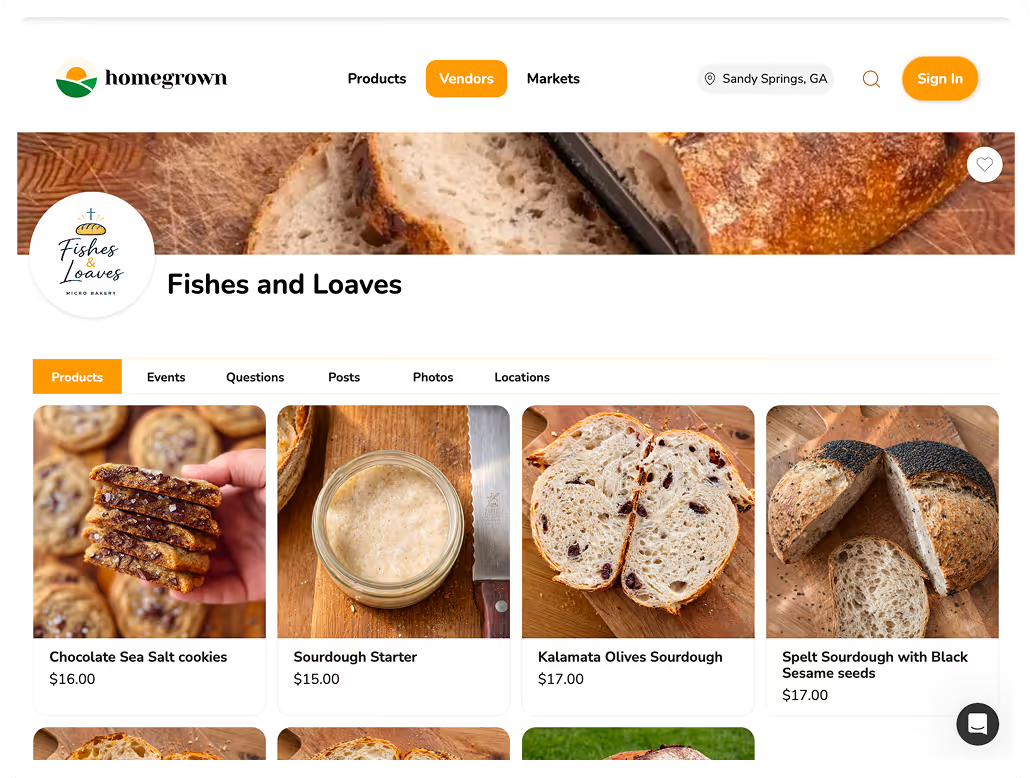
Homegrown is $10/month with no percentage fees. Pre-orders, subscriptions, and one-time purchases all show up in one dashboard. You set product limits, and when an item sells out, it shows as unavailable — no more double-selling. You set order cutoffs, and ordering closes automatically before your production day. Customers browse, order, and pay in one step instead of DMing you and waiting for a Venmo request.
Compare that to Square Online, where you get an ordering page but pay 2.9% plus 30 cents per transaction and manage subscriptions through a separate system. Or Etsy, where you pay 6.5% of every sale and have no concept of local pickup and delivery scheduling or weekly cutoffs.
Homegrown does not track your farmers market cash sales or decide how to split production across channels — that is your allocation table and your weekly rhythm. But it turns every non-market order into one confirmed, paid entry in one place, which is what makes multi-channel selling manageable instead of chaotic.
A multi-channel weekly schedule blocks specific tasks on specific days so nothing overlaps and nothing gets forgotten. Here is a realistic schedule for a vendor who sells at a Saturday farmers market, takes online pre-orders, runs a subscription program, and handles occasional custom orders.
| Day | Morning | Afternoon | Evening |
|---|---|---|---|
| Sunday | Review past week's sales, count leftover inventory | Update storefront quantities for new week | Plan production (fill out quantity allocation table) |
| Monday | Open online ordering for the week | Respond to customer messages, confirm custom orders | Source ingredients, order supplies |
| Tuesday | Ingredient shopping and supply runs | Prep work (wash, chop, measure, portion) | Review incoming orders |
| Wednesday | Continue prep work | Last call for online orders (close ordering at end of day) | Finalize production numbers, print order labels |
| Thursday | Production day — bake, cook, prep all products | Continue production, package finished items | Label and sort: market inventory vs. online orders vs. subscriptions |
| Friday | Pack subscription orders for pickup/delivery | Pack market booth supplies (signage, change, bags) | Final check: all orders packed, coolers prepped, vehicle loaded |
| Saturday | Farmers market (6 AM to 1 PM) | Fulfill online order pickups | Count remaining inventory, update storefront, rest |
A few notes on this schedule:
If you run a weekly food drop instead of (or in addition to) the farmers market, you can adapt this same structure. Check out our guide on how to run a weekly food drop for the pickup logistics side of things.
If your farmers market is not on Saturday, shift the entire schedule backward. The three anchors stay the same: ordering cutoff 2 days before production, production day 2 days before market, and packing day 1 day before market.
You scale by adding one channel at a time and only after the existing channels run smoothly. Here is a recommended order:
A few boundaries that protect your sanity:
The vendors who successfully manage multiple sales channels are not the ones who work the most hours. They are the ones who set the firmest boundaries around when and how orders come in.
Ready to get all your orders into one place? Set up your Homegrown storefront and stop losing track of orders across five different apps.
You can manage multiple sales channels as a food vendor with a simple online storefront and a weekly production spreadsheet. The key is not the tool — it is the process. Route every order to one place, plan production before you start making, and set firm ordering cutoffs. A basic storefront handles this for most cottage food vendors doing under $50,000 per year.
Most solo vendors can handle two to three channels well and four channels with tight systems in place. Beyond four active sales channels, the administrative overhead starts cutting into your production time. If you find yourself spending more time managing orders than making products, you have too many channels. Cut the lowest-performing one and reinvest that time into the channels that actually drive revenue.
Yes. Text and DM orders are the number one source of lost orders, miscommunication, and double-selling for small food vendors. You do not have to be rude about it — just redirect. When someone DMs you wanting to order, reply with your storefront link and a friendly note. Most customers actually prefer a real ordering page because it confirms their order, shows them what is available, and gives them a receipt.
Send them your ordering link by text: "Here is my menu — you can pick what you want and choose pickup or local delivery." If they genuinely cannot use a phone or computer, take their order over the phone and enter it into your storefront yourself. This keeps all orders in one system even when the customer interaction happens outside of it.
Use your online storefront as the hub for all non-market orders and your market booth as a separate, allocated channel. Before each market day, set aside a specific quantity for market sales and keep everything else in your storefront system. After the market, update your storefront with any remaining inventory. This approach covers 90% of cottage food vendor needs without any complex software.
Plan one full week in advance. On Sunday, review your committed orders and set your farmers market targets based on recent sales history. Fill out your production allocation table and finalize ingredient needs by Monday. Vendors who plan week-by-week instead of day-by-day waste 30 to 40% less product and miss fewer orders.
Yes, and you should. Running subscriptions and pre-orders through the same storefront means every order — whether it is a one-time purchase, a recurring subscription, or a custom order — shows up in one dashboard. You get one total production number instead of adding up counts from three different places. Homegrown handles both pre-orders and subscriptions in a single storefront, which is exactly why it works for vendors selling through multiple channels.