Pop-up shops are one of the easiest ways for small food vendors to reach new customers outside of farmers markets — with almost no startup cost. You pick a time, find a location, set up a table, and start selling. No long-term lease. No permanent storefront. No $10,000 food truck investment.
Whether you bake bread, make jam, sell honey, or package dry mixes, a pop-up shop lets you test new markets, build brand awareness, and turn one-time buyers into repeat customers — all on your own schedule.
This guide covers everything you need to run a food pop-up, from finding a location and handling permits to marketing the event and collecting customer info that drives sales between pop-ups.
The short version: A food pop-up is a temporary selling event you organize or partner on — at a local brewery, coffee shop, community space, or your own property. You need either a temporary food permit or cottage food compliance (depending on your state and what you sell), a basic table setup, a way to accept payments, and a plan to collect customer contact info. Keep your menu to 5-8 items, bring enough inventory for 10 to 15 percent of expected foot traffic, and focus on building long-term customers — not just one-day sales. Most food pop-ups cost under $100 to set up if you partner with a host business that provides the space for free.
What Is a Food Pop-Up Shop?
A food pop-up shop is a temporary, short-term selling event where you set up in a location for a few hours, a full day, or a recurring weekly slot. Unlike a permanent storefront, there is no lease. Unlike a food truck, there is no vehicle to buy. You bring a table, your products, and your signage — and you sell.
The key difference between a pop-up and other event-based selling (like craft fairs or community festivals) is that you are creating or co-creating the selling opportunity, not just showing up as a vendor at someone else's event.
Common Pop-Up Formats for Food Vendors
There are four main ways food vendors run pop-ups:
- Partner pop-up: You set up inside or outside a local business — a brewery, coffee shop, bookstore, or boutique. The business benefits from offering food to their customers, and you benefit from their foot traffic. This is the most common and lowest-cost format.
- Solo pop-up: You host the pop-up yourself — at your home, a rented community space, a church hall, or even your driveway. You control everything, but you are also responsible for driving all the traffic.
- Shared pop-up market: You organize with two or three other vendors to create a mini market. A baker, a jam maker, and a honey producer set up together at a community center on a Saturday morning. More variety draws a bigger crowd than any single vendor could.
- Guest vendor: A local business invites you to sell inside their space for the day. This is similar to a partner pop-up, but the business initiates it — often because they want to offer something special to their customers during a holiday weekend or event.
Why Are Pop-Up Shops Worth It for Small Food Vendors?
Pop-ups give you selling flexibility that farmers markets cannot match. A typical farmers market runs one morning per week, has limited vendor slots, and charges $25 to $75 per week in booth fees. Pop-ups let you sell when and where it works for you.
Here are five reasons pop-ups are worth adding to your selling strategy:
- Lower cost than almost any other venue. Many host businesses let food vendors pop up for free because the food draws more customers. Even rented community spaces typically cost $50 to $150 for a full day.
- Test new products without commitment. Trying a new cookie recipe or a seasonal jam flavor? A pop-up gives you real customer feedback without committing inventory for a full market season.
- Reach customers outside your usual crowd. A pop-up at a brewery on a Friday evening reaches a completely different audience than a Saturday morning farmers market.
- Create urgency. "Available this Saturday only" is a powerful motivator. Pop-ups naturally create scarcity that drives impulse purchases.
- Build your customer list for online orders. Every new customer at a pop-up is someone you can sell to again — through email, social media, or an online store — without needing another in-person event.
What Permits Do You Need to Sell Food at a Pop-Up?
Most areas require either a temporary food event permit or cottage food compliance to sell food at a pop-up — which one depends on your state and what you are selling.
Cottage Food Rules at Pop-Ups
If you sell non-potentially-hazardous foods (baked goods, jams, honey, dry mixes, candy, granola), you likely fall under your state's cottage food law. Most states allow cottage food sales at pop-ups under the same rules as farmers markets — direct-to-consumer, with proper labeling, and within your state's annual revenue cap.
The key requirement is that your products must be on your state's approved list of cottage food items, and you must follow all labeling rules. If you are not sure whether your state allows cottage food sales at pop-ups, check with your local health department or look up your state's cottage food law in the Illinois Extension cottage food directory, which links to state-by-state resources. You can also read our full guide to cottage food laws by state for a detailed breakdown.
Temporary Food Event Permits
If you are serving hot food, cut produce, potentially hazardous items, or anything that falls outside cottage food regulations, you will need a temporary food event permit from your local health department.
Here is what to expect:
- Cost: $25 to $100 per event in most areas
- Lead time: Apply 2 to 4 weeks before the event
- Requirements: A food handler's certification is usually required, along with details about your menu, food sources, and food handling procedures
- Duration: Most temporary permits cover a single event or a set number of days (typically 1 to 14 days)
Some cities — including Chicago, New Orleans, and San Francisco — have specific pop-up food vendor permit categories. Check your city's business licensing website for pop-up-specific requirements.
Insurance for Pop-Up Events
General liability insurance for a small food vendor typically costs $200 to $500 per year and covers claims related to injuries or property damage at your selling location. Product liability covers food-related claims like allergic reactions.
Some host businesses and venues require proof of insurance before they will let you sell on their property. If you sell at more than two or three pop-ups per year, a general liability policy is worth the investment. If you only do one or two pop-ups, ask the event organizer or host business whether their existing insurance covers visiting vendors.
How Do You Find a Location for Your Food Pop-Up?
The easiest way to start is by reaching out to local businesses that already draw foot traffic and would benefit from offering food to their customers. You do not need to find an empty retail space or rent a storefront — you need a business owner who wants to attract more people.
Best Places to Host a Food Pop-Up
- Breweries and taprooms: Many do not have kitchens and actively look for food vendors. Friday and Saturday evenings are prime time. Some breweries schedule rotating food pop-ups every week.
- Coffee shops: Weekend morning pop-ups for baked goods, pastries, or breakfast items pair naturally with coffee. The shop gets a reason for customers to visit, and you get foot traffic.
- Boutiques and retail shops: Holiday shopping weekends are the best fit. A jam or honey vendor at a gift shop during the holiday season brings in customers who are already in a buying mood.
- Community spaces: Church halls, community centers, co-working spaces, and libraries sometimes rent out space for low fees or even free for local vendors.
- Your own front yard or driveway: Some vendors host pop-ups from home, especially if they live on a busy street or in a walkable neighborhood. Check your local zoning rules before setting up — some areas require a permit or have restrictions on home-based retail.
How to Pitch a Pop-Up to a Local Business
When you approach a brewery, coffee shop, or boutique about hosting a pop-up, lead with what is in it for them:
- More foot traffic: "I'll promote the event to my customer list and on social media, which brings new people into your space."
- Social media content: "I'll tag your business in all my posts, and we can cross-promote to both our audiences."
- No cost to them: "I bring my own table, setup, and products. All you need to provide is the space."
- A trial run: "Let's try one pop-up with no commitment. If it goes well, we can make it a regular thing."
Most host businesses let food vendors pop up for free because the food benefits their customers. Some may ask for a small flat fee ($25 to $50) or a revenue-sharing arrangement (typically 10 to 15 percent of sales). Both are reasonable if the location has strong foot traffic.
What Should You Bring to a Food Pop-Up?
A successful food pop-up does not require a lot of equipment. Here is a practical checklist:
Setup and Display
- Folding table (6-foot is standard) and a clean tablecloth or runner
- Signage with your business name, logo, and menu with prices
- Product display items: tiered stands, wooden crates, baskets, or cutting boards
- Business cards or flyers with a QR code linking to your online store
- A banner or sandwich board if you are set up outside
Food Handling Supplies
- Disposable gloves and tongs or serving utensils
- Napkins, paper bags, and product packaging
- Cooler with ice packs if you sell anything that needs to stay cold
- Handwashing station (a jug of water, soap, and paper towels) if required by your permit
- Trash bag for cleanup
Payment and Customer Capture
- Card reader (Square, Clover Go, or similar — most charge around 2.6 percent per transaction with no monthly fee)
- Cash box with at least $30 in small bills and coins for change
- Email signup sheet on a clipboard or tablet
- QR code printed on a tent card linking to your online store or email signup
Do not skip the customer capture step. A pop-up without an email signup sheet is a one-time sales event. A pop-up with an email signup sheet is the start of a customer relationship that lasts months.
How Do You Plan Your Menu for a Pop-Up?
Keep it small — 5 to 8 items maximum. A focused menu is easier to prep, faster to serve, and creates a stronger brand impression than a table crowded with 20 different products.
Here is how to build your pop-up menu:
- Lead with your best sellers. If your chocolate chip cookies outsell everything else at the farmers market, they should anchor your pop-up menu.
- Include a mix of price points. Have something at $3 to $5 (a single cookie, a small jar of jam) for impulse buyers and something at $10 to $20 (a gift box, a variety pack) for bigger spenders.
- Stick to pre-packaged items when possible. Pre-packaged products are faster to sell, easier to permit, and simpler to display than made-to-order items.
- Offer bundles. "3 jars for $20" or "baker's dozen cookies for $15" increases your average transaction size. Bundles give customers a reason to buy more and feel like they are getting a deal.
- Consider the venue. A pop-up at a brewery on a Friday evening calls for different products than a Saturday morning pop-up at a coffee shop. Match your menu to the crowd.
How Much Inventory Should You Bring?
A good starting rule is to prep enough for 10 to 15 percent of the expected foot traffic. If the host business expects 200 customers that day, bring enough to serve 20 to 30 people.
Here are more inventory planning tips:
- Ask the host business about typical customer counts. A brewery might see 150 people on a Saturday night. A coffee shop might see 80 on a Sunday morning.
- Bring more of your top sellers, less of experiments. If you are testing a new flavor, bring a small batch. Load up on your proven sellers.
- Track what sells. Keep a simple tally at each pop-up. After three or four events, you will know exactly how much to bring.
- Selling out is not a failure. Selling out early creates buzz and urgency. Customers who miss out will ask when your next pop-up is. Having too much leftover is worse — it wastes product and eats into your profit.
How Do You Price Products for a Pop-Up Shop?
Price the same as you would at a farmers market — or slightly higher if the venue has an upscale clientele. Do not discount your products just because it is a pop-up. You are offering convenience, exclusivity, and a unique experience.
Follow these pricing guidelines:
- Round to whole dollars. $5, $10, $15 — not $4.75 or $12.50. Whole-dollar pricing speeds up transactions and simplifies making change.
- Create a pop-up special. A bundle deal or limited-edition flavor gives customers a reason to buy now instead of waiting.
- Cover your costs plus your time. Your pricing should cover ingredients, packaging, permit fees, gas, and your labor. If you need help figuring this out, read our guide to how to price food products for a farmers market — the same principles apply to pop-ups.
- Have a range. Something at $5, something at $10 to $12, and something at $15 to $20. Three tiers give every customer a way to buy.
How Do You Market Your Pop-Up?
Start promoting at least one to two weeks before the event on social media and through your email list. The biggest mistake new pop-up vendors make is showing up without telling anyone they will be there.
Before the Pop-Up
- Post on Instagram and Facebook with the date, time, location, and what you will be selling. Post at least three times in the week before the event.
- Ask the host business to share your post and tag you in their stories or feed.
- Post in local community Facebook groups — neighborhood groups, buy-local groups, and foodie groups.
- Send an email to your existing customer list. Even if it is only 20 people, those are 20 warm leads who already know your products.
- Put up a flyer at your farmers market booth the week before with the pop-up details.
During the Pop-Up
- Post stories and photos in real time. Show your setup, your products, and your customers (with permission).
- Encourage customers to tag your business on social media.
- Offer a small incentive for email signups — a free sample, a 10 percent discount on their next order, or entry into a giveaway.
After the Pop-Up
- Thank the host business publicly on social media.
- Share photos and a quick recap: "Sold out of cinnamon rolls by noon — thank you to everyone who stopped by!"
- Follow up with new email subscribers within 48 hours. A simple "Thanks for visiting — here's how to order from me anytime" email goes a long way.
- Announce your next pop-up date, even if it is tentative.
How Do You Turn Pop-Up Customers Into Repeat Buyers?
The real value of a pop-up is not the one-day revenue — it is the customers who discover your products and keep buying from you afterward. A single pop-up where you sell $300 in baked goods and collect 15 email addresses is more valuable than a pop-up where you sell $500 but do not capture any customer info.
Here is how to turn pop-up visitors into long-term customers:
- Collect emails at every single pop-up. Use a clipboard signup sheet, a QR code that links to a signup form, or a tablet at your table. No exceptions.
- Hand out cards or flyers with your online store link. Every customer who walks away with a product should also walk away with a way to find you again.
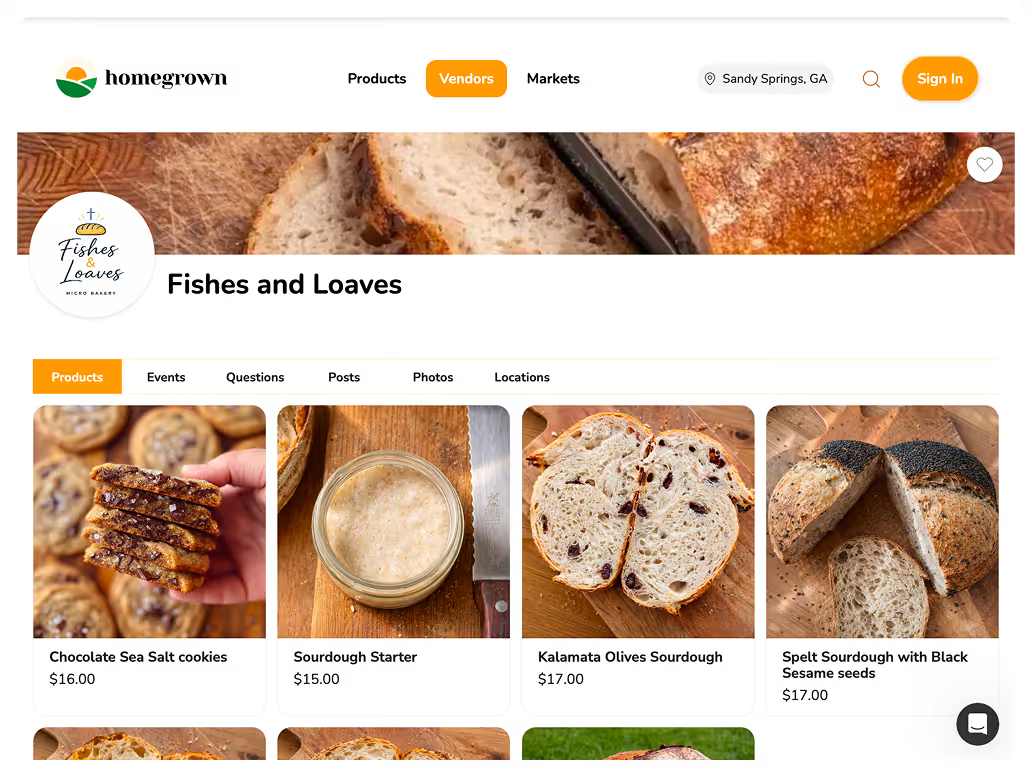
- Give them somewhere to order between events. The email list is useless if the email says "I'll be at another pop-up in three weeks" and they have no way to buy until then. You need somewhere to send them now. An Instagram bio link gets eyeballs but has no checkout. An Etsy shop charges 6.5% per sale and is built for shipped products, not "pick up Saturday at the brewery." Homegrown is $10/month — list your products, share the link on the card you hand every customer, and they can order and pay between pop-ups for local pickup. When you announce your next pop-up in your follow-up email, the link lets people who cannot make it still buy from you. It will not replace a full website or handle catering inquiries — it is the ordering link that turns a one-time pop-up buyer into a weekly customer.
- Offer a "next order" incentive. A card that says "Order from my ordering page and get free delivery on your first order" gives customers a reason to come back.
- Follow up. Send a thank-you email within 48 hours, announce your next pop-up, and include your ordering link. If you need help building your email list, read our guide on how to build a customer email list as a food vendor.
Common Pop-Up Mistakes (And How to Avoid Them)
Even experienced farmers market vendors make mistakes at their first pop-up. Here are the most common ones:
- Bringing too many menu items. Stick to 5-8 products. A cluttered table confuses customers and slows down service.
- Not collecting customer contact info. If you leave a pop-up with zero email addresses, you missed the biggest opportunity of the day.
- Underpricing to "attract" customers. Your products are worth what they are worth. Discounting signals low quality, not good value.
- Skimping on signage and branding. Customers should be able to see your business name, what you sell, and your prices from 10 feet away. A bare table with products on it is not a pop-up — it is a yard sale.
- Forgetting to plan cleanup. Bring trash bags, a folding crate for packing up, and a plan for leftover inventory. Leave the space cleaner than you found it — host businesses remember vendors who make their life easy.
- Not following up with customers after the event. Send a thank-you email within 48 hours. Post a recap on social media. Announce your next pop-up. If you do not follow up, customers will forget you within a week.
- Trying to do everything alone at a busy pop-up. If you expect more than 50 customers, bring a friend or family member to help with transactions while you talk to customers and answer questions.
Frequently Asked Questions
Do I Need a Business License to Do a Food Pop-Up?
It depends on your state and local rules. Many cottage food vendors operate under a cottage food exemption that does not require a full business license. However, if you are selling food that falls outside cottage food (hot prepared food, potentially hazardous items), you will likely need a temporary food event permit and possibly a business license. Check with your local health department and city clerk's office.
Can I Sell Cottage Food at a Pop-Up Shop?
Yes, in most states. Cottage food laws typically allow direct-to-consumer sales at locations like farmers markets, pop-up events, and from your home. The rules vary by state — some require you to sell only from your home or at farmers markets, while others allow any direct sale. Check your state's specific cottage food law for details.
How Much Does It Cost to Set Up a Food Pop-Up?
Most food pop-ups cost under $100 to set up if you partner with a host business that provides the space for free. Your costs are a folding table ($30 to $50 if you do not already have one), signage ($10 to $20 for a printed banner), packaging supplies ($15 to $30), and a card reader ($0 to $50 — Square offers a free basic reader). If you need a temporary food permit, add $25 to $100 for the permit fee.
How Often Should I Do Pop-Ups?
Start with one pop-up per month to learn what works. As you build a following and find host businesses you like working with, you can increase to biweekly or weekly. Many vendors run a weekly pop-up at one location (like every Friday evening at a brewery) and do occasional one-off pop-ups at other venues.
Do I Need Insurance for a Food Pop-Up?
Not always, but it is strongly recommended if you sell at pop-ups regularly. General liability insurance for a small food vendor costs $200 to $500 per year. Some host businesses and event spaces require proof of insurance before they will let you sell on their property. If you only do one or two pop-ups per year, ask whether the host's insurance covers visiting vendors.
What Food Sells Best at Pop-Up Shops?
Pre-packaged, grab-and-go items sell best at most pop-ups because they are fast to serve and easy for customers to carry. Top sellers include baked goods (cookies, brownies, bread), jams and preserves, honey, seasoning blends, granola, and candy. Items that make good gifts — like a curated jar of local honey with a ribbon — also perform well, especially at holiday pop-ups.
Can I Do a Pop-Up at My Own House?
In many areas, yes — but check your local zoning rules first. Some municipalities allow occasional home-based retail sales, while others restrict commercial activity in residential zones. If your state's cottage food law allows sales from your home, a pop-up in your front yard or driveway may be covered. Some vendors avoid zoning issues by framing it as a "pre-order pickup" rather than a retail pop-up. Our guide on how to sell food from home covers the legal basics.
A food pop-up is one of the lowest-risk, highest-reward ways to grow your food business beyond farmers markets. You do not need a storefront, a food truck, or a big budget. You need a folding table, your best products, a way to collect customer info, and a plan to follow up.
Start with one partner pop-up at a local brewery or coffee shop. Focus on making it a great experience for 20 to 30 customers. Collect their emails. Follow up. Then do it again.
Start with one partner pop-up. Collect emails. Hand out cards with your ordering link. Then follow up and watch the between-event orders roll in.