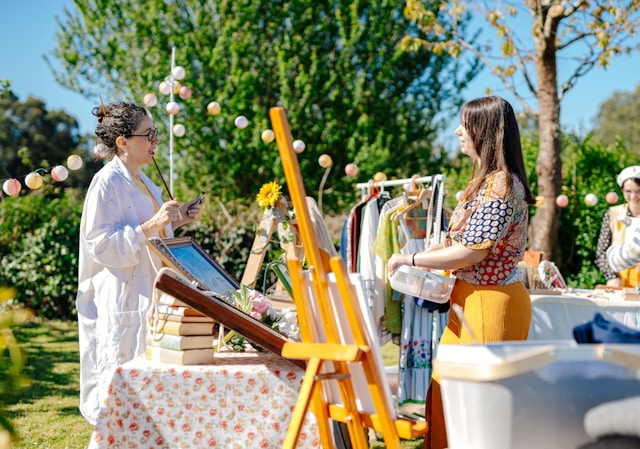


Craft fairs and festivals offer something a weekly farmers market often doesn't: sheer volume. A well-attended festival can bring thousands of people past your booth in a single day — more foot traffic than a month of Saturday farmers markets. That volume means more first-time buyers, more impulse purchases, and the chance to reach an entirely new audience that might never have visited your regular farmers market.
The short version: Craft fairs and festivals are high-volume, one-shot events where impulse purchases and gift-ready products drive sales. Bring shelf-stable, visually appealing products with clear pricing and gift bundles. Get your permits early, bring a helper, set up for speed, and use samples to close sales. The real long-term value comes from collecting email addresses and turning one-time festival buyers into repeat customers through your Homegrown storefront.
But craft fairs and festivals work differently than a farmers market in almost every way that matters. The crowd is often there once. They're buying gifts or spontaneous treats, not restocking their weekly pantry. The permitting requirements can be different. The booth setup stakes are higher because you have seconds to catch someone's eye before they've moved past. And the inventory planning is harder because you're guessing attendance at an event you may have never done before.
This guide covers what food vendors need to know to sell successfully at craft fairs and festivals — from permits and product selection to booth setup, pricing, staffing, and how to turn a one-time festival customer into a long-term buyer.
The biggest difference is customer intent: farmers market shoppers come to buy food, while festival-goers come for the experience and buy on impulse. The dynamics at a craft fair or festival are genuinely different from what you experience at a weekly farmers market, and the vendors who do best at events are the ones who adjust their approach rather than treating the event like a bigger version of Saturday morning at the farmers market.
| Factor | Farmers Market | Craft Fair / Festival |
|---|---|---|
| Customer intent | Planned food shopping | Impulse purchases and gift-buying |
| Repeat visits | Weekly regulars | Mostly one-time attendees |
| Sales window | Relationship-driven, low pressure | Seconds to catch attention |
| Product fit | Weekly staples, fresh products | Gift-ready, shelf-stable, visually appealing |
| Price sensitivity | Moderate — comparing to grocery | Lower — gift context shifts perception |
At a farmers market, customers come back regularly. Many of them visit every week or every other week. They know your products, they trust your quality, and the buying decision is often already made before they reach your booth. Relationships matter, and the familiar rhythm of returning to the same vendors creates loyalty that builds over time.
At a craft fair or festival, most customers are there once. They don't know you, they've never tasted your products, and they're making split-second decisions based on what catches their eye, what smells good, and what looks like a gift worth buying. The window to make a sale is dramatically shorter than at a farmers market, and the relationship-building that drives repeat business at a farmers market doesn't apply in the same way.
This shift in customer dynamics has practical implications for every aspect of how you sell. Products need to be immediately appealing — confusing, niche, or complex products don't sell well when customers have no prior relationship with you and limited time to evaluate what you're offering. Packaging and presentation carry more weight than at a regular farmers market because the product can't speak for itself until after someone has bought it. Gift-friendly products perform especially well at holiday fairs and seasonal events where customers are specifically looking for presents. And samples close sales more effectively at festivals than almost anywhere else, because letting someone taste before they buy removes the uncertainty that makes first-timers hesitate.
Check with your local health department for the specific event — don't assume your farmers market permits carry over. Selling food at a craft fair or festival requires permits, and the requirements vary significantly by state, county, and event type. Resources from craft fair vendor resources offer more detail here.
Most local health departments require vendors selling food at events to have a temporary food event permit, even if you already hold a cottage food license or a regular farmers market permit. These temporary permits are usually applied for through your county or city health department and are specific to the event you're attending. Some are single-day permits, while others cover a weekend or multi-day festival. Application timelines vary, but many health departments want the application submitted two to four weeks before the event, so plan ahead.
Cottage food rules add another layer of complexity:
Beyond government permits, the event organizer typically has their own requirements. Festival organizers commonly require proof of liability insurance, health department approval, a list of products you'll be selling, and sometimes proof of food handler training. Get the vendor application packet from the organizer well in advance and make sure you understand exactly what documentation they need and when it's due. Missing a deadline or showing up without the right paperwork can mean getting turned away at the gate.
Gift-ready, shelf-stable, visually appealing products that require zero explanation are your best performers. Not everything that moves well at a farmers market translates to a craft fair crowd. The customer mindset is different, and the products that perform best are the ones that align with how people shop at events — quickly, impulsively, and often with gift-giving in mind.
Strong performers at craft fairs:
Products that tend to underperform:
If your core product is something like sourdough bread or fresh vegetables, craft fairs aren't necessarily the wrong venue. But consider whether you have a secondary line of packaged, shelf-stable products that travels better, presents well, and fits the impulse-purchase and gift-giving dynamics of events. Many successful farmers market vendors develop a "festival lineup" that's a subset of their full product range, specifically chosen for the event context.
Your booth needs to stop people in their tracks within two to three seconds — height, clear pricing, and samples near the front are essential. At a craft fair with hundreds of competing booths, the principles of good booth design that work at farmers markets apply even more strongly at festivals, where the competition for attention is fierce and the browsing pace is faster.
For a deeper dive on booth setup fundamentals that apply across all selling venues, see booth setup.
Price slightly higher than your farmers market prices and create pre-packaged gift bundles at multiple price points. Festival pricing tends to run slightly higher than regular farmers market pricing, and there are good reasons for this. Your costs are higher — booth fees at festivals are often significantly more expensive than farmers market fees, you may need extra staff, and you're producing larger inventory quantities. The gift-purchase context also makes customers less price-sensitive because they're evaluating your product against other gift options, not against the grocery store.
A $12 jar of jam that feels like a reasonable weekly purchase at a farmers market also feels like a reasonable gift at a holiday fair. The perceived value shifts when the context shifts from pantry restocking to gift-giving. Price accordingly, and don't undercut yourself because you're worried about festival customers being more price-conscious than farmers market customers — in most cases, they're less so.
| Bundle Type | Price Range | What to Include |
|---|---|---|
| Small gift set | $15–$20 | Two jars or a jar plus baked products |
| Medium gift set | $25–$35 | Three jars in a box with ribbon |
| Premium gift set | $40–$50 | Curated assortment in a decorated tin or basket |
Creating gift sets or bundles specifically for festivals is one of the highest-return moves you can make. Three jars of jam in a small box tied with ribbon at $30 to $35 moves better at a holiday fair than three separate $10 jars sitting on a table. The perceived value is higher because the packaging adds a gifting layer. The buying decision is easier because the customer doesn't have to choose individual products and figure out how to present them. And your revenue per transaction increases because bundles naturally drive higher average order values.
Bring more than you think you'll need, focus on shelf-stable products, and track everything for next time. First-time events are notoriously hard to predict. You don't have historical data for the event, attendance estimates from organizers are often optimistic, and weather can dramatically affect turnout at outdoor events.
For a first-time event, bring more than you think you'll sell but build your inventory around products with shelf life that lets you sell unsold products at your next farmers market or through pre-orders during the following week. Running out of product at a busy festival means lost revenue you can never recover. Bringing home a quarter of your inventory from a slow event is disappointing but not costly if those products are shelf-stable and can be sold elsewhere.
Use every available signal to estimate volume:
Track everything during the event so you have data for next time. Note what sold, what didn't move, what time of day sales peaked, what customers asked for that you didn't have, and what price points seemed to work best. The second time you do an event is always more profitable than the first because you're making decisions based on actual data rather than guesses.
At least two people for any high-traffic event — one handling transactions, the other handling samples and conversation. A craft fair with high foot traffic is genuinely hard to run solo. When your booth is busy, you're simultaneously offering samples, explaining products to people who've never seen them, handling cash transactions, processing card payments, bagging purchases, answering questions, and making change. Something will slip — a customer walks away while waiting, a transaction takes too long, samples run out and nobody notices.
Even one additional person at your booth makes a significant difference. A partner, a friend, a family member — anyone who can handle one side of the operation while you handle the other. The most effective approach is assigning roles: one person handles transactions and bagging, the other handles sampling, conversation, and customer engagement. This keeps the line moving while still providing the personal interaction that drives sales.
If you consistently do festivals and events, building a small, reliable team is worth the investment. Even one trusted helper who knows your products and can answer basic questions about ingredients, pricing, and your business frees you to focus on the higher-value interactions and operational decisions that only you can handle.
Announce the event to your existing customers through email and social media, and offer pre-orders for festival pickup. If you have an existing customer base from your farmers market, festivals and events are a chance to deepen those relationships and generate advance revenue from people who already know your products.
An email or social media post announcing "I'll be at the [Event Name] festival on [date]" reaches people who already like your products and might be attending the event anyway. Some will specifically come to find your booth. Others will be reminded that the festival is happening and decide to attend because they know you'll be there.
For high-demand or limited-quantity products, consider taking pre-orders for festival pickup. Customers who pre-order pick up their products at your booth, which gets them physically in front of everything else you're selling. Many pre-order customers end up buying additional products on the spot because they're already there and already in buying mode. If you use Homegrown for pre-orders, you can link to your Homegrown storefront in the event announcement and let customers order ahead for pickup at the event. See food booth safety requirements for additional context.
Pre-event marketing also helps with inventory planning. If you've announced the event to your email list and received a handful of pre-orders, you have a baseline of confirmed sales that informs how much additional inventory to bring for walk-up customers.
Bring your fully charged card reader, enable offline mode, and have a backup device for high-volume events. Your payment setup for a farmers market applies directly to a craft fair — the core considerations are the same. Make sure your card reader is fully charged before you arrive, you have enough small bills and coins for cash transactions, and offline mode is enabled on your payment app in case connectivity is spotty at the venue.
The one important addition for events: at very high-volume events, have a backup card reader or a phone with a secondary payment account loaded. At a busy festival, a reader glitch, a dead battery, or a connectivity dropout during peak hours means lost sales you can't recover. A backup device costs nothing extra to bring and can save you hundreds of dollars if your primary setup fails.
Test your payment setup at the venue before the event opens, especially if you're at an indoor venue where cell service might be weak or an outdoor location where connectivity varies. For more on payment setup fundamentals, see that guide.
It depends on booth fees, expected attendance, and whether your products fit the event format — start small to test. The economics vary significantly by event, and not every fair or festival is a good fit for every vendor. Booth fees range from $50 for a small community event to $500 or more for a large regional festival. You need to sell enough to cover the booth fee, the cost of products, your time, staffing costs if applicable, and any travel expenses — and still come out with meaningful profit.
Before committing to an event, ask some practical questions:
Starting with lower-cost, smaller local events lets you test the festival format before committing to a large booth fee at a regional event. A $75 booth fee at a local community fair is a low-risk way to learn how your products perform in a festival setting, refine your event-specific lineup, and build confidence before investing in a $300 to $500 booth at a bigger event.
The upside of a successful festival weekend can be substantial. One good event can introduce your products to more people in two days than months of weekly farmers markets. New customers you meet at a festival who sign up for your email list or follow your social media become potential repeat buyers at your regular farmers market. The revenue from a strong event weekend can exceed what you'd earn in two or three regular farmers market days. And the experience of selling at a high-volume event makes you a better, more efficient vendor at your weekly farmers market too.
Ready to turn this into a real business? The easiest way to take local orders and get paid is an online storefront — see the best platform to sell food from home, or set up a Homegrown storefront in about 15 minutes ($10/mo, 0% commission).
Yes, in most cases. A temporary food event permit is typically issued per event, not as a blanket authorization. Even if you hold a cottage food license or a regular farmers market permit, many health departments require a separate temporary permit for each festival or craft fair you attend. Check with your local health department at least two to four weeks before any event.
Bring 25 to 50 percent more than you think you'll sell, and make sure most of it is shelf-stable so you can sell leftovers at your next farmers market or through your Homegrown storefront. It's better to bring home extra products than to sell out at noon and miss the afternoon crowd. After your first event, you'll have real data to plan more accurately next time.
Booth fees range from $50 to $75 for small local events up to $300 to $500 or more for large regional festivals and popular holiday markets. The fee usually includes your table or tent space and sometimes electricity. Always ask what's included before committing, and factor the fee into your break-even calculation.
Not necessarily. Craft fair shoppers are impulse buyers and gift-givers, so focus on shelf-stable, visually appealing, gift-ready products. Many successful vendors develop a "festival lineup" that's a curated subset of their full product range. Fresh products that work at farmers markets may not translate well to the craft fair context.
Collect email addresses at every event with a signup sheet or QR code. The question is what link goes on your business card. A Facebook page shows your posts but has no ordering — customers have to DM you or comment to buy anything. An Etsy shop takes 6.5% per sale and is built for shipping, not for someone who tried your jam at the holiday fair and wants to pick up three more jars next Saturday. Homegrown is $10/month — print a QR code on your business card that takes festival shoppers straight to your ordering page with this week's products, prices, and pickup details. They go from "I loved that jam" at the craft fair to placing a pre-order for Saturday pickup without hunting for your Instagram or remembering your booth number. It does not handle event booth registration or craft fair vendor applications — but for turning a one-day festival customer into a weekly pre-order customer, it is the link worth printing. After the event, send a welcome email to new subscribers letting them know where they can find you regularly. The real long-term value of a festival is not the day's sales — it is the new customers you funnel into your regular business. Shoppers can order for pickup or local delivery.
Yes, if the single-day economics work. Calculate your break-even based on one day's booth fee (some events offer single-day rates) and projected sales. Saturday is typically the stronger day at most festivals, so if you can only do one day, choose Saturday. You'll miss some revenue but also save on inventory costs and time.
This is why shelf-stable products are ideal for festivals. Unsold jars, packaged baked products, honey, and spice blends can all go straight to your next farmers market or be listed on your Homegrown storefront for pre-order customers. Track what didn't move so you can adjust your product selection for the next event.