

You grew it. You raised it. You harvested it. Why should a grocery store or distributor take a cut of the sale?
Direct-to-consumer farm sales hit $17.5 billion in 2022, and the growth isn't coming from massive operations selling through Whole Foods. It's coming from small farms selling straight to the people who eat their food.
But most guides about "direct farm sales" read like MBA course material. They want you to diversify across seven revenue streams, build a farm website, invest in a POS system, and launch a CSA program — all before you've sold your first dozen eggs to the neighbor.
This guide is for the farmer who just wants a straightforward way to get products from the field to the customer. No middleman. No complicated infrastructure. Just you, your products, and the people who want to buy them.
The short version: You can sell farm products directly to customers through word of mouth, farm stands, farmers markets, and online ordering for pickup. Start with your neighbors, price at full retail to keep your margins, and collect payment upfront through a Homegrown storefront to eliminate no-shows and payment chasing. You don't need hundreds of customers — 10 to 20 regulars spending $25 per week adds up to real income.
Direct sales means your customer buys from you — not from a grocery store that bought from a distributor that bought from you. No middleman taking a markup at every step.
For a large farm, direct sales might mean running a Homegrown storefront that ships nationwide, managing a CSA with 200 members, and selling wholesale to local restaurants. That's a legitimate business model — but it's not the only one.
For a small or part-time farmer, direct sales usually looks much simpler. Your neighbor texts asking if you have eggs this week. Someone at church asks if you can bring tomatoes on Sunday. A friend's coworker heard about your honey and wants three jars.
Need more help here? See our guide on selling at a farmers market.
That's direct sales. You don't need to formalize it into a "channel strategy." You just need to make it easier to manage as your customer list grows.
The biggest advantage of selling direct is your margins. A dozen farm-fresh eggs that might wholesale for $2-3 sells direct for $5-7. Tomatoes that a distributor pays $1.50 per pound for sell direct at $3-5. You're keeping the full retail price because you're doing the retail part yourself. Resources from USDA NASS direct-to-consumer farm sales data offer more detail here.
The best channels for most small farmers are word of mouth, farm stands, farmers markets, and online ordering for pickup. Most vendors use a combination of these, starting with whatever feels natural and adding more as demand grows.
Word of mouth is the simplest way to sell farm products directly — no setup, no fees, no technology required. This is where most small farmers start, and for good reason.
Your neighbor mentions they saw your chickens and asks if you sell eggs. You say yes. They tell their friend. That friend tells someone at work. Within a few months, you have fifteen people who regularly buy from you through text messages and cash at the door.
How to make it work:
When it stops working: Somewhere between 15 and 25 regular customers, the text messages start piling up. Orders get confused. Someone forgets to pay. You spend more time managing messages than tending your garden. That's the signal to add some structure — not to abandon the model, but to make it scale a little further.
A farm stand gives you visibility that word of mouth alone can't match. People driving past your property can see that you sell products, and they stop. It's one step up from selling to neighbors.
The basics: A table, a cooler, a sign, and a way to take payment. That's a farm stand. It can be as simple as a folding table under a shade tree with a cash box and a price list. Or as built-out as a permanent shed with shelving, a card reader, and seasonal decorations.
Self-serve vs. staffed: Many small farm stands run on the honor system — products are out, prices are posted, and customers leave money in a box. This works surprisingly well in rural and suburban areas. If you're in a higher-traffic area or selling higher-value products, staffing it during peak hours is worth the time.
What sells best at a farm stand:
Anything a passing driver can grab quickly. Heavier products or things that need explanation (like specialty meats or unusual varieties) sell better at a farmers market where you can talk to the customer.
Regulations: Most states allow on-farm sales with minimal permitting for unprocessed agricultural products. Check with your county or state Department of Agriculture. Many areas have specific farm stand exemptions in their zoning codes.
Farmers markets give you a built-in crowd of people who showed up specifically to buy local food — something a farm stand and neighborhood sales can't match. Pricing your products well can help you make the most of it.
Typical farmers market costs:
| Cost | Range |
|---|---|
| Booth fee per market day | $20–$75 |
| Percentage-based fee (some markets) | 5–10% of sales |
| Table setup, signage, bags | $50–$200 one-time |
| Gas and time per market day | 4–6 hours including setup and teardown |
The real value: It's not just the sales you make that day. It's the customers you meet who want to buy from you the rest of the week. Every person who tries your tomatoes at the Saturday farmers market is a potential regular who orders from you on Tuesday.
Making farmers markets work for direct sales: Bring a sign with a QR code or your ordering link. Tell every customer: "If you want to order between markets, here's where to go." Your farmers market booth becomes a customer acquisition engine for your between-market sales, where you don't have to pay a booth fee or stand in the sun for six hours.
For platform recommendations for farmers market vendors, check out our guide on the best ecommerce platforms for farmers market vendors.
Online ordering ties all your other sales channels together. It lets your farm stand customers, farmers market regulars, and neighbors all order from the same place, on their own schedule. It's not a replacement for in-person sales — it's what makes them more efficient.
The setup is simple:
The National Sustainable Agriculture Coalition provides additional guidance on this.
The biggest benefit is pre-orders. When customers order before harvest day, you know exactly what to pick. No waste, no guessing, no unsold produce wilting in a cooler at the end of market day.
For a detailed walkthrough on setting up online ordering, see our guide on how to sell farm products online.
When you sell farm products directly, you keep the full retail price. No distributor taking 30-40%. No grocery store doubling the wholesale price. That margin is yours.
Here's what that looks like in practice:
| Product | Wholesale Price | Direct Sale Price | Margin Increase |
|---|---|---|---|
| Eggs (dozen) | $2–$3 | $5–$7 | 2–3x more revenue |
| Tomatoes (per lb) | $1.50 | $3–$5 | 2–3x more revenue |
| Honey (1 lb jar) | $5–$7 | $10–$15 | 2x more revenue |
| Specialty produce (per lb) | $2–$3 | $5–$8 | 2–3x more revenue |
General pricing rules:
The best approach is to collect payment upfront through a Homegrown storefront when customers place their order. This eliminates no-shows, reduces cancellations, and means you always know your revenue before harvest day.
If you've ever chased someone for a $12 Venmo payment for three days, you know why upfront payment matters. Here's how the payment options compare:
| Payment Method | Fees | Tracking | Reliability | Best For |
|---|---|---|---|---|
| Cash | None | Manual | Moderate — requires exact change | Farm stands, informal sales |
| Venmo / Zelle / Cash App | None–low | Partial | Low — customers forget or delay | Small order volumes |
| Homegrown storefront payment | Standard processing | Automatic | High — pay-at-order | 20+ orders per week |
Cash at the stand or door. The original payment method. Zero fees, zero technology. Works fine for farm stands and informal sales. The downside: customers need exact change (or you need to make change), and there's no record unless you keep one manually.
Venmo, Zelle, or Cash App. Better than cash for tracking, but creates its own headaches. You send a request, they pay when they get around to it. Some pay immediately. Some take three days. Some forget entirely. If you're managing 20+ orders per week, this becomes a significant time drain.
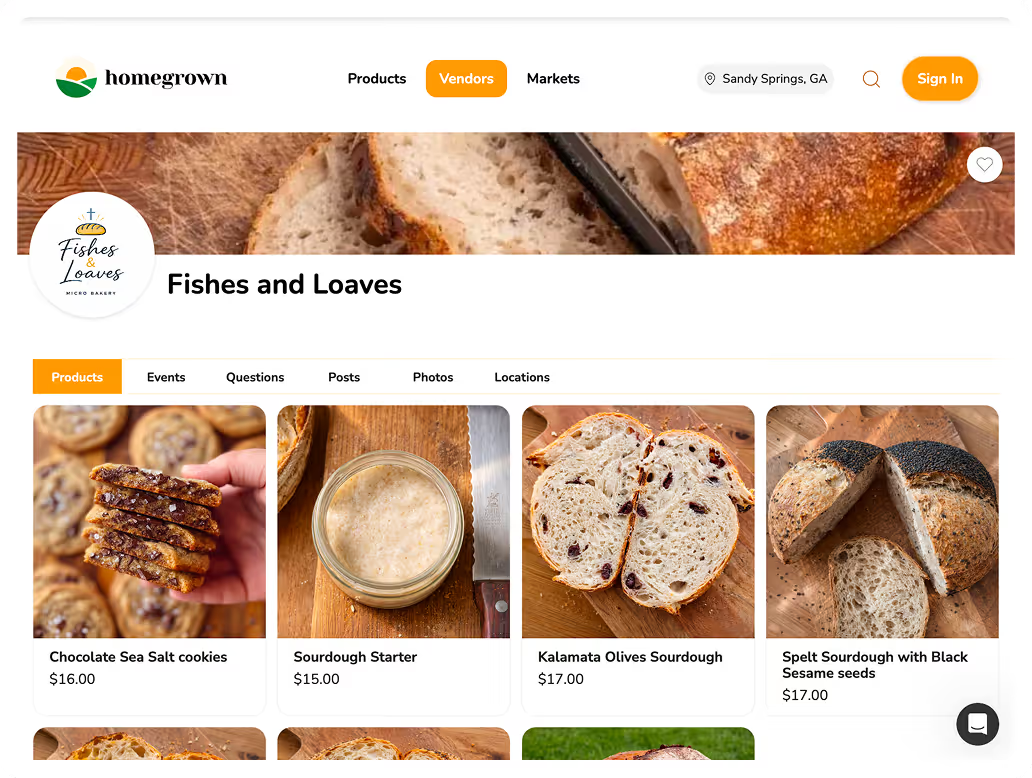
Online payment through a Homegrown storefront. This is the upgrade that changes everything. When a customer places an order through your Homegrown storefront, they pay right then. Card on file, payment processed, money in your bank account within a few days. No requests to send. No payments to chase. No "I'll Venmo you later."
The shift from "pay when you pick up" to "pay when you order" is the single biggest quality-of-life improvement for direct-selling farmers. It eliminates no-shows (people who order but never pick up), reduces last-minute cancellations, and means you always know exactly how much revenue is coming in before you harvest.
Homegrown costs $10/month with no percentage fees beyond standard payment processing (2.9 percent plus $0.30 per transaction) — customers pay when they order, and the money goes straight to your bank. Barn2Door ($99/month plus setup fees) and GrazeCart ($49/month) offer more features for large-scale farms with CSA subscriptions and delivery routes, but they are overkill for a small-plot vendor with 20 regular customers. Homegrown does not manage CSA shares, handle delivery logistics, or build you a full farm website — it handles the ordering and payment step that eliminates the "text me if you want eggs" workflow.
Repeat customers are built through relationships, not advertising. Direct farm sales grow when your first 10 customers tell their friends, and those friends tell theirs.
Your first 10 customers will probably be people you already know — neighbors, friends, coworkers, people at church or school. Your next 20 will come from those first 10 telling their friends. And so on.
Here's what keeps those customers coming back:
Be consistent. Same products. Same quality. Same pickup days. Same communication rhythm. When your customers know what to expect, ordering becomes a habit rather than a decision. "Tuesday is egg day from Sarah's farm" is a thought pattern you want to build. The FarmersWeb direct sales guide provides additional guidance on this.
Communicate weekly. A quick text, email, or social media post that says "Here's what's available this week" keeps you top of mind. You don't need a newsletter. You don't need a marketing strategy. You need to tell people what's available, every week, on the same day. Monday morning post → orders by Wednesday → pickup Friday. Simple rhythm, reliable results.
Make ordering easy. Every friction point costs you orders. If customers have to text you, wait for a reply, get a total, then send a Venmo, that's four steps where they might abandon the order. A Homegrown storefront makes it one step: pick what you want, pay, done.
Weekly communication checklist:
Treat your regulars list like gold. The 20-30 people who buy from you every week are the foundation of your farm sales. Know their names. Remember what they like. Give them first notice when something special comes in. The relationship is why they buy from you instead of the grocery store. Nurture it.
In most states, no — not for unprocessed products. Many states have agricultural exemptions that let farmers sell unprocessed products (produce, eggs, honey) directly to consumers without a business license. Some states require a basic sales tax permit. Check with your state's Department of Agriculture for specific requirements — the rules are usually much simpler than people expect.
Fewer than you think — as few as 10 regulars can generate meaningful income. If you have 10 regular customers who each spend $25 per week, that's $250 a week or about $1,000 a month. At 20 regulars, you're at $2,000 a month. When you sell farm products directly and keep full retail margins, you don't need hundreds of customers.
In many rural and suburban areas, yes. Most states have specific exemptions for on-farm sales of agricultural products. The rules get more complex if you're selling processed foods, if your stand is off your property, or if you're in a municipality with strict zoning. Your county extension office or state Department of Agriculture can clarify what applies to your situation.
Direct sales refers to the sales channel — selling directly to the consumer instead of through a retailer or distributor. Cottage food refers to a specific category of products (typically shelf-stable foods made in a home kitchen) and the laws that govern them. You can do both — sell cottage food products through direct sales channels. But fresh farm products like produce and eggs are generally governed by agricultural regulations, not cottage food laws.
A Homegrown storefront is built specifically for small, local vendors who sell farm products directly to customers. It handles online ordering, payment processing, and pickup coordination in one link — without the complexity of general ecommerce platforms designed for shipping physical products nationwide.
Use pre-orders through your Homegrown storefront so customers can reserve products before harvest day. This way you know exactly what to pick, and customers don't miss out. You can set product limits and close ordering when you've hit your capacity. Pre-orders also eliminate waste from unsold products at the end of market day.
Sales tax rules vary by state and by product type. Many states exempt unprocessed agricultural products (fresh produce, eggs, raw honey) from sales tax entirely. Processed or value-added products like jams, baked goods, or sauces are more likely to be taxable. Check with your state's Department of Revenue or Department of Agriculture for the specific rules that apply to your products and sales channels.
You don't need seven revenue streams or a multi-channel marketing plan to sell your farm products directly. You need customers who want what you grow, and a way to take their orders without it eating up your whole evening.
Start with whoever's already buying from you. Make ordering easy. Get paid upfront. Keep showing up every week. That's direct sales for a small farm — and it works.
Start with whoever's already buying from you. Set up an ordering page, share the link, and get paid upfront. Fifteen minutes of setup eliminates the payment chasing forever.