

If you have been searching for a way to sell your food products online and came across RootSeller, you probably noticed something pretty quickly. RootSeller is a directory. It lists farms and farmers markets so consumers can find local food near them. That is genuinely useful for discovery, but it does not give you a storefront, take orders, or collect payments from your customers.
For small vendors who need a practical tool to manage pre-orders, accept payments, and actually sell their products to local buyers, a directory listing alone leaves a significant gap between "someone found me" and "someone placed an order."
This guide breaks down what RootSeller actually does, why vendors look for alternatives, and which platforms handle the ordering and selling part that RootSeller does not.
The short version: RootSeller is a consumer-facing directory of ecologically conscious farms and farmers markets. It helps people find local food but does not offer storefronts, ordering, or payment processing for vendors. If you are a small cottage food vendor or farmers market seller who needs to take pre-orders and collect payments, Homegrown is the best fit at $10 per month (annual) or $12.50 per month (monthly) with a 7-day free trial. It handles ordering, payments, and local customer discovery in one place. Square Online works if you already use Square at your booth. Local Line is worth considering once your farm operation grows into subscriptions and multi-location logistics.
RootSeller is a directory that bills itself as America's largest directory of ecologically conscious farms. It lists farms, CSAs, farmers markets, and related events so that consumers can search for local food sources near them. Listings include farm descriptions, locations, product categories (grass-fed beef, no-till produce, organic vegetables), and links to farmers markets where those vendors sell.
The platform is consumer-facing. That means its primary purpose is helping buyers discover farms and markets, not helping vendors manage their selling operations. Here is what RootSeller includes:
And here is what RootSeller does not appear to include:
For a consumer who wants to find a farm stand or Saturday market near their house, RootSeller serves that purpose. For a vendor who needs customers to actually place and pay for orders, the platform stops short of the functionality that drives sales.
It is also worth noting that RootSeller's website has shown intermittent availability issues during research for this article, which raises practical questions about reliability for vendors who depend on consistent visibility.
The core reason is that directory visibility does not equal sales. Being listed in a directory is a starting point, but most small vendors need a tool that moves customers from "I found this vendor" to "I placed an order and paid." RootSeller does not bridge that gap.
Here are the specific limitations that drive vendors to look elsewhere:
If you are currently managing orders through text messages, Instagram DMs, or cash-only market sales and want to move toward a more organized system, a directory alone will not get you there. You need a platform that handles the actual transaction. The good news is that more consumers are buying food online than ever. According to the Food Institute, online grocery spending expanded at 27.6% year over year, and 52% of consumers prefer using retailer-owned platforms over third-party apps when ordering food.
That is exactly why having your own storefront matters more than having a listing on someone else's directory.
The best alternative depends on where you are in your business. Below are three options that cover the range from part-time cottage food vendors to mid-size farm operations.
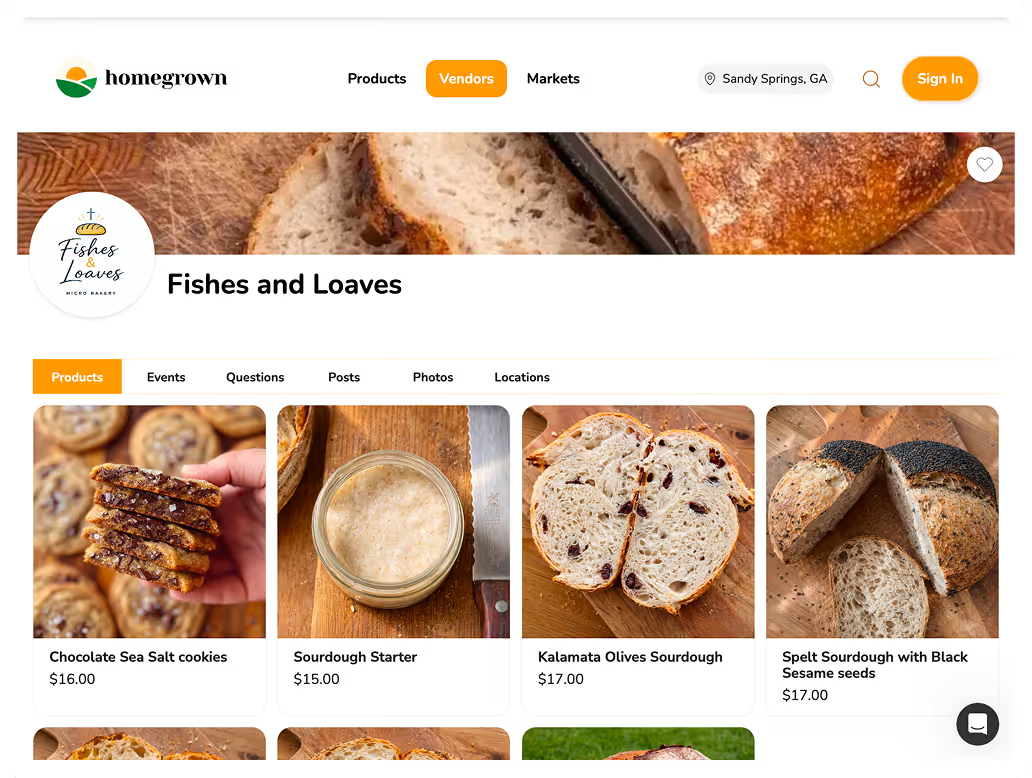
Homegrown is the closest match for small vendors because it is built specifically for the pre-order and local pickup model that cottage food producers and farmers market vendors actually use. Unlike RootSeller, Homegrown gives you a full storefront with ordering, payment processing, and local customer discovery.
Homegrown lets you list your products with photos, descriptions, and prices. Customers browse your storefront, place their order before your cutoff, and pay through the platform. You get consolidated order summaries for production planning and a pickup list for market morning. The entire workflow is designed around how small vendors actually sell: take orders during the week, prepare the products, and hand them off at the farmers market or a local pickup spot.
The pricing is straightforward:
That puts Homegrown well within reach for vendors doing $500 to $2,000 per month in sales. The monthly cost represents 0.5% to 2.5% of revenue at that range, which is manageable for even the smallest part-time operations.
Homegrown also includes local customer discovery. That means new customers in your area can find your storefront through the platform, not just people who already know about your business. This is the piece that most selling platforms miss entirely and the piece that directories like RootSeller handle on the discovery side but fail to convert on the sales side.
What Homegrown does well:
What Homegrown does not do:
Best for cottage food producers, farmers market vendors, and small farms doing pre-orders with booth or neighborhood pickup.
If you are still selling mostly to people you already know, the guide on going from selling to friends to reaching real customers covers how to make that transition.
Square Online is a strong option if you already use Square for card payments at your farmers market booth, because your in-person and online sales stay in one system.
Square Online lets you build a basic e-commerce storefront that integrates with the Square point-of-sale system many market vendors already use. Customers can order online for pickup, and payment processes through your existing Square account. Your sales data, inventory, and financial reporting are consolidated in one dashboard.
Here is the pricing structure:
| Plan | Monthly Cost | What You Get |
|---|---|---|
| Free | $0 | Basic storefront, Square transaction fees (2.9% + $0.30/transaction) |
| Plus | $29/month | Custom domain, removed Square branding, enhanced features |
| Premium | $79/month | Lower transaction rates, advanced tools |
The free plan is enough for most small vendors who just want to add online ordering to their existing Square setup.
What Square Online does well:
What Square Online does not do:
Best for vendors already using Square for in-person sales who want a consistent payment ecosystem across both channels.
If you are thinking about adding online ordering to your existing market operation, the guide on adding online ordering to your market business walks through the practical steps.
Local Line makes sense when your farm operation outgrows simple pre-orders and you need subscription management, multiple price lists, and wholesale functionality. It starts at $99 per month, which reflects its positioning for established farm businesses.
Local Line is a farm-specific e-commerce platform that handles online sales, inventory management, customer accounts, and delivery logistics. It is built for farms that sell through multiple channels: farmers markets, farm stands, CSA subscriptions, wholesale to restaurants, and direct-to-consumer delivery.
Here is the pricing:
| Plan | Monthly Cost | Annual Cost | Best For |
|---|---|---|---|
| Core | $99/month | $950/year | Growing farms ready for an all-in-one sales tool |
| Premium | $199/month | $1,920/year | Farms needing subscriptions and advanced features |
| Ultimate | $399/month | $3,830/year | Large farms and food hubs scaling operations |
What Local Line does well:
What Local Line does not do:
Best for mid-size farms running CSA programs, wholesale accounts, and multi-channel operations where the monthly cost is justified by the operational complexity.
Here is a direct comparison across the features that matter most to small local vendors:
| Feature | RootSeller | Homegrown | Square Online | Local Line |
|---|---|---|---|---|
| Type | Farm directory | Vendor storefront | General e-commerce | Farm e-commerce |
| Monthly cost | Free listing | $10-$12.50/mo | Free-$79/mo | $99-$399/mo |
| Online ordering | No | Yes | Yes | Yes |
| Payment processing | No | Yes | Yes | Yes |
| Pre-order management | No | Yes (with cutoffs) | Basic | Yes |
| Local customer discovery | Yes (directory) | Yes (marketplace) | No | No |
| Pickup coordination | No | Yes | Basic | Yes |
| CSA/subscription tools | No | No | No | Yes |
| Best for | Consumer discovery | Small vendors, cottage food | Square POS users | Mid-size farms |
The table makes the key distinction clear. RootSeller helps consumers find farms, but it does not help vendors sell. Homegrown handles both discovery and selling for the smallest vendors. Square Online handles selling but not discovery. Local Line handles selling with advanced farm features but at a cost that only mid-size operations can justify.
The right choice depends on your current business stage and what you actually need the platform to do.
You sell at a farmers market part-time and want to start taking pre-orders. Homegrown is the best fit. It handles pre-orders, collects payment, and helps local customers find your storefront. At $10 per month, the cost works even if you only do a few hundred dollars in monthly sales. Try Homegrown free for 7 days to see if it fits your workflow.
You already use Square at your booth and want to add online ordering. Square Online is the path of least resistance. Your payments, inventory, and reporting stay in one system. Start with the free plan and see if the basic storefront meets your needs.
You run a mid-size farm with CSA subscriptions and wholesale accounts. Local Line is designed for your level of complexity. The $99/month starting price (plus payment processing additional on top) makes sense when you are managing subscriptions, multiple buyer types, and delivery logistics.
You just want people to know your farm exists. RootSeller's directory listing still has value for pure visibility. But pair it with a selling tool so that the people who discover you have a way to actually place an order.
You are exploring ways to sell beyond the market booth. Read the guide on selling food without a farmers market for additional channels that work well alongside online pre-orders.
According to Escoffier's analysis of local food production, consumer demand for locally sourced food continues to grow across the United States, which means the opportunity for small vendors to capture online orders is stronger than it has been in years. The vendors who set up a storefront now position themselves to benefit as that demand keeps climbing.
RootSeller appears to offer free directory listings for farms and farmers markets. The platform's sign-up page is accessible, though detailed pricing information is not prominently displayed. Since RootSeller functions as a directory rather than a selling platform, the "free" listing provides visibility but not the ordering or payment tools that generate revenue.
No. RootSeller is a directory, not a marketplace or storefront. Customers can find your farm listing and learn what you produce, but they cannot place an order or make a payment through the platform. To sell directly to customers online, you need a separate platform like Homegrown, Square Online, or Local Line that includes checkout and payment processing.
The most affordable option that includes real ordering and payment functionality is a Homegrown storefront at $10 per month (annual billing) or $12.50 per month (monthly billing) with a 7-day free trial. If you need a true zero-cost starting point, Google Forms paired with a Venmo or Cash App payment link works for testing pre-orders, but you will outgrow that manual setup quickly once you pass 20 to 30 orders per market cycle.
No, you do not need a traditional website. A Homegrown storefront gives you a dedicated page where customers can browse products, place orders, and pay, all without you building or maintaining a website. You share a single link through text, social media, or a QR code at your booth, and customers handle the rest themselves.
The best approach combines a marketplace with local promotion. Platforms like Homegrown include built-in local customer discovery, meaning buyers in your area can find your storefront through the platform itself. Layer that with word-of-mouth at the farmers market, a QR code on your booth signage, and posts on your social media profiles. The combination of marketplace visibility and personal promotion builds a customer base faster than either approach alone.
Yes, and that combination makes practical sense. Use RootSeller as one of several places where your farm or products appear in search results, and use Homegrown as the place where customers actually place and pay for orders. Your RootSeller listing drives awareness. Your Homegrown storefront drives revenue. They serve different purposes, and using both covers more ground than either one alone.
RootSeller's website (rootseller.app) was experiencing intermittent 503 errors during research for this article. The directory still appears in search results and individual farm and market listing pages load at various times, but the reliability of the main site has been inconsistent. If you are considering listing your farm, check the site's current status before investing time in setting up a profile.