

Starting a food business from home looks simple from the outside. You make something people love, you sell it, money comes in. What's complicated about that?
Quite a bit, it turns out. Not because the business itself is impossibly hard, but because there are things you don't know that you don't know — gaps in the picture that only become visible once you're already in it.
This isn't a list of things that will scare you off. Most of them are actually manageable once you know they exist. But walking in without knowing them costs time, money, and enthusiasm that you don't need to lose.
The short version: The biggest surprises in a home food business aren't the legal stuff or the equipment — they're the math (pricing is harder than it looks), the psychology (your first real customer is not your family), and the systems (you need order-tracking before you think you do). Everything else you can figure out as you go.
Most people start by guessing. They look at what competitors charge, pick a number that feels reasonable, and go with it. Sometimes this accidentally works out. More often it doesn't.
The problem is that pricing a food product correctly requires knowing your actual cost per unit — and most people dramatically underestimate that number when they're starting out. Ingredients are obvious. Labor usually isn't. Packaging sometimes gets counted, sometimes doesn't. The booth fee, the gas to get there, the labels, the bags, the cost of the batches that didn't turn out right — these all add up.
A dozen cookies might cost you $2.80 in ingredients. Add packaging ($0.45), your time at any reasonable rate ($15 for 45 minutes), booth fee allocation ($2.67), and utilities/waste ($0.50), and you're at $21.42 before you've made a dollar of profit. If you're selling them for $10, you're losing money. If you're selling them for $14, you're making less than a dollar an hour.
Before you sell your first product, do the full math. Write down every cost, including your time. Set a price that actually covers everything. It will feel higher than you think it should be. Charge it anyway.
Pocket Baker's guide to costing and pricing baked goods walks through exactly how to track actual time per batch and build all costs into your unit price — the step most vendors skip when they're starting out.
The guide on how to price food products for a farmers market has a step-by-step formula if you want to work through it for your specific products.
The first people who buy from you will almost certainly be people who love you. That's fine — it gets the ball rolling and gives you confidence. But it creates a distorted picture.
Family and friends buy because they want to support you. They'll rave about your product regardless of whether it's genuinely better than what they can get elsewhere. They'll pay any price without flinching. They won't give you honest feedback if it might hurt your feelings.
The real test is a stranger. Specifically, a stranger at a farmers market or pop-up who has no idea who you are, has no reason to be nice to you, and is choosing between your table and six others. When that person stops, tastes your sample, and hands you money — that's validation.
Your first ten family sales don't tell you nearly as much as your first three stranger sales. Get to the stranger test as fast as you can.
A lot of people delay starting because they're not sure what's legal. The rules sound complicated. There are different laws in different states. It's easy to think you need a lawyer before you can bake a single cookie for sale.
In most cases, you don't. Cottage food laws in most US states let you make and sell a specific list of low-risk foods (baked goods, jams, honey, dried herbs, and others depending on the state) from your home kitchen without a commercial license. The requirements are usually straightforward: proper labeling, a cap on annual revenue, and selling direct to the consumer.
The right move is to look up your specific state's cottage food law — most state agriculture department websites have a plain-language summary — and spend twenty minutes understanding what applies to you. It's almost always less scary than it sounds.
What trips people up isn't the laws themselves. It's not knowing the laws exist, or assuming the rules are stricter than they are, and never starting as a result.
Selling out on your first market day feels incredible. It's exciting. It confirms that people want what you make. But if you're consistently selling out in the first hour or two, it might mean something different than you think.
Selling out fast usually means one of two things: you brought too little inventory, or your price is too low. When a product is priced correctly for demand, you should sell through most of your inventory by the end of the market — not in the first ninety minutes.
If you sell out early every week, try bringing more inventory. If you still sell out early, try raising your price. A higher price that leaves you with a small amount unsold at the end of the day is often more profitable than a lower price that empties your table before lunch.
Here's a quick way to read your sellout pattern:
| Sellout Pattern | What It Likely Means | What to Try |
|---|---|---|
| Sold out in first hour, every week | Price too low or inventory too low | Bring 30-50% more next week first |
| Sold out by noon consistently | Good balance, maybe room to raise price | Try a 10-15% price increase |
| Sold through by end of day | Optimal — demand matched supply | Hold steady |
| Left with 20%+ unsold | Price may be high or product not connecting | Test a sample station or small discount |
Consistent early sellouts are information. Don't just celebrate them — interpret them.
When you're selling twenty loaves of bread at a market, keeping track of everything in your head works fine. When you're getting text messages for pre-orders, Instagram DMs for custom cakes, and trying to remember who paid a deposit and who didn't — it falls apart fast.
The time to set up a simple order-tracking system is before things get chaotic, not after. You don't need complicated software. A shared spreadsheet, a simple order form, or a basic online storefront that handles orders automatically is enough to stay organized.
The vendors who hit a wall at moderate growth almost always hit it because their systems didn't scale with their demand. The ones who grow smoothly set up the infrastructure first, even when it felt premature.
If you're taking pre-orders or custom requests, how to create a pre-order system for your food business walks through exactly how to set one up without overcomplicating it.
New customers get attention on social media. Regulars are the actual business.
The vendors who do well long-term are the ones who build a core group of people who come back every week, who recommend them to friends, who text ahead to hold something. These customers aren't acquired through marketing — they're earned through consistency, quality, and actually knowing their names.
Treat every repeat customer like they matter, because they do. Remember what they like. Notice when they haven't come around in a few weeks. Offer a small loyalty perk. The extra effort costs almost nothing and the compounding effect on retention is enormous.
One loyal customer who comes every week for a year is worth far more than ten one-time buyers who never return.
Building that kind of loyalty doesn't require a formal program or a punch card. It requires showing up consistently, making something reliably good, and treating the people who keep coming back like the valuable customers they are. A note that you're running low on their favorite thing, a heads-up that you'll be at a new market next month, or simply remembering their name — these small things compound into the kind of customer relationship that marketing can't buy.
The instinct is to wait until everything is ready. The perfect labels, the full product line, the polished booth setup, the LLC filed, the website launched. Most people overestimate what "ready" requires before their first sale.
Start with one product you're confident in. A six-item product line at launch is not better than a two-item product line — it's more confusing for customers and harder for you to manage. Customers at a farmers market make quick decisions. A focused table with one or two great things is easier to buy from than a sprawling display that requires a decision. Start with what you know is good, sell it, listen to feedback, and add things as you learn what people actually want.
The vendors who try to launch fully-formed often burn out on the prep before they ever get to the selling. The vendors who start small and iterate tend to still be at the market two years later.
You can always add. You can't get back the time you spent preparing for a version of the business you weren't ready for.
When you show up to a market, you're not just competing on product quality. You're competing on the whole experience of buying from you. And a big part of that experience is you — whether you're warm, whether you make eye contact, whether you remember the person who bought from you last week.
The vendors who build the most loyal followings are usually not the ones with the most technically impressive product. They're the ones who make buying feel good. They're enthusiastic about what they make, generous with samples, and genuinely happy to be there.
Customers can tell when a vendor is just trying to move inventory versus when they're proud of what they made and glad you stopped. Show up like the second one, even on slow days.
Most cottage food businesses can get started for under $500. Your main costs are initial ingredients, packaging and labels, a cottage food permit if your state requires one (often $0 to $150), and a farmers market booth fee (usually $20 to $75 for your first market). You don't need a commercial kitchen, specialized equipment, or a website to start.
No. Many vendors sell for months or years before forming an LLC. It's worth setting one up eventually for liability protection, but it's not required to start. Check your state's cottage food rules — most let you sell as an individual under your own name.
Most vendors see their first profit within their first few market days if they've priced correctly. Building a sustainable income that you'd rely on takes longer — usually six months to a year of consistent selling. The key is getting the pricing right from the start so each sale is actually profitable.
Underpricing. Specifically, calculating the cost of ingredients, adding a small markup, and calling it done — without accounting for labor, packaging, booth fees, or any overhead. This creates the illusion of a business while actually operating at a loss or near zero.
Start with what you already make well and that people around you consistently ask for. Then test it at a market and watch what sells. The market will tell you what it wants — trust the actual sales data more than your own assumptions about what's best.
Farmers market first, almost always. You get direct feedback, you learn what customers respond to, and you test your pricing with real people in real time. Online selling requires more setup and it's harder to get traction without an existing audience. Build your in-person presence first and let the online side grow out of that.
Every vendor has them. Rain, slow foot traffic, a competing event nearby — there are days where nothing goes right. The vendors who last through bad days are the ones who track their numbers over time rather than evaluating each day in isolation. One bad market means nothing. A consistent trend of slow markets might mean something worth investigating.
Looking back across all of these, here's a quick summary of the lessons that save people the most time and money:
| Mistake | What It Costs You | The Fix |
|---|---|---|
| Pricing by ingredients only | Working for less than minimum wage | Do the full cost math before your first sale |
| Testing with family and friends | False confidence in an unvalidated idea | Get to a stranger buyer as fast as possible |
| Waiting until you're "ready" | Months of prep that delays real learning | Start with one product and one market |
| Ignoring the sellout signal | Leaving money on the table every week | Raise price or bring more inventory |
| No order system until it's chaos | Errors, forgotten orders, frustrated customers | Set up basic tracking before you need it |
| Chasing new customers, ignoring regulars | Higher acquisition costs, lower retention | Prioritize the people who already come back |
Nobody starting a food business knows all of this going in. That's normal. The goal isn't to have all the answers before you start — it's to know enough to avoid the mistakes that cost you the most time and money.
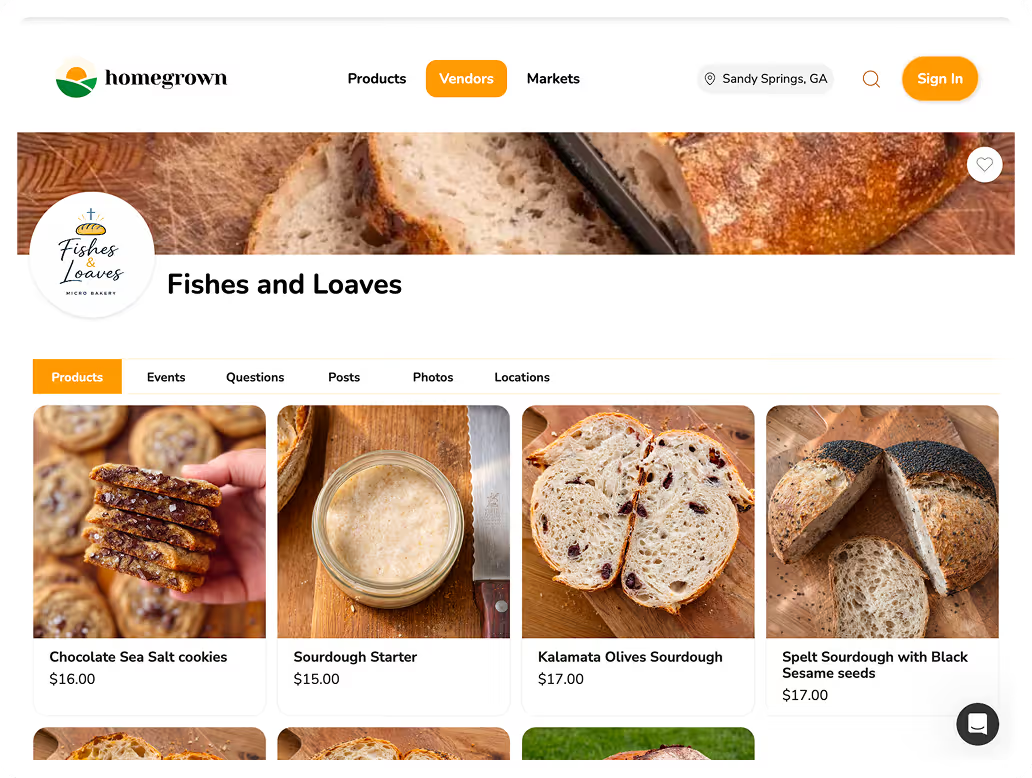
If you're ready to take orders beyond the market, a Homegrown storefront lets customers order and pay directly from your product page — no DMs, no spreadsheets, no chasing people down for payment. Start your free 7-day trial and see how it works.