

You got into this business because you love making food. You love the look on someone's face when they bite into your banana bread or open a box of your decorated cookies. Every order feels like proof that your business is working.
So when someone asks you to make 200 cupcakes by Friday, or wants a product you have never made, or sends you a message at 11 pm asking for a rush delivery, the word "no" gets stuck somewhere between your brain and your mouth. You say yes because you are afraid of losing them. You say yes because you feel guilty. You say yes because you think you have to.
You do not have to.
The short version: Saying no to orders is not a sign of failure. It is a sign of a vendor who knows their limits, protects their quality, and values their own time. The vendors who say yes to everything burn out, deliver subpar products, and end up resenting the business they built. The vendors who learn to say no strategically keep their quality high, their customers happy, and their energy intact. This article gives you the exact situations where you should decline, word-for-word scripts to do it gracefully, and systems to reduce how often you need to say no in the first place.
Saying no to orders feels terrifying when you are a small food vendor because every single order feels precious. You are not a bakery chain with 500 orders a week. You might get 10 or 15 orders in a good week. Turning one down feels like throwing money away.
But the fear goes deeper than money. Here is what actually makes it hard:
Here is the truth most vendors learn too late: saying yes to the wrong orders is more damaging than saying no. A rushed order that turns out mediocre hurts your reputation more than a polite decline ever would. A customer you bend over backward for at a price that does not cover your costs trains you to undervalue your work. An order that wrecks your weekend and leaves you dreading Monday is not worth the $50.
Not every order deserves a yes. Some situations are clear-cut, and recognizing them saves you from a lot of stress and regret.
| Situation | Why You Should Say No | What Happens If You Say Yes |
|---|---|---|
| You are at capacity | Quality drops, you burn out | Late deliveries, sloppy work, exhaustion |
| Product you do not make | You are experimenting on a paying customer | Subpar result, wasted ingredients, unhappy customer |
| Timeline is impossible | You cannot do your best work rushed | Compromised product, stress, potential food safety shortcuts |
| Customer has been difficult before | Pattern will repeat | More drama, more stress, same outcome |
| Price is too low | You lose money or work for pennies | Resentment, financial loss, devalued brand |
| Order conflicts with your personal life | Missing important events builds resentment | You start hating your business |
Here are the specific moments when saying no to orders as a food vendor is not optional — it is necessary:
The good news is that saying no does not have to mean burning a relationship. Most customers respond well to a polite, clear decline — especially when you offer an alternative. The key is to be direct, kind, and brief.
Never apologize excessively or over-explain. A short, warm response is always better than a rambling guilt-filled paragraph. Here are six scripts you can copy and adjust for the most common situations.
> "Thank you so much for thinking of me! I am fully booked for [date/weekend/this week] and would not be able to give your order the attention it deserves. I would love to help you with a future order — my next availability is [date]. Want me to save you a spot?"
This works because it flatters them, explains the reason without over-sharing, and opens the door for future business.
> "I appreciate you reaching out! I do not currently offer [product] — I focus on [your specialty] to make sure every order is my best work. If you are looking for [product], I would recommend checking [local vendor or resource]. And if you ever want [your products], I would love to help!"
Referring them to another vendor is a power move. It shows confidence and generosity, and the other vendor will remember that you sent business their way.
> "I would love to help with this, but [date] does not give me enough time to make something I would be proud to put my name on. My minimum lead time is [X days]. If you can adjust the date to [new date], I am happy to make it happen. Otherwise, I totally understand if you need to find someone who can fit a faster timeline."
This positions your quality standards as the reason, not your schedule or willingness.
> "I am not taking custom orders right now — I am focusing on my regular menu to keep quality consistent and my schedule manageable. You can check out what I currently have available on my ordering page. I will post on [social media/email list] when I open custom orders again!"
If you want to learn how to handle custom orders without overcommitting, that is a skill worth building for the long term.
> "I am taking a short break from orders [dates]. I will be back and taking orders starting [return date]. If you would like to place an order for after I am back, I would love to hear from you then!"
Short. Direct. No need to explain why you are taking a break. You do not owe anyone a reason.
> "Thank you for your interest! For an order like this, my pricing would be [your actual price]. That covers my ingredients, time, and the quality I put into every order. If that works for you, I would love to make it. If not, no hard feelings at all."
Never lower your price to avoid saying no. A customer who only wants you at a discount is not your ideal customer.
Something surprising happens when you start turning down the wrong orders: your business gets better. Not in theory. In real, measurable ways.
You protect your quality. When you are not stretched thin across too many orders, every single product that leaves your kitchen is something you are proud of. Your reputation is built on consistency, and consistency requires capacity.
You have energy for your best customers. The customers who order regularly, pay your prices without haggling, refer their friends, and send you kind messages — those are the people who deserve your best effort. When you say yes to everyone, you dilute what you can give to the people who actually sustain your business.
You stop resenting your business. This is the big one. So many vendors who started with passion end up dreading their kitchens because they never learned to set limits. Every weekend consumed by orders you did not want to take. Every evening spent on a custom project that pays less than minimum wage when you do the math. Saying no is how you protect the joy that got you into this in the first place.
You actually rest. Rest is not a luxury for small food vendors. It is a business requirement. Tired vendors make mistakes. They forget ingredients, miscount orders, miss deadlines, and eventually get sick or injured. A vendor who takes regular breaks and says no when they need to is a vendor who stays in business for years instead of burning out in months.
Here is a simple framework to evaluate whether an order is worth taking: For more details, see our guide on setting business hours.
If you answered "no" to any of those, think hard before saying yes to the customer.
The best way to reduce how often you need to say no is to build systems that say it for you. When your ordering process has clear guardrails, customers self-filter before they ever reach you with an impossible request.
Set up a clear ordering page with built-in limits. Your ordering page should show exactly what you offer, your lead times, your order minimums and maximums, and your pricing. When customers can see that your minimum lead time is 5 days, they will not ask for a next-day order. When your menu shows exactly what you make, they will not ask for products outside your range.
Use automated cutoffs. Setting order cutoff times is one of the most effective boundaries you can build. When your ordering page automatically closes at a specific date and time before your next market or delivery day, you never have to manually tell someone "it is too late." The system does it for you.
Restrict your menu to what you do best. A smaller, focused menu protects you from scope creep. Instead of offering 30 products and getting requests for 30 variations of each, offer 8 to 12 products that you make exceptionally well. Customers respect a focused menu because it signals expertise.
Set maximum order quantities. If you can only handle 25 orders per week, cap your ordering page at 25. First come, first served. This creates urgency for customers to order early and protects your capacity automatically.
Post your policies visibly. Put your lead times, cutoffs, and order limits on your ordering page, your social media bio, and your farmers market signage. The more visible your boundaries are, the fewer awkward conversations you need to have.
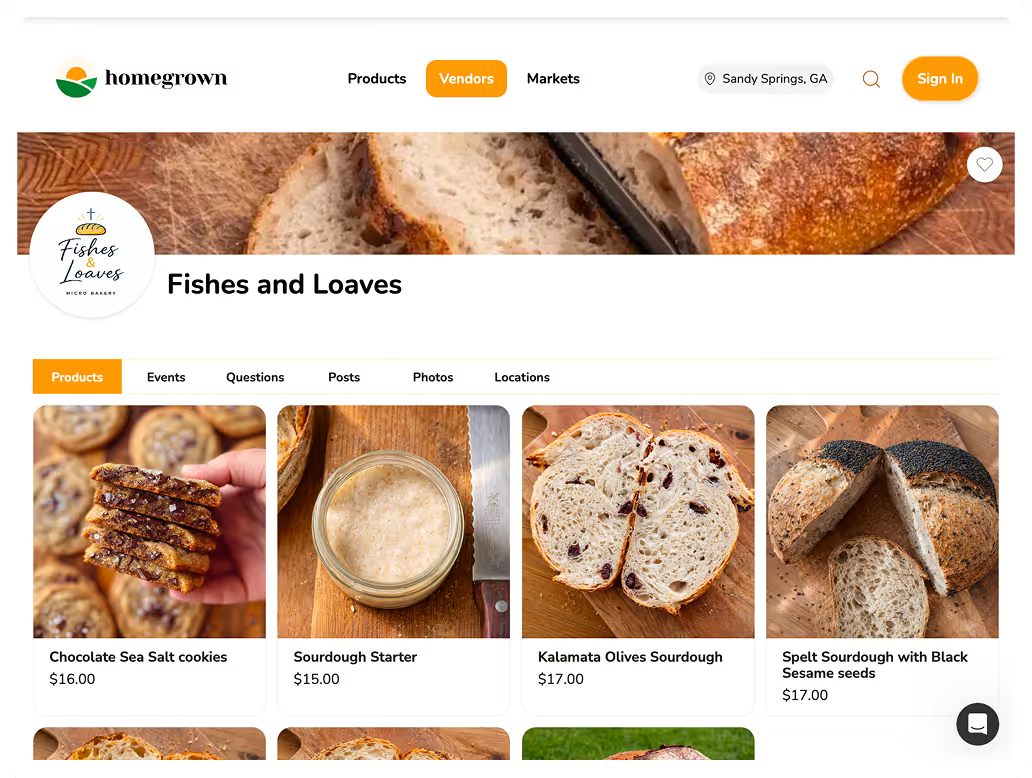
A tool like Homegrown lets you set up a storefront with order cutoffs, menu limits, and clear product descriptions so your customers know exactly what to expect before they place an order.
If you want to handle custom orders without overcommitting, the key is building a separate custom order process with its own timeline, pricing, and capacity limits — completely separate from your regular menu.
Yes. Full stop. Taking a break from your food business is not quitting. It is maintenance. As this guide to navigating small business burnout puts it, recognizing the signs and stepping back is how you stay in business long-term.
Seasonal breaks make sense for a lot of vendors. If your products are seasonal, if your farmers market closes for the winter, or if you simply need a few weeks off during the holidays, take them. Your customers will understand, and the ones who do not are not customers worth keeping.
Personal breaks are just as valid. Family events, vacations, health issues, creative burnout, or just wanting a weekend to yourself — all of these are legitimate reasons to pause ordering. You do not need to justify it to anyone.
Here is how to take a break without losing your customer base:
Your business will survive a break. In fact, many vendors report that customers are more excited to order after a break because there is built-in scarcity. The vendor who is always available becomes background noise. The vendor who takes breaks and comes back refreshed becomes an event.
If you are worried about dealing with difficult customers who push back on your time off, remember: you are running a small food business, not a hospital. Nobody is going to suffer because your cookie business is closed for a week.
Be direct, kind, and offer an alternative when possible. Most customers respect a polite decline, especially when you explain that you are protecting quality. Use a simple script: thank them, explain you are unable to take the order right now, and offer a future date or alternative. Saying no to orders as a food vendor is a normal part of running a sustainable business, and the customers worth keeping will understand.
In the short term, you might miss some revenue. In the long term, you will protect your pricing, your quality, and your reputation — all of which drive more revenue than any single order. Vendors who say yes to everything often end up working for less than minimum wage when they factor in their time. The math almost always favors strategic boundaries over accepting every order that comes in.
Track how many orders you can comfortably fill in a week without sacrificing quality, sleep, or personal time. That number is your capacity. For most cottage food vendors, it is somewhere between 10 and 30 orders per week depending on the product. Once you know your number, set a hard cap and stick to it.
Even loyal customers need to respect your process. You can soften the no by acknowledging the relationship: "I love making orders for you, and I want to make sure I give you my best. My lead time is [X days] so I can get everything right. Can we plan for [later date] instead?" If they are truly a good repeat customer, they will adjust.
Not at all. Restaurants close on Mondays. Bakeries take seasonal breaks. Farmers markets shut down for winter. Taking planned breaks is a sign of a well-run business, not an unprofessional one. Communicate the break in advance, set a return date, and your customers will be there when you come back.
Stay calm and do not reverse your decision. A simple "I understand, and I am sorry I am not able to help with this one" is enough. If they continue to push, you do not need to keep engaging. Saying no to orders as a food vendor gets easier every time you do it, and the customers who get angry about reasonable boundaries are exactly the customers you do not want.
A brief reason is fine, but you do not owe a detailed explanation. "I am fully booked" or "that timeline does not work for my schedule" is plenty. Over-explaining invites negotiation. The more reasons you give, the more openings someone has to argue with each one. Keep it short, kind, and final.
Saying no is a skill, and like every skill, it gets easier with practice. Start with one boundary this week. Maybe it is a cutoff time. Maybe it is a maximum order count. Maybe it is just the next time someone asks you to work for a price that does not respect your time, you hold your ground.
Your food business should feed your life, not consume it. And sometimes the most important ingredient in a sustainable business is a well-placed "no."
If you are ready to set up an ordering system with built-in boundaries, Homegrown gives you a storefront with order cutoffs, menu limits, and everything you need to protect your time and your quality.