

You are standing in your kitchen at 9:47 pm on a Tuesday. Your phone buzzes. A customer wants to know if you can add two extra jars of salsa to their Saturday order. You are in pajamas. Your kids are asleep. You already cleaned the kitchen. But you pick up the phone and reply anyway because what if they go somewhere else?
This is what running a home food business without set business hours looks like. Your kitchen is your workplace, your phone is your storefront, and "closing time" does not exist because you never actually opened. You are always sort of working and never fully off. It is exhausting, and it is completely fixable.
The short version: Every home-based food vendor needs defined business hours, even if those hours look nothing like a traditional 9-to-5. Setting business hours for your home food business means picking the days and times when you respond to messages, take orders, and handle admin work, then communicating those hours clearly and sticking to them. You do not need to be available all the time to run a successful cottage food business. You need to be available at predictable times.
Home-based food vendors struggle with business hours because there is no physical separation between work and life. As this guide to balancing business and personal life as a cottage food entrepreneur explains, running a business from home can blur every line between work and rest. When your kitchen is your production space and your phone is your point of sale, there is no moment where you "leave work." The boundary between vendor and person disappears.
Here is what makes it so hard:
The result is a vendor who is technically working 16 hours a day but only productive for 4. You check messages during dinner. You answer ordering questions while watching a movie. You think about tomorrow's baking list while trying to fall asleep. None of that is actual work, but none of it is actual rest either.
Setting business hours is not about working less. It is about working intentionally and resting fully. Research on work-life boundaries shows that 92% of employees say it is important that their organization values emotional well-being — and when you are a solo vendor, you are both the employer and the employee.
The right business hours for your home food business depend on your operation type, your products, and your personal life. There is no single correct schedule. The only wrong answer is having no schedule at all.
Here are sample schedules for three common operation types:
| Operation Type | Suggested Business Hours | Baking/Prep Time | Communication Window | Day Off |
|---|---|---|---|---|
| Farmers market vendor | Tue-Fri 10 AM - 4 PM | Tue-Thu mornings | Tue-Fri afternoons | Sun-Mon |
| Weekly subscription/menu | Mon-Thu 9 AM - 5 PM | Mon-Wed mornings | Mon-Thu 1 PM - 5 PM | Fri-Sun |
| Custom order vendor | Mon-Fri 10 AM - 6 PM | As needed, weekday mornings | Mon-Fri 2 PM - 6 PM | Sat-Sun |
A few principles that apply to every vendor:
Most cottage food vendors find that 20 to 30 hours per week of structured work replaces 50+ hours of unstructured chaos. The difference is not how much time you spend. It is how you organize that time.
Setting business hours only works if your customers know about them. The biggest mistake vendors make is choosing hours in their head and never telling anyone. Your hours need to be visible everywhere a customer might try to reach you.
Here is where to post your business hours:
Repetition is the key. Customers will not remember your hours from seeing them once. When they encounter your hours on your ordering page, in your auto-reply, and on your social media, the message sinks in. After a few weeks, most regular customers will naturally adjust their behavior and reach out during your available times.
If you already have SOPs for your business, add your communication hours to them. When your hours are documented as part of your process, they become a system rather than a suggestion.
Use auto-replies and batch your responses. Do not respond to messages outside your business hours, even if you see them. The moment you reply at 10 PM, you train that customer to expect 10 PM responses forever.
Here is an auto-reply template you can set up on your phone or messaging app:
> "Thanks for your message! I will get back to you during my business hours (Mon-Fri, 10 AM - 5 PM). If you need to place an order, visit [your ordering page link]. Talk soon!"
Adjust the hours to match your actual schedule. The key elements are:
Beyond auto-replies, here is how to manage your communication time: For more details, see our guide on running a food business from a small apartment kitchen. For more details, see our guide on create a production schedule that protects your weekends.
Most customer messages are not urgent. "What flavors do you have this week?" does not need a midnight response. "Can I add an item to my order?" can wait until morning. When you set order cutoff times, most of these last-minute questions disappear because the system handles them automatically.
Block scheduling is the single most effective way to separate production from communication. Baking time and customer communication time should never happen at the same time because both require your full attention.
Here is a sample block schedule for a cottage food vendor:
Morning block (6 AM - 12 PM): Production
Afternoon block (12 PM - 4 PM): Communication and admin
Evening block (4 PM - onward): Off
This schedule works because it respects how your brain operates. Production work requires focus and flow. Customer communication requires a different kind of energy — patience, friendliness, attention to detail in messages. Switching between the two all day drains you faster than doing either one for a sustained period.
Here are practical tips to make block scheduling stick:
When you set expectations on custom orders upfront, your communication block gets shorter because customers already have the answers to their most common questions. Clear policies reduce back-and-forth messages dramatically.
You protect weekends by declaring them off-limits and then actually following through. It sounds simple, but for home food vendors, weekends are often the busiest time because that is when farmers markets happen and customers are home browsing your page. The temptation to "just check one more message" is constant.
Here is how to build real boundaries around your personal time:
It is okay to not work Sundays. It is okay to not work Saturdays. It is okay to take two consecutive days off every single week. Your cottage food business does not need to run seven days a week to be profitable. Most successful vendors work four to five days and rest the other two or three.
If a customer pushes back on your availability, you have a decision to make. In many cases, it is completely appropriate to say no to orders that conflict with your personal time. The customers worth keeping will respect your boundaries. The ones who do not were never going to be long-term customers anyway.
A vendor who works every day is a vendor who quits within a year. A vendor who rests intentionally is a vendor who stays in business for a decade. Protecting your time is not selfish. It is the most responsible business decision you can make.
Good business hours for a home food business are whatever hours match your production schedule and your customers' ordering habits. Most cottage food vendors set communication hours between 9 AM and 6 PM on weekdays, with at least one full day off per week. The specific hours matter less than being consistent and communicating them clearly to your customers.
No. You need to respond within your stated business hours, but immediate responses are not expected or necessary. Batch your replies into two or three response windows per day. As long as customers know your hours and can see them on your ordering page and auto-reply, a response within a few hours during business hours is perfectly professional.
If your food business is part-time alongside another job, set narrower business hours that fit your actual availability. For example, you might set communication hours for Tuesday through Thursday evenings from 6 PM to 8 PM and Saturday mornings. The key is choosing hours you can consistently honor. Two hours of reliable availability is better than "whenever I get a chance."
Setting business hours for your home food business will not cost you good customers. Customers who value your products will adapt to your schedule. You might lose the occasional impulse buyer who wanted an instant response at midnight, but those are not the customers who sustain a food business. Clear boundaries actually increase customer confidence because they signal that you run a real, organized operation.
Define what counts as urgent. A food safety issue with a product you sold that day is urgent. A question about next week's menu is not. For genuine emergencies, have a separate contact method (like a phone call) and mention it in your auto-reply: "For food safety concerns about a current order, call me at [number]." Everything else waits until your next business hours window.
Many cottage food vendors adjust their business hours seasonally, and that is perfectly fine. You might extend your hours during peak season when farmers markets are running and scale back during the winter. Just communicate the change a week or two in advance so customers can adjust. Post your seasonal hours on your ordering page and social media so there is no confusion.
The guilt fades with practice and evidence. After a few weeks of sticking to your business hours, you will notice that customers still order, still come back, and still value your products. Nobody stopped buying your jam because you did not reply at 9 PM. Remind yourself that a well-rested vendor makes better food, provides better service, and stays in business longer. Your off-hours are not neglect. They are what make your on-hours excellent.
Your home food business deserves structure, and you deserve a life outside of it. Setting business hours is not about being less available. It is about being available with intention and energy instead of being half-present all the time.
Start this week. Pick your hours. Post them on your ordering page and your social media. Set up an auto-reply. Tell your family. And then, when the clock hits your end time, close up shop — even if shop is just your kitchen table and your phone.
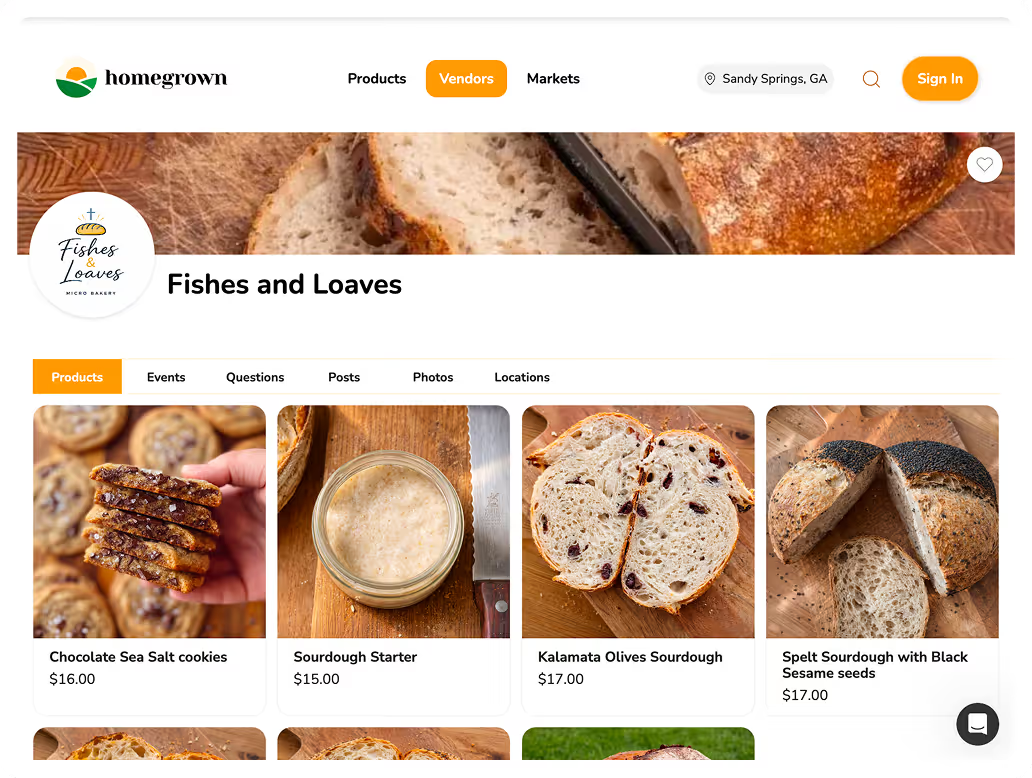
If you want a storefront that reinforces your boundaries with built-in order cutoffs, menu limits, and a professional ordering page your customers can browse on their own time, Homegrown was built for exactly that.